
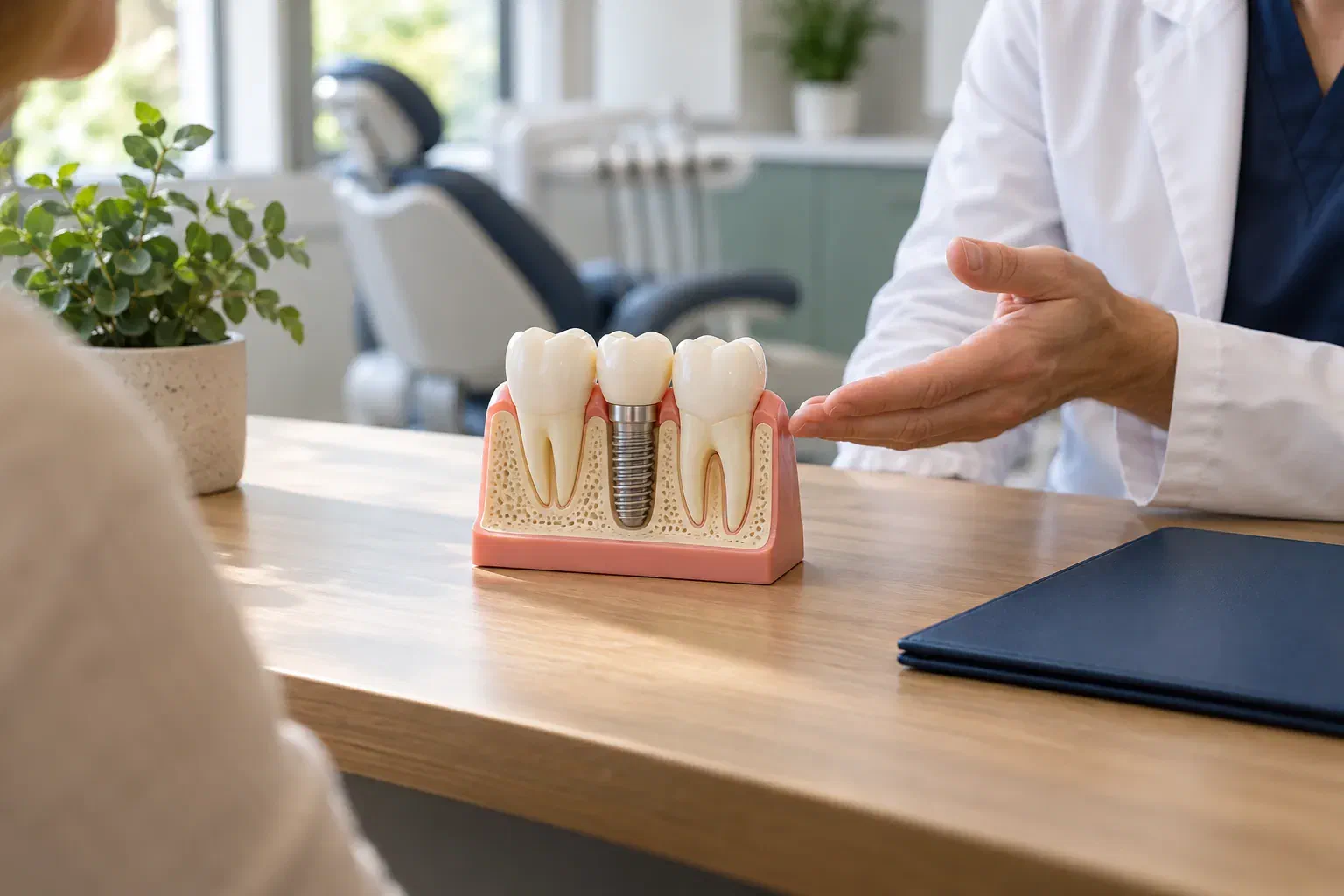
An implant consultation is a planning conversation, not a commitment to surgery. It should help you understand whether an implant-supported replacement is appropriate, what other choices exist, and what the full treatment would involve. That is especially useful when advertisements make complex treatment sound like a single appointment or a single product.
For people exploring dental implant consultations in Milton, the best preparation is a clear account of the missing tooth, your health history, and your priorities. You may be concerned about chewing, appearance, a loose denture, or avoiding changes to neighbouring teeth. Those concerns should shape the discussion, alongside the examination and the practical demands of treatment and maintenance.
Understand the parts of the replacement
The implant is the component placed in the jaw to support a replacement tooth or teeth. It is not necessarily the visible tooth itself. Depending on the plan, other components connect the implant to a crown, bridge, or denture.
The Canadian Dental Association’s implant guide explains the implant, connecting component, and artificial tooth as parts of the overall treatment. Ask the clinician to show you the proposed arrangement. Knowing which parts are included makes estimates and appointment plans easier to understand.
If several teeth are missing, ask whether the proposal replaces them individually or supports a larger restoration. Find out whether the final replacement is fixed or removable by you. These are meaningful differences for cleaning, daily use, and expectations, even when both options are described broadly as implant treatment.
Begin with the tooth’s history
Tell the clinician when and why the tooth was lost, or whether it is still present and being considered for removal. Mention previous infections, injuries, grafting, or attempts to restore it. If you have old images or treatment records elsewhere, ask how they can be transferred securely.
If the tooth is still present, ask whether retaining it is a reasonable option before focusing on replacement. An implant discussion should not make the existing tooth disappear from the decision. Understand the reason for any proposed extraction and whether further assessment would clarify its outlook.
If the space has been present for a long time, describe how you have adapted. You may chew differently or have concerns about the position of nearby teeth. These observations help explain your goals, but the clinician still needs to assess the area rather than relying on how comfortable the space feels.
Suitability involves more than age
An implant assessment considers oral and general health, the local tissues, and the ability to maintain the result. The CDA identifies gum health and adequate bone among important considerations. The ADA’s implant information also discusses health factors and the need for a careful evaluation.
Bring an accurate list of medicines and supplements, and disclose smoking or nicotine use and relevant medical conditions. If you have had treatment affecting bone or healing, make sure the clinician knows. Do not assume a condition automatically rules implants in or out, and do not withhold information because you worry it will complicate the plan.
Ask which factors are favourable and which require attention before proceeding. A useful consultation may identify preparatory care or a reason to reconsider timing. It should provide an explanation, not simply a yes-or-no label based on a brief look at the missing tooth.
Ask what imaging needs to establish
The clinician may recommend images to evaluate the proposed site and surrounding anatomy. Ask what question each investigation will answer and whether useful previous images are available. The choice of imaging should relate to assessment and planning rather than the assumption that more pictures are always better.
If three-dimensional imaging is proposed, ask how it changes the information available and who will interpret it. Find out whether it is performed at the same office or elsewhere and whether a separate fee applies. These are practical details that help you understand the next step.
Our guide to dental X-rays explains why imaging decisions are individualized. At an implant consultation, the important outcome is understanding what the clinician needs to know before recommending surgery or a particular restoration.
Bone grafting is a separate part of the discussion
If the proposed site does not have suitable bone, the clinician may discuss grafting or another approach. The CDA explains that grafting can sometimes be considered when the jawbone is insufficient. It is not an automatic solution for every patient or every site.
Ask why grafting is recommended, what material or technique is proposed, and whether it changes the timing or risks. Find out whether it would happen before implant placement or as part of another stage. Also ask what the alternatives are if you do not want that additional procedure.
Include grafting in the written plan and estimate rather than treating it as an incidental detail. A timeline advertised for a straightforward implant case may not reflect a plan that requires preparatory surgery and healing. Your schedule should be based on the assessment, not a generic promise.
Compare the reasonable alternatives
A bridge, removable denture, or monitored space may be part of the discussion, depending on the circumstances. Ask how each option affects nearby teeth, cleaning, comfort, treatment time, and future maintenance. Some options may be unsuitable, but you should understand why.
If you already wear a denture, explain what is and is not working. Is the main issue movement, soreness, chewing, or appearance? An implant-supported plan should be evaluated against the problem you want to solve, rather than assumed to address every difficulty automatically.
Our bridge guide describes questions about tooth-supported replacements. You can use the same approach at an implant consultation: ask what supports the restoration, what must be changed, and how it will be cared for over time. Compare complete treatment pathways rather than isolated prices.
Clarify who performs each stage
Implant care can involve more than one clinician. Ask who will assess the site, perform any surgery, create the final restoration, and provide maintenance. The CDA notes that dentists may provide care or refer to appropriately trained specialists depending on the case.
If a referral is needed, find out whether the next visit is an assessment or a procedure. Ask which office coordinates the overall plan and how information is shared. You should know whom to contact if a problem occurs between stages.
This guide explains general planning questions and does not establish that every implant procedure is provided at one location. Confirm the scope of care and any referral arrangements with the office you contact. That clarity is useful before arranging time off, travel, or multiple appointments.
Separate temporary teeth from the final result
Ask what you will have in the space during healing. Depending on the plan, a temporary replacement may be possible, but its appearance, function, and restrictions can differ from the definitive restoration. Do not assume that leaving an appointment with a tooth means all treatment is complete.
The FDA’s patient information on dental implants explains that healing can take months and that treatment has risks and limitations. Ask which stages apply to you and what must be checked before the final replacement is used normally.
If you have an important event or travel planned, say so at the consultation. The clinician can explain what is realistic and what remains uncertain. A useful timeline includes healing and review, not only the day the implant is placed.
Discuss risks without relying on guarantees
Ask about the risks most relevant to the proposed site and your health. These may include surgical complications, failure to integrate, tissue problems, or issues with the restoration. The FDA guide describes several potential complications and the importance of discussing them with the dental provider.
Find out what would happen if healing did not proceed as expected. Would treatment be delayed, changed, repeated, or reconsidered? Ask how additional visits or procedures would be handled. A contingency discussion does not predict failure; it makes the plan more understandable.
Be cautious with phrases such as permanent teeth or lifetime solution when they are used without explanation. An implant-supported replacement still needs maintenance and can develop problems. Ask what any written warranty actually covers and which ongoing responsibilities remain with you.
Test the maintenance plan before committing
Ask the team to demonstrate how the proposed restoration would be cleaned. A single crown, a fixed bridge, and a removable implant-retained denture may require different access and tools. Understanding the routine before treatment can reveal practical issues worth addressing in the design.
Tell the clinician if hand strength, dexterity, vision, or access to help affects your daily care. If you already struggle to clean a difficult area, describe that honestly. A realistic plan should account for the person who will maintain the restoration every day.
The FDA recommends following cleaning instructions and attending regular follow-up. Ask how often the treating team expects to review your result and what those visits involve. Report changes such as looseness, discomfort, or difficulty cleaning promptly rather than assuming that an artificial replacement cannot develop a problem.
Request a complete estimate
Ask the estimate to identify assessment, imaging, preparatory treatment, surgery, connecting components, temporary restorations, and the final tooth replacement where applicable. Not every plan includes every item, but you should know which stages are included in the quoted amount.
Discuss what could change the estimate and what is already known. If benefits are involved, distinguish a preliminary estimate from confirmed coverage. If financing is offered, review the terms separately from the clinical decision and make sure you understand the total commitment.
Consider future maintenance as well as the initial cost. Ask about likely review visits and how repairs are managed. A lower initial figure is not necessarily a useful comparison if it excludes stages included in another plan or describes a different type of restoration.
Bring a short list of priorities
Before the consultation, write down your main goal, your questions about surgery, and any limits on time, cost, or daily maintenance. Include the names of clinicians who have treated the area and a current medication list. You do not need to arrive having chosen a particular implant system.
At the end, ask for a summary of suitability, alternatives, stages, and responsibilities. If you need time to consider the options, request the information in a form you can review. A well-explained consultation should make the decision clearer, even when the outcome is further assessment or choosing a different approach.
To begin a conversation about a missing tooth and appropriate assessment or referral, contact Milton Dental Clinic at (905) 876-4488. The aim is a replacement plan that fits the clinical findings and your everyday life, with a clear understanding of the care required after treatment.
