
Sometimes a permanent canine does not arrive where expected. The baby tooth may remain in place, one side of the smile may develop differently from the other, or an image taken during a dental assessment may reveal a tooth lying away from its usual path. Learning that a tooth is impacted can be surprising when nothing hurts.
For families discussing impacted canine teeth in Milton, the next step is to understand the tooth’s position and its relationship to nearby teeth. Treatment planning is usually about more than bringing one tooth into view. It considers space, root position, the developing bite, and whether orthodontic and surgical care need to be coordinated.
A tooth can be present without appearing in the mouth
The canine is the pointed tooth near the corner of the dental arch. An impacted canine is prevented from erupting normally; an ectopic canine is developing along an abnormal path. These terms may appear together in a referral, but the clinician should explain exactly what they mean for the tooth shown on the image.
The American Academy of Pediatric Dentistry identifies asymmetrical canine eruption, the absence of an expected palpable canine bulge, and certain neighbouring tooth variations as reasons for investigation. Early assessment can help identify risk to nearby teeth and guide timing. AAPD guidance on developing teeth and occlusion.
Parents are not expected to feel for the tooth or interpret eruption patterns themselves. Keep regular dental visits and mention a retained baby tooth or a difference you have noticed between the two sides. A child who is comfortable still benefits from assessment when the dentist identifies a concern.
The image should answer a specific question
An initial dental image can show whether the canine is present and suggest its position. Further views may be considered when the clinician needs to understand how it relates to neighbouring roots or plan treatment. Three-dimensional imaging is not automatically necessary for every impacted tooth.
Newcastle Dental Hospital’s referral guidance identifies uncertain localization of unerupted teeth and suspected resorption of adjacent roots as situations in which cone-beam imaging may be indicated. The decision should follow a clinical question rather than a preference for the newest technology. Newcastle Dental Hospital imaging referral criteria.
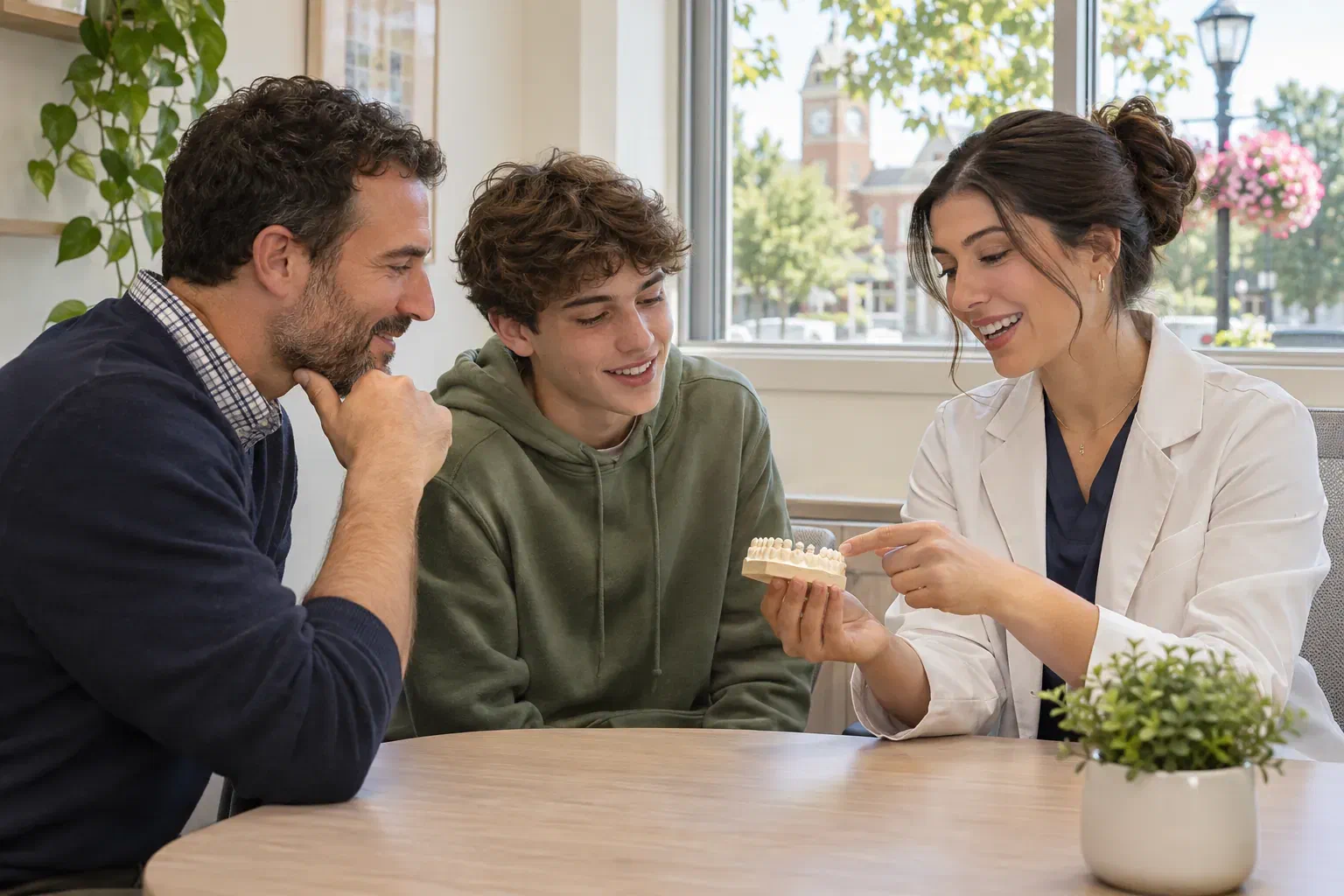
Ask to see the tooth on the image and have the clinician identify the neighbouring roots. Understanding the direction and available space makes the proposed plan less abstract. If another office already has relevant images, arrange transfer so the team can assess whether additional imaging is needed rather than repeating it automatically.
No pain does not mean there is nothing to consider
An impacted canine may remain quiet, but the decision is based on more than symptoms. Hospital patient guidance describes possible effects on neighbouring teeth, including root damage or displacement, and the occasional development of a cyst. Some teeth can be monitored when that is the appropriate choice, with review directed by the dentist. Liverpool University Dental Hospital information on impacted canines.
This does not mean that every buried canine is damaging another tooth. Have the clinician distinguish a possible risk from an actual finding in your images. Those are different reasons for treatment and may lead to different recommendations about urgency.
If observation is proposed, it should be a defined plan. Know who will review the tooth, what information will be compared, and when another assessment is due. A symptom-free child should not be left with an open-ended instruction to return only if pain appears when monitoring is clinically indicated.
Early management and later treatment are different decisions
For some developing teeth, an early intervention may be considered to improve the eruption path. For others, the position or stage of development means a more involved orthodontic plan is required. The correct approach cannot be chosen from the child’s age alone.
Ask whether the proposal is intended to encourage eruption, create space, move the canine actively, or manage the situation without bringing it into the arch. If a baby tooth is to be removed, understand why and what will be checked afterward. Removal does not automatically guarantee that the permanent tooth will appear in the desired position.
The early orthodontic assessment page explains the role of evaluating development before every permanent tooth has erupted. A consultation can help clarify timing even when active treatment will begin later. The useful outcome is a decision based on the current records, not a promise tied to a birthday.
Exposure and bonding are parts of a larger sequence
When orthodontic movement of an impacted canine is planned, a surgical procedure may expose the tooth and allow an attachment to be bonded to it. The orthodontic team then uses the attachment as part of controlled movement. The surgical step alone does not place the tooth in its final position.
Ashford and St Peter’s Hospitals describes exposure and bonding as an option used with orthodontic care, with risks and practical details that should be discussed before treatment. Hospital information on exposure and bonding.
Find out whether braces or another appliance need to be in place first and how space will be managed. Also confirm the appointment after surgery: who checks the wound, who begins or continues orthodontic movement, and what happens if an attachment becomes loose. These links between stages are essential to making the plan work.
The child should understand the plan too
A parent may focus on the long-term result while a child is thinking about a school trip, a visible gap, or whether an appointment will hurt. Give those concerns room in the conversation. Ask the clinician to explain the next visit in language the child understands without overwhelming them with every later possibility.
Avoid promising that nothing will feel uncomfortable or that the whole process will be finished by a particular event unless the treating team has said so. A more useful message is that the team will explain each step, provide appropriate comfort measures, and tell the family what to do if something is bothering the child.
For older teenagers, include them in decisions about scheduling, appearance, and the daily care involved. Treatment can require sustained participation. A plan understood only by the parent may be harder to follow when the teenager is responsible for cleaning, appliances, and reporting problems.
Duration is a range with decision points
An impacted canine may add complexity to an orthodontic plan, but a reliable timeline requires individual assessment. Ask for a reasonable estimate and the factors most likely to change it. A tooth’s position, response to movement, and the wider treatment goals can matter more than the number of appointments initially listed.
Ask how progress will be judged between visits. The answer may involve clinical changes, appliance adjustments, or selected imaging. You should also know what would lead the team to reconsider the plan if movement is slower than expected or the tooth cannot be moved as intended.
Separate the estimate for bringing the canine into the mouth from the estimate for completing the entire bite correction. They may be different milestones. A tooth becoming visible can feel like the end of treatment to a family, while the orthodontist may still need to refine its position and coordinate the surrounding teeth. Naming those milestones early helps the teenager understand why appointments may continue after the tooth has finally appeared.
This is particularly useful when treatment overlaps with a move, university, or changing insurance. Discuss those transitions early. Records can be transferred, but a change of clinician during complex treatment is easier when the current stage, remaining objectives, and appliance details are clearly documented.
Alternatives need an honest comparison
Bringing the tooth into the arch is not always feasible or preferable. Depending on the findings, alternatives may include monitoring, removal, or a different orthodontic and restorative strategy. Ask what the main benefit and limitation of each reasonable option would be in this specific case.
The Royal College of Surgeons’ guideline treats management as an individualized decision involving the canine position, adjacent teeth, patient factors, and available options. It does not support choosing treatment solely because a canine is impacted. Guideline on the palatally ectopic maxillary canine.
If a recommended approach would leave a space or require future replacement, discuss that endpoint now. It is easier to compare options when the full result is described, including later maintenance, than when only the next surgical appointment is explained.
Keep routine dental care in the picture
Orthodontic visits and surgical reviews do not replace routine dental examinations and preventive care. Clarify which clinician is watching for cavities, gum inflammation, and other changes while the canine plan proceeds. A complex treatment schedule can make ordinary appointments easy to overlook.
If fixed appliances are used, request a cleaning demonstration around the specific attachment and nearby gum. The guide to keeping teeth clean with braces provides related practical context. Report a broken component, sore area, or difficulty cleaning rather than waiting for it to become a reason to stop the routine.
After any surgery, follow the operating clinician’s instructions about food, activity, medication, and review. Contact the team for unexpected bleeding, increasing swelling, or worsening pain. Breathing or swallowing difficulty requires emergency medical attention. Generic advice for another person’s tooth should not replace the plan for your own surgical site.
Put the sequence in writing
A brief written plan can name the tooth, the aim of treatment, the next appointment, and the clinician responsible for each stage. Add estimated costs and the circumstances that could change the plan. That is especially useful when care involves several offices or a parent cannot attend every appointment.
An impacted canine consultation in Milton should leave the family with a clear understanding of the position, the reason for the proposed approach, and the way progress will be reviewed. With those pieces in place, an unfamiliar finding becomes a series of understandable decisions rather than a vague instruction to wait for a tooth that has not arrived.
