
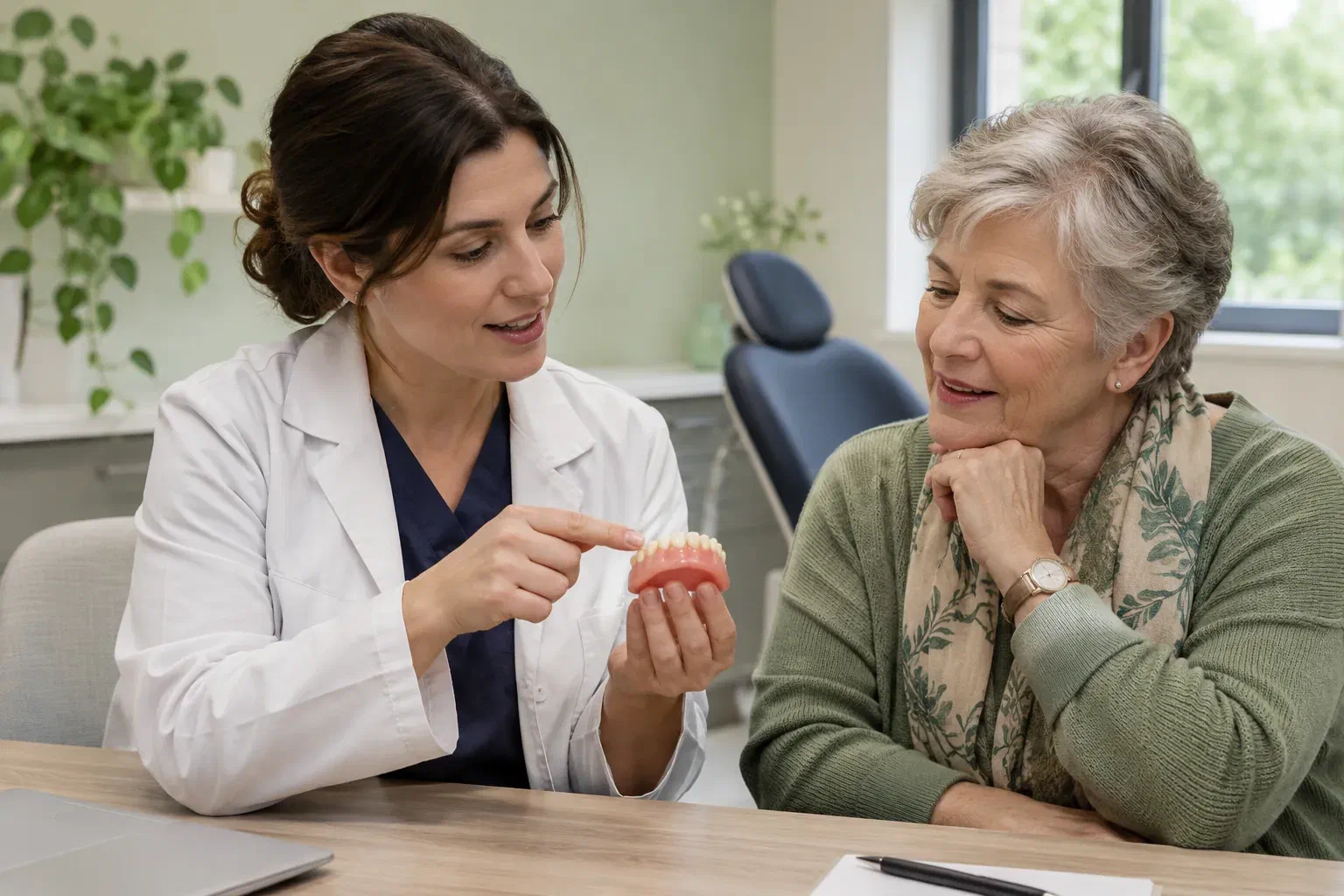
Someone considering an implant-retained overdenture may have a very specific goal: feeling less movement while talking, managing meals more comfortably, or reducing uncertainty about a lower denture. Advertising often compresses the discussion into the idea of teeth that snap into place. That phrase leaves out important details about removal, cleaning, attachments, surgery, and maintenance.
Implant-retained overdentures in Milton should be considered as a complete care arrangement. The useful comparison is not simply between a denture with implants and one without them. It is between realistic options for your mouth, your health, your ability to manage the appliance, and the ongoing care you are willing and able to undertake.
Clarify which kind of replacement is being discussed
An implant-retained overdenture is generally a removable appliance that connects to attachments associated with dental implants. A fixed implant restoration is different: it is not removed by the wearer for everyday cleaning. Ask the clinician to demonstrate the proposed design rather than relying on terms that different practices may use differently.
Leeds Teaching Hospitals describes implants as supports for replacement teeth, including removable dentures, and notes that treatment and maintenance depend on the individual situation. The number of implants, attachment arrangement, and support from the gums are design decisions, not details that can be assumed from the word overdenture.
Ask where the appliance will be supported and what will remain removable. Understanding those points helps you picture daily life with it. A demonstration model can make the distinction clearer than a photograph of a finished smile, which rarely shows how the appliance works underneath.
Define the problem you want to improve
Describe your current difficulty in practical terms. Does the denture move while speaking, feel unstable during particular meals, rub one area, or require repeated adjustment? Are you dissatisfied with its appearance, or is the main concern confidence in public? These are related but separate goals.
An examination can determine whether the existing denture needs ordinary adjustment, relining, replacement, or consideration of another approach. Do not assume that implants are the only solution to any movement. Equally, do not assume that repeated adhesive use is the only available response to a persistent problem.
Choose the two or three outcomes that matter most to you and bring them to the consultation. Ask how each option is expected to address those outcomes and what limitations would remain. A treatment that improves retention may still involve an adaptation period and regular maintenance.
Suitability requires more than interest in implants
The assessment considers oral health, available supporting bone, medical history, medicines, and other relevant factors. The Canadian Dental Association’s implant information explains that implants require evaluation and ongoing care. A person cannot determine suitability from age alone or from another patient’s experience.
Bring an accurate medicine list and explain any previous surgery, healing concerns, tobacco use, or changes in health. If medical input is needed, ask which question the dental team needs answered and who will coordinate communication. Do not stop a prescribed medicine in anticipation of implant treatment without instructions from the responsible clinician.
Also discuss what care is practical at home. Dexterity, eyesight, access to a sink, and help from another person can affect whether a proposed design is manageable. These considerations belong in the initial plan, not only after the appliance has been made.
Try to understand removal before choosing the design
Ask to see how an overdenture is inserted and removed. If a demonstration appliance is available, observe the direction of movement and the kind of hand control involved. Your own appliance will require specific instruction, but the demonstration can reveal questions you had not considered.
Tell the clinician about arthritis, tremor, limited grip, or another difficulty that might affect handling. A firm attachment may provide desirable retention but still need to be manageable for the wearer. Ask how attachment strength and maintenance will be reviewed over time.
If someone will help you, involve them with your consent before treatment is finalized. They should understand the intended role and receive instruction rather than being expected to work it out at home. A design needs to fit the person who will actually clean and handle it each day.
Map the treatment stages before comparing estimates
Ask for the proposed sequence in plain language. Which visits involve assessment and records, which involve surgery, when is healing reviewed, and when is the denture connected or fabricated? If grafting or other preparatory treatment is discussed, ask whether it is definite or only a possibility pending investigation.
Clarify what you will wear between stages. Will the existing denture be modified, will there be restrictions on its use, or is another interim arrangement planned? The answer affects work, social commitments, and meals during treatment. Do not assume that a finished replacement will be available immediately after surgery.
When comparing estimates, check that they describe comparable stages. One figure may include implants but not the final appliance or later attachment maintenance. Ask for an itemized explanation that separates initial treatment from anticipated ongoing care without implying that every future expense can be predicted exactly.
Discuss the contingency if an implant cannot be used as planned or healing changes the schedule. What temporary replacement would be available, which decisions would be revisited, and how would additional costs be discussed? Understanding that possibility before treatment makes an unexpected change easier to evaluate without making a rushed decision.
Cleaning happens above and below the appliance
A removable overdenture creates access for cleaning, but that access needs to be used effectively. Ask the dental team to demonstrate care for the denture, the attachments, and the tissues around the implants. The tools and technique should match the design and your ability to handle them.
The CDA emphasizes that implants need careful home cleaning and professional review. Implants are not a way to eliminate oral hygiene responsibilities. Ask which areas are most likely to be missed and how you can check that the recommended method is working.
Avoid buying a collection of products before receiving instructions. Some cleaners or tools may be unsuitable for particular components. Bring the products you already use and ask which can continue. A small, workable routine is easier to maintain than a complicated set of supplies with unclear purposes.
Attachments are maintenance items
The connection between an overdenture and its implants can include components that wear with use. Leeds Teaching Hospitals notes that overdentures and their retaining clips may need maintenance or replacement over time. Ask what applies to the particular system proposed for you.
Know what a change in retention might feel like and whom to contact. A denture that feels looser may need an assessment of attachments, fit, or another issue. Do not assume that tightening or replacing one small part is always the solution.
Do not glue, reshape, or replace components yourself using parts ordered online. The clinician needs to confirm compatibility and inspect the supporting structures. Keeping a record of the implant and attachment system can be useful if you travel, move, or need another provider to assist with maintenance.
Gum health remains part of the plan
Tell the dental team about bleeding, soreness, swelling, a change in taste, or discomfort around an implant. These symptoms need assessment rather than being dismissed because the appliance still snaps into place. Good retention does not establish that the surrounding tissues are healthy.
Ask what the maintenance visits will include and how often review is recommended for your situation. The schedule should reflect your needs and findings. If several providers share care, clarify who examines the implants and who services the denture so that neither responsibility is assumed to belong to someone else.
The clinic’s implant-denture maintenance information can help frame that discussion. At an appointment, bring both the appliance and the relevant treatment records. A complete view is more useful than assessing only one part of the system.
Compare removability with your own preferences
Some people like being able to remove the appliance for cleaning; others strongly prefer a fixed option. Neither preference should be treated as trivial. Ask how the available choices differ in cleaning access, repair, cost, comfort, and suitability for your anatomy.
Avoid deciding from photographs alone. A photograph does not reveal the amount of material in the mouth, the way the appliance is removed, or how a repair would be handled. Ask to discuss those everyday details before focusing entirely on the appearance of the teeth.
It can help to imagine a normal evening at home. Where would you clean the appliance? Can you manage its removal? What would happen during travel or an illness? These questions are practical tests of the plan, not reasons to reject an option automatically.
Plan for future changes in ability
A treatment may remain in use through changes in health, hand function, or living arrangements. Discuss whether the design can be maintained if you eventually need help. No one can predict every future need, but cleaning access and availability of replacement parts are reasonable considerations now.
Ask what records should be kept and where. A concise document naming the implant system, attachment type, provider, and maintenance history may be valuable to a future clinician. Keep it with other health information rather than relying on memory of a brand mentioned during surgery.
If a care partner is involved, document the agreed cleaning routine and update it when components or instructions change. Consistent information makes it easier to preserve care during travel, a hospital stay, or a move to another setting.
Choose a plan you can explain afterwards
Before agreeing to treatment, you should be able to describe the proposed appliance, its alternatives, the main stages, and the responsibilities after delivery. Ask about risks, expected benefits, and uncertainties. A consultation should leave room for those questions rather than reducing the decision to whether implants sound appealing.
If you are exploring implant-supported dentures or denture stabilization in Milton, contact the clinic for an assessment discussion. Bring your current denture and a clear account of the difficulty you want to improve. The most useful outcome is a replacement plan that works in everyday life and remains maintainable after the initial treatment is complete.
