
Getting braces changes the layout of your mouth almost overnight. The toothbrush now has brackets and a wire to work around. Flossing takes a different route. Food that used to be easy to clear may catch in a new place, and a quick glance in the mirror can leave you wondering whether you have done enough.
Keeping teeth clean with braces in Milton becomes easier when the routine is demonstrated, practised, and adjusted to daily life. You do not need to master every new movement on the first evening. You do need clear instructions, suitable tools, and a way to ask for help before frustration becomes a reason to skip cleaning. This guide focuses on fixed braces; removable aligners and other appliances have their own instructions.
Understand what the extra cleaning is for
Brackets and wires create places where plaque and food can be difficult to remove. The American Association of Orthodontists explains that poor cleaning during treatment can contribute to cavities and white marks on teeth. Its advice includes frequent brushing, daily interdental cleaning, and reporting broken or loose components. AAO guidance on oral hygiene during orthodontic treatment.
The goal is therefore broader than removing the visible piece of lunch caught beside a bracket. Ask your dental professional to show you the areas most easily missed in your mouth. Knowing what needs attention makes a routine more purposeful than simply brushing for longer while repeating the same movements.
A clear explanation also helps families avoid turning cleaning into a daily argument about effort. If an area is repeatedly missed, the useful response is to review access and technique. A teenager may be trying hard but using an angle that does not reach the intended surface.
Ask for a demonstration you can repeat
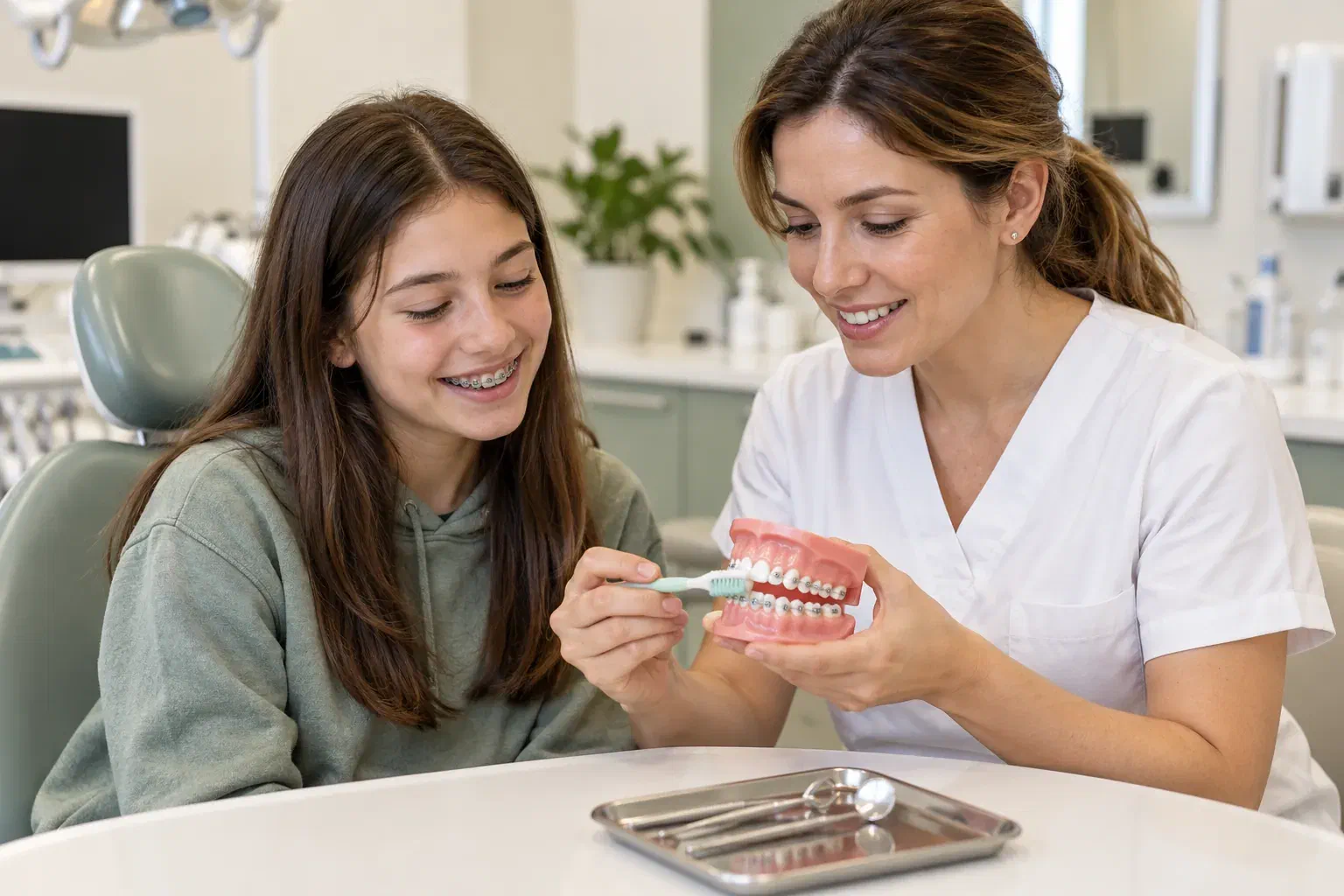
At an early appointment, ask to practise with the brush and mirror yourself. Watching a professional clean a model is helpful, but doing the movement while someone guides you reveals different questions. You may discover that you cannot see a back bracket clearly or that the handle feels awkward on one side.
Have the clinician explain the route around the gumline, above and below brackets, and over the remaining tooth surfaces. Ask how to approach crowded areas and the backs of the last teeth. The instructions should match your particular appliance rather than relying entirely on a generic picture.
If several items are recommended, request a short sequence you can take home. Record the names of the tools and where each is used. Before leaving, explain the routine back in your own words. That simple conversation can reveal whether you understood a cleaning step as something to do daily or only when food gets caught.
Make room for a deliberate brushing routine
The AAO recommends a soft-bristled brush and fluoride toothpaste during braces treatment. Ask your treating team how often to brush and which brush head works with your appliance. A manual or powered brush should be chosen with attention to your ability to use it comfortably and reach the required areas. AAO information on maintaining braces.
Choose a repeatable order so that you do not continually return to the easy-to-see front teeth while forgetting the back. For example, you can work through one section before moving to the next, checking the inner and chewing surfaces as well as the bracket side. Have your clinician confirm that your sequence covers the areas they want you to clean.
Allow enough time in the evening to concentrate. If brushing is always squeezed into the final minute before bed, move the start of the routine earlier. A timer may help with awareness, but it cannot tell whether the brush reached every surface. Coverage and technique still need attention.
Learn the route for cleaning between teeth
A fixed wire can prevent ordinary floss from approaching in the way you used before braces. Ask whether a floss threader, an orthodontic flossing aid, or another method suits your appliance. Practise threading and removal with supervision so that you understand how to avoid pulling on the wire.
The NHS describes interdental brushes as an option for appropriate spaces and advises that they fit snugly. A dental professional should help you choose the fit; forcing a brush into a tight space is not a useful shortcut. NHS advice on interdental cleaning.
Be clear about the difference between cleaning around a bracket and cleaning between neighbouring teeth. A tool may help with one task without covering every other area. Ask the clinician to identify which spaces each method is intended to reach, especially if the home-care kit contains several brushes that look similar.
Consider a water flosser for a defined purpose
The ADA describes water flossers as an option for people who find hand flossing difficult, including some people with braces. The device directs a pulsing stream around and between teeth. It remains part of a routine that includes toothbrushing, and product instructions matter. ADA information on water flossers.
Before buying one, ask what problem it would solve for you. If the challenge is reaching behind a wire, a demonstration should show exactly how the proposed tool helps. If the challenge is remembering the routine, another device may not address the main obstacle.
Check whether you can comfortably fill, hold, clean, and store it. Ask about suitable settings and tips, and follow the manufacturer’s guidance. A tool that causes pain or repeatedly catches around the appliance needs review. Do not interpret discomfort as proof that you are cleaning more thoroughly.
Prepare for lunch away from home
Cleaning during the school or work day is easier when the supplies are already available. The AAO suggests carrying a small kit with a toothbrush, toothpaste, floss, and an interdental brush. It also advises contacting the orthodontist about broken brackets or loose wires. AAO practical advice between appointments.
Keep the kit modest enough to use. A bulky bag containing every product in the bathroom is likely to be left at home. Choose a container that can be cleaned, replace supplies when they run out, and follow appropriate storage instructions so that items are not left indefinitely in a damp closed pouch.
If school facilities or break times make cleaning difficult, discuss that honestly with the treating team. Ask for a practical plan for those days and how to manage the full routine at home. Planning around an actual barrier is more useful than repeatedly agreeing to instructions that the schedule does not allow.
Adapt meals without losing variety
The AAO advises avoiding hard or sticky foods that can damage braces and suggests cutting suitable fruits and vegetables into smaller pieces. The details should come from the team responsible for your appliance, especially if it has additional components or particular restrictions. AAO braces-care advice.
Ask for alternatives to foods you genuinely enjoy. A broad instruction to choose soft food can become monotonous if no one discusses familiar meals. Consider texture, preparation, and portion shape rather than assuming that every favourite dish must disappear for the whole course of treatment.
For a child or teenager, involve them in packing lunch and choosing workable options. If meals are regularly skipped because eating feels difficult, contact the treating team. Dental advice needs to fit adequate nutrition, and persistent discomfort or an appliance problem should be addressed rather than quietly worked around.
Keep regular dental appointments
Orthodontic adjustments and general dental care have related but different purposes. The AAO emphasizes continuing visits to the family dentist during orthodontic treatment. Ask your dentist and orthodontist to clarify the recommended examination and cleaning schedule for your needs. AAO guidance on life during treatment.
Do not assume that an adjustment appointment replaces a planned cleaning simply because someone looked at your teeth. When booking, explain that you have fixed braces and mention any instructions from the orthodontic provider. If records or coordination are needed, the practices can discuss the appropriate arrangements with your consent.
Bring your home-care questions to these visits. A cleaning appointment can be an opportunity to identify a recurring missed area and revise the technique before it becomes a longstanding habit. Tell the clinician which tools you actually use, not only which ones were originally recommended.
Report changes instead of trying to repair them
If a bracket feels loose or a wire changes position, contact the orthodontic provider for advice. The AAO recommends reporting these problems promptly because broken components can interfere with treatment. Ask what to do while waiting and whether you should adjust any part of your cleaning routine around the affected area. AAO advice about loose brackets and wires.
Avoid experimenting with tools to bend or reposition the appliance. Describe what you can see and when the problem began. If the practice asks for a photograph, follow its instructions; you do not need to pull painfully at your cheek to obtain an ideal image.
Also report persistent gum soreness, bleeding, new white patches, or tooth pain to your dental team. These observations need an explanation rather than an assumption that they are all normal parts of wearing braces. Mention whether cleaning has become painful or whether one particular area is difficult to reach.
Support independence without removing support
Teenagers can take increasing responsibility for their routine while still needing help with supplies, scheduling, or a difficult technique. Agree on what support is welcome. A reminder to refill the travel kit may be more useful than repeated questions about whether brushing was done properly.
If a child feels embarrassed about cleaning at school, listen before offering a solution. They may need a smaller kit, a more convenient place to keep it, or advice from the treating team about how to manage the day. Respecting the concern makes it easier to have an honest discussion about what is actually happening.
Progress should be assessed through comfort, workable habits, and professional feedback, not a promise that braces will come off sooner if someone follows every instruction perfectly. Treatment timing depends on more than a home-care routine, and unrealistic promises can turn a useful habit into a source of disappointment.
Make the next appointment practical
Before your visit, choose one part of cleaning that remains awkward. Bring the tool involved and ask for another demonstration. You might need help reaching a back bracket, selecting an interdental brush size, or threading floss without tangling it. A focused question gives the dental team something specific to improve with you.
For general dental care and cleaning guidance while wearing braces in Milton, contact Milton Dental Clinic or call (905) 876-4488. Continue to contact your treating orthodontic provider for appliance adjustments and repairs. With clear roles, suitable tools, and a routine that fits your day, home care can become a manageable part of treatment rather than a daily guessing exercise.
