
Persistent bad breath can make a person feel unusually aware of every conversation. It may lead to repeated mouthwash purchases, a pocket full of mints, or avoiding sitting close to other people. Those responses are understandable, but they do not necessarily identify the source of the problem.
If you are seeking help for persistent bad breath in Milton, a useful plan begins with a straightforward conversation and an examination. The goal is to find out whether there is an oral cause that can be addressed, improve the daily routine where needed, and recognize when another healthcare professional should be involved. You do not need to feel embarrassed about raising it.
Separate an occasional episode from a recurring pattern
Breath can change after certain foods, during a period of dryness, or when a routine has been disrupted. Persistent or repeatedly returning odour deserves a closer look, especially when it comes with other symptoms. The NHS information on bad breath lists several possible contributors, including food, smoking, dental problems, dry mouth, and some medical conditions.
Think about when the concern arises. Is it mainly on waking, after a particular meal, or throughout the day despite cleaning? Have you noticed a bad taste, or has somebody else commented? These details help the clinician understand the experience without assuming that every episode has the same explanation.
Avoid making major dietary restrictions based only on guesswork. If one food clearly causes a temporary change, you can decide how to manage it socially. That is different from eliminating broad groups of food because you are worried about an odour that has not yet been assessed.
Bring the concern into the appointment directly
You can say, “I have been concerned about my breath for several weeks, and I would like to understand the cause.” That is enough to start. If it feels uncomfortable to say aloud, mention it when booking or write it on the health-history form so it is not overlooked during a visit focused on something else.
Explain what you have tried and whether it made any difference. Include mouthwashes, tongue cleaners, supplements, gum, and any prescription products. Bring product names or photos of labels if you are unsure what they contain. A precise account is more helpful than saying that you have tried everything.
Ask whether there are any preparation instructions for the assessment. Do not independently stop prescribed products or deliberately avoid normal hygiene to make the problem easier to notice. The practice can explain what it needs and how it will approach the concern.
Look at the mouth before assuming the stomach is responsible
The American Dental Association’s patient guide to bad breath describes oral bacteria, dry mouth, gum disease, tobacco, and food as possible contributors. It also notes that medical review may be appropriate when dental causes have been assessed. This supports a stepwise approach instead of assuming that persistent odour must come from the digestive system.
A dental assessment can consider the teeth, gums, tongue, soft tissues, and any appliances or restorations. Tell the clinician about areas where food repeatedly catches or where cleaning is difficult. If you have a painful tooth, bleeding gums, or a denture problem, raise that separately rather than treating odour as the only issue.
Ask the dentist to explain any finding and how it relates to the plan. If a filling, gum treatment, or other procedure is recommended, you should understand the clinical reason for it. A promise of fresher breath alone is not a substitute for explaining what condition needs care.
Make brushing and between-tooth cleaning workable
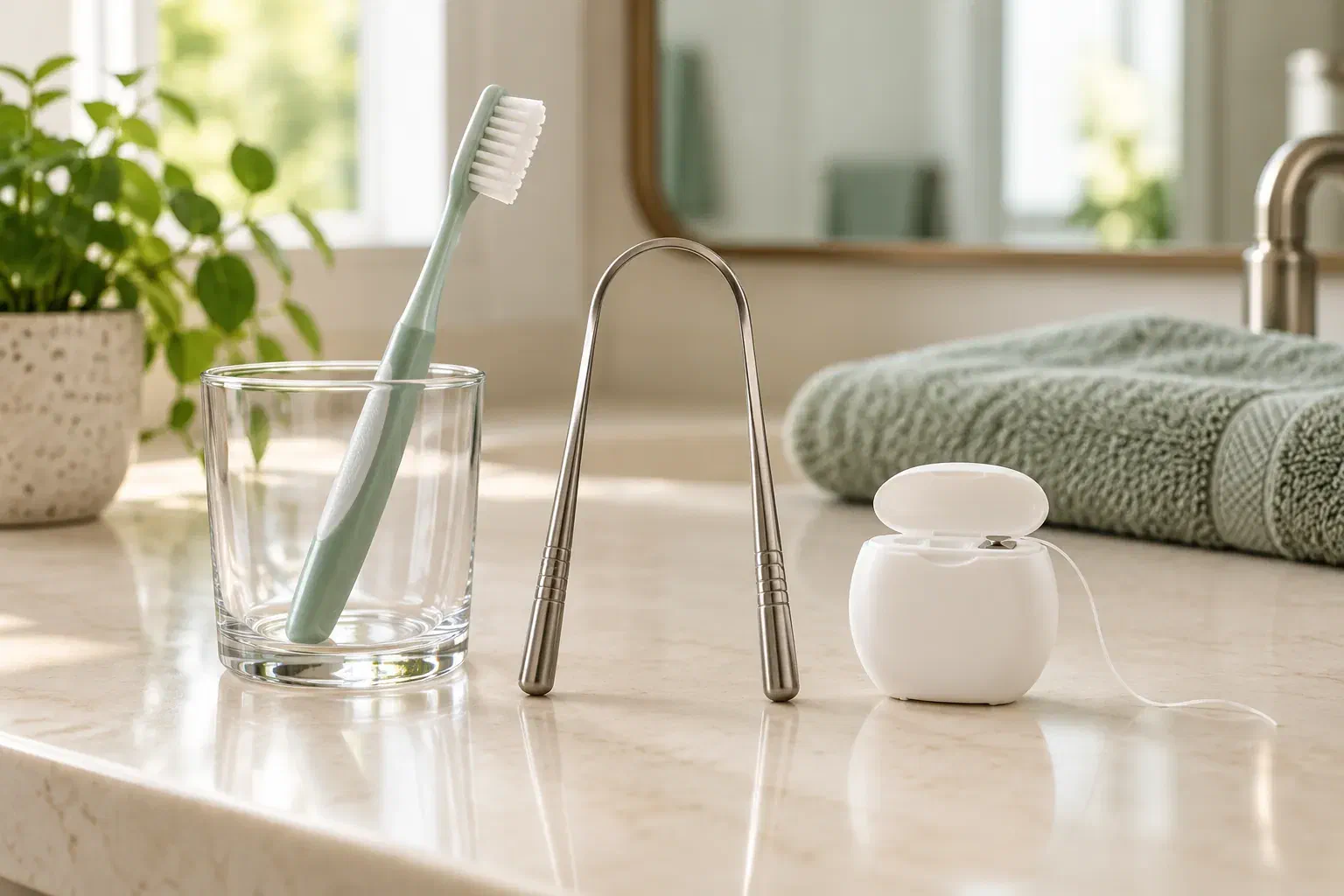
The foundation is gentle brushing with fluoride toothpaste twice daily and cleaning between the teeth every day. The NHS also advises gentle daily tongue cleaning and warns against brushing so aggressively that the gums or tongue bleed. More force is not the same as more effective cleaning.
Ask a dental professional to watch or demonstrate the technique you use. A brush may miss an area because of the angle, a difficult-to-reach tooth, or limited hand movement. Identifying one specific difficulty can be more useful than being told to spend longer repeating the same method.
For between-tooth cleaning, discuss a tool that suits the spaces and your dexterity. Floss, an appropriately sized interdental brush, or another recommended aid may be suitable. Do not force a brush into a space where it does not fit. If an area consistently hurts or bleeds, have it assessed rather than abandoning cleaning or repeatedly injuring it.
Treat the tongue gently
Tongue cleaning can be part of the routine, but it should not become an attempt to scrape the surface completely smooth or change its natural appearance. Ask the clinician to show you a comfortable technique and explain how often to use the chosen tool.
If you have a strong gag reflex, mention it. You can discuss a smaller tool, a different approach, or where to begin without repeatedly provoking gagging. A routine that you can use consistently is preferable to an aggressive attempt that leaves the mouth sore and makes you reluctant to try again.
Report a painful area, persistent patch, or change that does not settle. Do not assume every coating is the same or that every visible mark should be removed at home. Examination is more useful than escalating to harsh chemicals or abrasive products based on photographs found online.
Give mouthwash a defined role
The ADA’s guide to mouthwash distinguishes cosmetic rinses, which mainly provide a temporary taste or odour effect, from therapeutic rinses with active ingredients for particular purposes. Neither replaces brushing and cleaning between the teeth. Ask whether a rinse is needed and what it is intended to achieve in your case.
If one is prescribed or recommended, clarify the amount, timing, and duration. Ask whether it should be used separately from brushing and whether it has relevant side effects. Keep the instructions with the product rather than assuming that using it more frequently will work better.
If a rinse burns, worsens dryness, or causes another unwanted change, tell the dentist or pharmacist. Do not dilute or combine products unless instructed. A strong sensation is not evidence that a mouthwash is solving the underlying problem, and a pleasant taste is not proof that the mouth is free of disease.
Pay attention to gums and persistent bad taste
Bad breath can occur alongside gum disease. The NIDCR gum-disease guide describes examination of the gums and supporting tissues, including measurements around teeth, to assess the condition. Treatment depends on the findings rather than the odour alone.
If gum care is recommended, ask what stage of treatment is planned and what the review will assess. A cleaning visit may be one part of the process, while home care and follow-up address other parts. Make sure you know which areas need extra attention and which tools are appropriate there.
Bring practical barriers into the discussion. If a work schedule, anxiety, or a painful technique has made care inconsistent, explain that. The plan can only be useful if it is possible to follow. Ask for a written sequence when several appointments or changes are involved.
Consider dryness, dentures, and other appliances
Tell the dentist if the mouth feels dry, particularly if you have started a medicine or changed a dose. The ADA bad-breath guide notes that reduced saliva can contribute to odour. A medication review belongs with the appropriate prescriber; do not stop treatment yourself because you suspect a connection.
If you wear a removable denture, retainer, or guard, bring it to the visit. Explain how you clean and store it, and ask for directions suited to that particular material. An appliance that looks clean at a glance may still need a review of the routine or fit.
Plan cleaning around a consistent time and location so it does not become an extra task that is easily missed. If somebody assists with your care, include them in the demonstration with your permission. Clear instructions help avoid a situation where different helpers use different products or assume someone else has already completed the task.
Know when medical follow-up is useful
If the dental assessment does not identify an explanation, ask what should happen next. Symptoms involving persistent nasal or throat problems, reflux, or other health changes may need medical evaluation. Describe those symptoms to your medical clinician rather than relying on breath odour to identify a particular disease.
Find out what information the dentist can share and whether a referral is needed. Keep a note of the dental findings and any treatment already completed. This helps the next clinician understand what has been checked without repeating the story from the beginning or assuming that every oral cause has been ruled out by one cleaning.
Seek earlier care when odour accompanies toothache, swelling, loose adult teeth, or significant gum symptoms. The NHS recommends dental assessment for these associated problems. Do not keep postponing a visit while trying another product if the mouth is also painful or function is changing.
Reduce the burden of repeated checking
Concern about breath can become exhausting even while you are waiting for an appointment. Try to keep the assessment focused on reliable clinical feedback and the agreed routine. Repeatedly testing your breath or asking several people for reassurance may create more uncertainty without identifying a cause.
If the worry is affecting meals, work, relationships, or your willingness to leave home, tell the clinician. That impact matters whether or not a clear odour is detected at one visit. You deserve an explanation of the findings and support for the concern, not dismissal or an endless series of unnecessary products.
For assessment of persistent bad breath in Milton, contact Milton Dental Clinic or call (905) 876-4488. Bring a short account of the pattern and what you have tried. A clear diagnosis where possible, a realistic cleaning plan, and an agreed follow-up are more useful than continually covering the symptom with a stronger flavour.
