
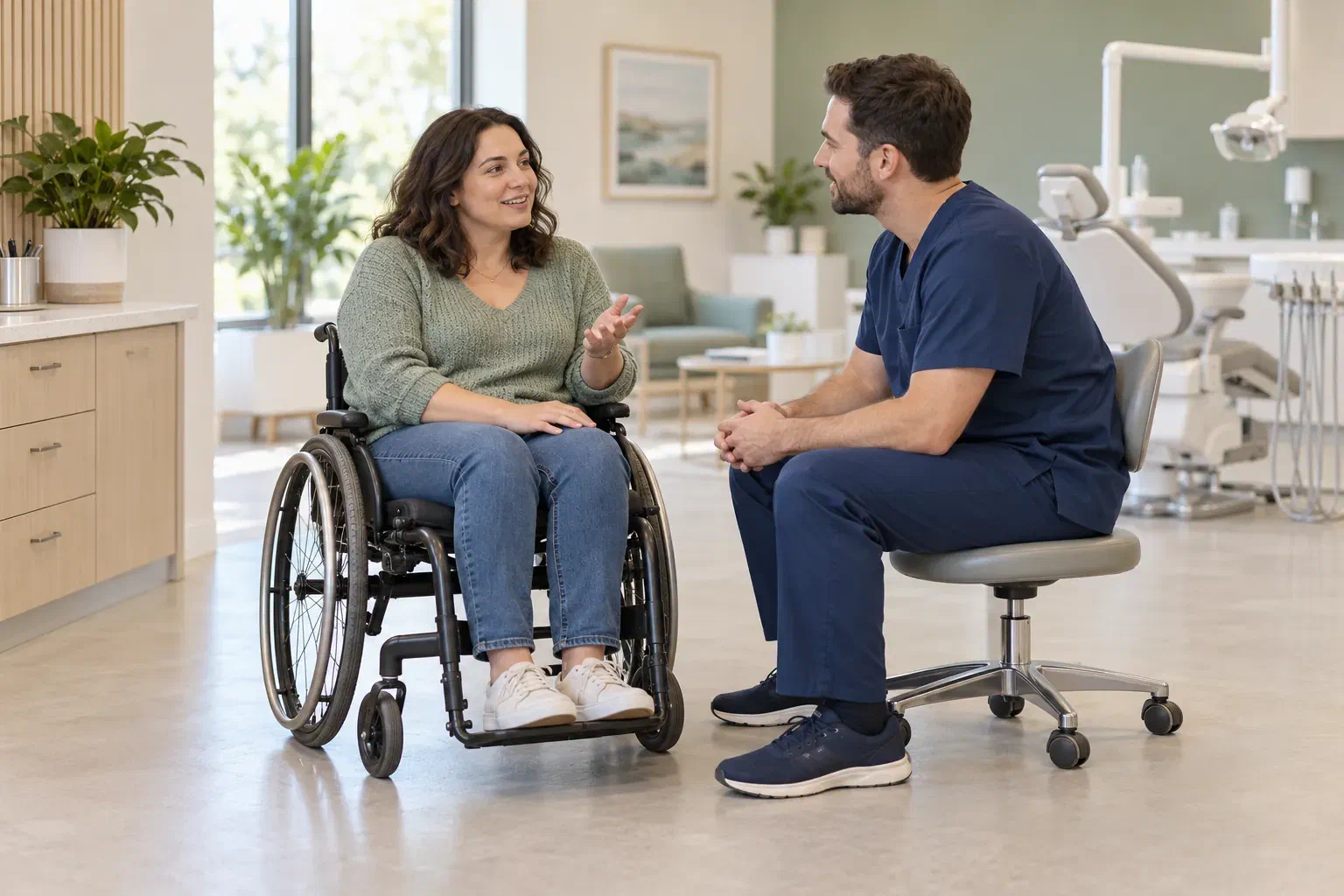
An accessible dental visit begins before you arrive at the entrance. The route into the building matters, but so do understanding the appointment, communicating comfortably, positioning safely, and having enough time to make decisions. Two people who use the same mobility aid or share a diagnosis may need very different arrangements.
Planning accessible dental visits in Milton is therefore a conversation about your particular visit. You can explain what helps, ask specific questions, and confirm the arrangements that matter before setting out. This guide offers a way to organize that conversation. It does not establish which facilities, equipment, or accommodations a particular practice currently provides; those details need direct confirmation with the team.
Start with the appointment you need
Tell the practice why you are seeking care as well as what would make attending easier. An examination, a discussion about a broken denture, and a procedure involving several stages may require different planning. If you have new pain, swelling, or an injury, mention that at the beginning of the call so the team can consider urgency alongside access needs.
Describe practical requirements in your own words. For example, you might need to remain in your wheelchair until a transfer plan is discussed, receive instructions in writing, or have questions addressed one at a time. A diagnosis can provide useful context, but it does not replace these details.
Ask who will coordinate the arrangements and how you will receive confirmation. If several people help organize your appointments, identifying one contact can prevent different versions of the plan from circulating. Keep a short record of the agreed visit type, expected length, and any information the practice still needs from you.
Check the whole route through the building
A general description such as accessible entrance may leave important questions unanswered. Consider your route from the drop-off point to reception, the treatment room, and the washroom. Ask about steps, slopes, door operation, lifts if relevant, and the space available for your particular mobility aid.
If a measurement matters, explain which measurement you need rather than relying on a photograph. A doorway that appears wide in an image may have a narrow opening when the door is fully open. Likewise, space beside a chair can matter as much as the route into the room. Ask whether the team can check the relevant dimensions before confirming the booking.
For a visit to Milton Dental Clinic, use the address Unit 1, 342 Bronte St. S, Milton when discussing arrival arrangements. Confirm the entrance and drop-off details directly rather than assuming that a map pin identifies the most suitable route. If you depend on scheduled transport, ask what arrival window is realistic and how to notify the practice about a delay.
Discuss positioning and transfers in advance
The National Institute of Dental and Craniofacial Research notes that access to the treatment area, transfers, and appointment length may require individual arrangements for people with mobility limitations. Its guidance also recognizes that positioning and communication needs differ between patients. NIDCR information on developmental disabilities and oral health.
Explain your usual transfer method, any equipment you require, and whether someone normally assists you. Do not assume the practice has a hoist, a particular chair, or staff trained for your usual transfer technique. Ask what can be supported safely and who needs to be involved in deciding that.
Mention if reclining, supporting your head, or maintaining one position becomes uncomfortable. You do not have to propose the clinical solution yourself. The useful information is what happens, how quickly it happens, and what has helped during previous healthcare visits. The team can then assess the available options rather than improvising after you have arrived.
Choose a communication method that works for you
Think about both booking and treatment. Telephone calls may be difficult even when face-to-face conversation is comfortable, while some people communicate more clearly through text or an assistive device. Ask which contact methods the practice can support and how important clinical information will be confirmed.
If you use hearing aids, lip-reading, a communication board, or an electronic communication aid, explain what you need during conversation. Ask whether discussions can happen before equipment is placed in your mouth and how you will signal a question or a pause. If an interpreter is needed, clarify arrangements and availability ahead of time rather than expecting a companion to interpret automatically.
For written information, specify what would help: larger print, a digital copy you can enlarge, short sections, or a verbal explanation followed by a summary. These requests are most useful when they describe the task you need to complete, such as understanding an estimate or following aftercare instructions. Confirm the format before leaving if you will rely on it at home.
Make sensory preferences part of the plan
The Canadian Dental Association supports individualized routines and communication about triggers and preferences. Its guidance describes approaches such as visual schedules, manageable steps, and familiar comfort items, depending on the person’s needs. CDA resources for patients with special health care needs.
You might find a particular sound, smell, light, or unexpected movement difficult. Describe the specific issue rather than feeling you must tolerate everything until the appointment ends. Ask which adjustments are possible and whether anything you plan to bring could interfere with communication or treatment.
A predictable sequence may help you prepare. Request a simple outline of the visit, including where discussion happens and when an examination might begin. If a familiarization visit would be useful, ask whether one can be arranged and what it would involve. Availability and suitability need confirmation; a preliminary visit is not a guarantee that every later procedure will feel the same.
Define the role of a support person
A companion may help with transport, remembering information, communicating preferences, or practical assistance. Decide which role you want that person to have. Tell the practice whether you would like them present throughout, only for discussion, or available nearby.
If you are the patient, explain whether you prefer the team to address questions directly to you before asking your companion for additional information. If you are supporting someone else, describe how they express preferences and what assistance they want. A need for physical or communication support does not by itself tell anyone how the person makes decisions.
Ask how consent and any relevant decision-making arrangements will be discussed. Bring documentation if the practice requests it, and clarify who may receive appointment information. When several family members are involved, it helps to distinguish the person organizing transport from the person authorized to receive clinical details. This avoids using a convenient contact as an automatic substitute for the patient’s own voice.
Plan around energy, comfort, and other care
Appointment length affects more than the time in a diary. Consider how long you can comfortably sit, the effort of travel, assistance available afterward, and other healthcare appointments that day. Explain these constraints while the visit is being planned.
Ask whether the expected work can be organized into suitable stages, and what the trade-offs would be. Several shorter appointments may suit one person, while repeated travel may be harder for another. The clinical team needs to balance these preferences with the treatment required; neither approach is automatically appropriate for everyone.
If medication timing, meals, or another health condition affects scheduling, tell the practice and follow individualized instructions. Do not change prescribed medicines or omit food because you assume all dental appointments require the same preparation. Clarify any instructions that conflict with your usual care plan before the visit.
Prepare a concise visit note
A useful note can fit on one page. Include the main reason for the appointment, relevant health information, current medicines and allergies, your preferred communication method, and the arrangements already discussed. Add the contact details of a support person or treating clinician when relevant and with appropriate permission.
Separate essential needs from preferences. For example, a required transfer arrangement needs confirmation before travel, while a preference about background music may be more flexible. This distinction helps the team identify what must be resolved first without dismissing the smaller details that also affect comfort.
Keep the note current. A document prepared several years ago may describe equipment, medicines, or communication needs that have changed. Reviewing it before the appointment also gives you an opportunity to decide which personal information is relevant to share, rather than handing over a long history without context.
Ask for home-care advice you can actually use
If brushing or cleaning between teeth is difficult, explain the task that causes trouble. It might be gripping a handle, reaching a back tooth, coordinating movements, or tolerating a sensation. The CDA describes adapted tools, including larger handles and floss holders, as possible supports. CDA guidance on individualized oral care.
Ask for a demonstration with equipment suited to your needs before buying several products. If someone helps with daily care, include them in the explanation where appropriate and agreed. A useful demonstration should leave you knowing what to do, how to recognize discomfort, and whom to contact if the suggested approach is not workable.
Arrange follow-up in a format you can use. Written steps, a product name, or a diagram may be easier to remember than a rapid explanation at the end of a tiring appointment. Tell the team if the proposed routine depends on assistance that is not consistently available at home.
Leave with a clear next step
Before leaving, confirm what was completed, what remains, and whether the next visit needs the same arrangements. Ask for any changes to be recorded so you do not have to reconstruct the entire discussion each time. If your needs cannot be met in that setting, ask what referral or alternative care arrangements can be explored.
Accessible care involves ongoing communication rather than one permanent checklist. Equipment, health, support, and preferences can change. For help planning a visit to Milton Dental Clinic, call (905) 876-4488 or use the contact page. Describe the appointment you need and the specific arrangements you would like to confirm so the team can discuss the next steps with you.
