
Introduction
Pregnancy is a time of a complex hormonal and physiological transformation within the human body. During pregnancy, when the focus is on prioritizing the overall health and wellbeing of the mother and the baby, the impact of pregnancy-related physiological changes on mother’s oral health may be overlooked. Understandably, prioritizing oral health can be challenging while pregnant due to various other changes happening within the body. Additionally, many pregnant individuals may lack the knowledge and resources to support their oral health during pregnancy. Expectant mothers may be educated to focus on diet and vitamins, but flossing can be just as important for supporting their baby’s health. In many communities, many expectant mothers may delay emergency dental care due to their fear of harming their baby. Many women in immigrant families never took dental visits on care into account for their baby’s health and that’s where the importance of public oral health education and awareness is needed for expectant mothers in all parts of the world.
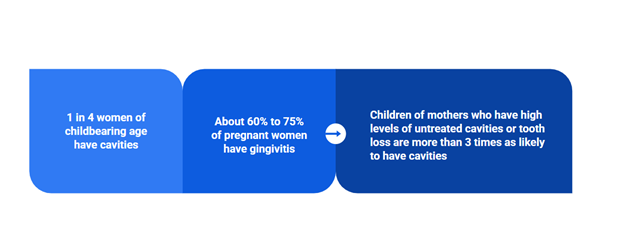
Numerous studies have shown that many expectant mothers face a significant risk of tooth decay and gum disease during pregnancy.1 Maternal oral health plays a critical role in shaping a child’s future dental outcomes. As shown in Figure 1, one in four women of childbearing age experience cavities, and up to 75% of pregnant women have gingivitis, conditions that significantly increase the risk of early childhood cavities.2 Gum diseases, such as gingivitis, are more likely to be neglected during pregnancy and can, at times, progress to periodontitis, a more advanced stage of gum disease involving inflammation of the bone supporting the teeth as well.1In case of a dental emergency, pregnant women may elect to not undergo radiographic assessment to prevent radiation exposure for their baby. This may further complicate management of dental emergencies among pregnant women. Given the heightened risk of oral health concerns, it is important to address, educate, and support women with their oral health during these times. Despite the risk of pregnancy-induced oral health complications, there are ways to mitigate such risks through appropriate preventive care as well as routine dental assessment with a qualified dental professional. In this piece, common oral health complications with gum disease during pregnancy, safety of dental X-rays, and preventive care throughout pregnancy will be explored.
Gum disease and hormones
Hormonal shifts during pregnancy can significantly affect oral health, particularly the gums. Increased levels of estrogen and progesterone are produced by the placenta.1 Elevated progesterone and estrogen levels affect neutrophils functionality, which is important in the microbiome balance.3 Pregnancy induces alteration in immune system responses and even shifts the dental-microbe plaque composition severely.3 Clinically, this presents itself as heightened gum inflammation, excessive plaque buildup, and prone to bleeding3 upon brushing and/or flossing. The surge of these symptoms in the second and third trimester is due to pregnancy gingivitis.4 This form of gingivitis causes swelling and is more prone to bleeding due to poor oral hygiene.4 A key contributor to this condition is plaque, a sticky film of bacteria that accumulates along the gumline and over time causes gums to become swollen, red, and inflamed.4 Pregnancy gingivitis typically begins in the second month, with the gums becoming especially sensitive and more susceptible to inflammation.1 According to the Centers for Disease Control and Prevention (CDC), gingivitis affects 60% to 75% of those who are pregnant.5
Another common but often overlooked condition is epulis gravidarum.1 These are benign (non-cancerous), soft tissue growths that typically appear on the gums, most often in the second trimester.1 Although they may look alarming, they are usually painless and often go away on their own after childbirth.
Moreover, there is a higher chance of getting inflamed gums due to a decrease in your body’s ability to respond to plaque and increase blood flow to the gum tissues1, which is why the lack of proper oral hygiene can lead to more spontaneous formation of these lumps from pregnancy gingivitis. Pregnancy gingivitis usually clears after birth, but dentists may recommend surgical removal if it persists.1 If someone is experiencing excessive bleeding while brushing, swollen gums and redness, a visit to their local dentist is recommended.
The link between gum disease and preterm birth
Research continues to highlight the important connection between oral health and pregnancy outcomes. A cohort study conducted among middle-class women in the United States found a significant association between periodontitis, a severe form of gum disease, and an increased risk of preterm birth and/or low birth weight.6
Understanding how oral conditions progress helps explain this connection. Untreated gingivitis may progress to periodontitis, a more severe gum disease like periodontitis has been associated with preterm birth and low-birth-weight babies. According to the World Health Organization, periodontitis is a chronic inflammation that affects tissues surrounding and supporting the teeth, which overtime can result in tooth loss.7
There are extensive research studies done globally that continue to support the notion that periodontal disease correlates to an increased likelihood of preterm birth. For instance, in a Taiwanese study, periodontal disease presence in expectant mothers was associated with an increased likelihood of premature birth, with disease severity positively correlating with preterm delivery risk, particularly in women aged 31 to 35 years.3 Additionally, a case study in Brazil revealed that periodontitis and hypertension could quadruple the risks of premature birth and low birth weight.3 In this study, among the 2474 participants, reported a preterm birth rate of 10.2% with a 21.7% prevalence of gingivitis and 14.9% of periodontitis among pregnant people.3
Dental X-rays and pregnancy
Many people worry about the safety of dental X-rays during pregnancy, but they are generally considered safe when proper precautions are taken.8 Modern digital X-ray technology uses very low levels of radiation, and protective measures like lead aprons and thyroid collars further reduce exposure.8 If dental X-rays are necessary for diagnosing or treating a serious issue, delaying them could pose greater risks to both the mother’s and baby’s health. Therefore, dental x-rays should be performed even while pregnant if necessary.8 It is a good idea to always inform the dentist if one is pregnant so they can tailor the dental care accordingly.
Safe dental care during pregnancy
Routine dental cleanings are safe and even recommended. Many soon to be mothers can have extreme cravings for different foods, especially carbohydrates and brushing can be often neglected.1 Thus, it is important to brush your teeth twice daily, flossing every night, gargling with warm salt water in the presence of painful swelling to the gums and cleaning your tongue.1 If the swelling and/or pain gets worse, then the dentist may prescribe oral antibiotics and/or prescription mouthwash.9
The timing of dental care is important. In the first trimester, nausea or morning sickness can make treatment challenging. Furthermore, the first trimester is also critical for fetus development. In the third trimester, reclining can cause discomfort or dizziness due to pressure on the heart. The American Pregnancy Association suggests routine cleanings and non‑emergency procedures are best scheduled in the second trimester, after organ development and before late‑pregnancy discomfort sets in.10
Nutrition plays a pivotal role in supporting oral health during pregnancy. It is necessary for mothers to take 1200 to 1500 mg of calcium daily to maintain bone health.1 Calcium rich foods such as milk and green vegetables should be consumed more during pregnancy.1 This is not only beneficial for the mother, but also the baby, since tooth development starts in the 5th to 6th week for the baby.1 This ensures the mother is maintaining the necessary balance of energy and nutrients needed to support the growth of the baby and sustain good oral health.
Barriers to oral health education during pregnancy
There are some challenges faced by pregnant women that may not give them an opportunity to obtain knowledge on this oral health while pregnant. Many of these women still believe a common myth that they should not visit the dental office often while pregnant, which is simply not true. Outside of the multitude of challenges the body goes through while pregnant, there are barriers that prevent access to oral health education while pregnant. Immigrant women may face language barrier challenges, lack of access to a local dentist, financial barrier, or simply a lack of attention to their oral health. These barriers, combined with persistent misconceptions, can prevent pregnant women from seeking timely dental care, ultimately putting both maternal and fetal health at risk. Developing culturally sensitive programs and open access to oral health knowledge and multilingual public health initiatives for pregnant people would dismantle this barrier and ultimately the potential risk during pregnancy
Conclusion
Comprehensive oral care during pregnancy involves prevention, assessment, and treatment, each with specific recommendations (see Figure 2). It is important for women to be aware of the risks, symptoms, safety with dental x-rays, and proper approach to oral hygiene during pregnancy. Many women are unsure or have not been properly advised about what they can and cannot do while pregnant. Having accurate knowledge can improve understanding and encourage preventive care, helping women maintain their oral health during a time when they are more susceptible to gum disease due to hormonal changes and common pregnancy symptoms like morning sickness. It is important for individuals to visit their dentist regularly and inform them of any pregnancy to ensure safe and appropriate treatment. A preventive approach to oral health is always better than a reactive one.
Fig. 2
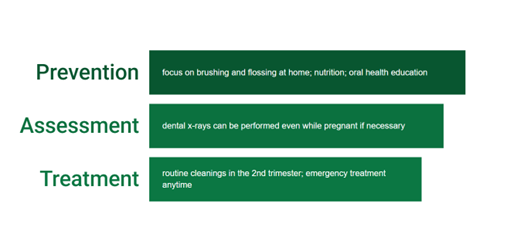
A guidance check for pregnant women to ensure prevention of oral disease through at-home oral health enhancement strategies, getting assessed for impairment in oral health through necessary x-rays and ensuring adequate cleaning during the second trimester with emergency treatment visits when needed.
References
- Yenen Z, Ataçağ T. Oral care in pregnancy. Journal of the Turkish-German Gynecological Association. 2019 Dec 1;20(4):264–8. doi:10.4274/jtgga.galenos.2018.2018.0139
- “Pregnancy and Oral Health Facts.” Centers for Disease Control and Prevention, Centers for Disease Control and Prevention, www.cdc.gov/oral-health/data-research/facts-stats/fast-facts-pregnancy-and-oral-health.html. Accessed 29 Oct. 2025.
- Tsikouras, Panagiotis, et al. “The Impact of Periodontal Disease on Preterm Birth and Preeclampsia.” Journal of Personalized Medicine, vol. 14, no. 4, 26 Mar. 2024, p. 345, doi:10.3390/jpm14040345.
- Addy M, Shellis RP. Interaction between attrition,abrasion and erosion in tooth wear. Monographs in Oral Science. 2006;17–31. doi:10.1159/000093348
- Kinane DF, Stathopoulou PG, Papapanou PN. Periodontal diseases. Nature Reviews Disease Primers. 2017 Jun 22;3(1). doi:10.1038/nrdp.2017.38
- Sun W-L, Lei L-H, Chen L-L, Yu Z-S, Zhou J-W. Multiple gingival pregnancy tumors with rapid growth. Journal of Dental Sciences. 2014 Sept;9(3):289–93. doi:10.1016/j.jds.2013.02.002
- Oral Health [Internet]. World Health Organization; 2025 [cited 2025 Jul 30]. Available from: https://www.who.int/news-room/fact-sheets/detail/oral-health
- Gamba TO, Visioli F, Bringmann DR, Rados PV, da Silveira HL, Flores IL. Impact of dental imaging on pregnant women and recommendations for Fetal Radiation Safety: A systematic review. Imaging Science in Dentistry. 2024;54(1):1. doi:10.5624/isd.20230177
- Antibiotics and dental care [Internet]. 2024 [cited 2025 Jul 30]. Available from: https://www.cda-adc.ca/en/oral_health/talk/antibiotics/#:~:text=cold%20or%20flu.-,Dental%20procedures%20and%20antibiotics,your%20current%20oral%20health%20condition
- Pregnancy and dental work [Internet]. 2021 [cited 2025 Jul 27]. Available from: https://americanpregnancy.org/healthy-pregnancy/is-it-safe/dental-work-and-pregnancy/#:~:text=The%20American%20Dental%20Association%20(ADA,dentist%20know%20you%20are%20pregnant.