

Illustrative child and parent listening to a dental clinician before a checkup
Children’s Dentistry

Children’s Dental Checkups in Brampton

Three kids, three mouths, three stages of growing up. Checkups for children can often be arranged close together, yet each child gets their own look at teeth, gums and habits, and their own plan for what comes next.

Booking siblings from Brampton

Same day, different children, separate plans.

When a household has a preschooler, a grade-schooler and a preteen, the dental calendar gets crowded fast. It is natural to want everyone seen in one trip. That often works, as long as each child is treated as an individual: the youngest may still have every baby tooth, while the oldest is managing new molars and a routine of their own.

Making the drive southwest from Brampton is smoother with a note for each child. Who has a wobbly tooth? Who complains about cold drinks? Who hands the toothbrush back after ten seconds? Each child is welcome to bring a question too, and younger ones often enjoy watching an older sibling go first.

Recommendations are made child by child. One may be offered sealants, another an X-ray, a third simply a review of brushing. Cleaning and fluoride may also come up, but nothing is added automatically because a sibling had it. Ask what is planned for each, and why the next visits were timed the way they were.

Book checkups for your children
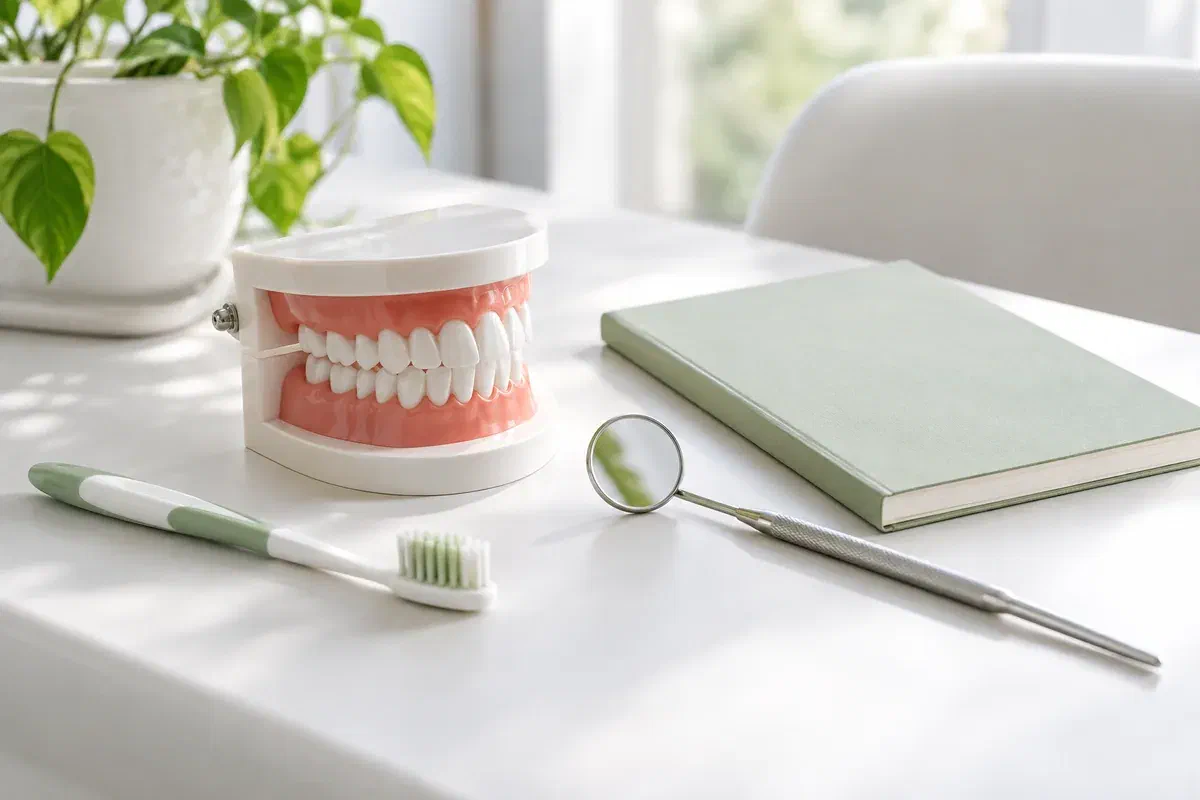
Illustrative child-sized toothbrush, dental model, mirror, and notebook
One list per child

Keep each child’s changes separate.

In a busy house, worries get mixed up between children. Jot a line or two for each one, in whatever words your child used to describe it.

Teeth erupting, loosening or moving

Write down which child has a new adult tooth, a baby tooth that refuses to fall out, or a crowded area that is tough to brush. The dentist can review development and explain whether monitoring is enough. A tooth that looks out of line is not, by itself, a sign that braces are required.

Tender teeth, bleeding gums, mealtime changes

Note any child who winces at cold food, chews on one side, keeps getting food stuck or bleeds when brushing. Say when it happens and whether it is getting worse. These issues may need their own appointment rather than waiting for the family's next round of checkups.

Routines that differ between kids

Tell us who brushes for whom, which child resists, and whether a new schedule has upset things. Ask about flossing and newly erupted molars for the older ones. Each child's advice should reflect their own abilities, not their place in the birth order.

Please share each child's medicines, health changes, injuries and any sensory or support needs before the visit. If one of them has pain or swelling, say so when booking so their appointment can be adjusted.

Why separate plans matter

Siblings share a bathroom, not a risk profile.

A regular visit allows the dentist to see where each child stands, think about their chance of developing cavities and talk about growth and prevention. Because those factors differ, intervals can differ too. It is quite common for one sibling to be recalled sooner while something is being watched.

No checkup can promise that nothing will happen before the next one. The benefit is knowing what was found for each child and what to do if things change. Try to leave with a clear next step for every child, not just a stack of appointment cards.

Patient information: AAPD — continuing examinations and preventive care

A record for each child over time

Findings compared across several visits show whether an area is holding steady or needs attention. Ask what is being monitored for each child and what would change the plan. Your notes from home are valuable, particularly for symptoms that flare up only now and then.

Techniques suited to each stage

The routine that works for a child with gaps and loose teeth will not suit an older sibling with a full adult set. Ask the team to show each child how to reach their own trouble spots. When one technique stops working, it should be swapped for another.

Each child gets their own turn to talk

Younger and older children can both be invited to ask questions and say what helps. Simple choices and plain descriptions keep them involved, without promises about how it will feel. Let us know if one child needs more preparation or a different way of communicating.

For each child in turn

What each checkup involves.

Every child's appointment is built around their own history and present needs. Ask what has been booked for each one, and what extra services might be discussed afterward.

  1. A quick catch-up

    We ask about each child's symptoms, health, brushing routine and earlier dental experiences. Children can ask something before we begin. The team explains the exam in words suited to that child's age and sets up a simple way to ask for a pause.

  2. The examination

    The dentist checks teeth, gums and development with attention to that child's stage and any concerns. Ask which of their teeth are primary and which are permanent. If a child could not manage the whole exam, find out what was assessed and how the rest will be done.

  3. Prevention and imaging decisions

    Depending on what is found, the dentist may discuss X-rays, cleaning, fluoride or sealants. Ask what information an image would give, or which tooth a sealant would protect. One sibling receiving something does not mean the others need it.

  4. Results and next dates

    We explain treatment needs, prevention tips and what to monitor. Ask about each child's recall interval and whether any concern needs a separate visit. Each child gets a chance to ask a last question.

Back home with the kids

Realistic routines for a full house.

A routine exam on its own seldom requires recovery care. If a child had a product or procedure during the visit, follow the instructions given for them.

Match supervision to each child

Ask how much brushing and flossing help each child still needs. An older sibling's independence is not a guide for a younger one, and keen children can still miss the back teeth. The team can suggest a sharing plan for each.

Track whose advice is whose

Follow the toothpaste amount, technique and any preventive steps recommended for each child. If something is hard to fit into a hectic evening, tell us. A manageable change beats an instruction that keeps getting lost.

Do not wait for the family’s next round

Call if any child develops new pain, swelling, an injury or a tooth that looks different. Mention when it started and whether eating or sleep is affected. A good checkup last time does not mean a new problem should wait.

Sorting out the bookings

Not every child needs the same kind of visit.

Tell us the reason for each booking so the right appointments can be set aside. A checkup may show one child needs a separate visit for treatment or assessment.

For regular review and prevention

Routine checkup

This covers oral health, development and a forward plan. Other services are raised when they are indicated. Ask what each child's visit includes and whether cleanings or procedures are booked separately.

When one child needs more

Treatment for a specific problem

Pain, decay, injury or a damaged tooth may need care beyond a routine exam. The dentist will explain options and timing. Ask what the follow-up covers and which symptoms mean calling sooner.

When growth or support needs need a closer look

Developmental or specialist referral

Some findings are best observed over time or reviewed by a clinician with relevant expertise. Ask what prompted the suggestion and what it aims to answer. An early referral does not automatically mean treatment must begin.

Patient information: AAPD — selecting dental radiographs for children

Brampton parents ask

Booking more than one child.

Answers about scheduling siblings, different plans and keeping track. Each child's questions are welcome.

(905) 876-4488
How many children can we book in one trip?
Ask the team when you call. It may be possible to schedule several children close together, depending on availability and what each child needs. If one child has pain or a specific concern, mention it so their visit can be planned properly.
Why did my younger child get a different recall date from my older one?
Each child’s teeth, history and risk are assessed separately. One may need to come back sooner while an area is monitored. Ask the dentist to explain each interval so you understand the reasoning.
Can an older sibling watch the younger one’s checkup?
Often, if it helps and space allows. Some younger children feel calmer after seeing a brother or sister go first. Ask the team what works best on the day.
Do all my kids need fluoride if one is getting it?
No. Fluoride and other preventive steps are recommended based on each child’s findings and risk. Ask why it is being suggested for a particular child.
Can I promise the kids a treat if they behave?
That is your call, but avoid promising that nothing else will happen at the visit. Explain that the dentist will look, count teeth and talk about what they see. If anything more is suggested, it will be discussed with you first.
My oldest brushes alone and had a clean checkup. Should the younger ones copy?
Not necessarily. Each child’s skills and teeth are different, and one good visit does not show every surface is being reached. Ask how much help each child still needs and review it as they grow.
Family checkups from Brampton

One trip, and a plan for every child.

Call our Bronte Street practice to arrange checkups for your children. Let us know their ages, what has changed for each one, and any pain or support needs, so we can line up appointments that make sense.

Recall intervals are set for each child individually. If any child develops pain, swelling or an injury, please call at the time instead of waiting for the next scheduled visit.

Visit Milton Dental Clinic
Unit 1, 342 Bronte St. S, Milton, ON L9T 5B7
Get directions Clinic hours
Monday–Thursday
11am–7pm
Friday–Sunday
By appointment only

Areas we serve

  • Milton
  • Oakville
  • Mississauga
  • Georgetown
  • Halton Hills
  • Acton
  • Campbellville
  • Brampton
  • Burlington
  • Puslinch
  • Rockwood
  • Erin
  • Caledon
  • Etobicoke
  • Old Milton
  • Bronte Meadows
  • Timberlea
  • Dorset Park
  • Dempsey
  • Clarke
  • Beaty
  • Coates
  • Harrison
  • Scott
  • Willmott
  • Ford
  • Bowes
  • Cobden
  • Walker
  • Mountain View
  • Milton Heights
  • Hawthorne Village
  • Valley View
  • Fallingbrook
  • Nassagaweya
  • Trafalgar
  • Esquesing
  • Nelson
  • Brookville
  • Moffat
  • Glen Williams
  • Norval
  • Limehouse
  • Stewarttown
  • Ashgrove
  • Hornby
  • Silver Creek
  • Speyside
  • Scotch Block
  • North Oakville
  • River Oaks
  • Glen Abbey
  • West Oak Trails
  • Palermo
  • Bronte Creek
  • College Park
  • Joshua Creek
  • Uptown Core
  • Preserve
  • Iroquois Ridge
  • Lisgar
  • Meadowvale
  • Meadowvale Village
  • Churchill Meadows
  • Erin Mills
  • Central Erin Mills
  • Streetsville
  • East Credit
  • Creditview
  • Heartland
  • Sheridan
  • Mount Pleasant
  • Credit Valley
  • Huttonville
  • Churchville
  • Springbrook
  • Northwest Brampton
  • Bram West
  • Fletcher's Meadow
  • Fletcher's Creek South
  • Alton Village
  • Orchard
  • Millcroft
  • Headon Forest
  • Tansley
  • Brant Hills
  • Tyandaga
  • Kilbride
  • Lowville
  • Aberfoyle
  • Morriston
  • Arkell
  • Hillsburgh
  • Freelton
  • Carlisle
  • Waterdown
  • Flamborough
  • Mountsberg

How can we help?

Milton Dental Clinic

Have a question about your smile? Choose the option that works best for you.

For urgent dental concerns, please call.
Messages are reviewed during clinic hours.