

Illustrative child and parent learning about molar chewing surfaces
Children’s Dentistry

Children’s Dental Sealants in Brampton

Is your child nervous about anything new in the dental chair? For families in Brampton, we explain what a sealant visit sounds and feels like, which grooves could qualify, and how it is reviewed later.

Helping Brampton kids feel ready

Paint, a little breeze, and a blue light.

That is roughly how many children describe a sealant appointment afterward. For a child who worries about the unknown, knowing those details beforehand can make the chair feel less strange. It also helps parents to understand what the coating is, and what it isn’t.

A sealant is a protective material placed into the deep grooves on top of a back tooth. Once set, it closes off pits that are hard to clean. Whether your child needs one is decided by examining the tooth: how far it has erupted, how the surface looks, any early change, and the child’s chance of developing decay.

Sealing a sound groove generally involves no drilling. Even so, it is a preventive step with limits. It protects chosen chewing surfaces, does not reach between teeth, and does not replace brushing or fluoride. Ask what the coating is guarding, how it will be checked, and what your child should tell you afterward.

Prepare for a sealant visit
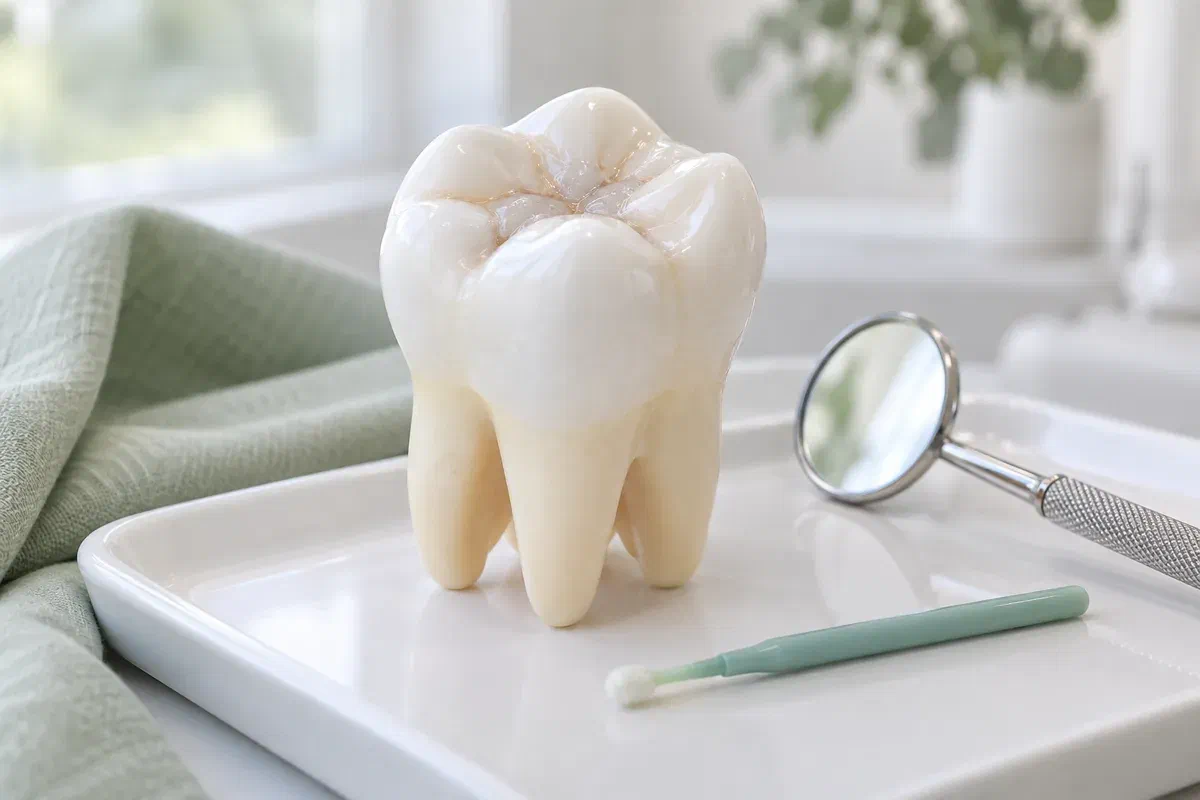
Illustrative molar teaching model, dental mirror, and sealant applicator
Good times to bring it up

Is now the moment to ask?

Judging groove depth or spotting early decay is the dentist’s job, not yours. What you can offer is a description of what your child has noticed and how home brushing is going.

A back tooth with no gap before it

A new molar often appears behind the baby teeth without anything falling out. Let us know when you see one. We can confirm it is permanent and show a brushing trick for teeth still partly under gum, and plan any sealant around how far it has come in.

Fillings in the past or a spot that gets skipped

Earlier cavities, or a corner your child always seems to miss, are useful to hear about. Tell the team how much help you give with the brush. A sealant suggestion should line up with the risk the dentist actually finds.

An existing coating that feels odd

If your child says a sealed tooth feels bumpy, the bite has changed, or the sealant came from another clinic, mention it. We can check whether the material is still in good shape. Steer them away from picking at it with fingernails or anything sharp.

A tooth that hurts, a hole you can see, or food catching in the same spot needs a full look first. Sealants belong on suitable surfaces, and the dentist has to rule out damage that calls for a different treatment.

Why the coating can help

Smoothing out the hardest place to brush.

A sealant can help prevent cavities from forming in the pits and fissures of a suitable surface. Sometimes a dentist will also seal over a very early lesion that hasn’t broken through, if it has been properly diagnosed and will be watched. Covering a cavity that hasn’t been examined is not what sealants are for.

Like any coating, it lasts only as long as it stays attached and intact. Future visits include a look at the sealant and the enamel around it. Ask how wear is spotted and whether part of it could need replacing later.

Patient information: AAPD and ADA — pit-and-fissure sealant guideline

Teamwork with the toothbrush

The coating takes care of particular grooves. Brushing, flossing and fluoride cover the rest of each tooth. Ask how the plan fits together, so your child understands that a smooth molar does not mean the brush can skip it.

A chance for your child to see their tooth

Many children don’t know a grown-up molar has arrived. A mirror and a model can show them where it is and how the brush gets there. Encouraging them to point it out themselves builds confidence, with your help as needed.

Reasons in plain words

The dentist can say why this surface is being sealed and what will be watched. If another tooth is handled differently, ask why. Each choice should come from what the examination found, not a one-size approach.

A walk-through for nervous children

What your child will hear, feel and see.

The method changes a little with each material. We explain things in child-friendly language and agree on a signal, such as raising a hand, for a break.

  1. A quick look and a plan

    The dentist counts and checks the teeth, considers cavity risk, and looks for any early spots. You can ask whether this is pure prevention or a way to manage a small early change, and whether any pictures of the teeth are needed before going ahead.

  2. Washing and drying the tooth

    The groove gets cleaned and prepared. Then the area needs to stay dry, so your child may feel cool air, hear a slurping suction tip, or have soft cotton tucked beside the tooth. We show each item first so nothing is a surprise.

  3. Brushing on the sealant

    The material is painted into the grooves, a little like nail polish. Some types are hardened with a small blue light held close to the tooth. We tell your child what usually happens, without promising every step will be identical.

  4. The bite test

    Your child gently closes so we can check how the teeth meet. If it feels too tall or sore, they should say so. We then share any instructions for that product and note when the sealant will be checked at a later visit.

When you get home

Normal brushing, and speak up if something feels wrong.

Aftercare depends on the material placed and anything else done that day. Not every sealant comes with the same instructions about eating.

Toothbrush time does not change

Keep using the fluoride toothpaste amount suggested for your child and cleaning between their teeth. The sealant only covers the top grooves. Stay involved with brushing at the level your child still needs, even when the molar feels smooth.

Listen for complaints about the bite

A high spot that doesn’t settle, ongoing soreness, or a coating that looks chipped are all reasons to call. Avoid telling your child to just chew it out, and keep hard objects away from the tooth. We can check it properly.

Return for the check

Sealants may wear and need a repair or a new layer. Let us know about any from another clinic, and ask which surfaces are being followed. Checks matter even when everything feels fine, because children rarely notice slow changes.

Other ways to protect a tooth

Three choices, and sealing is only one.

Ask what the examination found and which choice matches it. Combining approaches can make sense if each has a reason.

For a surface that may need a barrier

Coating suitable grooves

Targets specific chewing areas and relies on careful placement plus later checks. The dentist can tell you which tooth is suitable and why. A sealant plan should always mention how and when it will be reviewed.

For protection across the whole mouth

Fluoride and a solid routine

Often recommended with a sealant, or on its own when sealing is not yet the right move. Ask about the product, the amount and how much adult help suits your child. Fluoride and sealants are different tools, so one cannot take the other’s place.

When the tooth needs another approach

More checking or a filling

If the surface has already broken down, or something else is found, a sealant may not be enough. A molar that is only partly through may need to wait, with an interim plan. Ask what limits the present option and when it will be reconsidered.

Questions from Brampton parents

What children and parents want to know.

Ask about the teeth being sealed, the material and the follow-up. Answers should match your child’s own findings.

(905) 876-4488
How can I explain a sealant to my child before the visit?
Simple words work best: the dentist will clean a back tooth, paint a protective coat into its grooves, and harden it. Avoid promising that nothing will be felt. Our team can explain again at the visit in a way that suits your child’s age.
Can I stay with my child during the sealant appointment?
Ask the clinic when you book about how you can support your child during the visit. Many parents find that staying calm and letting the team guide the conversation helps their child settle.
Does the curing light hurt or get hot?
The light is used to harden some sealant materials and is held near the tooth for a short time. Children may be given protective glasses. If your child is worried about it, ask the team to show them the light beforehand.
Can sealants go on baby molars?
In selected cases, suitable primary molars may be sealed. It depends on the tooth’s surface and your child’s risk. Ask the dentist why that baby tooth is a candidate and how long it is likely to remain in the mouth.
If a sealant falls off, will my child need the whole thing redone?
Not necessarily. Contact the clinic so the dentist can check what is left and the tooth underneath. Sometimes a repair is enough, and sometimes a new sealant or other care is advised. Don’t try to remove leftover material at home.
Is my child still at risk of cavities after getting sealants?
Yes. Sealants cover selected chewing grooves, but the sides and spaces between teeth can still develop decay. Keep up brushing, cleaning between teeth and the fluoride advice given for your child, and keep regular review visits.
Coming in from Brampton

We’ll take it one step at a time.

Call our Bronte Street practice to book a sealant discussion for your child. We can check molars as they come in, review existing sealants, and explain prevention that suits the findings, at a pace that works for your child.

Sealants are recommended only when the examination shows a suitable surface. They need review and do not replace daily brushing or other preventive care.

Visit Milton Dental Clinic
Unit 1, 342 Bronte St. S, Milton, ON L9T 5B7
Get directions Clinic hours
Monday–Thursday
11am–7pm
Friday–Sunday
By appointment only

Areas we serve

  • Milton
  • Oakville
  • Mississauga
  • Georgetown
  • Halton Hills
  • Acton
  • Campbellville
  • Brampton
  • Burlington
  • Puslinch
  • Rockwood
  • Erin
  • Caledon
  • Etobicoke
  • Old Milton
  • Bronte Meadows
  • Timberlea
  • Dorset Park
  • Dempsey
  • Clarke
  • Beaty
  • Coates
  • Harrison
  • Scott
  • Willmott
  • Ford
  • Bowes
  • Cobden
  • Walker
  • Mountain View
  • Milton Heights
  • Hawthorne Village
  • Valley View
  • Fallingbrook
  • Nassagaweya
  • Trafalgar
  • Esquesing
  • Nelson
  • Brookville
  • Moffat
  • Glen Williams
  • Norval
  • Limehouse
  • Stewarttown
  • Ashgrove
  • Hornby
  • Silver Creek
  • Speyside
  • Scotch Block
  • North Oakville
  • River Oaks
  • Glen Abbey
  • West Oak Trails
  • Palermo
  • Bronte Creek
  • College Park
  • Joshua Creek
  • Uptown Core
  • Preserve
  • Iroquois Ridge
  • Lisgar
  • Meadowvale
  • Meadowvale Village
  • Churchill Meadows
  • Erin Mills
  • Central Erin Mills
  • Streetsville
  • East Credit
  • Creditview
  • Heartland
  • Sheridan
  • Mount Pleasant
  • Credit Valley
  • Huttonville
  • Churchville
  • Springbrook
  • Northwest Brampton
  • Bram West
  • Fletcher's Meadow
  • Fletcher's Creek South
  • Alton Village
  • Orchard
  • Millcroft
  • Headon Forest
  • Tansley
  • Brant Hills
  • Tyandaga
  • Kilbride
  • Lowville
  • Aberfoyle
  • Morriston
  • Arkell
  • Hillsburgh
  • Freelton
  • Carlisle
  • Waterdown
  • Flamborough
  • Mountsberg

How can we help?

Milton Dental Clinic

Have a question about your smile? Choose the option that works best for you.

For urgent dental concerns, please call.
Messages are reviewed during clinic hours.