

Illustrative child and parent discussing a sports-related dental concern
Children’s Dentistry

Children’s Dental Trauma Treatment in Georgetown

A broken front tooth worries children about how they look and parents about what lies beneath. Coming from Georgetown, call us to talk through the break, save any fragment and plan both the repair and the reviews.

Chipped and broken front teeth

Your child is worried about the smile. The dentist is thinking about the nerve.

Older kids often ask one thing after chipping a front tooth: will people notice? It is a fair worry, and a repair can usually address it, but there are other priorities first. Look over your child for signs of a more serious injury. Head or facial trauma that seems severe, trouble with breathing or swallowing, or heavy bleeding that continues needs emergency medical care.

Then call a dental office and explain how the tooth broke and when. If, instead of chipping, an adult tooth has come out entirely, that is urgent and needs immediate care; a baby tooth that falls out is never replanted. For families in Georgetown, our team can share availability by phone, and if urgent care can’t be arranged with us, please see another emergency dental provider.

The repair your child cares about is one part of the plan. The dentist also checks how close the break came to the pulp, the condition of the root and gum, and how developed the tooth is. Some effects only show over time, so ask what will be reviewed once the tooth looks whole again.

Book a non-urgent repair consultation
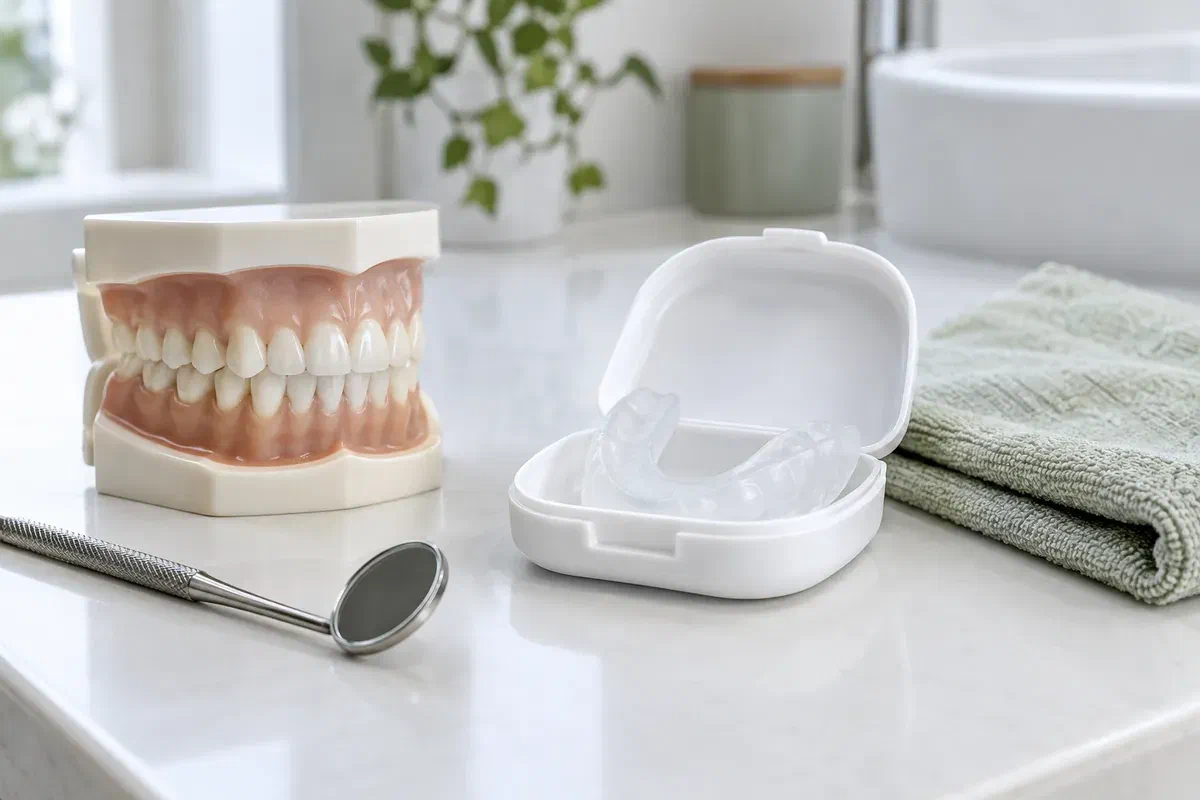
Illustrative dental model, mirror, and protective mouthguard in a case
Describing the break

How big is the break, and does it hurt?

The way the tooth broke, when it happened and your child’s symptoms help the dentist judge what is involved. Avoid poking the broken area or testing the tooth with hard bites.

The size and feel of the chip

Estimate whether a thin edge or a larger part has broken away, and whether air, cold drinks or touch cause pain. Look for the fragment; if it can be collected safely, put it in milk or water. Home glue and emery boards should stay in the drawer.

Movement alongside the break

A broken tooth can also be loosened or shifted. Mention if it looks out of line or longer or shorter than before, or if the bite feels off. Those changes need prompt attention, so don’t push the tooth into place or assume a baby tooth is just loose.

Lips, gums and missing pieces

Tell us about a cut or swollen lip, gum bleeding and any piece you couldn’t find, since fragments occasionally lodge in the lip. Share other symptoms too, including any concern about a head injury. The clinician needs the full picture to plan the examination.

If a permanent tooth has been knocked out rather than chipped, seek first-aid advice and dental care immediately. Handle the crown only, keep the tooth in milk if safe replanting isn’t possible, and don’t let a young child keep it in their cheek.

More than a cosmetic fix

Why the pulp and root get attention too

A fracture can expose or come close to the pulp, and the impact behind it can affect the root and the ligament around it. The dentist considers these alongside the visible break. A neat restoration on the front doesn’t confirm that the inner tooth is healthy.

A young permanent tooth with a root still forming is not managed like a baby tooth. Development shapes which repair makes sense and how closely the tooth is watched. Ask which tooth broke, what the examination shows and what will only be known later.

Patient information: IADT and AAPD — fractures and luxations of permanent teeth

A repair suited to the break

Depending on the fracture, care might be bonding, reattaching the fragment, protecting the pulp or simply monitoring. Ask what each measure is meant to do, since a restoration may deal with the shape while the pulp still needs following.

Photos and notes for future visits

Records taken at the first visit help the dentist see change later. Mention any earlier injury to the same tooth. Ask what will be compared at each review and what change would lead to further treatment.

Realistic expectations

How a broken tooth fares can’t always be predicted at first. Ask which signs are good and what problems are being watched for. A clear follow-up plan is more helpful than a promise the repair will last forever.

From broken tooth to finished repair

What the appointment covers

The order and urgency vary with the injury. Please call about a recent break instead of using the routine online booking form.

  1. The history of the break

    Tell the dentist when and how it happened, what first aid you gave and whether a doctor has seen your child. Mention any missing pieces and changes in the bite. Bring the fragment if found, your child’s health information and a note of medicines.

  2. Examination and any imaging

    The broken tooth, nearby teeth and soft tissue are checked, and the dentist explains whether imaging or tests would help. Ask what can be confirmed now and whether some tests might be repeated as the tooth responds.

  3. Repair and pulp protection where needed

    Treatment may involve reattaching the fragment, rebuilding the tooth, pulp care, a splint if it has moved, or observation. Let us know if your child is anxious about how the tooth looks. If a referral is suggested, ask why and how soon.

  4. Care at home and review dates

    Confirm what was done and how to protect the repair while eating and brushing. Ask when to come back and which symptoms should prompt an earlier call. Reviews may continue after the tooth looks normal.

Protecting the repair

A repaired tooth still needs looking after.

Your instructions depend on the break and the treatment. A small bonded repair usually needs different care from a tooth that was also loosened or splinted.

Go easy on the repaired edge

Ask which foods and habits, like biting nails, pens or hard snacks with the front teeth, to avoid and for how long. Keep the area clean as shown. If sensitivity makes brushing uncomfortable, call for help rather than skipping it.

Notice sensitivity, colour and comfort

Let us know if pain grows, sensitivity returns or worsens, the gum swells or forms a bump, the bite changes or the tooth darkens. Colour on its own isn’t a diagnosis; it is interpreted with the symptoms and examination.

Plan for sport and a mouthguard

Ask when your child can return to sport and whether a mouthguard would help protect the repaired tooth. If they already have one, check that it still fits. A guard reduces risk but can’t guarantee against another break.

Patient information: IADT — broken teeth and preserving a fragment

Ways a broken tooth may be treated

Bond it, watch it or go further

What fits depends on the tooth, the break, development and the examination. Ask how the first repair relates to any care later.

When the lost part can be restored

Reattachment or rebuilding

If the fragment is intact, it can sometimes be bonded back; if not, a tooth-coloured filling can recreate the shape. The dentist will explain how durable it is and how to care for it. Restoring the look doesn’t replace checking the pulp.

When the tooth also moved or loosened

Monitoring and, if needed, a splint

When a fractured tooth has also been loosened, it may need repositioning or a splint, while others need a planned period of observation. The diagnosis sets the approach and review timing. Observation involves instructions and return dates.

When the break reaches the nerve

Pulp care or specialist input

Treatment of the pulp, extraction or other care may be discussed if indicated. For a baby tooth, the adult tooth below it is part of the decision. Ask why further care is advised and whether a clinician with specific expertise should be involved.

Patient information: IADT and AAPD — injuries to primary teeth

Questions about broken teeth

Will the chip show, and what else should we know?

Bring your child’s questions as well as your own. The first visit sets a starting point, and some answers take time.

(905) 876-4488
Can my child’s broken piece of tooth be glued back on?
Sometimes the dentist can bond an intact fragment back in place. Whether it’s suitable depends on the fragment and the injury. Keep it moist in milk or water and bring it in, but never try to attach it yourself.
Will a repaired front tooth look like the others?
The dentist can explain what the chosen repair is likely to look like and its limits. Tooth-coloured materials are matched as closely as practical, but no repair is guaranteed to be invisible or to last indefinitely.
Why does my child’s chipped tooth hurt with cold drinks?
A break can expose the inner layers of the tooth, which may make it sensitive. Mention this when you call, as it helps the dentist judge how close the break came to the pulp and how soon to see your child.
If the chip is tiny, is a dental visit really needed?
Call to describe it. Even a small chip may come with damage to the root, pulp or nearby teeth that isn’t visible. The dentist can advise whether an examination or monitoring makes sense.
Could the repaired tooth need more treatment later?
It might. Some complications develop months after an injury, sometimes without pain. That is why reviews continue after the repair. Ask what signs to watch for and keep the scheduled visits.
We’re coming from Georgetown. Can the repair be finished in one visit?
Some repairs can be done in one appointment, but it depends on the break and whether the pulp or root need care. Ask what to expect when you call, and plan for follow-up reviews either way.
Broken tooth care for Georgetown children

Bring the fragment, and we’ll take a look.

Ring our Bronte Street practice to discuss the break, availability and the next step. If a recent injury is urgent and we can’t arrange care, please use an available emergency dental provider.

A knocked-out adult tooth needs immediate attention. Seek emergency medical care for a serious head injury, breathing or swallowing problems, or bleeding that can’t be controlled.

Visit Milton Dental Clinic
Unit 1, 342 Bronte St. S, Milton, ON L9T 5B7
Get directions Clinic hours
Monday–Thursday
11am–7pm
Friday–Sunday
By appointment only

Areas we serve

  • Milton
  • Oakville
  • Mississauga
  • Georgetown
  • Halton Hills
  • Acton
  • Campbellville
  • Brampton
  • Burlington
  • Puslinch
  • Rockwood
  • Erin
  • Caledon
  • Etobicoke
  • Old Milton
  • Bronte Meadows
  • Timberlea
  • Dorset Park
  • Dempsey
  • Clarke
  • Beaty
  • Coates
  • Harrison
  • Scott
  • Willmott
  • Ford
  • Bowes
  • Cobden
  • Walker
  • Mountain View
  • Milton Heights
  • Hawthorne Village
  • Valley View
  • Fallingbrook
  • Nassagaweya
  • Trafalgar
  • Esquesing
  • Nelson
  • Brookville
  • Moffat
  • Glen Williams
  • Norval
  • Limehouse
  • Stewarttown
  • Ashgrove
  • Hornby
  • Silver Creek
  • Speyside
  • Scotch Block
  • North Oakville
  • River Oaks
  • Glen Abbey
  • West Oak Trails
  • Palermo
  • Bronte Creek
  • College Park
  • Joshua Creek
  • Uptown Core
  • Preserve
  • Iroquois Ridge
  • Lisgar
  • Meadowvale
  • Meadowvale Village
  • Churchill Meadows
  • Erin Mills
  • Central Erin Mills
  • Streetsville
  • East Credit
  • Creditview
  • Heartland
  • Sheridan
  • Mount Pleasant
  • Credit Valley
  • Huttonville
  • Churchville
  • Springbrook
  • Northwest Brampton
  • Bram West
  • Fletcher's Meadow
  • Fletcher's Creek South
  • Alton Village
  • Orchard
  • Millcroft
  • Headon Forest
  • Tansley
  • Brant Hills
  • Tyandaga
  • Kilbride
  • Lowville
  • Aberfoyle
  • Morriston
  • Arkell
  • Hillsburgh
  • Freelton
  • Carlisle
  • Waterdown
  • Flamborough
  • Mountsberg

How can we help?

Milton Dental Clinic

Have a question about your smile? Choose the option that works best for you.

For urgent dental concerns, please call.
Messages are reviewed during clinic hours.