

Illustrative child and parent discussing a sports-related dental concern
Children’s Dentistry

Children’s Dental Trauma Treatment in Old Milton

When a child injures a tooth while a grandparent, sitter or coach is in charge, the details can get lost on the way home. From Old Milton, call us first; we assess the injury, explain treatment and set up the reviews.

When someone else saw the accident

Piece the story together, then pick up the phone.

In Milton’s historic downtown, plenty of children spend after-school hours with grandparents or neighbours, so the adult who calls us is often not the one who saw the fall. Whoever is with the child should check on them as a whole before worrying about a tooth. A heavy blow to the head or face, laboured breathing, difficulty swallowing or bleeding that keeps going needs emergency medical help.

Next, phone a dental office and share what you know about the time and cause of the injury. An adult tooth that has been knocked right out is the most time-sensitive case and needs care at once. Baby teeth that fall out from an injury are never put back in. Ask us about availability; if we cannot fit in an urgent visit, turn to another emergency dental provider.

Fixing what shows is only one piece. The dentist looks at the injured tooth, the tissue around it and where your child is in their development before explaining today’s care and the plan afterwards. Certain problems take time to appear, so ask what will be reviewed later even when your child is back to normal.

Schedule a non-urgent injury review
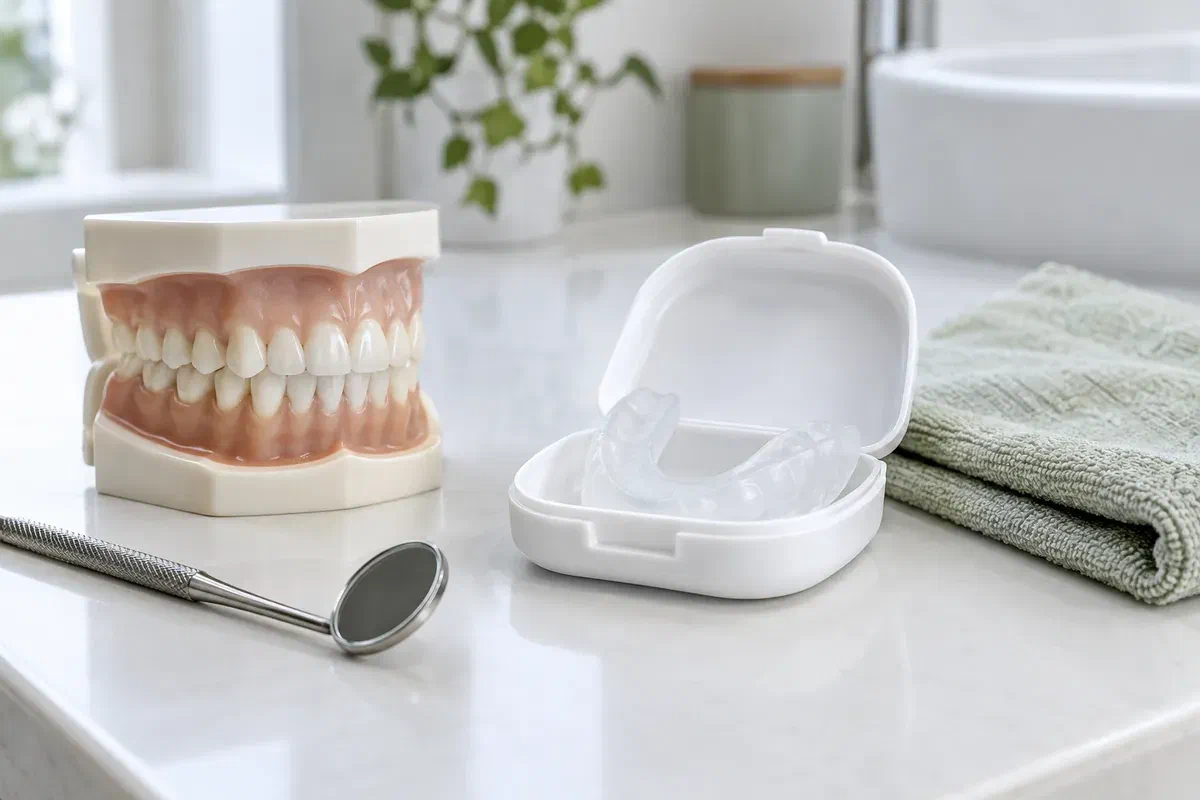
Illustrative dental model, mirror, and protective mouthguard in a case
Questions to ask whoever was there

What hit the tooth, when, and what changed?

These answers help the dentist judge what to examine. Meanwhile, resist checking the tooth by rocking it or having your child chomp down to test it.

A broken corner or missing piece

Estimate how much of the tooth is gone and whether it stings with cold, touch or chewing. If the caregiver picked up a fragment, keep it damp in milk or water and bring it in. Home glue and nail files are not safe fixes for a jagged edge.

A tooth sitting in a new position

Tell us if a tooth looks pushed in, sticks out, leans or no longer lines up, or if the bite feels wrong to your child. Any of these deserves a timely examination. Avoid nudging the tooth back yourself, and do not assume a baby tooth was simply due to come out.

Mouth injuries and anything still missing

Describe cut lips, a swollen gum, bleeding and any tooth or piece nobody could find. Share any other symptoms the caregiver noticed, especially ones that suggest a head injury. With that information, the clinician can decide what to look at and whether a doctor should also be involved.

A knocked-out adult tooth needs first-aid guidance and dental care straight away. Pick it up by the chewing end, never the root, and keep it in milk if it cannot be put back safely. Do not ask a young child to hold the tooth in their mouth.

Beyond the part that shows

Every layer of the tooth can take the hit.

A single knock can damage the outer tooth, the root, the pulp at its centre and the ligament that anchors it, sometimes all together. The dentist may need to think about each one. Restoring the front surface tells you nothing about whether the hidden structures are healing.

How old the tooth is matters as well. Treatment for a baby tooth and for a young adult tooth with a still-developing root can differ quite a bit. It is fair to ask, at the first appointment, which tooth was affected, what has been established and what is still unclear.

Patient information: IADT and AAPD — fractures and luxations of permanent teeth

Treatment shaped by the findings

Care may involve observation, a repair, a splint to hold the tooth or other steps, depending on the examination. Ask what each part of the plan is meant to do. One measure, such as a filling, may handle only one aspect of the injury.

Notes that later visits can rely on

What the dentist records at the start helps make sense of future checks. Mention if the same teeth were hurt before, even years ago. Ask what will be compared next time and which changes would prompt more testing or care.

Honesty about the unknowns

The long-term outcome is not always clear at first. Ask which signs would be good news and which complications the team is watching for. Practical follow-up guidance helps more than a reassurance that the tooth will never need anything again.

What the appointment involves

Four steps from the first question to the next review.

Urgency and order depend on the injury. For a fresh injury, call the clinic directly; a standard online request is not the right route.

  1. Collect the account of the injury

    Tell the dentist when and where it happened, what your child hit, what first aid was given and whether a doctor has seen them. Mention missing teeth or pieces and any bite change. If the caregiver is not coming, bring their written notes along with your child’s health and medicine details.

  2. Check the tooth and the teeth around it

    The teeth and gums are examined, and the dentist explains which images or tests may help. Nearby teeth might need attention too. Ask what can be known today and whether some findings may need to be checked again as the tooth settles.

  3. Decide on and carry out the needed care

    Options may include a repair, a splint, care for the pulp, a period of watching or something else suitable. Let the team know what helps your child stay comfortable and what worries them. If another setting or a referral is advised, ask why and how urgent it is.

  4. Confirm home care and the review dates

    Go over what was done and any limits on food, play or cleaning. Find out when to return and which symptoms warrant an earlier call. Trauma follow-up may carry on after the tooth seems completely back to normal.

Looking after the tooth at home

Keep it clean, keep it protected, keep the dates.

Home advice follows the type of injury and treatment. A minor repair may come with different guidance from a tooth that was moved, splinted or replanted.

Stick to the eating and cleaning plan

Find out which foods and biting to avoid, and for how long. Clean the area as you were shown. If a sore mouth or a splint gets in the way of brushing, call for advice instead of skipping it, and share the plan with anyone else who looks after your child.

Tell us about changes you notice

Call if pain increases, the gum swells, a small bump appears, the bite shifts or the tooth darkens. Colour on its own does not tell you how the tooth is doing. Its meaning depends on the tooth, the symptoms, the examination and the injury.

Ask before returning to sport

Check when the injured area can handle your child’s usual activities and whether a mouthguard is a good idea. An existing guard may not fit after treatment or tooth movement, so have it checked. Protection lowers the chance of injury but does not rule it out.

Patient information: IADT — broken teeth and preserving a fragment

How treatment choices differ

Rebuild it, watch it, or treat it further.

The fit depends on the kind of tooth, the injury, development and the examination. Ask how the plan for today ties in with care in the months ahead.

When broken structure can be replaced

A repair followed by checks

In some cases the original piece can be bonded back on, or the tooth rebuilt with a suitable filling material. The dentist will explain the limits and how to protect it. A neat repair does not stand in for assessing the pulp and supporting tissues when they were affected.

When position and healing are the concern

A watching period or a splint

Some injuries need a set observation plan, while others need the tooth repositioned or held steady with a splint. The diagnosis decides which and how often to review. Watching has clear instructions; it is not waiting for pain to show up.

When the injury reaches deeper

More involved care or a referral

Treatment of the pulp, removing the tooth or other care may be raised when appropriate. For an injured baby tooth, the adult tooth developing below is part of the thinking. Ask why extra care is advised and whether a clinician with particular expertise should see your child.

Patient information: IADT and AAPD — injuries to primary teeth

Common questions from Old Milton households

Short answers to the questions parents ask most.

Write down questions about the injury, the repair and what could change. Some long-term answers only become clear over several visits.

(905) 876-4488
I was not there when my child got hurt. What should I find out before calling?
Ask the caregiver roughly what time it happened, what your child hit, whether any tooth or piece came out and what first aid was given. Any sign of a head injury is important too. Even partial information is useful, so do not delay the call to gather every detail.
Does a small chip mean only a small injury?
Not necessarily. The force that chipped the tooth may also have reached the root, the pulp or the teeth beside it. The dentist can explain what needs examining and whether imaging or follow-up checks would be sensible.
We found the broken piece but it is tiny. Is it worth keeping?
Keep it if you have it. Store it in milk or water and bring it in, and the dentist will decide whether it can be used. Do not hold up urgent care hunting for it, and do not try to stick it back on.
Can my child go to school the day after a tooth injury?
Many children can, but it depends on the injury, the treatment and how your child feels. Ask the dentist about food, sports and activity limits, and let the school know about any restrictions or a splint.
Why is a baby-tooth injury followed up if the tooth will fall out anyway?
The adult tooth forms close to the baby tooth’s root, and some injuries can affect it depending on timing. Follow-up lets the dentist look for changes. A knocked-out baby tooth is still never replanted.
Is it okay to cancel the review if the tooth looks and feels fine?
It is best to keep the review unless the dentist changes the plan. Some problems appear later without pain, and the visit looks at healing and development, not just appearance.
Child tooth injury care near Old Milton

Bring us the details, and we will work out the next step together.

Call our Bronte Street practice after a dental injury so we can talk through availability and what your child needs next. If the injury is recent and urgent and we cannot see you, please use an available emergency dental provider.

An adult tooth that has been knocked out needs care at once. Serious head injury, trouble breathing or swallowing, or bleeding that cannot be controlled needs emergency medical attention.

Visit Milton Dental Clinic
Unit 1, 342 Bronte St. S, Milton, ON L9T 5B7
Get directions Clinic hours
Monday–Thursday
11am–7pm
Friday–Sunday
By appointment only

Areas we serve

  • Milton
  • Oakville
  • Mississauga
  • Georgetown
  • Halton Hills
  • Acton
  • Campbellville
  • Brampton
  • Burlington
  • Puslinch
  • Rockwood
  • Erin
  • Caledon
  • Etobicoke
  • Old Milton
  • Bronte Meadows
  • Timberlea
  • Dorset Park
  • Dempsey
  • Clarke
  • Beaty
  • Coates
  • Harrison
  • Scott
  • Willmott
  • Ford
  • Bowes
  • Cobden
  • Walker
  • Mountain View
  • Milton Heights
  • Hawthorne Village
  • Valley View
  • Fallingbrook
  • Nassagaweya
  • Trafalgar
  • Esquesing
  • Nelson
  • Brookville
  • Moffat
  • Glen Williams
  • Norval
  • Limehouse
  • Stewarttown
  • Ashgrove
  • Hornby
  • Silver Creek
  • Speyside
  • Scotch Block
  • North Oakville
  • River Oaks
  • Glen Abbey
  • West Oak Trails
  • Palermo
  • Bronte Creek
  • College Park
  • Joshua Creek
  • Uptown Core
  • Preserve
  • Iroquois Ridge
  • Lisgar
  • Meadowvale
  • Meadowvale Village
  • Churchill Meadows
  • Erin Mills
  • Central Erin Mills
  • Streetsville
  • East Credit
  • Creditview
  • Heartland
  • Sheridan
  • Mount Pleasant
  • Credit Valley
  • Huttonville
  • Churchville
  • Springbrook
  • Northwest Brampton
  • Bram West
  • Fletcher's Meadow
  • Fletcher's Creek South
  • Alton Village
  • Orchard
  • Millcroft
  • Headon Forest
  • Tansley
  • Brant Hills
  • Tyandaga
  • Kilbride
  • Lowville
  • Aberfoyle
  • Morriston
  • Arkell
  • Hillsburgh
  • Freelton
  • Carlisle
  • Waterdown
  • Flamborough
  • Mountsberg

How can we help?

Milton Dental Clinic

Have a question about your smile? Choose the option that works best for you.

For urgent dental concerns, please call.
Messages are reviewed during clinic hours.