

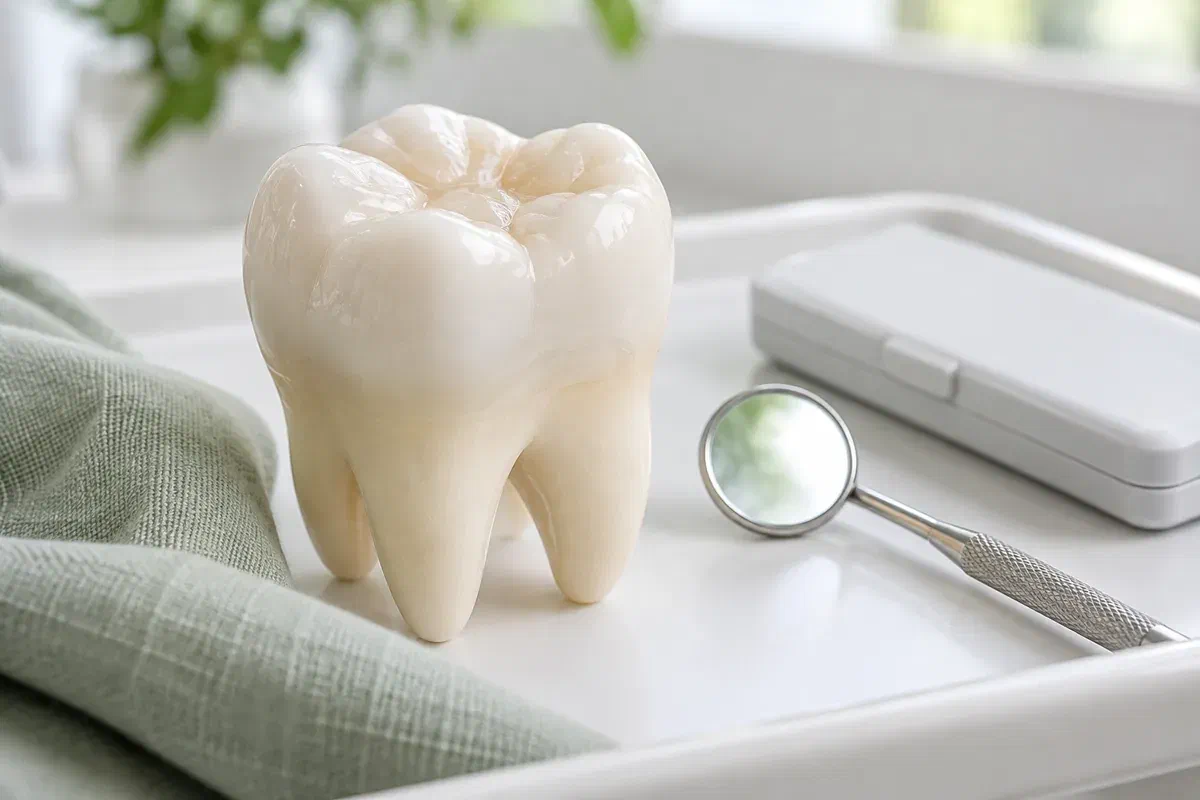
Illustrative child and parent discussing a tooth model with a dental clinician
Children’s Dentistry

Children’s Tooth-Coloured Fillings in Erin

For a child who reacts strongly to sounds, tastes or touch, a filling visit needs extra thought. If you are coming from Erin or Hillsburgh, we plan a tooth-coloured repair around those sensitivities, step by step.

Planning around sensitivities

Sounds, tastes and textures, planned for in advance.

The buzz of a handpiece, the taste of a material, a cool stream of air on a tooth: for most children these are minor details. For a child with sensory sensitivities, autism, anxiety or communication differences, they can be the whole appointment. Knowing ahead of time what tends to overwhelm your child lets the team plan rather than react.

None of this changes the clinical starting point. The dentist still needs to see where the damage is, how much sound tooth surrounds it, whether it is a primary or permanent tooth, and whether saliva can be kept away long enough for a tooth-coloured material to bond. Your child’s tolerance for isolation and time in the chair is part of that judgement.

Families travelling from Erin often prefer to prepare well so that each trip counts. Tell us what helps your child, what has gone wrong before, and how they communicate discomfort. Alongside the repair, we will discuss home routines that are realistic for your child’s sensory profile.

Plan a filling visit around your child’s needs
Illustrative opaque molar teaching model with a tooth-coloured repair
Information that helps us prepare

What does your child find hardest?

The dental problem and your child’s sensory needs both shape the visit. Be as specific as you can; small details often make the biggest difference.

The tooth you are worried about

Point out a dark spot, a broken edge or a place where food packs in. Some children with sensory differences resist brushing in certain areas, so mention those too. The dentist confirms the extent, and a tiny opening may hide more damage below.

Signs of pain your child shows

Children who communicate differently may show pain through behaviour, such as refusing food, chewing on one side, hitting their face or sleeping poorly. Describe what you have seen. Swelling or pain that seems constant may mean the pulp is involved, and a filling might not be enough.

Triggers and coping strategies

List sounds, tastes, smells, textures or positions your child finds difficult, plus what helps, such as headphones, weighted items or countdowns. Mention past responses to numbing. These details shape planning, and they directly affect how well the tooth can be isolated.

Behaviour changes that suggest increasing pain, a swollen face or a broken tooth need prompt attention. Phone us, and involve a doctor if your child seems unwell.

What a repair can offer

A smoother tooth that is easier to clean.

A direct filling replaces decayed or broken tooth and is shaped during the visit. Restoring a smooth surface can also remove a rough edge that bothers a sensitive tongue or catches food. A tooth-coloured appearance is a nice result, but suitability for the tooth and the situation comes first.

Tooth-coloured materials differ. Some, such as composite resin, need a very dry field and more time to place; others, like glass ionomer, are more tolerant of moisture but generally wear faster. For some children, this trade-off affects the choice. Ask the dentist what is proposed and why. No filling is guaranteed to last indefinitely.

Patient information: AAPD — pediatric restorative dentistry

Suited to the tooth and the child

The dentist looks at the size and position of the damage. If too much tooth is weakened, a crown or another restoration may give more support. When a child finds treatment very difficult, the plan may also reflect what can be done safely.

A surface that feels right

Children with sensory sensitivities may notice changes in shape or texture strongly. The filling is shaped and the bite checked. If your child seems bothered by the new surface afterwards, let us know so it can be reviewed.

A home routine that works for them

Talk with the team about brushing approaches, toothpaste flavours, fluoride and snack frequency that suit your child’s sensitivities. Practical advice is more useful than ideal advice. One repaired tooth does not protect the others.

A predictable sequence

Show, tell, then do.

Exact steps depend on the diagnosis and material. Agree on a clear stop signal that your child can use, whether that is a hand raise, a tap or a picture card.

  1. Assess and agree on a plan

    The dentist examines the tooth, using X-rays if they would add useful information. Discuss whether a filling is appropriate, alternatives and what could happen without treatment. Ask whether it is a primary tooth, and how your child’s needs affect the options.

  2. Introduce each sensation first

    If freezing is indicated, the team explains it and may show instruments before they are used. Isolation keeps the tooth dry, sometimes with a rubber dam. Watch for signs of distress, since many children don’t say when they are struggling.

  3. Prepare the tooth and place the filling

    Decay is removed with the method that matches the findings, and the chosen material goes in and hardens in its own way. Some need a long dry period, so your child’s comfort during the visit can influence which material is used.

  4. Check, then a calm finish

    Shape and bite are reviewed. Ask about eating, numbness and warning signs. Find out whether other teeth need care, how future visits can be adapted for your child, and when the filling will be checked again.

Settling afterwards

Numbness can feel strange. Plan for it.

Use the aftercare advice for the material and freezing as your guide. A numb lip may feel very odd to a sensory-sensitive child, and they may chew, rub or pick at it.

Help with the numb feeling

Offer distraction and calm activities until feeling returns, and hold off on food as advised. Gently stop biting, sucking or rubbing at numb tissue. If a sore forms or you need advice, call the clinic.

Watch for bite or pain changes

Report a tooth that touches first, discomfort when chewing, or sensitivity that is strong, keeps going or increases. For a child who does not describe pain, watch for refusing food or chewing on one side. Don’t encourage chewing through it.

Keep routines predictable

Return to the usual brushing and cleaning routine as soon as advised, with your help. Keep review visits, ideally with the same approach that worked. If a piece breaks or an edge feels rough, call us rather than fixing it.

Patient information: AAPD — local anaesthesia for pediatric dental patients

Options that may be discussed

A plan that fits the tooth and the child.

Ask how each option affects the length and number of appointments, expected durability and follow-up, and how well it suits your child.

When the tooth and the visit suit direct repair

Tooth-coloured direct filling

Composite or another white material may be chosen depending on the damage and how well the tooth can be isolated. Some materials are more forgiving of moisture. Your preference for white is welcome, though it can’t decide suitability by itself.

When more is needed than a filling

Crown, pulp care or specialist referral

Large decay or an affected pulp may need the tooth crowned, the pulp treated, or a different plan altogether. For some children with significant sensory or behavioural needs, referral to a pediatric specialist, including for sedation, may be discussed.

When filling right away is not recommended

Prevention with planned rechecks

Early changes may sometimes be managed with fluoride, adapted home care and monitoring. This should be a clear plan with a review date and achievable steps, not a cavity left unexplained.

Sensory and support questions

Headphones, rubber dams and visual schedules.

If your child uses pictures or a specific way of communicating, let us know. We will try to explain things in a way that works for them.

(905) 876-4488
Can my child bring headphones or a comfort item?
Ask the team when booking. Headphones, a favourite object or a familiar blanket can often help, as long as they don’t interfere with treatment or safety.
What is a rubber dam, and will my child mind it?
It is a thin sheet that isolates the tooth to keep it dry and catch debris. Some children find it reassuring because it keeps water and materials out of the mouth; others dislike the feeling. The team can show it beforehand.
Can you describe the steps so we can make a visual schedule?
Yes. Ask the team for a simple outline of the visit, such as sitting in the chair, counting teeth, freezing, cleaning the tooth and filling it. Preparing at home can make the sequence more predictable.
What if my child reacts strongly to tastes?
Let us know beforehand. Some materials and products have tastes or smells. Isolation can help keep them out of the mouth, and the team can explain each step so your child knows what to expect.
Can a filling visit be split into shorter sessions?
Sometimes. It depends on the treatment needed and what is clinically safe. Ask the dentist whether a staged approach is reasonable for your child, especially when making the trip from Erin.
Is a white filling harder to place for a child who moves a lot?
Some tooth-coloured materials need a dry field for longer. If a child finds it hard to stay still, the dentist may suggest a more moisture-tolerant material, a different plan or a referral. Ask about the options.
Children’s fillings, families from Erin

Tell us what helps. We’ll plan around it.

Arrange a planning appointment with our Bronte Street team to discuss your child’s tooth and their sensory needs. Share symptoms, triggers, coping strategies and past experiences so we can suggest a suitable next step.

Treatment depends on the exam and your child’s needs. Call promptly about pain or swelling.

Visit Milton Dental Clinic
Unit 1, 342 Bronte St. S, Milton, ON L9T 5B7
Get directions Clinic hours
Monday–Thursday
11am–7pm
Friday–Sunday
By appointment only

Areas we serve

  • Milton
  • Oakville
  • Mississauga
  • Georgetown
  • Halton Hills
  • Acton
  • Campbellville
  • Brampton
  • Burlington
  • Puslinch
  • Rockwood
  • Erin
  • Caledon
  • Etobicoke
  • Old Milton
  • Bronte Meadows
  • Timberlea
  • Dorset Park
  • Dempsey
  • Clarke
  • Beaty
  • Coates
  • Harrison
  • Scott
  • Willmott
  • Ford
  • Bowes
  • Cobden
  • Walker
  • Mountain View
  • Milton Heights
  • Hawthorne Village
  • Valley View
  • Fallingbrook
  • Nassagaweya
  • Trafalgar
  • Esquesing
  • Nelson
  • Brookville
  • Moffat
  • Glen Williams
  • Norval
  • Limehouse
  • Stewarttown
  • Ashgrove
  • Hornby
  • Silver Creek
  • Speyside
  • Scotch Block
  • North Oakville
  • River Oaks
  • Glen Abbey
  • West Oak Trails
  • Palermo
  • Bronte Creek
  • College Park
  • Joshua Creek
  • Uptown Core
  • Preserve
  • Iroquois Ridge
  • Lisgar
  • Meadowvale
  • Meadowvale Village
  • Churchill Meadows
  • Erin Mills
  • Central Erin Mills
  • Streetsville
  • East Credit
  • Creditview
  • Heartland
  • Sheridan
  • Mount Pleasant
  • Credit Valley
  • Huttonville
  • Churchville
  • Springbrook
  • Northwest Brampton
  • Bram West
  • Fletcher's Meadow
  • Fletcher's Creek South
  • Alton Village
  • Orchard
  • Millcroft
  • Headon Forest
  • Tansley
  • Brant Hills
  • Tyandaga
  • Kilbride
  • Lowville
  • Aberfoyle
  • Morriston
  • Arkell
  • Hillsburgh
  • Freelton
  • Carlisle
  • Waterdown
  • Flamborough
  • Mountsberg

How can we help?

Milton Dental Clinic

Have a question about your smile? Choose the option that works best for you.

For urgent dental concerns, please call.
Messages are reviewed during clinic hours.