

Illustrative child and parent learning about tooth alignment with a dental model
Children’s Dentistry

Early Orthodontic Assessment in Rockwood

Sometimes the question comes from your child: why do my teeth look like this? For kids travelling from Rockwood, an early orthodontic assessment explains, in words they can follow, how their adult teeth are arriving and whether anything needs watching, recording or a specialist’s view.

When your child is the one asking

Big new teeth in a small smile

Around the early school years, adult front teeth can look oversized, gappy or slightly crooked next to the baby teeth still in place. Children notice, and a comment from a classmate can turn it into a worry. Often what they are seeing is a normal stage, but it deserves a proper answer.

When a child from Rockwood comes in, we talk to them as well as to you. The dentist explains which teeth are new and which will still fall out, checks how much space is left and watches how the teeth come together. Then we describe what is ordinary for this age and what we would like to keep an eye on.

Coming in does not mean your child is about to get braces. Some findings are worth catching while they grow, and many settle or become clearer later. You and your child should both come away understanding why we suggest a particular timing and what the next visit will check.

Book a visit your child can ask questions at
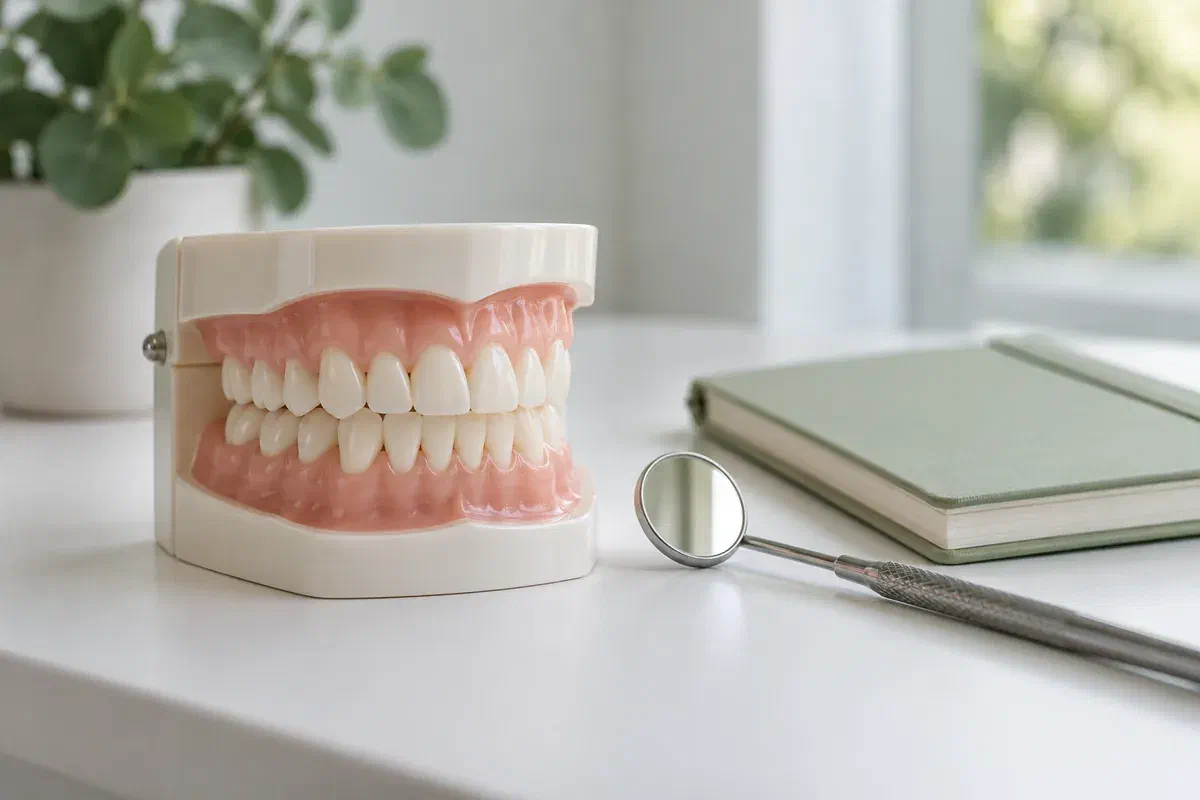
Illustrative upper and lower dental teaching model beside a mirror and notebook
Worth telling the dentist

What has your child noticed, and what have you?

Neither of you needs to name an orthodontic problem. Between your observations, the examination and records only where findings warrant them, the dentist can sort what simply needs time from what deserves a closer look.

Teeth that seem too big, too crowded or out of line

New adult teeth often look large at first. Still, mention any that are emerging in an unusual spot or a side that looks different. The dentist weighs the space available, the baby teeth still to be lost and the order teeth are arriving before drawing conclusions.

A bite that feels odd to your child

Children sometimes say their teeth feel wrong when they bite, or that one side touches first. Note any jaw shift on closing or difficulty with certain foods. The clinician can then judge whether the cause lies with the teeth, the jaw or something else.

Habits, bumps and early gaps

A thumb that still finds its way into the mouth, an old tumble that hit the teeth and baby teeth lost earlier than usual can each affect development. Share any of these. If you are concerned about snoring or breathing at night, mention that too, since a doctor may also need to look into it.

Toothache, swelling or a recent injury needs a different appointment from an orthodontic review. Let us know about those when you call so we can book your child appropriately.

Why it helps to look now

Reassurance for your child, reasons for you

Orthodontists in Canada, through their national association, recommend that children be checked by a specialist by about age seven. The intent is to spot developing issues early. It does not mean that most children of that age need treatment. Ask us how a dental review fits with that specialist assessment.

Some children are helped by care during growth; for many others, watching and deciding later is wiser. We should tell you honestly how far a general dental review can go and at what point a specialist becomes the better person to ask. Appearance alone never tells anyone what a child’s full treatment path will look like.

Patient information: Canadian Association of Orthodontists — assessment and treatment questions

An explanation your child can understand

Showing a child which teeth are baby teeth and which are here to stay can ease a lot of worry. The dentist can point out what really matters and what usually changes by itself as the smile fills in.

A purpose behind any follow-up

If we suggest waiting, we will say what we are waiting to see, whether a particular tooth, the spacing or the bite. Knowing that goal helps your child see it as a check-in rather than a cause for concern.

Time to talk about a referral at home

If an orthodontist’s opinion would help, find out what we plan to send them and whether recent records will do. A specialist can go deeper into the diagnosis, the timing and the alternatives. Discuss it as a family before agreeing to any appliance.

What your child will do

Simple steps, explained as we go

Prepare your child by telling them we will look, count and ask them to bite. Their questions matter, even if they differ from yours.

  1. A chat about history and what you have seen

    We ask about health, previous dental treatment, injuries, habits and roughly when baby teeth came out. Your child can tell us what they have noticed too. Bring any earlier orthodontic advice or records if you have them.

  2. A look at the teeth and how they fit

    Using a mirror and a light, the dentist counts teeth, looks at the gaps between them and sees how top and bottom line up. We will invite your child to bite down, open and close, and we describe what we are looking at in plain words.

  3. Deciding whether more information would help

    Sometimes the examination leaves a question only an image can answer, like where a hidden tooth is waiting. That is when we would suggest an X-ray, and not before. You can always ask what it will tell us and whether the orthodontist would rather take their own.

  4. A plan you both understand

    We explain the findings and why one timing fits better than another. If referral is advised, find out who arranges it and what to do meanwhile. If monitoring, note the interval and any changes that should bring you back sooner.

At home, until the next check

Help your child feel confident about a changing smile.

An assessment rarely brings home an appliance to care for. Follow any specific advice, and keep the usual brushing routine and dental visits going while their teeth develop.

Keep the next appointment

Note the date of the review or referral and its purpose. Should plans shift, phone us to move it instead of letting it slip. A tooth we are watching can only be followed if we see it again.

Make brushing new teeth a shared job

New molars and crowded areas are hard for young children to reach. Ask for tips, and keep helping in a way that suits their age. Taking good care of the teeth matters just as much as watching how they line up.

Talk about changes, but let us handle them

Let us know about chewing trouble, an unexpected lost tooth or anything you were asked to watch. Gently discourage your child from pushing teeth with fingers or tongue to straighten them, and avoid online kits. Moving teeth needs professional care.

Where things might go

Watching, a specialist visit or early care

Ask what each option aims to do now and what might come later. Starting early only makes sense when the timing has a clear reason.

When growth will make the picture clearer

Keeping an eye on things

Often the right move is to let a few more teeth come in, then look again. We will name the month or season for that check, what we hope to learn from it and the signs that would justify calling before then. Deciding to wait is still a decision made for a reason.

When diagnosis or timing needs a specialist

A visit with an orthodontist

Some questions are best answered by an orthodontist, who can examine the developing problem and describe the approaches they use. Going to see one is not the first day of braces. It is a chance for you and your child to hear the diagnosis, the options and what each would involve.

When a particular finding justifies acting now

Early treatment for one specific issue

A few findings may justify care before all adult teeth have arrived. The recommendation should explain its aim and its limits. Treating early does not guarantee that braces or other care will not be needed when your child is older.

Questions from parents and kids

Talking about teeth with your child

These answers are a starting point. Your child’s own examination decides what applies to them.

(905) 876-4488
Why do my child’s new front teeth look so big?
Adult teeth are larger than baby teeth, and they often arrive while the face and jaws are still growing. They can look oversized at first. The dentist can explain whether the size and spacing look typical for your child’s stage.
How can I prepare my child for an orthodontic assessment?
Tell them the dentist will look at their teeth, count them and ask them to bite together. Let them know we will explain each step before doing it. Encourage them to think of any questions they would like to ask.
My child is upset about a gap or crooked tooth. What should I say?
Reassure them that teeth change a lot at this age and that the dentist can explain what is happening. Hearing it from the clinician often helps. If the worry persists, mention it at the visit so we can talk it through together.
Does seeing an orthodontist by age seven mean starting treatment?
No. The suggestion of a check by seven is about identifying developing concerns. Many children simply need monitoring. Where earlier care is discussed, the reasons should be explained clearly to you and your child.
Is a dentist’s assessment the same as an orthodontist’s?
They overlap, but they are not identical. Our dentists look for early signs and help you decide what to do next. An orthodontist has gone on to years of further training focused on bites and tooth movement. Feel free to ask who is seeing your child and whether we think a specialist would add something.
Coming from Rockwood, can reviews be timed around school?
Let the team know your preferred times when booking. Where possible, we can suggest appointments that fit around school and may pair a monitoring check with your child’s routine visit.
Early bite checks for kids from Rockwood

Answers for you and your child

Contact our Bronte Street practice to arrange a review. Let us know what you and your child have noticed and any earlier advice, and we will explain the findings in plain language and let you know whether an orthodontist’s opinion would help.

Coming in for a look is not signing up for treatment. What happens next depends on what we find.

Visit Milton Dental Clinic
Unit 1, 342 Bronte St. S, Milton, ON L9T 5B7
Get directions Clinic hours
Monday–Thursday
11am–7pm
Friday–Sunday
By appointment only

Areas we serve

  • Milton
  • Oakville
  • Mississauga
  • Georgetown
  • Halton Hills
  • Acton
  • Campbellville
  • Brampton
  • Burlington
  • Puslinch
  • Rockwood
  • Erin
  • Caledon
  • Etobicoke
  • Old Milton
  • Bronte Meadows
  • Timberlea
  • Dorset Park
  • Dempsey
  • Clarke
  • Beaty
  • Coates
  • Harrison
  • Scott
  • Willmott
  • Ford
  • Bowes
  • Cobden
  • Walker
  • Mountain View
  • Milton Heights
  • Hawthorne Village
  • Valley View
  • Fallingbrook
  • Nassagaweya
  • Trafalgar
  • Esquesing
  • Nelson
  • Brookville
  • Moffat
  • Glen Williams
  • Norval
  • Limehouse
  • Stewarttown
  • Ashgrove
  • Hornby
  • Silver Creek
  • Speyside
  • Scotch Block
  • North Oakville
  • River Oaks
  • Glen Abbey
  • West Oak Trails
  • Palermo
  • Bronte Creek
  • College Park
  • Joshua Creek
  • Uptown Core
  • Preserve
  • Iroquois Ridge
  • Lisgar
  • Meadowvale
  • Meadowvale Village
  • Churchill Meadows
  • Erin Mills
  • Central Erin Mills
  • Streetsville
  • East Credit
  • Creditview
  • Heartland
  • Sheridan
  • Mount Pleasant
  • Credit Valley
  • Huttonville
  • Churchville
  • Springbrook
  • Northwest Brampton
  • Bram West
  • Fletcher's Meadow
  • Fletcher's Creek South
  • Alton Village
  • Orchard
  • Millcroft
  • Headon Forest
  • Tansley
  • Brant Hills
  • Tyandaga
  • Kilbride
  • Lowville
  • Aberfoyle
  • Morriston
  • Arkell
  • Hillsburgh
  • Freelton
  • Carlisle
  • Waterdown
  • Flamborough
  • Mountsberg

How can we help?

Milton Dental Clinic

Have a question about your smile? Choose the option that works best for you.

For urgent dental concerns, please call.
Messages are reviewed during clinic hours.