
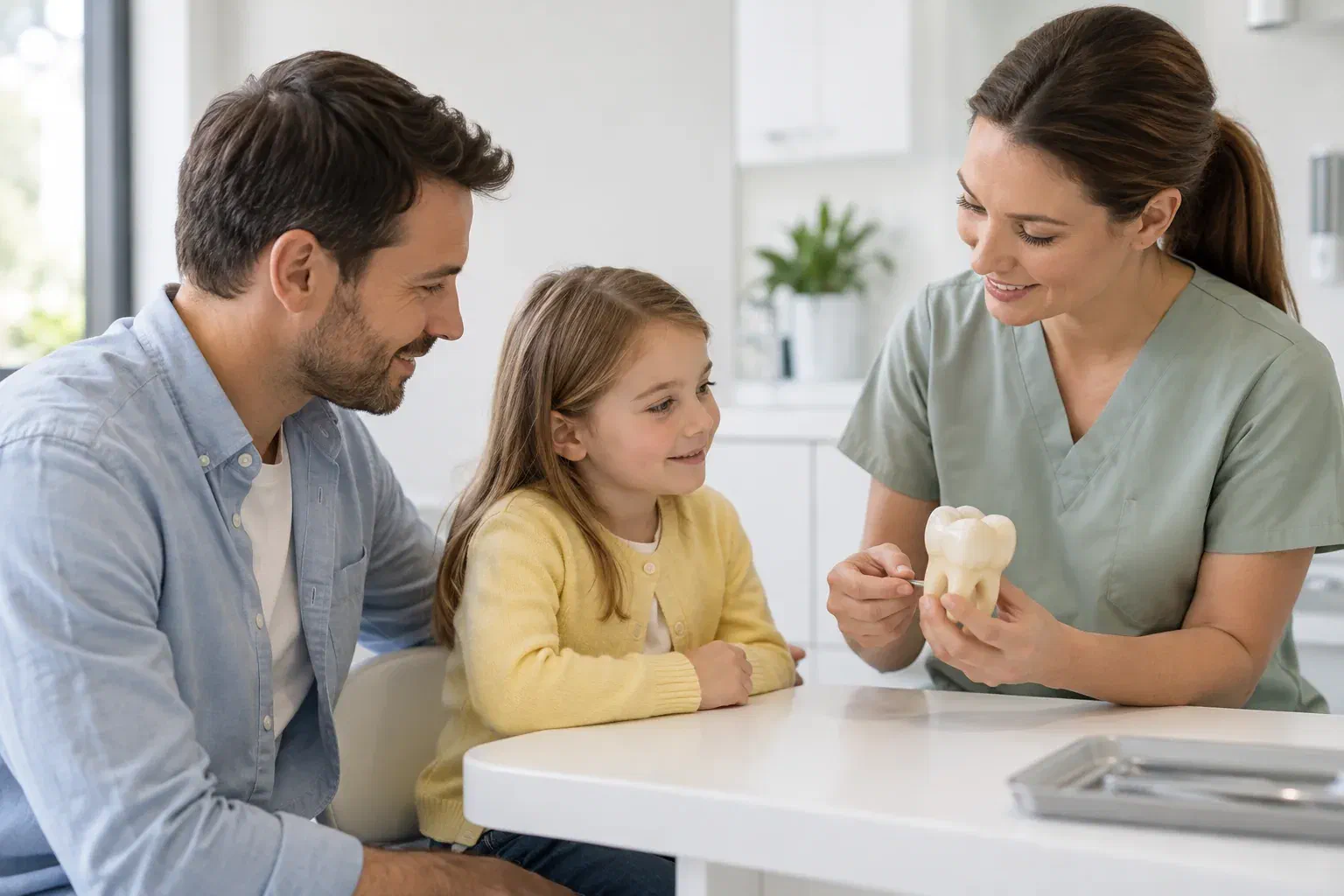
Illustrative child and father discussing a tooth model with a dental clinician
Children’s Dentistry

Pediatric Pulpotomy in Oakville

Were you told your child’s baby molar needs a pulpotomy and want a second look? Oakville parents can use this page to understand the diagnosis, the alternatives, and the restoration and checkups that should come with the treatment.

Weighing a recommendation

Is a pulpotomy really the right call for this tooth?

It is reasonable to want a clear answer before agreeing to work inside your child’s tooth. Here is the core idea. When decay reaches the pulp of a primary tooth, a pulpotomy takes out the inflamed tissue in the crown and tries to keep the root pulp alive and healthy. It sits between a simple filling and a treatment that empties the root canals.

Suitability is a judgment, not a formula. Two cavities that look alike on an X-ray can behave differently. The dentist weighs how the tooth has felt, clinical signs, imaging, whether the tooth can be rebuilt soundly, and what the pulp looks like once it is exposed. Any one of those can lead to another recommendation.

For families coming from Oakville with a plan already in hand, we can review the earlier advice alongside a fresh examination. Expect an explanation of why keeping this baby tooth is or is not worthwhile, how treatment would be arranged around your child, and how the tooth would be sealed and checked over time.

Request a review of the plan
Illustrative solid primary molar model beside a dental mirror and gauze
Clues the dentist relies on

What has the tooth been doing lately?

A good history matters as much as the images. Tell the team everything your child has mentioned, even if the tooth is calm today; one symptom or snapshot cannot prove a pulpotomy is suitable.

Pain that starts by itself

Toothache that appears unprovoked, wakes your child at night, or keeps going after food and drink is worth describing in detail. Note how long it lasts and what helps. This kind of pain may suggest the pulp is more affected than a pulpotomy can address.

Gum swelling, drainage or early looseness

A small swelling beside the tooth, any discharge, puffiness of the face, or a tooth loosening ahead of schedule all need examining. They may indicate infection that calls for a different approach. A swelling that comes and goes still needs attention.

Restorability and time left in the mouth

A baby molar may have years of chewing and space-holding ahead, or it may be close to falling out. The dentist considers whether enough tooth remains to restore reliably and how that timing affects the choice. Treatment should have a reasonable clinical basis.

Call us quickly if pain or swelling is getting worse. Problems breathing or swallowing, swelling that spreads across the face, or a child who seems very sick need emergency medical attention.

What the treatment is meant to do

Remove the damaged crown pulp so healthy roots can carry on

In a primary tooth that is a good match, the aim is for the root pulp to stay healthy and for the tooth to keep working until it is naturally replaced. That is what makes it a vital-pulp treatment. It is not a way to rescue a tooth already infected through its roots.

Outcomes rest on diagnosis, the conditions during treatment, the material used, the restoration and the follow-up. When comparing opinions, ask each dentist what findings they are relying on and what would change their advice. A good result on the day still calls for checks later.

Patient information: AAPD — vital pulp therapies in primary teeth

A reason specific to your child

Ask how this baby tooth contributes to chewing and spacing at your child’s stage. Compare treatment with removal, including whether an early loss would need a space assessment. Advice should be tailored to this tooth, not based on a general rule about primary teeth.

A restoration that closes the tooth properly

Sealing the tooth well after pulp treatment helps keep bacteria and fluids out. A crown may be advised when decay is extensive. Ask how the restoration was chosen, how it connects with the pulp step, and whether both can happen in one sitting.

A written plan for future checks

Scheduled clinical examinations and X-rays show how the treated tooth and nearby bone are responding. You should know in advance which symptoms mean calling early. Reviews should be part of the original plan, not an afterthought.

How the visit usually runs

What happens between the first check and the final seal?

The plan adapts to your child and to the tooth. Ask what is expected and how you would be consulted if the findings changed partway through.

  1. Review findings and every reasonable option

    The dentist goes over history, examination and images, including any you bring from another office. You hear why a pulpotomy is suggested, what restoration would follow, and what the alternatives are. You also discuss comfort support and whether referral or another setting would be better.

  2. Numb the tooth and protect the area

    Local anaesthetic is given and the tooth is isolated to keep it clean and dry. The team tells your child what they may feel and agrees on a signal for stopping. Children should feel free to report pain rather than putting on a brave face.

  3. Treat the crown pulp only if it still fits

    After the pulp in the crown is removed, the dentist inspects the tissue below. If it does not support the planned procedure, the approach may change. If it does, a suitable material is placed to protect the living root pulp.

  4. Restore the tooth and explain next steps

    A proper restoration goes in after the pulp work. Ask if it is final or if another visit is needed. Before you leave, you will go over eating, numbness, pain relief and the schedule for checking the tooth.

Back home in Oakville

How do you protect the tooth over the coming weeks?

Follow the specific instructions for your child’s treatment and any anaesthetic or other support used. Ask for anything you need to share with a second caregiver in writing.

Guard against bitten lips and cheeks

Numbness can lead children to chew their lip, cheek or tongue without noticing. Supervise and follow the food advice until feeling comes back. Use pain medicine only as the clinician recommends for your child’s age, weight and health.

Notice how eating feels

When your child returns to regular food, ask about the tooth. Report a bite that feels high or uncomfortable, pain that persists or worsens, or a restoration that cracks or loosens. Your child should not be expected to tolerate real discomfort.

Keep up cleaning and scheduled reviews

Continue helping with brushing around the restoration. A treated tooth can still develop problems, and other teeth still need protection. Keep each planned examination and X-ray appointment, even if your child is comfortable.

Patient information: AAPD — local anaesthesia in pediatric dental care

Comparing treatment options

Which approach fits the pulp you actually have?

For each choice, ask what it would accomplish and why it is or is not right for this tooth. Doing less is not automatically enough, and doing more is not automatically better.

If living tissue can sensibly be kept

Vital-pulp treatment

Depending on what is found, indirect pulp treatment or a pulpotomy may be proposed. These are different procedures with different indications. Ask why the method chosen suits the tooth’s condition, rather than focusing on the label.

If the root pulp cannot be preserved

Pulpectomy or another pulp procedure

A restorable baby tooth with more widespread pulp disease may need treatment through its root canals. That is a separate diagnosis and procedure. The condition of the roots, among other findings, decides whether it is reasonable.

If keeping the tooth is not appropriate

Extraction with development in mind

Removal may be advised when a tooth cannot be restored well or its outlook is poor. Ask how the space will be handled and whether spacing or the adult tooth’s eruption should be watched. Complex needs may benefit from referral.

Second-opinion questions

Clear answers before you say yes

Similar-sounding procedures are easy to confuse. Ask the dentist to explain the advice using your child’s actual tooth, images and history.

(905) 876-4488
Is it reasonable to ask for a second opinion on a pulpotomy?
Yes. Asking for another assessment is a normal part of making an informed decision. Bring any X-rays and notes you have. If your child has active pain or swelling, though, do not delay care while you wait for an appointment.
Why might two dentists recommend different treatments for the same tooth?
Findings can change over time, images may be read differently, and each clinician weighs restorability and timing in their own way. Ask both what evidence they are relying on. A clear explanation should help you understand the reasoning behind each view.
Should I bring X-rays from my child’s previous dental office?
Yes, if you can. Recent images and notes help the dentist see how the tooth has changed and may reduce the need to repeat X-rays. The clinic can explain how to request records from another office.
Does a pulpotomy keep any living tissue in the tooth?
That is the aim. The inflamed pulp in the crown is removed, while healthy pulp in the roots is preserved where conditions allow. If the root pulp is not healthy enough, a different procedure such as a pulpectomy, or removal, may be discussed instead.
Do X-ray checkups still matter if the tooth never hurts again?
Yes. Some problems after pulp treatment show up on images before they cause symptoms. Follow-up examinations and radiographs help the dentist judge whether the treatment is holding. Ask how often they are recommended for your child’s tooth.
Can a pulpotomy be done on a permanent molar the same way?
Permanent teeth, especially young ones with roots still forming, need their own assessment and planning. This page is about baby teeth. Ask which tooth is affected and whether a pediatric specialist or endodontist should be involved.
Oakville families welcome

Get a second look at the plan

Reach our Bronte Street practice in Milton to book an assessment or to review a pulpotomy that another office suggested. Bring the previous advice and any images, describe your child’s symptoms, and we will explain what we find and the options.

Care depends on diagnosis and whether the tooth can be restored. For current pain or swelling, please call rather than waiting for an online reply.

Visit Milton Dental Clinic
Unit 1, 342 Bronte St. S, Milton, ON L9T 5B7
Get directions Clinic hours
Monday–Thursday
11am–7pm
Friday–Sunday
By appointment only

Areas we serve

  • Milton
  • Oakville
  • Mississauga
  • Georgetown
  • Halton Hills
  • Acton
  • Campbellville
  • Brampton
  • Burlington
  • Puslinch
  • Rockwood
  • Erin
  • Caledon
  • Etobicoke
  • Old Milton
  • Bronte Meadows
  • Timberlea
  • Dorset Park
  • Dempsey
  • Clarke
  • Beaty
  • Coates
  • Harrison
  • Scott
  • Willmott
  • Ford
  • Bowes
  • Cobden
  • Walker
  • Mountain View
  • Milton Heights
  • Hawthorne Village
  • Valley View
  • Fallingbrook
  • Nassagaweya
  • Trafalgar
  • Esquesing
  • Nelson
  • Brookville
  • Moffat
  • Glen Williams
  • Norval
  • Limehouse
  • Stewarttown
  • Ashgrove
  • Hornby
  • Silver Creek
  • Speyside
  • Scotch Block
  • North Oakville
  • River Oaks
  • Glen Abbey
  • West Oak Trails
  • Palermo
  • Bronte Creek
  • College Park
  • Joshua Creek
  • Uptown Core
  • Preserve
  • Iroquois Ridge
  • Lisgar
  • Meadowvale
  • Meadowvale Village
  • Churchill Meadows
  • Erin Mills
  • Central Erin Mills
  • Streetsville
  • East Credit
  • Creditview
  • Heartland
  • Sheridan
  • Mount Pleasant
  • Credit Valley
  • Huttonville
  • Churchville
  • Springbrook
  • Northwest Brampton
  • Bram West
  • Fletcher's Meadow
  • Fletcher's Creek South
  • Alton Village
  • Orchard
  • Millcroft
  • Headon Forest
  • Tansley
  • Brant Hills
  • Tyandaga
  • Kilbride
  • Lowville
  • Aberfoyle
  • Morriston
  • Arkell
  • Hillsburgh
  • Freelton
  • Carlisle
  • Waterdown
  • Flamborough
  • Mountsberg

How can we help?

Milton Dental Clinic

Have a question about your smile? Choose the option that works best for you.

For urgent dental concerns, please call.
Messages are reviewed during clinic hours.