

Illustrative child and parent discussing a silver-crowned tooth teaching model
Children’s Dentistry

Pediatric Stainless Steel Crowns in Acton

“My tooth feels tall.” Many children say something like it the evening a crown goes on. For families in Acton, this guide covers why a stainless steel crown may be advised for a baby molar and what the first days of eating and brushing are like.

Acton · life with a new crown

Dinner tonight may feel a little different.

Children notice changes in their mouths quickly. A back tooth that suddenly has a smooth metal cap can feel odd against the tongue, and the bite may seem uneven at first. Knowing what to expect before the appointment makes that first meal much less worrying for everyone.

So what is going on that tooth? A pediatric stainless steel crown is a pre-made metal cover in a set size. The one chosen is fitted snugly over all of the visible part of a primary molar, leaving it silver. Dentists suggest it when a baby back tooth has lost too much structure to a cavity or fracture for a filling to last, or after the pulp has been treated.

Before agreeing, ask what led to the recommendation, how much of the tooth is still healthy and which other repairs were considered. Ask too what your child is likely to feel afterward, since that depends partly on the technique used. Your child deserves a chance to ask their own questions about the visit.

Ask what to expect after a crown
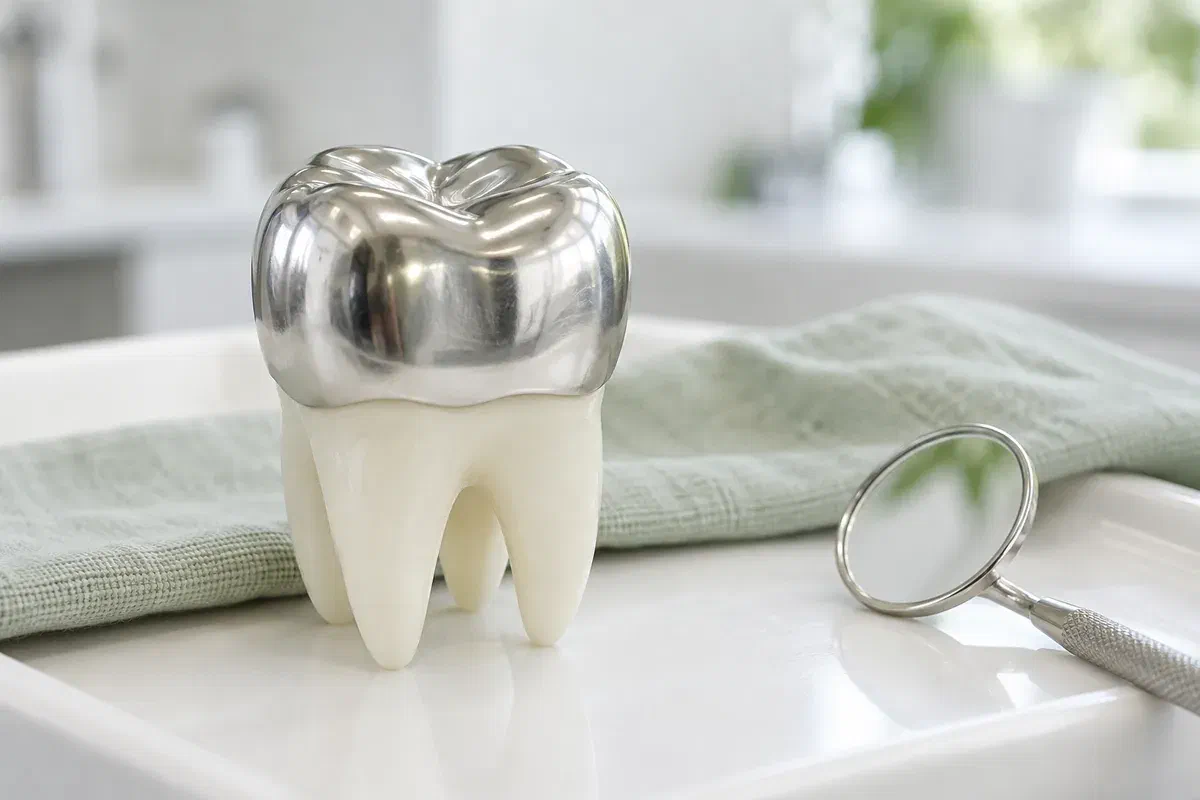
Illustrative molar teaching model with a smooth stainless steel crown
Why a crown might be on the table

Signs a baby molar needs full coverage

Whether a tooth needs a crown or a smaller repair depends on the extent of damage, the surfaces involved and the state of the nerve. Mention symptoms and earlier work so the assessment is complete.

Big cavities, broken edges or failed fillings

A molar decayed on several surfaces may not have enough sound tooth left to hold a filling. Point out any previous repair that cracked or fell out. The dentist can then say whether covering the tooth would hold up better.

Nerve treatment needing a protective top

After a pulpotomy or pulpectomy, the inside of the tooth has been dealt with, but the outer part still needs restoring. Ask whether a crown is planned for that. A tooth that feels fine now can still be at risk if the final step is skipped.

Allergies, sensitivities and how it will look

Tell the clinician about any reaction to nickel or other metals. Mention if your child is sensitive to textures, tastes or the feeling of new things in the mouth, and whether a silver tooth concerns them. Those details shape the approach and material.

Swelling, a gum bump or pain that will not settle can point to a problem deeper in the tooth, one a cap on top would not reach. Mention these when you book so enough time is set aside to investigate.

What coverage achieves

Chewing on a tooth that is held together

Encasing the top and sides of a weakened molar lets the tooth take chewing forces as a single unit. That is the main reason dentists consider a crown for baby teeth with extensive decay, fragile walls or recent nerve treatment. The recommendation should rest on a diagnosis.

It is intended to see the tooth through until it falls out naturally. Along the way, crowns can come loose or wear, and the tooth inside can still develop trouble. Good daily cleaning, prevention and regular reviews matter just as much afterward, and the first few weeks are a good time to build a brushing habit that reaches the back of the mouth.

Patient information: AAPD — restorative dentistry for children

A tooth your child can chew on

Ask how the pattern of damage led to this advice. A very large filling across thin walls may not withstand chewing as well. The reasoning should come from the tooth’s structure and the work it does at mealtimes.

Space saved for the next tooth

A baby molar that stays in place can help guide the adult tooth that replaces it. When this tooth is expected to be lost matters. Ask whether the developing permanent tooth changes the recommended treatment.

Part of a wider care routine

If other teeth need work, ask how the crown fits into the order of treatment and how many appointments to expect. Bring home prevention advice too, so care carries on for every tooth, not just the crowned one.

On the day of treatment

Four parts of a crown appointment

A preformed metal crown can be placed in different ways, and the method affects how the bite feels afterward. Ask which technique is planned and why.

  1. Confirm the diagnosis

    Your child’s symptoms are reviewed, the tooth is looked at closely and X-rays are taken if there is a clinical reason. The dentist explains whether the pulp needs treating and whether the molar is restorable. This is the time to ask about alternatives, looks, allergies and comfort.

  2. Prepare, or not, depending on technique

    Conventionally, the tooth is numbed, decay is removed and the shape is adjusted so the crown fits. With the Hall technique, which suits only selected primary molars, the crown is seated without that preparation. The dentist decides based on the tooth’s condition.

  3. Seat and cement

    A preformed crown of suitable size is tried on and its fit checked, then it is cemented into place. Precise steps depend on the method. Agree on a way your child can ask to pause, and the team can tell them what they will feel.

  4. Check how the teeth meet

    Before leaving, ask how your child’s bite may feel over the following days and what would be a reason to call. Confirm advice about numbness and the next review, and how any other planned treatment will be scheduled.

The first few days

Eating, brushing and getting used to it

Advice varies with the method and whether freezing was used. If your child will be with a sitter or at a relative’s after the visit, send the instructions along.

Meals while numb, and soon after

Wait until the clinician says it is fine to eat, and start with softer foods if advised. A numb lip or cheek is easy to chew by accident, so keep an eye on your child. Ask which pain relief suits them; strong or worsening pain should be reported.

Toothbrush on the crown and the gum

Food and plaque still collect at the crown’s edge and between nearby teeth. Brush that area every day, helping as much as your child needs for their age, and floss as you were shown. Tell us if food keeps getting caught in one place.

Signs the crown needs a look

Phone us if the crown moves, falls out or looks worn. If it comes out, keep it in a closed container; do not glue it or put it back, and keep it out of your child’s mouth. Continue regular reviews even if all seems fine.

Patient information: Guy’s and St Thomas’ — stainless steel crowns for children

Comparing what could be done

Different repairs, different first weeks

Every suitable repair has its own preparation, look, follow-up and drawbacks, and each may feel different in the days after. Ask the dentist to lay those out side by side. A tooth-coloured result is not always realistic for a badly damaged molar.

When the whole tooth needs covering

Stainless steel crown

May be recommended for a primary molar with significant damage or one that has had pulp treatment. Expect to hear how it will be placed and whether material concerns apply. It is cemented to stay, not a cap that is removed for eating.

When another restoration suits

A filling or a different crown

A smaller defect might be suitable for a direct filling, and some cases allow another crown material. How the tooth looks, how much remains, what placement involves and your child’s needs all factor in. Ask which options are actually possible.

When a crown would not tackle the cause

Treating inside the tooth, or extracting it

If the nerve is involved, internal treatment may be needed before restoring the tooth. Where too little is left to rebuild, taking the tooth out may be the sensible course. Ask how the diagnosis steers the decision; an early extraction can raise its own questions about keeping room open.

After-crown questions

Getting used to a silver tooth

Most questions in the first week are about eating, brushing and that unfamiliar feeling. Here are some starting answers.

(905) 876-4488
Why does my child say the crown feels too high?
With some methods, particularly the Hall technique, the bite can feel raised at first. Ask the dentist what to expect for your child. Call if eating is difficult, pain is significant or the feeling does not settle as described.
What foods are best on the first day after a crown?
Follow the dentist’s advice. Soft foods are often easier while your child gets used to the new feel, and waiting until any numbness has gone helps prevent accidental biting.
Is it normal for the gum around the crown to look a little red?
Mild tenderness at the gum edge can happen, but ask the dentist what is expected. Report swelling, bleeding that continues, pain that worsens or anything that does not improve.
Should my child avoid chewing gum or toffee with a crown?
Very sticky foods can pull at restorations and feed decay on other teeth. Ask the dentist for advice suited to your child, and keep such treats occasional.
Can my child play sports after getting a crown?
Usually, once numbness has worn off and your child feels comfortable. Ask whether a mouthguard is recommended for their activities, and call about any knock to the crowned tooth.
How do we fit follow-up visits in from Acton?
Ask when booking whether reviews can be coordinated with other family appointments. Keeping up with checks matters, so plan them in a way that is realistic for your household.
Crown advice for Acton families

Know the first week before it begins.

Give our Bronte Street practice a call if your child has been offered a crown, or if a baby molar is crumbling or decayed and you are not sure what comes next. We will explain the findings, which repairs suit the tooth and what the days after treatment usually involve.

The material and technique depend on assessment. Tell us about pain, swelling or any metal allergy when you phone.

Visit Milton Dental Clinic
Unit 1, 342 Bronte St. S, Milton, ON L9T 5B7
Get directions Clinic hours
Monday–Thursday
11am–7pm
Friday–Sunday
By appointment only

Areas we serve

  • Milton
  • Oakville
  • Mississauga
  • Georgetown
  • Halton Hills
  • Acton
  • Campbellville
  • Brampton
  • Burlington
  • Puslinch
  • Rockwood
  • Erin
  • Caledon
  • Etobicoke
  • Old Milton
  • Bronte Meadows
  • Timberlea
  • Dorset Park
  • Dempsey
  • Clarke
  • Beaty
  • Coates
  • Harrison
  • Scott
  • Willmott
  • Ford
  • Bowes
  • Cobden
  • Walker
  • Mountain View
  • Milton Heights
  • Hawthorne Village
  • Valley View
  • Fallingbrook
  • Nassagaweya
  • Trafalgar
  • Esquesing
  • Nelson
  • Brookville
  • Moffat
  • Glen Williams
  • Norval
  • Limehouse
  • Stewarttown
  • Ashgrove
  • Hornby
  • Silver Creek
  • Speyside
  • Scotch Block
  • North Oakville
  • River Oaks
  • Glen Abbey
  • West Oak Trails
  • Palermo
  • Bronte Creek
  • College Park
  • Joshua Creek
  • Uptown Core
  • Preserve
  • Iroquois Ridge
  • Lisgar
  • Meadowvale
  • Meadowvale Village
  • Churchill Meadows
  • Erin Mills
  • Central Erin Mills
  • Streetsville
  • East Credit
  • Creditview
  • Heartland
  • Sheridan
  • Mount Pleasant
  • Credit Valley
  • Huttonville
  • Churchville
  • Springbrook
  • Northwest Brampton
  • Bram West
  • Fletcher's Meadow
  • Fletcher's Creek South
  • Alton Village
  • Orchard
  • Millcroft
  • Headon Forest
  • Tansley
  • Brant Hills
  • Tyandaga
  • Kilbride
  • Lowville
  • Aberfoyle
  • Morriston
  • Arkell
  • Hillsburgh
  • Freelton
  • Carlisle
  • Waterdown
  • Flamborough
  • Mountsberg

How can we help?

Milton Dental Clinic

Have a question about your smile? Choose the option that works best for you.

For urgent dental concerns, please call.
Messages are reviewed during clinic hours.