

Illustrative child and parent discussing a silver-crowned tooth teaching model
Children’s Dentistry

Pediatric Stainless Steel Crowns in Caledon

The same filling has come out again, and now a crown is being suggested. For parents from Caledon, Bolton and the surrounding villages, this page sets out what a stainless steel crown is, why it may hold where a filling has not, and what to ask first.

For children from Caledon

When a filling will not stay put

Third time this year, the same back tooth. The filling chips, food packs into the gap and your child starts chewing on the other side. At some point the dentist suggests a different approach, and a stainless steel crown comes up.

Here is what that means. These crowns are shop-made silver caps, manufactured in a run of sizes so one can be matched to a child’s back tooth. The chosen crown is cemented over every visible surface of the primary molar, so nothing is left exposed above the gum. It is typically suggested once a tooth has too little sound structure for a filling to hold, or after pulp treatment.

Before you agree, it is fair to want the reasoning. Ask why earlier repairs failed, how much of the tooth is still healthy and what other choices exist. Ask how follow-up will work for a family coming in from further afield. Your child may have questions of their own about the silver colour, and those deserve answers too.

Get a second look at a troublesome tooth
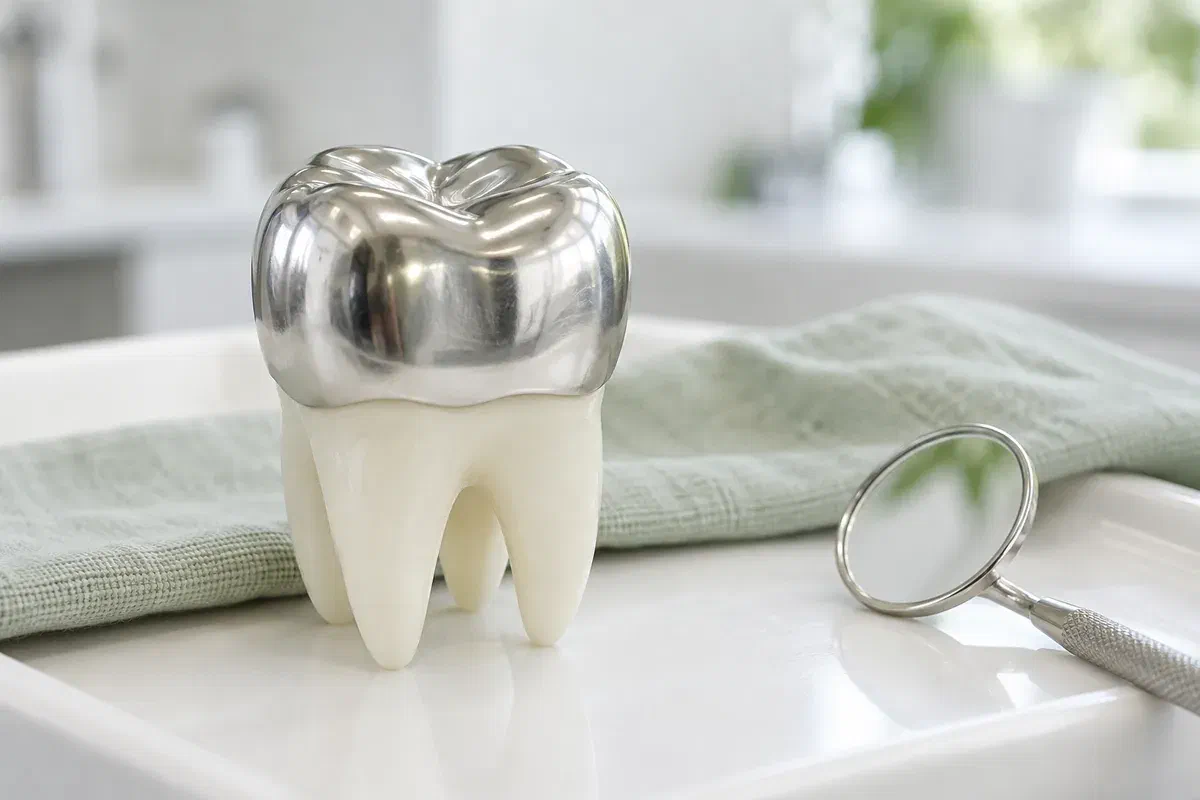
Illustrative molar teaching model with a smooth stainless steel crown
Why the advice has changed

Repeated repairs can leave less tooth to work with.

Each time decay is removed or a filling is redone, the tooth can lose a little more structure. The depth of decay, the sides involved and the health of the nerve all shape the next step, so share the history in full.

A filling that keeps chipping or falling out

When damage reaches several sides of a molar, a filling may have thin walls to bond to and little to keep it in place. Tell the dentist how often it has failed and how. That helps explain whether a cap over the whole tooth is the steadier option.

Nerve treatment underneath the repair

If the tooth has had a pulpotomy or pulpectomy, the restoration on top is a separate part of the job. Ask whether a crown is planned to finish it. An end to the ache is welcome, but the covering still matters.

Allergies, comfort and appearance

Mention any nickel or metal allergy and past reactions. Describe how your child handles dental visits, any sensory or communication needs, and whether a silver tooth would upset them. Those details shape the material and the plan.

Pain, gum swelling or a recurring pimple near the tooth may point to infection rather than just a lost filling. Describe these when booking so the right checks are planned.

What a crown does differently

Covering the tooth instead of patching it again

A filling replaces a missing piece and relies on the surrounding tooth to hold it. A stainless steel crown works the other way round, enclosing the whole visible tooth and holding it together. For some baby molars with extensive decay, weak walls or a history of failed repairs, that difference matters. The diagnosis still leads.

The hope is that the crown lasts until the tooth is lost naturally. It can still loosen or wear, and the tooth beneath can develop new problems. Brushing, prevention and reviews continue, and the dentist will want to understand why the earlier repairs kept failing.

Patient information: AAPD — restorative dentistry for children

Fewer repeat repairs on a weakened tooth

Ask the dentist to show where the tooth is thin or cracked. Rebuilding a large filling on the same weak walls may lead to the same result. The advice should be tied to the tooth’s structure and the force of chewing.

Holding the baby tooth in place

A well-restored baby molar keeps room for the adult tooth below and keeps your child chewing comfortably on both sides. How long the tooth still has matters. Ask whether the developing adult tooth affects the choice.

A fresh look at the whole plan

If this tooth has needed repeated work, others may need attention too. Ask for a clear list of planned treatment and how visits will be grouped. Prevention advice should be part of it, aimed at the reasons the decay keeps coming back.

How a crown replaces a failing filling

From the old repair to a fitted cap

Stainless steel crowns can be placed using different methods. The dentist should name the one planned for your child and say why it suits this tooth.

  1. Take stock of the tooth

    Expect questions about the tooth’s history, a thorough examination and radiographs if there is a clinical reason. The dentist looks at what is left after earlier repairs and checks the nerve. Raise other options, the look of the crown, allergies and how comfort will be managed.

  2. Remove what has failed and prepare

    With conventional placement, freezing is usual, old filling material and decay are cleared and the tooth is shaped. Some primary molars that meet set criteria may suit the Hall technique instead. The dentist decides based on the tooth, not preference.

  3. Size and secure the crown

    A preformed crown is tried for size, its fit assessed and then it is cemented in place. Exact steps depend on the method. Before starting, settle on a raised hand or similar cue that means stop for a moment, and the team will describe each sensation before it comes.

  4. Bite check and a clear plan

    Before you leave, find out how chewing may feel at first and which signs would justify a call. Note numbness precautions for the trip home and the next review date. If other teeth need care, confirm the schedule.

Looking after it at home

Less fixing, more routine

Guidance depends on the technique and whether freezing was used. If your child heads to a relative’s or a sitter’s afterward, pass the instructions along.

Ease into eating

Hold off on food until the clinician says it is fine, and start soft if advised. A numb cheek or lip can be bitten without your child feeling it, so keep watch. Check what pain relief suits them and phone about pain that grows or becomes severe.

Brush where the metal meets the gum

That edge, and the teeth on either side, collect plaque like any other surface. Brush there daily with whatever help your child still needs, and floss as you were shown. If food keeps catching in one place, let us know.

A wobble, a gap or a worn spot

Call if the crown shifts, falls off or shows wear. Put a crown that comes out in a small closed container and keep it away from your child; home fixes are not safe. Regular reviews stay important, even after things settle.

Patient information: Guy’s and St Thomas’ — stainless steel crowns for children

What else could be tried

Another filling, a crown or something else?

Lay each suitable choice side by side: what it takes to place, how it looks, what follow-up it needs and where it may fall short. A tooth that has lost a lot may not suit a white, minimal repair.

When the tooth needs complete coverage

Stainless steel crown

Commonly proposed for a primary molar with repeated failed repairs, major damage or pulp treatment. You should hear which placement method is planned and whether the metal raises any issue. It is cemented for the long term rather than taken on and off.

When enough tooth remains for another option

A new filling or a different crown

If damage is limited, a new direct filling may still work, and a non-metal crown may be considered in some situations. Appearance, the structure left, the demands of each procedure and how your child copes all matter. Ask which choices genuinely fit.

When a cap alone would not help

Nerve treatment or taking the tooth out

Where the nerve is inflamed or infected, it may need attention before restoring. If the tooth is beyond saving, removal may be advised. Ask how the findings shape the decision and whether the resulting gap would need to be held open.

Questions before you decide

What to ask about a crown after failed fillings

A change of plan is a good time to ask questions. These are some that parents often bring to the appointment.

(905) 876-4488
Why does my child’s filling keep coming out?
Possible reasons include too little sound tooth to support it, new decay at the edges or heavy chewing forces. The dentist can examine the tooth and explain what applies in your child’s case.
Is a crown more likely to last than another filling?
For a tooth with damage across several surfaces, a crown can be the more suitable option because it covers the whole tooth. Results vary, so ask the dentist how it compares for this tooth.
Should I get a second opinion before agreeing to a crown?
You are welcome to ask questions until the plan makes sense, and a second opinion is always your choice. Bring any previous records or X-rays so the assessment has full information.
Will the old filling be removed before the crown goes on?
In a conventional crown visit, failing filling material and decay are usually cleared first. With the Hall technique, the approach differs. Ask which method is planned and what it involves.
Can the stainless steel crown be taken off later and replaced with a filling?
It is designed to stay until the baby tooth sheds. If problems arise, the dentist will advise on next steps. Do not try to remove it at home.
How can we keep trips from Caledon to a minimum?
Ask whether treatment for several teeth or siblings can be grouped, and book reviews ahead. The tooth’s needs come first, but sensible planning can cut down on extra visits.
Children’s crowns for families coming from Caledon

Break the cycle of repeat repairs.

If a filling on your child’s back tooth keeps failing, or a crown has been suggested, contact our Bronte Street practice. We will examine the tooth, explain the options and show how this fits into your child’s wider dental plan.

The crown and technique are chosen after assessment. Mention pain, swelling, earlier repairs or known metal allergies when you phone.

Visit Milton Dental Clinic
Unit 1, 342 Bronte St. S, Milton, ON L9T 5B7
Get directions Clinic hours
Monday–Thursday
11am–7pm
Friday–Sunday
By appointment only

Areas we serve

  • Milton
  • Oakville
  • Mississauga
  • Georgetown
  • Halton Hills
  • Acton
  • Campbellville
  • Brampton
  • Burlington
  • Puslinch
  • Rockwood
  • Erin
  • Caledon
  • Etobicoke
  • Old Milton
  • Bronte Meadows
  • Timberlea
  • Dorset Park
  • Dempsey
  • Clarke
  • Beaty
  • Coates
  • Harrison
  • Scott
  • Willmott
  • Ford
  • Bowes
  • Cobden
  • Walker
  • Mountain View
  • Milton Heights
  • Hawthorne Village
  • Valley View
  • Fallingbrook
  • Nassagaweya
  • Trafalgar
  • Esquesing
  • Nelson
  • Brookville
  • Moffat
  • Glen Williams
  • Norval
  • Limehouse
  • Stewarttown
  • Ashgrove
  • Hornby
  • Silver Creek
  • Speyside
  • Scotch Block
  • North Oakville
  • River Oaks
  • Glen Abbey
  • West Oak Trails
  • Palermo
  • Bronte Creek
  • College Park
  • Joshua Creek
  • Uptown Core
  • Preserve
  • Iroquois Ridge
  • Lisgar
  • Meadowvale
  • Meadowvale Village
  • Churchill Meadows
  • Erin Mills
  • Central Erin Mills
  • Streetsville
  • East Credit
  • Creditview
  • Heartland
  • Sheridan
  • Mount Pleasant
  • Credit Valley
  • Huttonville
  • Churchville
  • Springbrook
  • Northwest Brampton
  • Bram West
  • Fletcher's Meadow
  • Fletcher's Creek South
  • Alton Village
  • Orchard
  • Millcroft
  • Headon Forest
  • Tansley
  • Brant Hills
  • Tyandaga
  • Kilbride
  • Lowville
  • Aberfoyle
  • Morriston
  • Arkell
  • Hillsburgh
  • Freelton
  • Carlisle
  • Waterdown
  • Flamborough
  • Mountsberg

How can we help?

Milton Dental Clinic

Have a question about your smile? Choose the option that works best for you.

For urgent dental concerns, please call.
Messages are reviewed during clinic hours.