

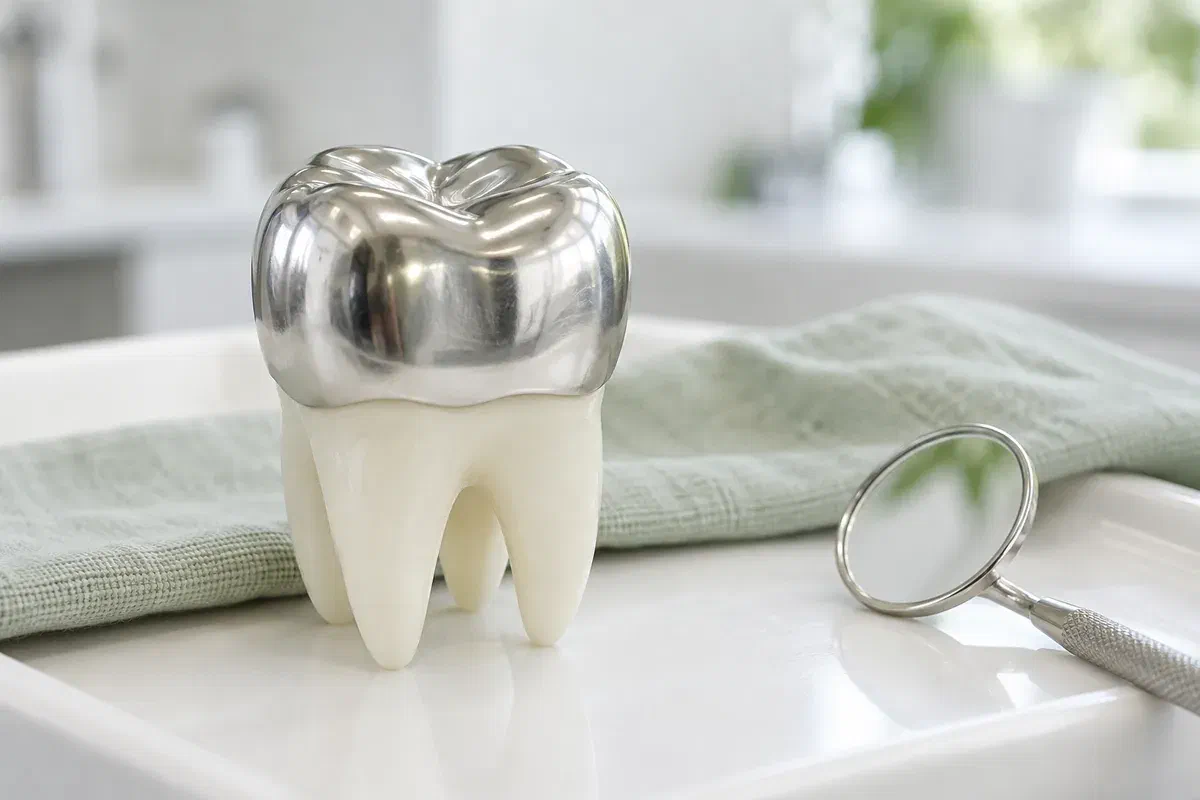
Illustrative child and parent discussing a silver-crowned tooth teaching model
Children’s Dentistry

Pediatric Stainless Steel Crowns in Erin

A crown repairs one baby molar. The routine at home decides what happens to the others. For households in Erin and Hillsburgh, here is how a stainless steel crown works and how to build habits that protect the rest of your child’s teeth.

Erin · crowns and the routine at home

Fix one tooth. Protect the rest.

It is natural to focus on the tooth that needs work. Yet a cavity big enough to need a crown is also a clue about what is happening across the mouth, from bedtime brushing to the drinks and snacks between meals. Both deserve attention.

The repair itself is a pediatric stainless steel crown. It is a silver metal cap, preformed in standard sizes, that the dentist fits and cements over the whole visible part of a back baby tooth. Dentists consider it for primary molars whose decay or breakage has gone too far for a dependable filling, and for teeth that have had pulp treatment.

Bring two sets of questions. For the tooth: why a crown, what alternatives were weighed and how it will be checked. For home: what may have contributed to the decay and which changes would help most. Children often take more ownership when they are part of that second conversation.

Talk about a crown and prevention
Illustrative molar teaching model with a smooth stainless steel crown
How a molar gets to this point

Decay that went further than a filling can fix

The suitable repair depends on how far decay has reached, which sides of the tooth it has spread to and the condition inside. Share symptoms, past treatment and your child’s daily routine, since the habits that led here also shape what happens next.

Cavities that spread across surfaces

Decay often starts between teeth or in grooves and spreads unseen. Once several surfaces are involved, a filling may lack sound tooth to hold onto. Mention earlier repairs, and ask whether a crown is the better match for what remains.

Nerve treatment already done

A pulpotomy or pulpectomy deals with the inner tissue of a baby tooth, and covering the outside is a separate step. Ask if a crown completes that care. Relief from pain does not mean the restoration can be skipped.

Allergies, routines and how your child feels

Let the clinician know about any nickel or metal allergy and past reactions. Mention sensory needs, communication preferences and any concern about a silver tooth. Describing a typical day of eating and brushing helps with prevention planning too.

Pain, swelling or a gum bump near the tooth can mean infection, not just a cavity. Mention them when you call so the visit is planned to look into it.

What the crown provides

Sturdy coverage while better habits take hold

A stainless steel crown surrounds the chewing surface and sides of the tooth, so a molar weak in several places gets support all at once. That is why it is often considered for baby teeth with heavy decay, thin walls or recent nerve treatment. The diagnosis comes first.

It is meant to last until the tooth naturally sheds. Even so, the cement can fail or the metal can thin, and the tooth beneath can still run into trouble. More to the point, the crown does nothing for the neighbouring teeth, which still rely on daily cleaning, prevention and checkups.

Patient information: AAPD — restorative dentistry for children

Support for a heavily damaged tooth

Ask which surfaces are weakened and why a filling was ruled out. Stretching a large filling over fragile walls is not always the better route. The choice should follow the tooth’s structure and the chewing it handles.

Keeping the tooth for its natural span

A restored baby molar can keep space and chewing function while the adult tooth develops. Its likely remaining years matter. Ask whether the adult tooth below changes the recommendation.

A turning point for the whole mouth

If several teeth are affected, ask how treatment will be organised. Use the moment to set up prevention: brushing support, fluoride as advised and changes to snacks or drinks, so fewer teeth need repair later.

The appointment, briefly

Diagnose, prepare, fit and talk prevention

Preformed metal crowns can be placed in more than one way. You should be told which method fits your child’s molar and the reasons for it.

  1. Examine the tooth and the habits behind it

    The dentist reviews symptoms, checks the tooth and takes X-rays where clinically indicated. You talk about the state of the nerve, whether the molar is restorable and what may have contributed to the decay. This is the moment for questions on other repairs, the silver look, metal allergies and keeping your child comfortable.

  2. Ready the tooth

    In a conventional approach, the tooth is numbed, decay is cleared and the shape adjusted. Certain baby molars may be candidates for the Hall technique, which places the crown without that preparation. It has firm criteria and does not suit every tooth.

  3. Place the crown

    A preformed crown of the right size is tried, checked and then held in place with dental cement. Steps vary with the method. Give your child an agreed signal for a pause, and the team will explain any new sensations.

  4. Wrap up with bite and home advice

    Ask how your child’s bite may feel and what would mean a call. Note numbness precautions and the next review. This is also a good time to agree on one or two prevention changes to start at home straight away.

A routine that protects every tooth

Brush, watch and keep the sugar in check.

Short-term advice depends on the technique and any freezing. If a grandparent or babysitter helps out, share both the aftercare and the new home routine.

After the visit

Let your child eat only once the clinician says it is fine, choosing softer foods if advised. Numb areas can be bitten by accident, so stay alert. Ask about suitable pain relief and report pain that is severe or increasing.

Twice-daily brushing that reaches the back

Back molars, including the crowned one, are easy to miss. Brush along the gum edge every morning and night, helping as much as your child’s age needs, and floss as advised. Tell the team if food keeps catching around the crown.

Keeping an eye on the crown

Phone us if it feels loose, falls out or looks worn through. Keep a crown that comes out in a lidded container; avoid gluing or refitting it, and keep it out of your child’s mouth. Stick with regular reviews.

Patient information: Guy’s and St Thomas’ — stainless steel crowns for children

Repair choices to discuss

Which repair suits a tooth this damaged?

For each suitable option, compare preparation, appearance, follow-up and limits. When much of the tooth is gone, a white repair and a small one may not both be possible.

When the full tooth needs covering

Stainless steel crown

May be advised for a primary molar with major damage or after pulp therapy. You should hear the planned placement method and any reason the metal might not suit your child. It stays fixed on the tooth rather than coming off at mealtimes.

When a lesser repair will hold

Filling or another crown type

Smaller cavities may suit a direct filling, and occasionally a crown in a different material is an option. Appearance, how much tooth is left, the demands of each procedure and your child’s comfort all count. Ask what is realistic.

When covering will not address the cause

Nerve care or extraction

If the nerve is affected, it may need treatment before restoration. A tooth beyond repair may need removing. Ask how the diagnosis guides the decision and, if extraction is advised, whether the space needs looking after.

Prevention and crown questions

Keeping the next cavity away

Once a crown is needed, many parents want to know how to avoid another. These answers are a starting point for that discussion.

(905) 876-4488
What usually causes decay bad enough to need a crown?
Several factors can contribute, including frequent sugary snacks or drinks, missed brushing and deep grooves or tight contacts that trap food. The dentist can talk through what may apply to your child without blame. Most families find one or two changes are easier to keep up than a complete overhaul.
Does bedtime milk or juice affect baby teeth?
Drinks other than water at bedtime, after brushing, can increase the risk of decay because the teeth stay bathed in sugar overnight. Ask the dentist about a routine that suits your child’s age, and about how to wind down a bedtime bottle or cup if that is a habit.
Should my child use fluoride toothpaste?
Fluoride toothpaste is commonly recommended for children in amounts suited to their age. Ask the dentist how much to use and whether any other fluoride treatment would help.
Can sealants protect my child’s other back teeth?
Sealants may be suggested for suitable teeth, often adult molars as they come in, to help protect the deep grooves where decay tends to start. Ask whether they would help your child and when the first adult molars are likely to be ready.
Do I need to brush the crown differently?
No special technique is usually needed. Brush the crown and the gum edge like other teeth, and clean between teeth as advised. Never try to remove the crown for cleaning.
How often should we come in from Erin for checkups after a crown?
The dentist will suggest a review interval based on your child’s risk of decay, which may be shorter for a while after a crown. Ask about booking ahead and combining visits for siblings, so the drive down from Erin village or Hillsburgh covers more than one child.
Children’s crowns for households in Erin

Repair the tooth, then build the habits.

Reach our Bronte Street practice if your child has been told a back baby tooth needs a crown, or if one is crumbling. We will explain the findings and options, and help you put together a prevention routine for the whole family.

Material and method are chosen after assessment. Please mention pain, swelling or any metal allergy when you call.

Visit Milton Dental Clinic
Unit 1, 342 Bronte St. S, Milton, ON L9T 5B7
Get directions Clinic hours
Monday–Thursday
11am–7pm
Friday–Sunday
By appointment only

Areas we serve

  • Milton
  • Oakville
  • Mississauga
  • Georgetown
  • Halton Hills
  • Acton
  • Campbellville
  • Brampton
  • Burlington
  • Puslinch
  • Rockwood
  • Erin
  • Caledon
  • Etobicoke
  • Old Milton
  • Bronte Meadows
  • Timberlea
  • Dorset Park
  • Dempsey
  • Clarke
  • Beaty
  • Coates
  • Harrison
  • Scott
  • Willmott
  • Ford
  • Bowes
  • Cobden
  • Walker
  • Mountain View
  • Milton Heights
  • Hawthorne Village
  • Valley View
  • Fallingbrook
  • Nassagaweya
  • Trafalgar
  • Esquesing
  • Nelson
  • Brookville
  • Moffat
  • Glen Williams
  • Norval
  • Limehouse
  • Stewarttown
  • Ashgrove
  • Hornby
  • Silver Creek
  • Speyside
  • Scotch Block
  • North Oakville
  • River Oaks
  • Glen Abbey
  • West Oak Trails
  • Palermo
  • Bronte Creek
  • College Park
  • Joshua Creek
  • Uptown Core
  • Preserve
  • Iroquois Ridge
  • Lisgar
  • Meadowvale
  • Meadowvale Village
  • Churchill Meadows
  • Erin Mills
  • Central Erin Mills
  • Streetsville
  • East Credit
  • Creditview
  • Heartland
  • Sheridan
  • Mount Pleasant
  • Credit Valley
  • Huttonville
  • Churchville
  • Springbrook
  • Northwest Brampton
  • Bram West
  • Fletcher's Meadow
  • Fletcher's Creek South
  • Alton Village
  • Orchard
  • Millcroft
  • Headon Forest
  • Tansley
  • Brant Hills
  • Tyandaga
  • Kilbride
  • Lowville
  • Aberfoyle
  • Morriston
  • Arkell
  • Hillsburgh
  • Freelton
  • Carlisle
  • Waterdown
  • Flamborough
  • Mountsberg

How can we help?

Milton Dental Clinic

Have a question about your smile? Choose the option that works best for you.

For urgent dental concerns, please call.
Messages are reviewed during clinic hours.