

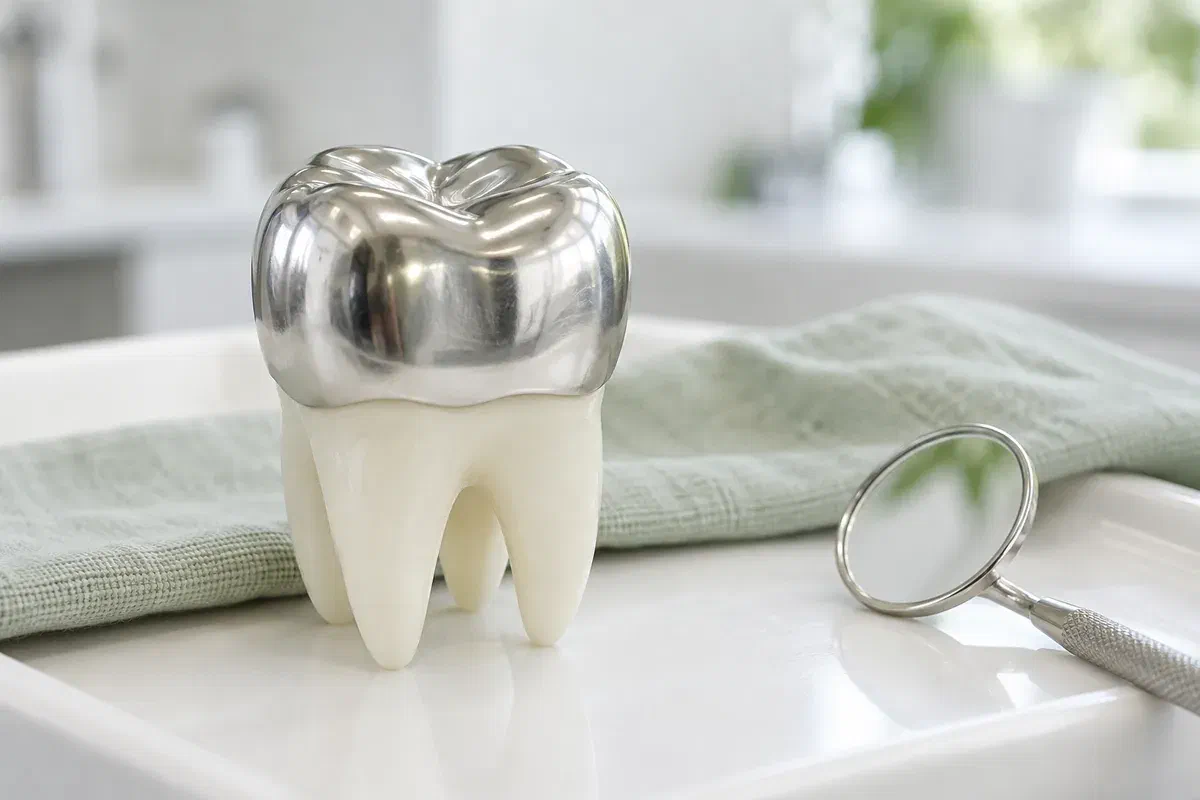
Illustrative child and parent discussing a silver-crowned tooth teaching model
Children’s Dentistry

Pediatric Stainless Steel Crowns in Etobicoke

Coming from Etobicoke for a child’s crown takes some planning. Learn when a stainless steel crown is suggested for a baby molar, how to make each visit count, and when a problem afterward is better handled by urgent care nearer home.

Planning a crown from Etobicoke

Make each trip do more of the work.

When the dentist is a longer drive away, a crown recommendation raises practical questions alongside clinical ones. How many visits will this take? Can two teeth be done together? What happens if something goes wrong on a weeknight? Those questions are worth asking out loud.

The crown being discussed is a preformed stainless steel cap. It comes in set sizes, and the one that matches is seated so it encloses everything you can see of a back baby tooth, in a silver finish. Dentists tend to recommend it when decay or breakage has left a primary molar too weak for a filling, or after treatment of the nerve inside.

For children who travel in, the best plans are clear about order and timing. Ask what the dentist found, which teeth need care first, what alternatives exist and how follow-up will be handled. Your child can ask their own questions as well, so the day holds fewer surprises.

Plan crown visits for your child
Illustrative molar teaching model with a smooth stainless steel crown
What prompts a crown suggestion

Signs the tooth needs more than a patch

The suitable repair depends on how deep decay goes, how many surfaces are affected and the state of the tooth’s nerve. Bring notes on symptoms and earlier treatment, especially if records come from another office.

Large or recurring cavities

Several damaged surfaces can leave too little sound tooth to hold a filling well. Mention earlier fillings that cracked or came out, and if possible bring records. The dentist can then explain whether full coverage would suit this molar better.

Nerve treatment still to be finished

A pulpotomy or pulpectomy treats the soft tissue in the middle of a baby tooth, but the outside still needs restoring. Ask whether a crown is the next step. A tooth that no longer hurts can still be left vulnerable without it.

Allergies, needs and expectations

Mention any allergy to nickel or other materials and past reactions. Let the team know about sensory or communication needs and whether your child is concerned about how a silver tooth looks. Those factors guide the material and how the visit is run.

Pain, swelling or a gum bump may mean the tooth needs more than a crown. Describe them when booking so the first trip includes the right assessment.

What a crown can add

Durable coverage that suits a long-distance plan

A stainless steel crown surrounds the chewing surface and sides of the molar rather than repairing one part. For selected baby teeth with widespread decay, weakened walls or recent pulp therapy, wrapping the whole tooth is what makes it worth discussing. It is still a decision that follows the diagnosis, and for a family making a longer trip, a sturdy single restoration can be easier to plan around than repeated repairs.

The hope is that the crown stays in service until the baby tooth makes its natural exit. Crowns can still come loose or wear, and new problems can develop in the tooth beneath. Brushing, prevention and reviews remain essential, wherever you live, and a dentist closer to home can help with routine checks if that is arranged.

Patient information: AAPD — restorative dentistry for children

Covering a tooth damaged on many sides

Ask the dentist to show how the damage pattern affects the recommendation. A very large filling stretched over thin walls is not always the better choice. The plan should rest on how the tooth is built and how hard it works when your child eats.

Holding the place for the adult tooth

A suitable primary molar that is restored can keep space and chewing function while the permanent teeth develop. The likely timing of its natural loss is part of the decision. Ask whether the adult tooth below changes what is advised.

Grouping treatment where it makes sense

If several teeth need work, ask whether some can be treated at the same visit and in what order. Clinical needs come first, but sensible grouping can reduce trips. Leave with prevention advice too, so the rest of the mouth is not forgotten.

Steps in a crown appointment

Assessment, preparation, fitting and a final check

Preformed metal crowns can be placed in different ways. Ask which method is proposed for your child’s tooth, why, and how long the visit is likely to feel for them.

  1. Diagnose and plan the sequence

    Expect questions about how the tooth has behaved, a careful examination and X-rays only where they are clinically justified. From there, the dentist sets out whether the nerve is involved, whether the molar is restorable and how other teeth fit into the order of care. Ask about alternatives, appearance, allergies and comfort or referral.

  2. Prepare the tooth for the chosen approach

    Conventional placement usually means local anaesthetic, removing decay and shaping the tooth. Selected primary molars may suit the Hall technique instead. That method has defined criteria and is not appropriate for every sore or decayed tooth.

  3. Select and cement the crown

    A preformed crown is chosen, checked for fit and secured with dental cement. The details vary with the tooth and method. Agree on a way for your child to signal they need a pause, and the team can explain pressure or new sensations.

  4. Review the bite before you leave

    Check what your child may feel when biting and chewing, and which symptoms mean calling us. Confirm numbness advice for the ride home and the date of the next visit. If other treatment remains, leave with the plan written down.

Back home in Etobicoke

Know what to do, and who to call, after the visit

Follow the advice for the technique and any anaesthetic. If someone else will care for your child after the trip home, ask for written instructions you can pass on.

Snacks in the car, meals at home

Follow the clinician’s guidance on when and what your child can eat; numbness may still be present on the drive. A child who cannot feel one side of the mouth may chew on it without noticing, so keep an eye out. Ask about suitable pain relief, and report pain that is significant or worsening.

Daily cleaning around the crown

The gum edge and the teeth beside the crown still need brushing and cleaning every day. Younger children still need an adult’s hand on the toothbrush, and flossing should follow the method you were shown. Let us know about any spot that keeps collecting food.

When the crown loosens or comes off

Phone the clinic if the crown moves, falls out or looks worn through. Keep it in a sealed container, and do not try home repairs or let your child hold it in their mouth. We can advise whether it can wait for a planned visit. Keep up regular reviews.

Patient information: Guy’s and St Thomas’ — stainless steel crowns for children

Comparing the choices

What the tooth can support decides the shortlist.

For every suitable option, compare the preparation, the look, the follow-up and the limits. Some teeth cannot have both a white finish and a minimal repair.

When full coverage is clinically right

Preformed stainless steel crown

A metal crown may be proposed for a heavily damaged primary molar or after pulp therapy. You should hear how it will go on and whether the metal raises any concern for your child. It is cemented to stay, not a cap your child removes before eating.

When a different restoration works

Filling or another type of crown

A smaller cavity may be handled with a direct filling, and a non-metal crown is sometimes an option. Appearance, how much tooth is left, placement demands and your child’s needs all count. Ask which alternatives truly apply.

When a cover alone falls short

Treatment inside the tooth, or removal

Affected nerve tissue may need treatment before restoring the tooth, and a tooth that cannot be saved may need extraction. Ask how the findings change the choices, and whether space for the adult tooth needs separate review.

Questions from families who travel

Practical answers for a longer trip

Distance adds planning questions to the usual ones about durability and appearance. Both kinds are worth raising before treatment.

(905) 876-4488
Can more than one crown be placed in a single appointment?
Sometimes. It depends on the teeth involved, the methods planned and how your child copes with a longer visit. Ask the dentist whether combining treatment is sensible or whether shorter visits would work better.
What should I do if the crown comes off on a weekend?
Keep the crown in a container and away from your child’s mouth, and contact the clinic for advice. If there is significant pain or swelling, seek urgent dental care closer to Etobicoke rather than waiting.
Can my child’s regular dentist do the follow-up checks?
Ask about this when planning treatment. Reviews of the crown and surrounding teeth are important, so make sure whoever sees your child knows the crown was placed and when.
Is the silver crown something my child will notice when eating?
Your child may notice the bite feels different at first, depending on the technique. Ask what to expect. Call if chewing is difficult, pain is significant or the feeling does not settle as described.
Do crowned baby teeth come out on schedule?
Generally, the crowned tooth sheds at its natural time and the crown comes out with it. Some teeth or crowns need attention sooner, which is why ongoing reviews are recommended.
Does crowning one tooth reduce the chance of cavities in the rest?
No. The crown restores one tooth only. Keep up brushing help, fluoride as advised, sensible snacking and regular checkups for the rest of the mouth.
Children’s crowns for Etobicoke families

Plan the visits, then plan the tooth.

Call our Bronte Street practice with the crown advice you have been given, or with a baby molar that is breaking down. We can explain the findings, the restoration options and how to organise appointments so the plan works for your household.

The crown material and method depend on assessment. Mention pain, swelling or known metal allergies when you call, so the first visit covers what it needs to.

Visit Milton Dental Clinic
Unit 1, 342 Bronte St. S, Milton, ON L9T 5B7
Get directions Clinic hours
Monday–Thursday
11am–7pm
Friday–Sunday
By appointment only

Areas we serve

  • Milton
  • Oakville
  • Mississauga
  • Georgetown
  • Halton Hills
  • Acton
  • Campbellville
  • Brampton
  • Burlington
  • Puslinch
  • Rockwood
  • Erin
  • Caledon
  • Etobicoke
  • Old Milton
  • Bronte Meadows
  • Timberlea
  • Dorset Park
  • Dempsey
  • Clarke
  • Beaty
  • Coates
  • Harrison
  • Scott
  • Willmott
  • Ford
  • Bowes
  • Cobden
  • Walker
  • Mountain View
  • Milton Heights
  • Hawthorne Village
  • Valley View
  • Fallingbrook
  • Nassagaweya
  • Trafalgar
  • Esquesing
  • Nelson
  • Brookville
  • Moffat
  • Glen Williams
  • Norval
  • Limehouse
  • Stewarttown
  • Ashgrove
  • Hornby
  • Silver Creek
  • Speyside
  • Scotch Block
  • North Oakville
  • River Oaks
  • Glen Abbey
  • West Oak Trails
  • Palermo
  • Bronte Creek
  • College Park
  • Joshua Creek
  • Uptown Core
  • Preserve
  • Iroquois Ridge
  • Lisgar
  • Meadowvale
  • Meadowvale Village
  • Churchill Meadows
  • Erin Mills
  • Central Erin Mills
  • Streetsville
  • East Credit
  • Creditview
  • Heartland
  • Sheridan
  • Mount Pleasant
  • Credit Valley
  • Huttonville
  • Churchville
  • Springbrook
  • Northwest Brampton
  • Bram West
  • Fletcher's Meadow
  • Fletcher's Creek South
  • Alton Village
  • Orchard
  • Millcroft
  • Headon Forest
  • Tansley
  • Brant Hills
  • Tyandaga
  • Kilbride
  • Lowville
  • Aberfoyle
  • Morriston
  • Arkell
  • Hillsburgh
  • Freelton
  • Carlisle
  • Waterdown
  • Flamborough
  • Mountsberg

How can we help?

Milton Dental Clinic

Have a question about your smile? Choose the option that works best for you.

For urgent dental concerns, please call.
Messages are reviewed during clinic hours.