

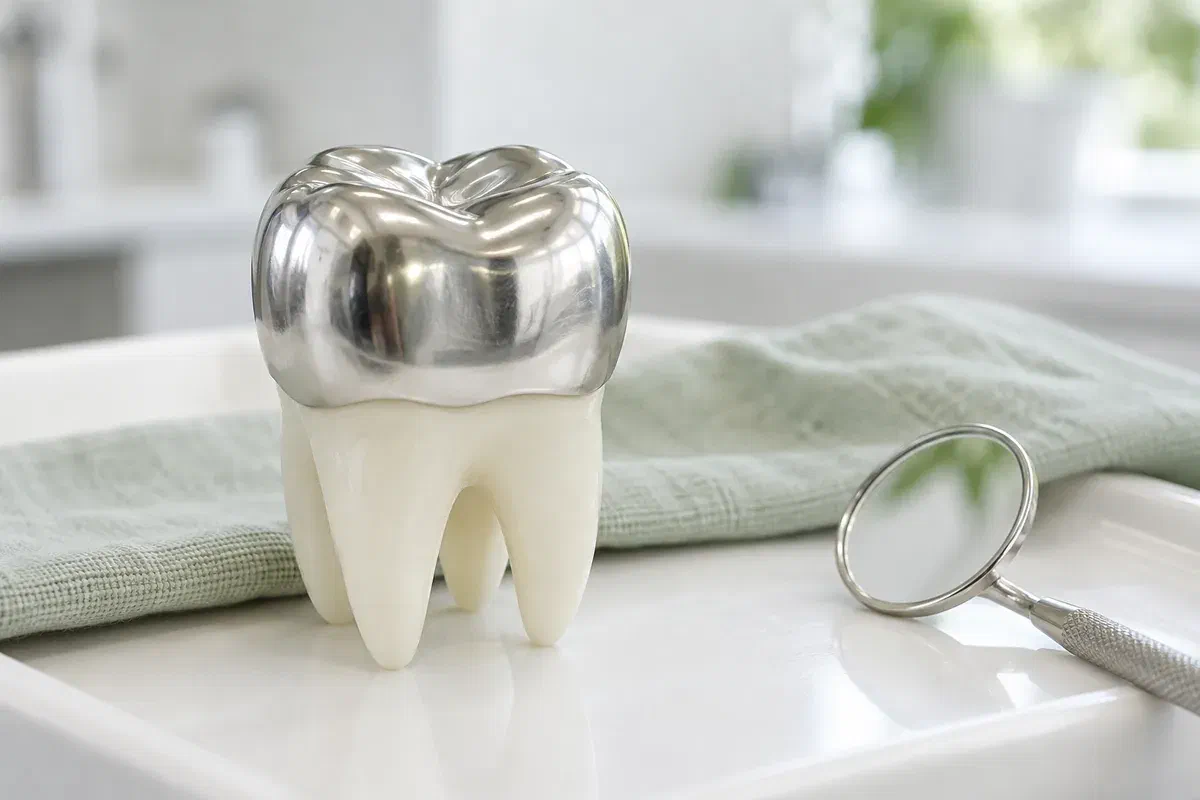
Illustrative child and parent discussing a silver-crowned tooth teaching model
Children’s Dentistry

Pediatric Stainless Steel Crowns in Rockwood

A four-year-old and a ten-year-old can have the same cavity and get different advice. For parents in Rockwood, this page explains how a child’s age, the adult tooth below and the baby molar’s remaining years shape a stainless steel crown recommendation.

Rockwood · timing and development

Same cavity, different child, different plan

Back baby teeth keep working for years, often until a child is around ten to twelve. That means a damaged molar in a preschooler has a long job ahead, while the same tooth in an older child may be close to its natural exit. Timing is one of the first things the dentist weighs.

If a crown is advised, it will usually be a stainless steel crown: a silver, ready-shaped metal cap available in a range of sizes. The right one is cemented over the visible part of the primary molar so that all of it is enclosed. Dentists turn to it when decay or fracture has taken too much of the tooth for a filling, or after pulp treatment.

So ask about the calendar as well as the cavity. How long is this tooth expected to stay? What is happening with the adult tooth underneath? Which other options were considered, and how will the crown be checked? Your child can join in too, especially older children who are curious about their changing teeth.

Ask how timing affects your child’s plan
Illustrative molar teaching model with a smooth stainless steel crown
Factors behind a crown recommendation

How much tooth is left, and how long it must last

Repair choices depend on decay depth, surfaces involved, the condition of the nerve and the tooth’s expected lifespan. Tell the dentist about symptoms and any earlier treatment.

Wide decay on a tooth with years to go

A molar damaged across several sides may not hold a filling well, particularly if it still has a long time to serve. Mention previous repairs that have chipped or come out. The dentist can explain whether a full covering is more suitable.

A tooth that needed pulp therapy

Pulpotomy and pulpectomy treat the nerve area within a baby tooth. The outside then needs restoring in its own right. Ask if a crown is planned as that final layer, even when the toothache has gone.

Allergies, comfort and appearance

Let the team know about any nickel or metal allergy and previous reactions. Describe sensory sensitivities, how your child communicates and whether a silver tooth would bother them. These feed into the material and treatment approach.

Gum swelling, a pimple-like spot or pain that lingers may signal a deeper problem. Describe it when you book, so the assessment can look beyond whether a crown is needed.

Why a crown can be worth it

Built for the remaining years of a baby tooth

Because it encloses the whole visible tooth, a stainless steel crown supports a primary molar weakened in several places. That can matter most when the tooth still has years of chewing ahead. For baby teeth with deep decay, weak walls or recent nerve treatment, it may be the more fitting repair.

It is meant to stay until the tooth sheds naturally. Over that time, the cement may give way or the metal may wear, and the tooth inside can still develop trouble. Brushing, prevention and reviews continue, and those visits also track how the adult teeth are coming along.

Patient information: AAPD — restorative dentistry for children

Durable cover for a long-serving tooth

Ask which surfaces are weakened and how many years the tooth needs to last. A sprawling filling across thin walls may not hold up for that long. The recommendation should reflect the tooth’s build and workload.

Guiding the adult tooth into place

A healthy baby molar helps keep room for the permanent tooth forming beneath it. Losing it early can sometimes allow neighbouring teeth to shift. Ask whether the adult tooth’s stage of development changes what is recommended.

Fitting into your child’s growth

If other teeth need care, ask how the crown fits the order of treatment and how it relates to upcoming changes, such as new adult molars arriving. Prevention advice should be part of the plan for every stage.

Steps to a fitted crown

Assess the timeline, then the technique

A preformed metal crown can go on in different ways. Your dentist will explain which is proposed for your child’s tooth and why it is a good fit at this age.

  1. Review the tooth and the adult tooth below

    The dentist checks symptoms, examines the molar and arranges radiographs if clinically warranted, which can also show the developing adult tooth. From there you talk over the health of the pulp and whether restoring the tooth makes sense given its age. Ask about other choices, appearance, allergies and comfort.

  2. Prepare in the chosen way

    A conventional crown generally involves local anaesthetic, removing decay and reshaping the tooth. Certain primary molars may suit the Hall technique, which does without that preparation. It follows strict criteria and is not offered for every tooth.

  3. Try in and cement

    The clinician picks a preformed crown of suitable size, checks how it sits and secures it with dental cement. Details differ by technique. Agree on a way your child can call a pause, and the team can tell them what each step feels like.

  4. Check the bite and book the next review

    Find out what your child may feel when chewing over the next few days, and what would be a reason to call. Confirm advice about numbness and when to come back. If other teeth are waiting, ask when they will be done.

Between now and the day it falls out

Years of everyday care, not just a few days

Short-term instructions depend on the technique and any freezing. If a relative or after-school sitter will care for your child, share the advice with them.

The first meal after treatment

Wait for the go-ahead before eating, and choose softer foods if advised. Numb lips and cheeks are easy to bite accidentally, so stay nearby. Ask what pain relief suits your child, and phone about pain that is intense or worsening.

Cleaning around a crown for the long haul

Plaque gathers along the crown’s rim at the gum and between neighbouring teeth. Keep brushing there every day, adjusting how much you help as your child grows, and floss as shown. Mention any spot where food keeps lodging.

Changes that need a check

Call if the crown feels loose, comes off or seems worn through. A crown that has come out should be kept in a closed container, not refitted at home or left in your child’s mouth. Regular reviews stay important for years to come.

Patient information: Guy’s and St Thomas’ — stainless steel crowns for children

Options at different ages

The right repair can change with the child’s age.

For every suitable option, compare preparation, appearance, follow-up and limits, and how each suits the time the tooth has left. A tooth-coloured, minimal repair is not always achievable.

When full coverage suits the remaining years

Stainless steel crown

Often advised for a significantly damaged or nerve-treated primary molar with time left to serve. Ask how it would be placed and whether materials are a concern. Once on, it remains fixed to the tooth until the tooth itself is lost.

When a smaller repair is enough

Filling or another crown material

Less extensive damage may be repaired with a direct filling, and some cases allow a crown in another material. Appearance, the tooth that is left, the steps each repair requires and how your child manages in the chair are all part of it. Ask which are truly possible, and how long each is likely to last relative to the time the tooth has left.

When covering would not fix the problem

Internal treatment or removal

An affected nerve may need care before any restoration. A tooth that cannot be saved, or is close to shedding, may be better removed. Ask how age and diagnosis shape the decision, and whether anything is needed to preserve space.

Timing questions

Age, adult teeth and the crown

Questions about timing come up often because a baby tooth’s remaining lifespan really does affect the plan.

(905) 876-4488
Is it worth crowning a baby tooth that will fall out in a year or two?
It depends on the tooth, the symptoms and how soon it is expected to shed. Sometimes a simpler option or monitoring is suitable; sometimes a crown is still advised. Ask the dentist to explain the reasoning for your child.
At what age do the back baby teeth usually fall out?
Timing varies, but back baby molars often stay until roughly ten to twelve years of age. The dentist can estimate the timing for your child, sometimes with the help of an X-ray.
Can a crown affect the adult tooth growing underneath?
A crown sits on the baby tooth, not the adult tooth. Problems in the baby tooth, such as infection, are a separate concern that the dentist will look for. Ask how the adult tooth is developing.
What happens if a crowned baby tooth is slow to fall out?
The dentist monitors this at reviews. If a baby tooth is not shedding as expected, they can assess whether anything needs to be done.
Do young children cope with crown placement?
Many do, with preparation and a method suited to them. Tell the team about your child’s temperament and needs, and ask about comfort options or referral if needed.
How do we schedule reviews from Rockwood as our child grows?
Ask about setting regular checkups ahead of time, ideally alongside other family visits, so the trip in from the village is planned rather than squeezed in. Keeping reviews steady helps the dentist track both the crown and the adult teeth as they arrive.
Crown advice for children in Rockwood

Plan for the years this tooth has left.

Has a dentist suggested a crown, or does a baby molar seem to be weakening? Get in touch with our Bronte Street practice. We will explain the findings, how your child’s age affects the options and how the plan connects with the rest of their dental care.

Technique and material are settled at the assessment. When booking, mention any pain, swelling or metal allergy so we can plan the visit.

Visit Milton Dental Clinic
Unit 1, 342 Bronte St. S, Milton, ON L9T 5B7
Get directions Clinic hours
Monday–Thursday
11am–7pm
Friday–Sunday
By appointment only

Areas we serve

  • Milton
  • Oakville
  • Mississauga
  • Georgetown
  • Halton Hills
  • Acton
  • Campbellville
  • Brampton
  • Burlington
  • Puslinch
  • Rockwood
  • Erin
  • Caledon
  • Etobicoke
  • Old Milton
  • Bronte Meadows
  • Timberlea
  • Dorset Park
  • Dempsey
  • Clarke
  • Beaty
  • Coates
  • Harrison
  • Scott
  • Willmott
  • Ford
  • Bowes
  • Cobden
  • Walker
  • Mountain View
  • Milton Heights
  • Hawthorne Village
  • Valley View
  • Fallingbrook
  • Nassagaweya
  • Trafalgar
  • Esquesing
  • Nelson
  • Brookville
  • Moffat
  • Glen Williams
  • Norval
  • Limehouse
  • Stewarttown
  • Ashgrove
  • Hornby
  • Silver Creek
  • Speyside
  • Scotch Block
  • North Oakville
  • River Oaks
  • Glen Abbey
  • West Oak Trails
  • Palermo
  • Bronte Creek
  • College Park
  • Joshua Creek
  • Uptown Core
  • Preserve
  • Iroquois Ridge
  • Lisgar
  • Meadowvale
  • Meadowvale Village
  • Churchill Meadows
  • Erin Mills
  • Central Erin Mills
  • Streetsville
  • East Credit
  • Creditview
  • Heartland
  • Sheridan
  • Mount Pleasant
  • Credit Valley
  • Huttonville
  • Churchville
  • Springbrook
  • Northwest Brampton
  • Bram West
  • Fletcher's Meadow
  • Fletcher's Creek South
  • Alton Village
  • Orchard
  • Millcroft
  • Headon Forest
  • Tansley
  • Brant Hills
  • Tyandaga
  • Kilbride
  • Lowville
  • Aberfoyle
  • Morriston
  • Arkell
  • Hillsburgh
  • Freelton
  • Carlisle
  • Waterdown
  • Flamborough
  • Mountsberg

How can we help?

Milton Dental Clinic

Have a question about your smile? Choose the option that works best for you.

For urgent dental concerns, please call.
Messages are reviewed during clinic hours.