

Illustrative child and parent discussing a dental arch model with a clinician
Children’s Dentistry

Space Maintainers in Etobicoke

A space maintainer is a plan that runs for months or years, so the trip matters. Coming from Etobicoke, you can have your child’s early gap assessed, learn whether an appliance is warranted, and set up reviews and a backup plan that suit a longer drive.

Planning from the west end of Toronto

Fewer trips, better organised

Choosing a dental office further from home makes sense for some families, but an appliance for a child is a long-running commitment. Before anything is fitted, it helps to know how many visits are likely, how the reviews can be spaced, and who to call nearby if something goes wrong between appointments. Many early gaps, it is worth saying, need no appliance at all.

The clinical question is simple to state. When a primary tooth goes early, the teeth beside it may shift before the adult tooth erupts. Our assessment looks at which tooth is gone and for how long, the room that remains, the stage the permanent tooth has reached, and your child’s wider needs. From there we may suggest watching, a maintainer, or specialist advice.

A fitted device must be cleaned daily, checked regularly, and eventually adjusted, replaced, or removed. We will explain the reason for it and the care it requires, and plan the follow-up with your journey in mind, before you agree to go ahead.

Plan a space-maintainer assessment
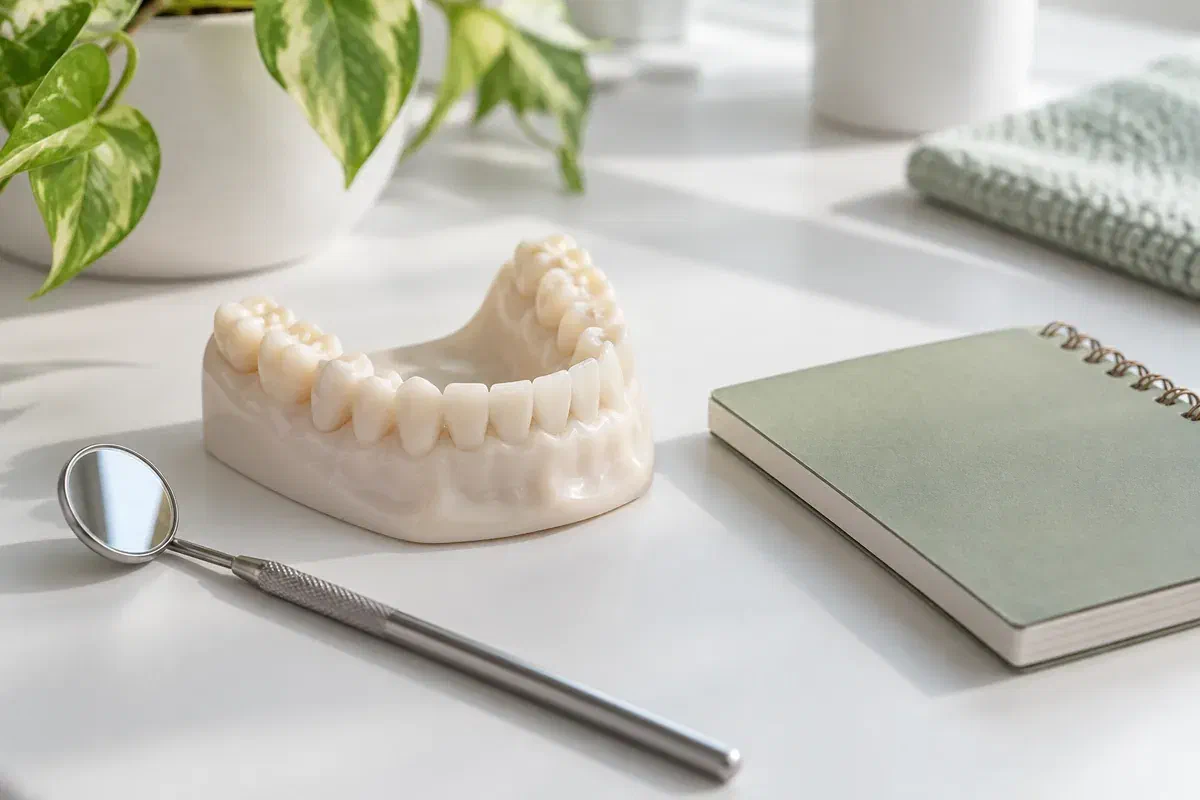
Illustrative lower dental teaching model beside a mirror and appointment notebook
Make the first trip count

Send or bring the background ahead of time.

Having records ready can reduce the number of visits. You do not need to decide whether an appliance is right; that is what the assessment answers.

The lost tooth and its date

Tell us how the tooth was lost, whether through extraction, injury, or very early shedding, and roughly when. Records from your child’s previous dentist are especially useful when you are travelling, because they help us place the gap in your child’s development quickly.

Existing images of the adult tooth

If recent X-rays exist, ask for them to be shared. New imaging may still be needed. Age alone does not predict eruption, so ask what each image would show and how it affects the choice between monitoring, an appliance, or referral.

What home care will look like

An appliance creates more to clean. Mention brushing challenges, decay, habits, or support needs. Because reviews may be spaced out, reliable home care is an important part of deciding whether a device is practical.

If the tooth was lost in an injury, have that assessed promptly by a nearby dentist or urgent care provider. A space discussion can follow once the injury has been checked.

The goal of the appliance

Hold the space now, review it over time.

In most cases the appliance acts as a placeholder, stopping nearby teeth from wandering into the opening a baby tooth left behind. Winning back room that has already closed is a separate, orthodontic matter, and a passive device is not built for it. Ask which of these describes your child.

Any benefit comes with possible problems. An appliance can loosen, break, gather plaque, or affect gums or the erupting tooth if no one checks it. It cannot guarantee ideal eruption or rule out future orthodontic care.

Patient information: AAPD — developing dentition and space maintenance

A recommendation you understand

The advice should make sense for the particular tooth that was lost and your child’s stage of development. Children of the same age may be advised differently. Find out which shift the device is there to stop.

A review schedule that is realistic

Reviews check the device, the anchoring teeth, and eruption. For a family travelling from Etobicoke, it is fair to ask about likely intervals and whether checks can be paired with other dental appointments. An appliance should never be left unchecked indefinitely.

Referral closer to home if needed

If a pediatric dentist or orthodontist is suggested, ask whether one closer to home would suit and how records will be shared. The goal is a single plan that covers the whole developing mouth.

Mapping out the visits

A clear sequence, planned in advance

The design and number of visits depend on findings and on what works for your family. Ask whether the appliance would be fixed or removable, since that changes how often small problems may need attention.

  1. Assess and gather records

    We examine the mouth and review history and any records you sent ahead. If imaging is needed, we aim to take it at this visit where appropriate. Mention any discomfort or change in the gap.

  2. Decide together

    We compare monitoring and suitable appliances, including the aim, limits, and responsibilities of each, plus how many visits each would take. Where room has already been lost, an orthodontic opinion may be the better route. The review schedule is set before treatment.

  3. Fit the appliance

    Some designs need measurements or impressions before fitting. On the day of placement, the clinician checks how the device sits on its supporting teeth and near the gum. Your child can mention anything that feels odd before you leave.

  4. Prepare for home

    We demonstrate cleaning and explain eating or wear guidance. Before your drive home, we also go over what to do about a loose or broken appliance and when to seek nearby urgent care. Each later review looks at the hardware and at the adult tooth working its way up.

Looking after it between trips

Good home care means fewer surprises.

Fixed and removable designs need different handling. Use the guidance written for your child’s appliance, and call before changing anything.

Clean thoroughly every day

Help your child brush the supporting teeth and the device, using the technique demonstrated at fitting. Bands and wires take a little extra care, so ask for tips on reaching them. Let us know about any area that remains sore or hard to keep clean.

Protect it from loosening

Ask your child not to press or pull at the appliance. Follow food advice to reduce the chance of dislodging it. Never try to tighten, bend, or glue a part at home.

Keep the agreed reviews

Attend scheduled checks even if everything feels fine. Tell us if a new tooth appears or the appliance seems to sit differently. Growth changes things, so any adjustment or removal is something we schedule, not something to try at home.

Weighing the choices

Monitoring, holding space, or a wider assessment

Each approach aims at something different and involves a different number of visits. The remaining space, eruption stage, and overall findings guide the choice.

When the findings support it

Watching without an appliance

Some gaps need only periodic rechecks, which can often be folded into routine visits. Find out what change would alter the plan and when an earlier look would be wise.

When current space should be held

Fixed or removable maintainer

Designs differ in how they are anchored and cared for. The choice depends on the teeth available to support one, where the adult tooth is in its development, oral health, and how reliably the device can be looked after between visits. A review plan should come with it.

When space or eruption has already changed

Orthodontic or pediatric dental opinion

Lost room or a complex eruption pattern may need further assessment. Getting room back calls for active treatment planning, and a passive maintainer is not built to reverse earlier shifts.

Questions from Etobicoke parents

Planning a spacer from further away

Every child’s plan is individual. Ask about your child’s own tooth and appliance rather than relying on general rules.

(905) 876-4488
Can the assessment and records happen in one visit?
Often some steps can be combined, depending on the design and what imaging is needed. Ask when booking, and send previous records ahead so the first appointment can cover as much as possible.
What if the appliance comes loose when we are far from the clinic?
Call us first for advice. Depending on what has happened, we may suggest a nearby dentist or urgent care. Keep any loose piece safe, do not put it back, and seek emergency help for choking or breathing difficulty.
How often will reviews be needed, roughly?
It depends on the appliance and your child’s development, and we will agree on a schedule at fitting. Ask whether reviews can be lined up with routine checkups to reduce trips.
Is a removable design easier for a family that lives further away?
Not necessarily. Fixed and removable appliances suit different situations and carry different risks of loss or damage. The choice should be based on clinical findings first, then practical factors.
Does a spacer mean braces will not be needed later?
No. It addresses a specific space concern. Tooth position, growth, and bite can still need assessment or treatment in the future. Ask what will be monitored as your child grows.
Can we stop the reviews once things look stable?
No. A stable appearance does not confirm that the supporting teeth, cement, gums, and erupting tooth are all healthy. Keep the planned checks, and call if travel makes a date difficult so we can rearrange.
Space maintainers for Etobicoke children

One organised plan, from first visit to removal

Call our Bronte Street practice to talk through a gap, a spacer recommendation, or a device your child already wears. Sending records and the approximate date of tooth loss ahead helps us use your trip well.

An appliance is not always the outcome. We base advice and any referral on the exam and on your child’s stage of growth.

Visit Milton Dental Clinic
Unit 1, 342 Bronte St. S, Milton, ON L9T 5B7
Get directions Clinic hours
Monday–Thursday
11am–7pm
Friday–Sunday
By appointment only

Areas we serve

  • Milton
  • Oakville
  • Mississauga
  • Georgetown
  • Halton Hills
  • Acton
  • Campbellville
  • Brampton
  • Burlington
  • Puslinch
  • Rockwood
  • Erin
  • Caledon
  • Etobicoke
  • Old Milton
  • Bronte Meadows
  • Timberlea
  • Dorset Park
  • Dempsey
  • Clarke
  • Beaty
  • Coates
  • Harrison
  • Scott
  • Willmott
  • Ford
  • Bowes
  • Cobden
  • Walker
  • Mountain View
  • Milton Heights
  • Hawthorne Village
  • Valley View
  • Fallingbrook
  • Nassagaweya
  • Trafalgar
  • Esquesing
  • Nelson
  • Brookville
  • Moffat
  • Glen Williams
  • Norval
  • Limehouse
  • Stewarttown
  • Ashgrove
  • Hornby
  • Silver Creek
  • Speyside
  • Scotch Block
  • North Oakville
  • River Oaks
  • Glen Abbey
  • West Oak Trails
  • Palermo
  • Bronte Creek
  • College Park
  • Joshua Creek
  • Uptown Core
  • Preserve
  • Iroquois Ridge
  • Lisgar
  • Meadowvale
  • Meadowvale Village
  • Churchill Meadows
  • Erin Mills
  • Central Erin Mills
  • Streetsville
  • East Credit
  • Creditview
  • Heartland
  • Sheridan
  • Mount Pleasant
  • Credit Valley
  • Huttonville
  • Churchville
  • Springbrook
  • Northwest Brampton
  • Bram West
  • Fletcher's Meadow
  • Fletcher's Creek South
  • Alton Village
  • Orchard
  • Millcroft
  • Headon Forest
  • Tansley
  • Brant Hills
  • Tyandaga
  • Kilbride
  • Lowville
  • Aberfoyle
  • Morriston
  • Arkell
  • Hillsburgh
  • Freelton
  • Carlisle
  • Waterdown
  • Flamborough
  • Mountsberg

How can we help?

Milton Dental Clinic

Have a question about your smile? Choose the option that works best for you.

For urgent dental concerns, please call.
Messages are reviewed during clinic hours.