
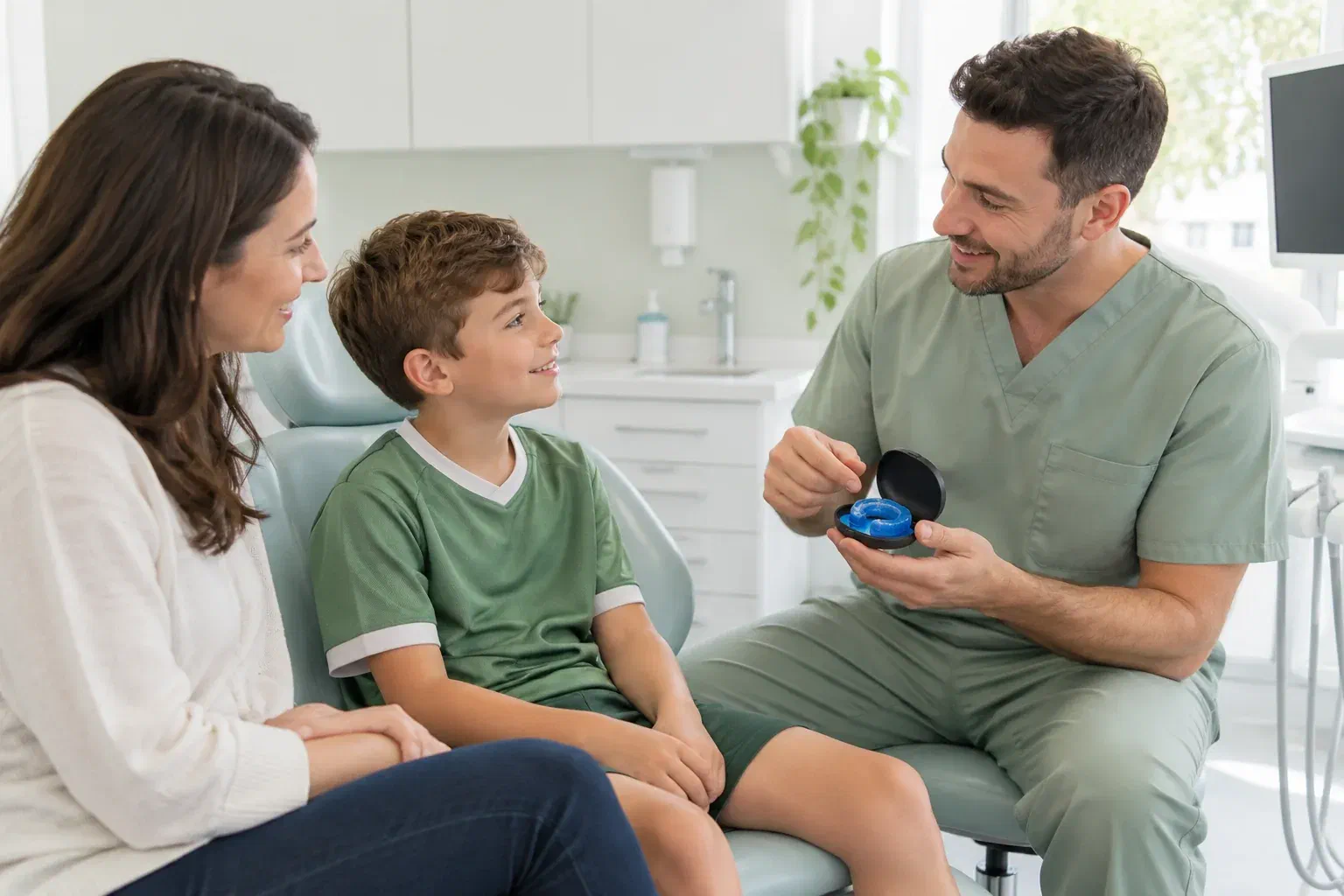
Illustrative young athlete and parent discussing a sports mouthguard with a clinician
Children’s Dentistry

Sports Mouthguards for Children in Burlington

Braces went on in August and tryouts start in September. When a child’s teeth are being moved, choosing sports protection takes a little more planning. We help you weigh guard types, coordinate with the orthodontist, and keep checking the fit as treatment progresses.

Burlington · braces and sport

New brackets, same practice schedule.

Orthodontic treatment rarely waits for the off-season. Many children get braces or another appliance right as soccer, basketball or hockey ramps up, and parents wonder whether the old mouthguard still works, whether a new one is needed, and who should be making that call.

Start by bringing everything: the current guard, the name of the treating orthodontist, and a rough idea of upcoming adjustments. For a family in Burlington, gathering those details before the visit saves back-and-forth later. We also want to hear about any earlier mouth injuries and teeth that are still coming in.

Your child’s experience counts. Brackets can make a guard feel tight or catch on the inside of the lips, and some children quietly stop wearing it rather than say so. Ask them how it feels, and pass that on to us.

Plan a mouthguard visit around braces
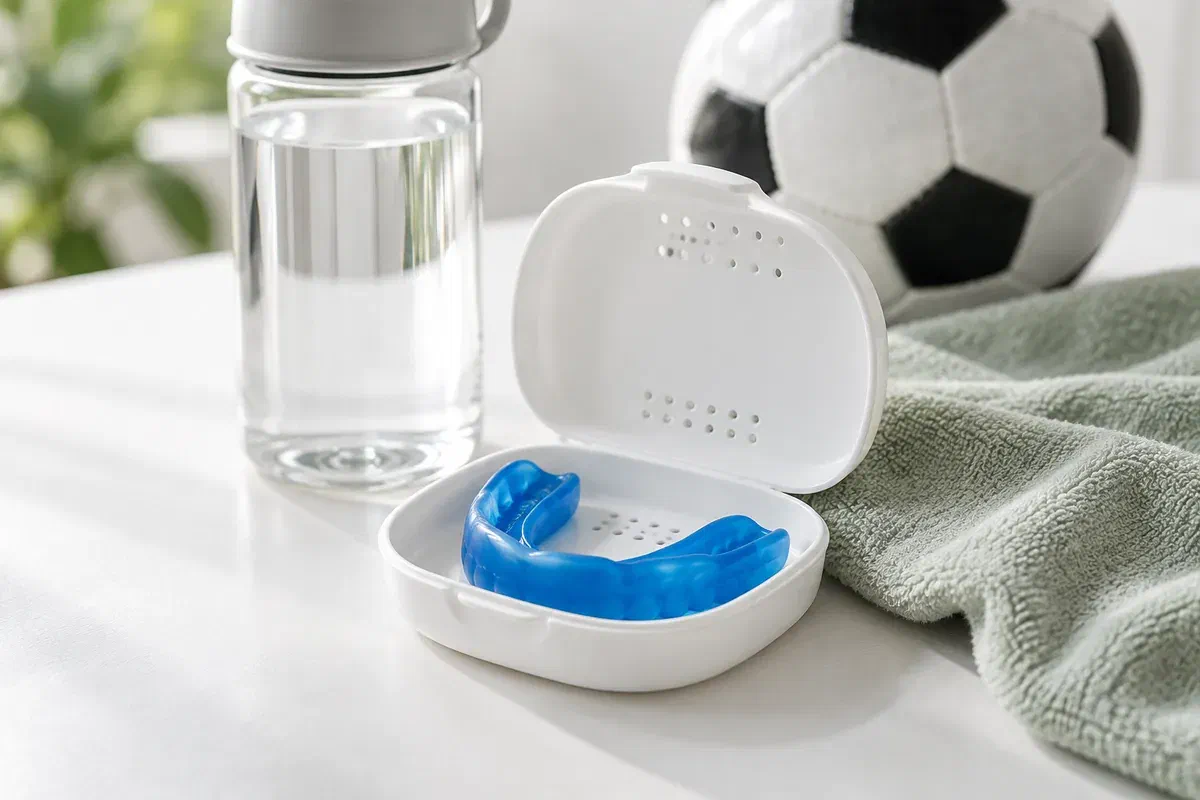
Illustrative blue sports mouthguard in a ventilated case beside sports equipment
When the teeth are on the move

What to flag when braces and sport overlap

A guard that suited last year’s teeth may not suit this year’s. Look at it again before the season and whenever the orthodontic plan changes.

Every activity, not just the main one

Tell the dentist about all the sports and games your child plays, including school gym, cycling and skating. Ask how a mouthguard sits alongside the helmet, face protection and safety rules for each, and whether braces change the advice.

Pressure on brackets or a guard that won’t stay

Soreness against the brackets, a guard that pops out, or one your child has to bite down to hold are all fit concerns. Bring it in rather than altering it at home, and reassure your child that mentioning it is the right move.

Tooth movement between appointments

Orthodontic adjustments, erupting permanent teeth and lost primary teeth can all change the shape a guard needs to fit. Share the orthodontic timeline with the clinician and ask when the guard should be reviewed as treatment moves along.

A blow to the mouth during orthodontic treatment may need assessment of the teeth and the appliance, even with a guard in. A mouthguard reduces risk; it does not rule out injury.

The value of planning ahead

Protection that respects the treatment plan

A well-fitted sports mouthguard helps lower the risk of injury to the teeth and surrounding soft tissue. The Canadian Dental Association encourages families to consider custom-fitted guards. With braces involved, staying in position and feeling comfortable over the appliance matter even more.

Even so, a guard is only part of keeping a child safe. It does not take the place of a helmet, facial protection, the sport’s rules, or medical assessment after a possible head injury. It should not be offered to you as protection against concussion or as a guarantee against dental injury.

Patient information: Canadian Dental Association — preventing sports-related oral injuries

A plan that accounts for the appliance

The clinician looks at the teeth, the bite and the braces or appliance, instead of choosing by age alone. Ask how fit will be checked over the brackets and what a suitable guard should feel like. Your child’s description is part of the assessment.

A trial run before tryouts

Practising with the guard in a relaxed setting helps your child learn to place it over braces, remove it and store it. Ask questions while there is time. Rubbing or pressure should be reported rather than tolerated.

Rechecks that track treatment

Because teeth are moving on purpose, the fit will need regular attention. Ask what should prompt a visit, and bring the guard to dental and orthodontic appointments. The aim is protection that keeps pace with treatment.

Step by step

Choosing a guard while teeth are being moved

Raise mouthguards early, ideally before the season and in step with the orthodontic plan. Timing depends on the guard selected, and a first visit does not include an instant guard.

  1. Gather the sport and orthodontic details

    Tell us the activities, level of play, current equipment, past injuries and the stage of orthodontic treatment. Bring the existing guard. If your child finds things in the mouth hard to tolerate, mention it so we can plan the visit around that.

  2. Examine and compare suitable approaches

    The clinician checks teeth, bite, eruption and the appliance, and explains how a custom guard differs from retail ones in your child’s case. Ask about visits, cost, and how often orthodontic changes might mean replacement.

  3. Take records if custom is chosen

    A custom guard is made from records of the teeth, taken by the method the treating clinician arranges, with the appliance in mind. Mention a strong gag or sensory difficulty in advance. Ask when it will be ready and if a fitting is included.

  4. Fit it, practise, and plan reviews

    At the fitting we check how it stays in, and how your child breathes and speaks with it over the braces. They practise handling it while we go through cleaning and storage. Confirm when to return and what to do after an adjustment, a new tooth or a tear.

Daily care with braces

Keep the guard clean, cool and checked.

Follow the care directions for your child’s guard and any extra advice from the orthodontic team. Younger children may need help until the routine sticks.

Clean it, then let it dry

Rinse and clean the guard as instructed with products suitable for its material. Allow it to air-dry and store it in a ventilated, protective case. Keep it away from heat sources, including a hot car, which can distort it.

Check for wear and stop the chewing

Inspect the guard for splits, wear from brackets, warping or sharp edges. Encourage your child to wear it rather than chew it on the bench. It should not be shared with friends or fixed with glue if it gets damaged.

Review after every big change

Bring the guard to appointments and call sooner if it stops seating comfortably. Adjustments, new teeth, lost teeth and restorations can all change the fit. Time since it was made is a poor guide to whether it still suits.

Patient information: Fraser Health — choosing and caring for sports mouthguards

Comparing guard types

Which guard suits a mouth in treatment?

Talk about cost and availability as well as the teeth. Ask which choices your child can realistically wear well during orthodontic care.

When an individual fit makes sense

Custom-fitted guard

Made from records of your child’s teeth, it is planned for the mouth assessed at that point. With tooth movement under way, it still needs care and regular review. Ask what is included and how treatment may affect how soon it needs replacing.

When looking at more accessible choices

Retail sports guard

Stock and mouldable guards vary in fit and in how they are prepared. Ask the dentist whether one is suitable over braces or around erupting teeth. Follow the instructions, and don’t assume a guard labelled for children will fit your child’s mouth properly.

When the appliance shapes the decision

Guard coordinated with the orthodontist

Your child’s orthodontist knows where the teeth are headed, so bring them into the choice of a guard that leaves room for that movement. Clear trays, retainers and night guards each have a separate job and are not impact protection. Check with both offices before pairing devices.

Braces, sport and guards

What parents ask once the brackets go on

Questions tend to cover braces, growth, cleaning and what to do if a guard is lost. Plan to have the fit looked at more than once.

(905) 876-4488
Should we wait until braces come off before getting a sports guard?
Your child may still need protection during treatment. Ask the dentist and orthodontist which guard is suitable while the braces are on and how often it should be reviewed, rather than going without for the whole treatment period.
Who decides which mouthguard my child wears with braces?
It works best as a shared decision. The dentist and the treating orthodontic clinician can each weigh in, and the sport’s rules apply too. Make sure everyone knows about the guard and the planned tooth movement.
Can clear aligners double as a mouthguard during games?
Do not assume so. Aligners are designed to move teeth, not to protect them from impact. Ask the treating clinician what sports protection is appropriate and how to manage the aligners on days your child plays.
What happens if my child gets hit in the mouth while wearing braces?
Stop play and arrange an assessment of the teeth, gums and appliance as needed, even if a guard was in. Contact the dentist or orthodontic office for advice, and seek emergency care for serious facial injury or any sign of a head injury.
How often will a guard need replacing during orthodontic treatment?
It depends on how the teeth move and the type of guard. Ask the clinician what to watch for, bring the guard to appointments and call if it starts to feel tight, loose or uncomfortable.
Is it fine for my child to wear a guard that feels tight after an adjustment?
Have it reviewed. A guard that presses on teeth or brackets after an adjustment may no longer fit well. Do not trim or reshape it at home, and ask what protection your child should use until it has been checked.
Mouthguards for Burlington children

Line up the guard with the treatment plan.

Contact our Bronte Street practice to talk about sports protection during orthodontic care. Bring the current guard, a list of activities, and details from the orthodontist about upcoming appointments or changes.

Guard type, fit, timing and replacement are discussed for each child. An injury needs assessment even when a mouthguard was worn.

Visit Milton Dental Clinic
Unit 1, 342 Bronte St. S, Milton, ON L9T 5B7
Get directions Clinic hours
Monday–Thursday
11am–7pm
Friday–Sunday
By appointment only

Areas we serve

  • Milton
  • Oakville
  • Mississauga
  • Georgetown
  • Halton Hills
  • Acton
  • Campbellville
  • Brampton
  • Burlington
  • Puslinch
  • Rockwood
  • Erin
  • Caledon
  • Etobicoke
  • Old Milton
  • Bronte Meadows
  • Timberlea
  • Dorset Park
  • Dempsey
  • Clarke
  • Beaty
  • Coates
  • Harrison
  • Scott
  • Willmott
  • Ford
  • Bowes
  • Cobden
  • Walker
  • Mountain View
  • Milton Heights
  • Hawthorne Village
  • Valley View
  • Fallingbrook
  • Nassagaweya
  • Trafalgar
  • Esquesing
  • Nelson
  • Brookville
  • Moffat
  • Glen Williams
  • Norval
  • Limehouse
  • Stewarttown
  • Ashgrove
  • Hornby
  • Silver Creek
  • Speyside
  • Scotch Block
  • North Oakville
  • River Oaks
  • Glen Abbey
  • West Oak Trails
  • Palermo
  • Bronte Creek
  • College Park
  • Joshua Creek
  • Uptown Core
  • Preserve
  • Iroquois Ridge
  • Lisgar
  • Meadowvale
  • Meadowvale Village
  • Churchill Meadows
  • Erin Mills
  • Central Erin Mills
  • Streetsville
  • East Credit
  • Creditview
  • Heartland
  • Sheridan
  • Mount Pleasant
  • Credit Valley
  • Huttonville
  • Churchville
  • Springbrook
  • Northwest Brampton
  • Bram West
  • Fletcher's Meadow
  • Fletcher's Creek South
  • Alton Village
  • Orchard
  • Millcroft
  • Headon Forest
  • Tansley
  • Brant Hills
  • Tyandaga
  • Kilbride
  • Lowville
  • Aberfoyle
  • Morriston
  • Arkell
  • Hillsburgh
  • Freelton
  • Carlisle
  • Waterdown
  • Flamborough
  • Mountsberg

How can we help?

Milton Dental Clinic

Have a question about your smile? Choose the option that works best for you.

For urgent dental concerns, please call.
Messages are reviewed during clinic hours.