

Illustrative patient discussing tooth shade and shape with a dental clinician
Cosmetic Dentistry

Composite Veneers in Brampton

“Will my tooth be shaved down?” is a fair first question. For visitors from Brampton, we explain exactly what a composite veneer would change on your tooth, how much enamel, if any, is involved, and how shade, shape and later maintenance fit into the decision.

What happens to the tooth?

Knowing what stays and what changes

It is natural to worry about losing healthy tooth. A composite veneer adds tooth-coloured resin to the visible front of a suitable tooth and shapes it to alter colour, outline or surface. How much of the original enamel is touched varies a great deal from one tooth, and one plan, to the next.

Sometimes very little preparation is needed; sometimes more shaping is required to make room or to help the resin bond. That is why it is worth asking, before anything else, whether your concern truly needs a full veneer. Gum health and the way your teeth meet will also limit what is sensible.

If you are coming from Brampton, you can ask us to spell out the preparation plainly for your own tooth. Share the change you would like, in ordinary words, and we will explain what composite may do, how a less invasive option compares, and what upkeep each path carries.

Ask about veneer preparation
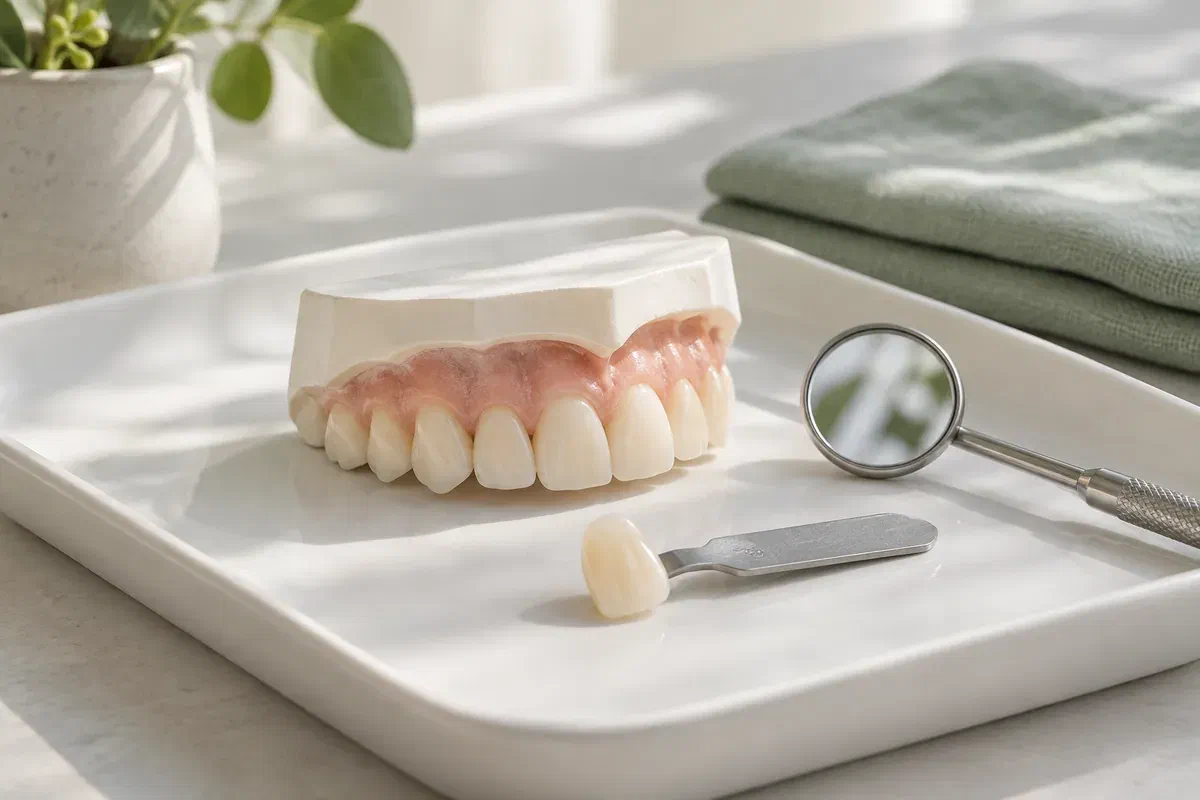
Illustrative front-teeth teaching model beside a shade sample and dental mirror
Start with the reason

The concern decides how much is done.

Explain what you would like to look different and how important it is to you. Assessment separates a preference about appearance from decay, gum problems or wear that would need other treatment.

A tooth that does not match the others

Tell us whether the colour is longstanding or more recent. A tooth that has darkened should be investigated before anything is bonded over it. Depending on the cause, whitening, cleaning, a filling or further tests may be more appropriate.

A shape that bothers you

Point to the length, width or edge that catches your eye, and whether it is one tooth or several. The neighbouring teeth may be fine as they are. Photos can explain what you like, but they do not show how much preparation your tooth would need.

Wear, clenching and past dental work

Grinding, repeated chips and fillings already on the tooth all affect preparation and longevity. Raise them at the start. The clinician may want to deal with bite forces or an older restoration before a veneer is discussed in detail.

Decay, gum health and symptoms are checked before any cosmetic plan. A veneer sits on top of a tooth; it will not resolve a problem underneath it.

What resin can do for a tooth

Change the look, and understand the cost to enamel

On a suitable tooth, composite can be shaded and sculpted to change its appearance, sometimes with modest preparation. You and the clinician will talk through colour, texture and proportion. A natural result does not need perfectly identical teeth or the brightest shade on the guide.

Resin does need ongoing care. It may lose polish, stain, wear or chip, and each of those can lead to polishing, repair or replacement. Any future work may also affect the tooth, so it is worth discussing the full lifecycle, not just the first appointment.

Patient information: American Dental Association — composite and porcelain veneers

A plan that preserves what you like

Tell us which parts of your smile you want kept. Many people want one detail softened and nothing more. Ask how the proposed surface relates to your other teeth and how much of your own tooth would remain untouched.

A frank comparison of preparation

Ask how much tooth structure each reasonable option would alter. Do not assume a resin veneer is reversible or requires no preparation just because it is composite. A clear picture of the starting step and the upkeep makes the choice fairer.

Only the teeth with a clear reason

Find out how many teeth the plan includes and what justifies each one. Each additional tooth means more preparation and more upkeep. Matching challenges should be explained without turning a single concern into a full-smile plan.

Inside the appointment

You will know what is being done, and why.

The number of visits depends on the teeth and the planned work. Ask what each stage involves, how comfort will be looked after, and when you can see the proposed shape before it is completed.

  1. Examination and discussion

    We talk about your concern, past dental work and any symptoms. The clinician examines teeth, gums and bite and notes whether X-rays or other records are needed. You decide together whether cosmetic treatment is appropriate now or whether another issue should come first.

  2. Agreeing the scope and preparation

    Compare a veneer with other reasonable options and settle which teeth are included. Ask exactly what preparation is planned and how the shade will relate to its neighbours and to any whitening. Confirm fees, maintenance and the limits of the change.

  3. Conditioning the tooth and adding resin

    For an agreed direct composite veneer, any planned preparation is carried out and the surface is conditioned so the resin can bond. Composite is applied in shaped layers and set with a curing light, with the outline built to suit the tooth and the available room.

  4. Polishing and checking the fit

    The veneer is finished and polished, and the clinician checks how your teeth meet and touch. Mention any spot that feels high or rough. You will review cleaning, any follow-up and the signs that should prompt a call.

After the veneer is placed

Protect the resin and the enamel it covers.

Care for both the veneer and your natural tooth. Follow the instructions you are given, and ask before using an abrasive product or trying to change the surface on your own.

Clean carefully every day

Brush with a fluoride toothpaste and clean between your teeth as recommended. Ask for a demonstration if the new contour feels unfamiliar. Bleeding that continues, trapped food or floss that shreds should be checked, not worked around.

Avoid unnecessary force on the veneer

Do not bite hard objects, chew ice or use the treated teeth to open things. Tell us about grinding or sports so protection can be discussed. A guard or retainer made before treatment may not fit the new surface.

Come in if the surface changes

Let us know about roughness, chips, staining or a different bite. The clinician can decide whether polishing, a repair or another step is needed, often without removing more tooth. Avoid filing, gluing or scrubbing the veneer at home.

Patient information: Cleveland Clinic — dental veneers and their care

Options that change less

Is there a gentler way to reach the goal?

For each choice, ask what it changes, how much preparation it involves and what it will not correct. The answer should reflect your teeth and the specific feature that matters to you.

When resin suits the change in question

Composite veneer or a small bonded repair

A veneer covers a whole front surface, while a small repair adds resin to one area and often involves less preparation. Ask which scope is justified. Both will need review and some maintenance over time.

When a different material or more coverage is raised

Porcelain or another restoration

Compare preparation, appearance, repair options and replacement needs. A more extensive restoration usually involves more change to the tooth, so it should have a clear reason. Ask what that reason is before assuming it is the better result.

When colour, position or preference points another way

Whitening, orthodontics or leaving it as is

Whitening lightens suitable natural teeth without adding material, and orthodontics moves teeth rather than covering them. Choosing to keep a healthy tooth as it is remains a valid decision once you know the options.

Brampton questions about preparation

How much of my own tooth is involved?

A veneer decision covers more than shade. Talk about preparation, the number of teeth, the care that follows, and what would happen if your oral health or preferences change in future.

(905) 876-4488
Can a composite veneer ever be placed with no enamel removed?
In some cases very little or no preparation is needed, depending on the tooth and the change planned. In others, shaping is required. The clinician will tell you what applies to your tooth before you agree to anything.
If I remove a composite veneer later, will my tooth look the same as before?
Not necessarily. Any preparation, bonding steps and later removal can change the surface. Ask what your tooth would be like if the veneer were taken off, so you understand how reversible the plan really is.
Will I need freezing for a composite veneer?
It depends on how much preparation is planned and on your comfort. Some appointments need little or no local anaesthetic, while others benefit from it. Ask how comfort will be managed for your visit.
Does a small chip need a full veneer, or just bonding?
A small chip can often be repaired with bonding to that area alone. A veneer is usually considered when the broader front surface needs changing. Ask which approach involves the least change for your concern.
Is my tooth weaker after a composite veneer?
That depends on the tooth, the preparation and your bite. The clinician considers these when planning. Mention grinding or heavy biting habits so the plan accounts for the forces the tooth will face.
Can I ask for a second appointment to think about it before any preparation?
Yes. You can take time after a consultation to consider the preparation, options and upkeep. No preparation needs to happen until you are comfortable with the plan.
Visiting from Brampton

Ask the hard questions first.

Book an assessment at our Bronte Street practice to talk through composite veneers and the alternatives. We will look at the teeth involved, the appearance you would like, and how much preparation and maintenance each option involves.

Whether resin is right for you rests on the strength of the tooth, the state of your gums and how you bite. The preparation, the planned appearance and the future upkeep should all be clear before treatment begins.

Visit Milton Dental Clinic
Unit 1, 342 Bronte St. S, Milton, ON L9T 5B7
Get directions Clinic hours
Monday–Thursday
11am–7pm
Friday–Sunday
By appointment only

Areas we serve

  • Milton
  • Oakville
  • Mississauga
  • Georgetown
  • Halton Hills
  • Acton
  • Campbellville
  • Brampton
  • Burlington
  • Puslinch
  • Rockwood
  • Erin
  • Caledon
  • Etobicoke
  • Old Milton
  • Bronte Meadows
  • Timberlea
  • Dorset Park
  • Dempsey
  • Clarke
  • Beaty
  • Coates
  • Harrison
  • Scott
  • Willmott
  • Ford
  • Bowes
  • Cobden
  • Walker
  • Mountain View
  • Milton Heights
  • Hawthorne Village
  • Valley View
  • Fallingbrook
  • Nassagaweya
  • Trafalgar
  • Esquesing
  • Nelson
  • Brookville
  • Moffat
  • Glen Williams
  • Norval
  • Limehouse
  • Stewarttown
  • Ashgrove
  • Hornby
  • Silver Creek
  • Speyside
  • Scotch Block
  • North Oakville
  • River Oaks
  • Glen Abbey
  • West Oak Trails
  • Palermo
  • Bronte Creek
  • College Park
  • Joshua Creek
  • Uptown Core
  • Preserve
  • Iroquois Ridge
  • Lisgar
  • Meadowvale
  • Meadowvale Village
  • Churchill Meadows
  • Erin Mills
  • Central Erin Mills
  • Streetsville
  • East Credit
  • Creditview
  • Heartland
  • Sheridan
  • Mount Pleasant
  • Credit Valley
  • Huttonville
  • Churchville
  • Springbrook
  • Northwest Brampton
  • Bram West
  • Fletcher's Meadow
  • Fletcher's Creek South
  • Alton Village
  • Orchard
  • Millcroft
  • Headon Forest
  • Tansley
  • Brant Hills
  • Tyandaga
  • Kilbride
  • Lowville
  • Aberfoyle
  • Morriston
  • Arkell
  • Hillsburgh
  • Freelton
  • Carlisle
  • Waterdown
  • Flamborough
  • Mountsberg

How can we help?

Milton Dental Clinic

Have a question about your smile? Choose the option that works best for you.

For urgent dental concerns, please call.
Messages are reviewed during clinic hours.