

Illustrative patient sharing smile goals with a dental clinician at a consultation table
Cosmetic Dentistry

Cosmetic Dental Consultation

You do not need to choose a treatment before asking about your smile. A cosmetic dental consultation in Milton helps connect your preferences with the condition of your teeth, suitable options, practical limits, and the maintenance each choice would involve.

A closer look at a cosmetic dental consultation

Begin with what matters to you, without having to name a procedure.

A cosmetic consultation is a chance to explain what you notice about your smile and understand the options. You might be curious about colour, a chipped edge, an uneven outline, or a restoration that stands out. The starting point can be a simple observation rather than a request for a particular treatment.

The discussion should connect that preference with an assessment of oral health. A surface stain, a changed tooth colour, and a damaged restoration can require different responses. Understanding the cause helps clarify whether the next step is cosmetic treatment, another kind of dental care, further information, or no change.

At Milton Dental Clinic, bring your questions, reservations, and priorities. You may want a subtle improvement, need time to compare costs, or prefer to avoid irreversible work. A useful consultation gives you a clearer basis for deciding what, if anything, you want to pursue.

Arrange a conversation about your smile
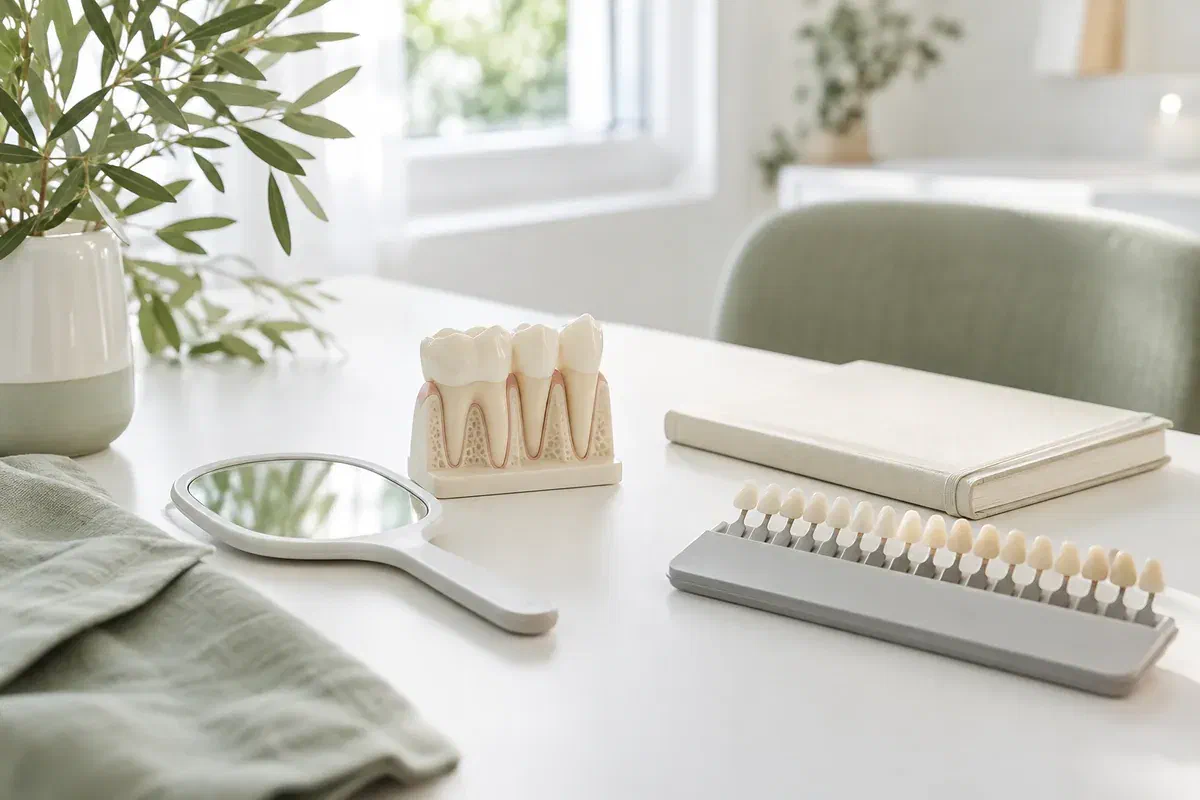
Illustrative consultation table with a teaching model, mirror, notebook, and tooth-shade guide
What to bring into the discussion

Describe the change you want and the things you value keeping.

Your own words are enough. Explain the feature that concerns you, when you notice it, and any practical limits that should be considered when discussing options.

A specific appearance question

Point to the tooth or area you are thinking about. If there are several concerns, say which matters most. A photograph can help explain a preference, but the aim is to understand your own teeth rather than copy another person's smile.

Symptoms, previous treatment, or recent changes

Mention pain, sensitivity, bleeding, injury, or a colour change even if you booked for appearance. Bring relevant information about older restorations, orthodontic care, and appliances. These details can change which options are appropriate and the order of care.

Time, budget, and maintenance preferences

Be open about the appointment commitment you can manage and the ongoing care you are comfortable with. Ask about costs without feeling you need to agree immediately. A plan is easier to assess when its practical requirements are discussed from the beginning.

A consultation does not require a decision to proceed with elective treatment. Ask what the visit includes, whether any additional records are needed, and which questions can be answered at that stage.

What you should gain from the visit

Leave with an explanation you can use to make a decision.

A helpful conversation separates the goal from the procedure. If you want a tooth to look less noticeable, there may be more than one way to approach it. Each option has its own limits, preparation, maintenance, and possible effect on the surrounding teeth.

You should also understand what remains uncertain. A recommendation may depend on further examination, records, disease management, or a specialist opinion. It is reasonable to ask for that uncertainty to be explained before treating a preliminary idea as a final plan.

Patient information: Cleveland Clinic — cosmetic dentistry options and considerations

A clear distinction between health needs and preferences

Ask which findings need attention for oral health and which choices are elective. The two can overlap, but they are not always the same. That distinction helps you decide priorities and understand why a cosmetic request may lead first to another assessment.

A comparison that includes doing less

Ask whether a smaller change, staged approach, or observation is reasonable. The discussion should explain what you would gain or give up with each choice. You do not need to assume the most extensive plan is the only worthwhile option.

An opportunity to make the plan understandable

Repeat the proposed steps back in your own words and ask about anything unclear. Useful questions include what would change permanently, what could need replacing, and who would provide each part of care. Take notes if that helps you consider the information later.

What happens during the consultation

Share the goal, assess the starting point, and discuss the choices.

The visit should make room for your questions as well as clinical findings. Ask beforehand about the appointment's scope and whether a separate examination or additional records may be needed.

  1. Talk through your preferences and history

    Describe what you hope to change and what you like about your current smile. Review relevant health information, medicines, previous dental work, and symptoms. Mention any event or deadline so its implications can be discussed without assuming treatment can be rushed.

  2. Assess the areas relevant to your concern

    The clinician considers the teeth, gums, existing restorations, and bite as appropriate. Photographs, radiographs, or other records may be recommended for a specific reason. Ask what each additional record is intended to clarify and whether the current information is enough to plan.

  3. Compare suitable options and their trade-offs

    Discuss the purpose of each reasonable approach, what preparation it involves, and the expected maintenance. Ask about risks, likely appointments, alternatives, and the estimated fees. If a referral is suggested, clarify what expertise or further opinion would help.

  4. Agree on the next decision, not just the next procedure

    You may choose further assessment, take time to consider a proposal, or proceed with a suitable plan. Confirm what has been agreed and what has not. Ask how to follow up with questions and whether any oral-health issue needs attention while you decide.

After your cosmetic consultation

Give yourself room to understand the recommendation.

The useful work after a consultation is often reviewing information and clarifying priorities. Continue your everyday oral care and follow any specific advice about findings that need attention.

Review the proposed scope and estimate

Check which teeth and procedures are included, how the stages connect, and what could create additional costs. Ask about maintenance and replacement as well as the first appointment. If a detail is unclear, request clarification before treating the estimate as a complete long-term plan.

Write down the questions that arise later

It is common to think of practical questions after leaving. Note whether you are uncertain about preparation, appearance, comfort, or timing. A short list makes a follow-up discussion more useful than trying to remember everything during the next appointment.

Coordinate other treatment and existing appliances

Tell the team if another clinician is planning dental work or if you use a retainer or guard. Do not begin an unrelated whitening or tooth-shaping approach while a coordinated plan is being considered. Ask how the order of care affects shade and fit.

Possible directions after the visit

The next step should follow the finding and your preference.

A consultation may lead to a straightforward plan, a staged discussion, or a decision to leave a healthy feature alone. The important point is understanding why that next step makes sense.

When one suitable change addresses the concern

A focused cosmetic treatment

A specific colour, contour, or restoration concern may have a focused option. Ask what it would change and what it would leave untouched. The plan should explain the preparation and aftercare without expanding automatically into treatment of unrelated teeth.

When a sound decision needs more information

Health care, records, or specialist advice first

A gum, structural, alignment, or symptom concern may need attention before elective work. Clarify what must be resolved and when cosmetic choices can be revisited. Further assessment should answer a defined question rather than leave you unsure why treatment has been deferred.

When you want to understand the choices before committing

Time to consider, a second opinion, or no change

You can compare the recommendation with your priorities and seek another opinion if helpful. Ask about any health findings that still require care. Choosing not to change a healthy appearance feature can be a considered outcome of the consultation.

Questions about booking a cosmetic consultation

You can arrive curious, uncertain, or ready to compare options.

The visit is a place to clarify the decision. Practical questions are welcome, including those about cost, treatment scope, and whether doing nothing is reasonable.

(905) 876-4488
Can I book a cosmetic consultation if I do not know which procedure I want?
Yes. Describe the feature you notice and the change you hope for. The assessment and discussion can help identify suitable options. You do not need to diagnose the cause or choose between treatments before asking for advice.
Should I bring a photograph of a smile I like to the consultation?
It can help explain a preference, such as a subtle shade or a particular outline. Treat it as a conversation aid rather than a promised result. Your tooth structure, bite, and overall circumstances determine what is appropriate for your own smile.
Will a cosmetic consultation tell me whether an appearance concern is also a health issue?
That is an important question to discuss. The clinician can explain the relevant findings and whether more assessment is needed. Mention symptoms or recent changes, and ask which recommendations address oral health versus an elective appearance preference.
How should I compare two cosmetic plans that involve different numbers of teeth?
Ask what each plan is intended to achieve, why each tooth is included, and what the smaller plan would leave unchanged. Compare preparation, maintenance, risks, and costs as well as appearance. A useful explanation makes the difference in scope understandable.
Can I ask for a cosmetic plan to be staged instead of completed all at once?
Yes. Explain your timing and budget preferences. The clinician can discuss whether staging is practical and how it might affect shade matching, sequencing, temporary work, or overall cost. Some steps depend on others, so ask which parts can sensibly be separated.
What should I ask before agreeing to an irreversible cosmetic procedure?
Clarify what tooth structure would be changed, why that change is recommended, and what alternatives exist. Ask about risks, future repairs or replacement, and the outcome you can reasonably expect. Take time to resolve unanswered questions before proceeding.
Cosmetic dental consultation in Milton

Bring one question or a whole list. Start with a conversation.

Contact our Bronte Street practice to arrange a cosmetic dental consultation. Tell us what you would like to understand, whether there are any symptoms, and the priorities you want considered as you explore suitable next steps.

A consultation helps clarify options and does not guarantee suitability for a requested procedure. Ask about the visit's scope and fees when arranging the appointment.

Visit Milton Dental Clinic
Unit 1, 342 Bronte St. S, Milton, ON L9T 5B7
Get directions Clinic hours
Monday–Thursday
11am–7pm
Friday–Sunday
By appointment only

How can we help?

Milton Dental Clinic

Have a question about your smile? Choose the option that works best for you.

For urgent dental concerns, please call.
Messages are reviewed during clinic hours.