
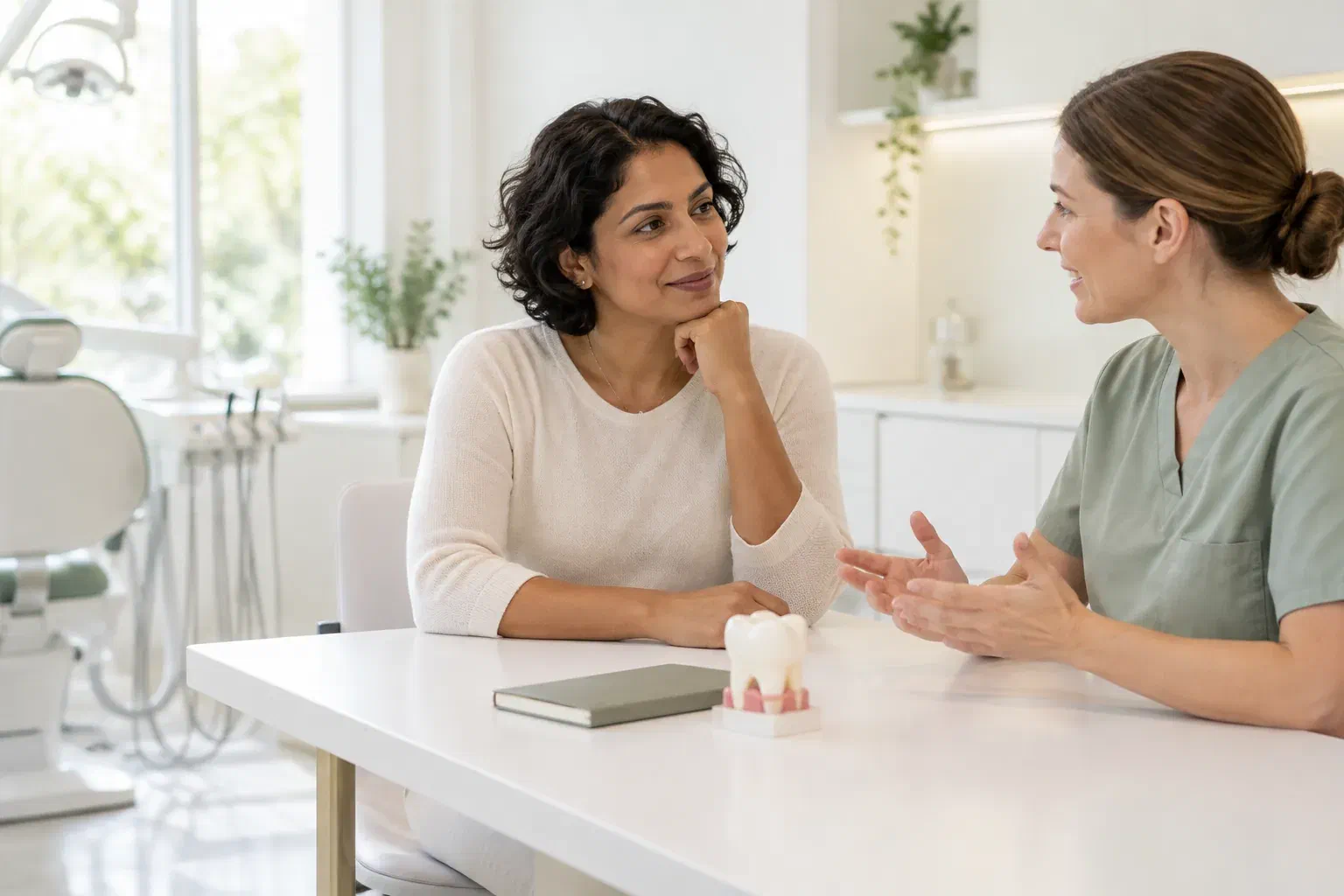
Illustrative patient sharing smile goals with a dental clinician at a consultation table
Cosmetic Dentistry

Cosmetic Dental Consultation in Old Milton

An old crown that has gone grey at the gumline, a filling that no longer matches, a smile that changed slowly over decades. A cosmetic dental consultation for Old Milton starts with what you see now and explains the options, limits, and upkeep behind each one.

When older dental work starts to show

Smiles change gradually. The conversation about them can start any time.

Restorations placed years ago can age differently from the teeth around them. A crown edge may become visible, a tooth-coloured filling may darken, and natural teeth may wear or shift. None of that has to be framed as a request for a specific procedure. Noticing it is a reasonable place to begin.

The first task is working out why something looks the way it does. A worn restoration, a stain sitting on the enamel, and a tooth that has changed colour from within are separate situations. That cause decides whether the answer is cosmetic care, a different kind of treatment, more information, or leaving things alone.

Long-time homeowners and newer arrivals around Old Milton bring very different histories of dental care. Share yours, along with how much change you want, how you feel about cost, and whether you would rather avoid altering sound teeth. A thoughtful consultation turns those priorities into a decision you can make calmly.

Ask about the dental work that bothers you
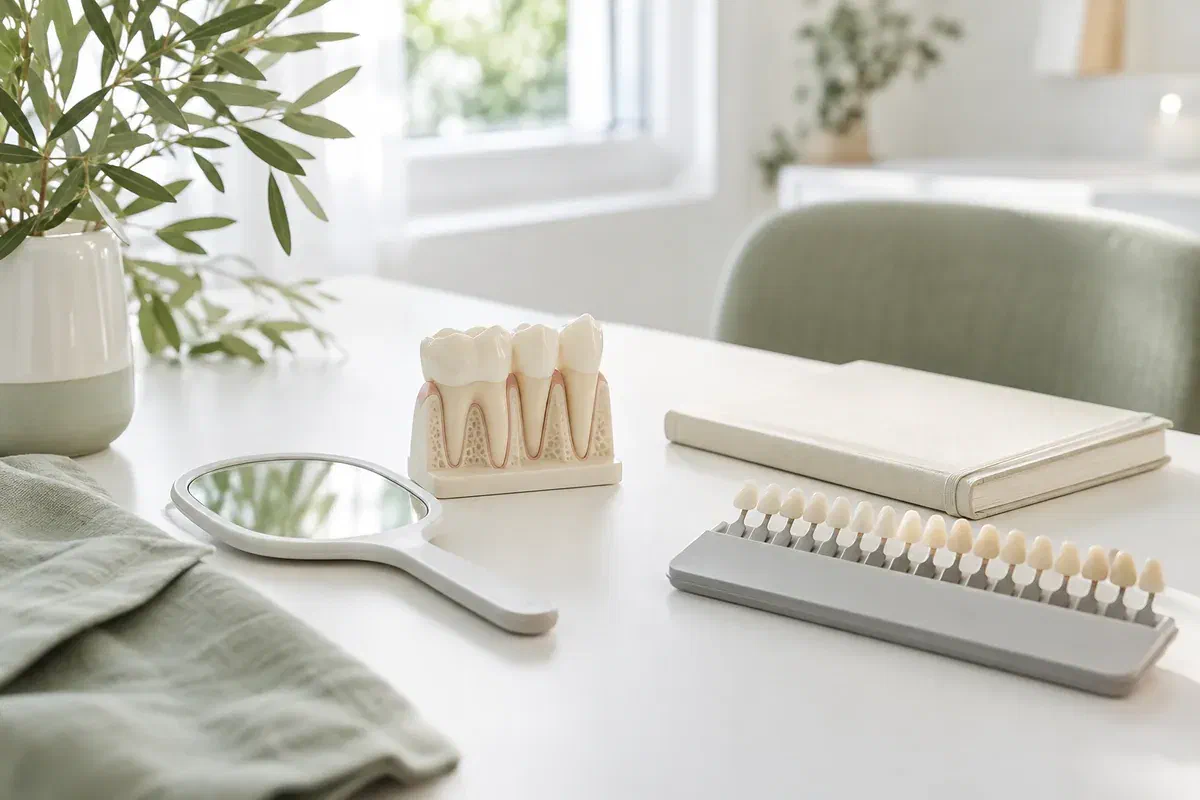
Illustrative consultation table with a teaching model, mirror, notebook, and tooth-shade guide
Useful details to share

History, hopes, and practical limits all belong in the room

Plain language is fine. Describe the area that concerns you, when it began to stand out, and the constraints, such as time or budget, that the options need to respect.

The restoration or tooth you would change

Indicate exactly where you are looking, and if several areas bother you, choose the one that matters most. An older photo of your own smile can show what has changed. The focus stays on your mouth, rather than matching a stranger's teeth.

Past treatment and anything new you have felt

Note when crowns, bridges, or large fillings were placed, if you remember, and mention orthodontic work or appliances. Report sensitivity, tenderness, bleeding, or a recent injury as well. Those facts affect which options are suitable and what should happen first.

How much time, cost, and upkeep feel right

Tell the team how many visits you could reasonably attend and what daily or long-term care you would accept. Questions about fees are welcome, and agreeing on the day is not expected. A plan is simpler to evaluate when its demands are clear early.

Attending a consultation does not commit you to cosmetic work. Ask when you book what the appointment involves, whether more images might be recommended, and which questions can be answered at that visit.

Why the conversation is worthwhile

Clarity about old work, new options, and what to leave alone

It helps to separate the result you want from the method used to reach it. A restoration that stands out might be refreshed, replaced, or approached differently, depending on what is found. Each route has limits, preparation, maintenance needs, and effects on nearby teeth worth understanding.

Not every answer arrives at once. Replacing older dental work, for example, can reveal what lies underneath only when it is removed. Ask the clinician to describe what is uncertain, and whether further exams, records, or a specialist view would firm up a preliminary idea.

Patient information: Cleveland Clinic — cosmetic dentistry options and considerations

Sorting health needs from personal preference

Some findings around older restorations, such as leaking margins or decay, may matter for oral health. Others are purely visual. The two can overlap, so ask which is which. That helps you set priorities and understand why one step might come before another.

An honest look at the modest options

Ask whether replacing one visible restoration, staging the work, or simply monitoring would be reasonable. The discussion should cover what each choice gains and what it leaves unchanged. A larger plan is not the only route worth considering.

Steps you can follow from start to finish

Summarize the proposal back in your own words and point out anything that feels fuzzy. Ask what would be permanent, what may need redoing in the future, and who would perform each part. Writing things down can make the details easier to revisit.

Inside the consultation

From your story to a set of choices you understand

Clinical findings matter, and so do your questions. Before the day, ask what the appointment includes and whether a separate examination or additional records may be advised.

  1. Go over what you want and what came before

    Describe the change you have in mind and the features you would like kept. Review medical history, medicines, and the dental work you have had over the years, plus any symptoms. Mention a family event or date so its timing can be discussed realistically.

  2. Look closely at the relevant teeth and restorations

    Depending on the concern, the clinician checks teeth, gums, crowns, fillings, and bite. Images or other records may be proposed when they would answer something specific. It is reasonable to ask what each one is for and whether existing information already covers it.

  3. Lay the options out with their trade-offs

    Talk through the purpose of each sensible approach, the preparation involved, and how it would need to be maintained. Ask about risks, how many appointments to expect, alternatives, and estimated fees. If another clinician is mentioned, ask what their input would clarify.

  4. Agree on what you are deciding now

    The outcome might be further assessment, time to reflect on a proposal, or going ahead with a suitable plan. Confirm which points are settled and which are not. Ask how to send follow-up questions and whether any health concern needs care in the meantime.

Once you are home again

Reflect before you choose.

Afterwards, the main job is usually reviewing what you heard and confirming your priorities. Keep your daily oral hygiene routine and follow any advice given about findings that need care.

Study the treatment scope and the estimate

Confirm which teeth and procedures are listed, how the stages fit together, and what could add expense. Ask about maintenance and the likely lifespan of new work, not only the first visit. If something is unclear, ask before treating the estimate as the complete picture.

Collect the questions that come to you later

Second thoughts and new questions are normal a day or two after a consultation. Note anything about preparation, appearance, comfort, or scheduling. A short written list keeps a follow-up call or visit focused.

Share news of other care or appliances

Let the team know if a specialist or another dentist has work planned, or if you wear a retainer, partial denture, or guard. Avoid starting whitening or shaping treatment elsewhere while a combined plan is under review. Ask how the order of steps affects colour and fit.

What might follow

Three broad paths, each with its own reasoning

You could leave with a simple plan, a phased approach, or the reassurance that a healthy feature can stay as it is. Whichever it is, you should understand why it suits your situation.

When one appropriate change answers the concern

A single, targeted improvement

An old restoration or one discoloured tooth may have a focused solution. Ask what would change and what would remain as it is. The proposal should describe preparation and aftercare clearly, without spreading to teeth that were never part of your question.

When more information is needed to choose well

Health treatment or more detail first

Decay under older work, gum concerns, or bite and symptom findings might need attention before elective care. Clarify what has to be resolved and when the cosmetic question can return. Any extra assessment should have a defined purpose, so the pause makes sense.

When you would like to weigh everything first

A pause, a second view, or no change at all

Compare the advice with your own priorities and ask for another opinion if it would reassure you. Find out which health findings still need care. Leaving a healthy, familiar feature exactly as it is can be a sound conclusion.

Questions from Old Milton

Old work and new ideas both deserve a question.

Use the visit to understand your options fully. Questions about cost, how much treatment is really involved, and whether to leave things alone are all fair.

(905) 876-4488
My crown is many years old. Does it need replacing just because it looks dated?
Not necessarily. Appearance alone does not always mean a restoration has failed. The clinician can check its fit and the tooth around it, and explain whether replacement would be for health reasons, appearance, or both, so you can decide.
Can a new crown or filling be matched to teeth I might whiten later?
Ask about sequencing. Whitening typically affects natural teeth rather than existing restorations, so the order of care can matter for shade. The clinician can explain how timing might influence the match before any new work is made.
Do I need to know the name of a treatment before I book?
No. Describe what you notice and how you would like it to look or feel. The examination and conversation can identify suitable approaches. Diagnosing the cause or comparing procedures in advance is not your job.
My teeth have shifted slightly over the years. Is that a cosmetic or a health question?
It can be either, or both. Mention when you noticed the change and any related symptoms. The clinician can explain what the findings suggest, whether further assessment is reasonable, and which recommendations are about appearance versus oral health.
If I replace one old restoration, will I feel I have to replace all of them?
Ask what replacing one would mean for how the others look. The clinician can explain whether a single change is likely to blend in or make neighbouring work more noticeable. Knowing that in advance helps you choose the right scope.
What should I understand before agreeing to permanent changes to a tooth?
Ask how much natural structure would be altered, why that is being recommended, and which alternatives exist. Discuss risks, future repairs, and a realistic outcome. You can take time to settle unanswered questions before going ahead.
Near Milton's historic downtown

Bring your history. We will start from there.

Call or message our Bronte Street practice, close to Old Milton's historic core, to arrange a cosmetic dental consultation. Tell us what you would like to understand, note any symptoms, and share the priorities you want respected as next steps are explored.

A consultation clarifies options and cannot confirm in advance that a requested procedure will suit you. Ask about the scope of the visit and its fees when you book.

Visit Milton Dental Clinic
Unit 1, 342 Bronte St. S, Milton, ON L9T 5B7
Get directions Clinic hours
Monday–Thursday
11am–7pm
Friday–Sunday
By appointment only

Areas we serve

  • Milton
  • Oakville
  • Mississauga
  • Georgetown
  • Halton Hills
  • Acton
  • Campbellville
  • Brampton
  • Burlington
  • Puslinch
  • Rockwood
  • Erin
  • Caledon
  • Etobicoke
  • Old Milton
  • Bronte Meadows
  • Timberlea
  • Dorset Park
  • Dempsey
  • Clarke
  • Beaty
  • Coates
  • Harrison
  • Scott
  • Willmott
  • Ford
  • Bowes
  • Cobden
  • Walker
  • Mountain View
  • Milton Heights
  • Hawthorne Village
  • Valley View
  • Fallingbrook
  • Nassagaweya
  • Trafalgar
  • Esquesing
  • Nelson
  • Brookville
  • Moffat
  • Glen Williams
  • Norval
  • Limehouse
  • Stewarttown
  • Ashgrove
  • Hornby
  • Silver Creek
  • Speyside
  • Scotch Block
  • North Oakville
  • River Oaks
  • Glen Abbey
  • West Oak Trails
  • Palermo
  • Bronte Creek
  • College Park
  • Joshua Creek
  • Uptown Core
  • Preserve
  • Iroquois Ridge
  • Lisgar
  • Meadowvale
  • Meadowvale Village
  • Churchill Meadows
  • Erin Mills
  • Central Erin Mills
  • Streetsville
  • East Credit
  • Creditview
  • Heartland
  • Sheridan
  • Mount Pleasant
  • Credit Valley
  • Huttonville
  • Churchville
  • Springbrook
  • Northwest Brampton
  • Bram West
  • Fletcher's Meadow
  • Fletcher's Creek South
  • Alton Village
  • Orchard
  • Millcroft
  • Headon Forest
  • Tansley
  • Brant Hills
  • Tyandaga
  • Kilbride
  • Lowville
  • Aberfoyle
  • Morriston
  • Arkell
  • Hillsburgh
  • Freelton
  • Carlisle
  • Waterdown
  • Flamborough
  • Mountsberg

How can we help?

Milton Dental Clinic

Have a question about your smile? Choose the option that works best for you.

For urgent dental concerns, please call.
Messages are reviewed during clinic hours.