

Illustrative patient discussing smile planning with a dental clinician at a consultation desk
Cosmetic Dentistry

Digital Smile Design in Erin

A new smile is something you brush, floss, chew with and look after for years. Digital smile design for Erin shows a proposed change on screen, then keeps the discussion grounded in the daily care, check-ups and limits that would come with it.

Living with the result

Beyond the reveal: brushing, chewing, maintaining

Picture an ordinary evening at the bathroom sink. Whatever your smile looks like after treatment, that routine continues, and some options change it more than others. Digital smile design combines clinical photographs, other suitable records and planning software to illustrate a proposed tooth shape or proportion. It is most useful when the conversation it starts includes what living with the change would involve.

On its own, the picture says nothing about upkeep. It also can't confirm that the gums, bite or available tooth structure suit the change, and it doesn't settle the final appearance. The examination and a clear explanation of procedures, preparation and maintenance supply that missing half.

Many people coming from Erin or Hillsburgh like to group dental appointments, so it helps to ask early what the consultation includes. Tell us what you'd like to change and how much routine care you're comfortable with. We'll recommend planning steps that suit, and explain each one.

Ask what a change would mean day to day
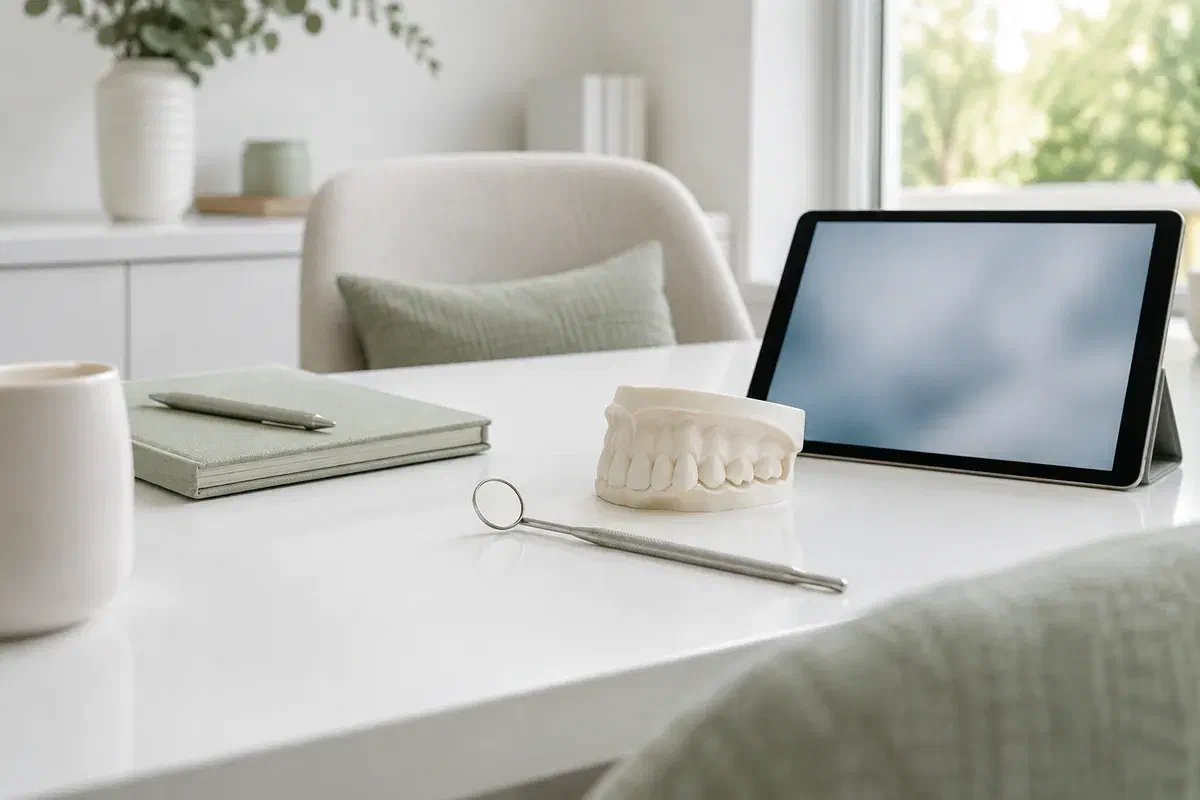
Illustrative dental planning desk with a teaching model, mirror, and tablet
Questions to bring to the screen

Looks good. But what does it ask of you?

Tell us the feature you want to alter and the parts of your smile you're happy with. A useful discussion makes the goal precise, and it may show that a difference doesn't need treating.

Proportions that feel slightly off

A tooth can seem too narrow, long or prominent without your being sure which. A proposal helps you name it. Then ask whether the new outline would come from added material, some reduction of enamel, or tooth movement, and how each would be cared for.

Treatments with very different upkeep

Composite, porcelain, crowns and aligners can all produce a similar preview. Each asks for different care afterwards, from polishing and repair to retainers. Ask what each route would change, what it would leave, and what your routine would look like.

A plan with several moving parts

Gum health, alignment, colour and restorations can affect each other and the order of care. Ask how the stages link and what home care each stage needs. A trustworthy proposal makes all this visible instead of hiding it behind a polished slide.

A preview illustrates a proposal; it isn't a diagnosis or a guarantee. Ask what the exam has confirmed and what is still to be checked.

What visual planning offers

One clear target, discussed in practical terms

A visual lets you and the clinician focus on the same feature. You can point to the edge or proportion you mean, and then ask how the proposed change would be achieved and maintained.

Its value depends on that practical discussion. Question the proposal, find out what it leaves out, and compare it with options that need less upkeep. A handsome image shouldn't make a long-term commitment feel already made.

Patient information: Research — smile documentation and digital planning · Clinical study — digital and conventional smile design

Your priorities on the table

Some people care most about appearance; others put low maintenance first. Seeing a concrete proposal helps you say which matters more to you. That shapes the plan, alongside the clinical findings.

The same brief for everyone involved

If a specialist or laboratory takes part, shared records help each person work toward one agreed result. Ask how the goal would be passed along, who looks after each stage, and who explains any change.

Long-term care in plain view

For each option, ask about preparation, appointments, fees, and future maintenance such as repairs or replacement. Knowing that, a simpler change may suit your routine and priorities better than the full design.

The planning steps

Assess, record, propose, then talk upkeep.

Records and tools vary from one situation to the next. Ask what is suggested, what it costs, and whether further assessment or a referral could be part of it.

  1. Goals and an examination

    Share what you'd like to change, your dental history, symptoms, any previous cosmetic work and your current home routine. The teeth, gums and bite are then assessed. Note any timing pressures and features you'd like left alone.

  2. The records that are really needed

    Depending on the goal, you may be offered clinical photos from set angles along with other relevant records. You're entitled to know what each one is for. A proposal based on proper records gives a much more realistic basis for discussion than an everyday photo would.

  3. Proposal plus practicalities

    The proposed shapes are reviewed with the procedures they require and the care each would need afterwards. Raise alternatives and limits, and ask whether a try-in or more assessment would help. Check what is still provisional.

  4. Your decision, in your time

    You may want a revision, another discussion or a treatment decision. Confirm the scope, estimate and next step before proceeding. Reviewing a design never obliges you to accept the procedures it implies.

After the planning visit

Imagine the routine, not only the result.

A design review usually leaves you with something to consider. Look at the explanation alongside the image, and ask further questions before agreeing to any irreversible work.

List the work and the care

For every tooth involved, note what would be done and what care it would need afterwards. Ask whether a lower-maintenance route could reach a similar goal. Keep a note of questions about referrals or records.

Allow for the limits of a screen

An image can't show how a restoration feels when you floss beside it, or how its surface will look after years of use. Ask how fit and comfort would be checked, and what a temporary mock-up can't tell you.

Keep your current care going

Hygiene visits, routine exams and treatment for anything already causing trouble should carry on while you decide. If something new crops up, or another dentist sees you in the meantime, mention it at your next appointment. Changes to your teeth may mean the proposal needs another look.

Finding the right amount of planning

Plan in proportion to the change.

Software-based design is one planning approach. Its usefulness depends on the change being considered and the information needed to decide sensibly.

For a change across several teeth or proportions

An on-screen proposal

A digital illustration can help define a broader goal. Ask what records it relies on and what it shows. Its feasibility, preparation and the routine care it would require still need explaining by the clinician.

For seeing or feeling the shape before deciding

Models, extra records or a trial smile

Where suitable, models, added records or a temporary mock-up can show aspects a screen misses. Ask what each method reveals and what stays uncertain. No planning aid replaces the examination.

For a minor issue or early curiosity

A simple assessment

A small concern might be handled after one consultation, without a design process. You can decide later whether more planning is worthwhile. Ask about scope and fees before extra records are taken.

Erin questions about smile design

Care, upkeep and what the preview means

These answers focus on what living with a change would involve. Bring other questions to your visit.

(905) 876-4488
Will cosmetic restorations change how I brush and floss?
They may. Some restorations need particular care where they meet the natural tooth and gum, and certain brushes, floss types or toothpastes may be suggested. Ask what home care each option in your proposal would involve, and whether a hygienist can show you the technique.
Would I need to wear a retainer if orthodontics is part of the plan?
Retainers are commonly recommended after teeth are moved, to help keep them in their new positions. Ask what retention would involve for you, how long it is usually advised, and how it would fit alongside any restorations planned afterwards.
How often might restorations shown in a smile design need repair?
That varies with the material, your bite, habits and care. No exact lifespan can be promised. Ask what maintenance and eventual replacement might look like for each option, and what signs would tell you a restoration needs checking sooner.
Does a nightguard ever form part of a cosmetic plan?
If grinding or clenching is a concern, a nightguard may be suggested to help protect teeth and restorations. Ask whether your bite or habits make this relevant.
Can I accept the look of a design without agreeing to every procedure?
Yes. A preference about appearance is separate from consent. Each procedure, with its risks, costs and alternatives, should be explained, and you can choose all, part or none of it.
Can routine checkups and planning visits be combined for trips from Erin?
Ask when booking. Depending on what is needed, it may be possible to arrange appointments close together or handle more than one step in a visit, where that is clinically sensible.
Smile planning for Erin

A plan you can see, and live with.

Visit us on Bronte Street to discuss the change you're considering and the care it would ask of you. We'll explain the information needed and how a proposal can help you choose something that fits your routine.

Planning approaches vary with individual needs. A digital design illustrates a proposal rather than a guaranteed result, and it doesn't replace an exam or an informed treatment decision.

Visit Milton Dental Clinic
Unit 1, 342 Bronte St. S, Milton, ON L9T 5B7
Get directions Clinic hours
Monday–Thursday
11am–7pm
Friday–Sunday
By appointment only

Areas we serve

  • Milton
  • Oakville
  • Mississauga
  • Georgetown
  • Halton Hills
  • Acton
  • Campbellville
  • Brampton
  • Burlington
  • Puslinch
  • Rockwood
  • Erin
  • Caledon
  • Etobicoke
  • Old Milton
  • Bronte Meadows
  • Timberlea
  • Dorset Park
  • Dempsey
  • Clarke
  • Beaty
  • Coates
  • Harrison
  • Scott
  • Willmott
  • Ford
  • Bowes
  • Cobden
  • Walker
  • Mountain View
  • Milton Heights
  • Hawthorne Village
  • Valley View
  • Fallingbrook
  • Nassagaweya
  • Trafalgar
  • Esquesing
  • Nelson
  • Brookville
  • Moffat
  • Glen Williams
  • Norval
  • Limehouse
  • Stewarttown
  • Ashgrove
  • Hornby
  • Silver Creek
  • Speyside
  • Scotch Block
  • North Oakville
  • River Oaks
  • Glen Abbey
  • West Oak Trails
  • Palermo
  • Bronte Creek
  • College Park
  • Joshua Creek
  • Uptown Core
  • Preserve
  • Iroquois Ridge
  • Lisgar
  • Meadowvale
  • Meadowvale Village
  • Churchill Meadows
  • Erin Mills
  • Central Erin Mills
  • Streetsville
  • East Credit
  • Creditview
  • Heartland
  • Sheridan
  • Mount Pleasant
  • Credit Valley
  • Huttonville
  • Churchville
  • Springbrook
  • Northwest Brampton
  • Bram West
  • Fletcher's Meadow
  • Fletcher's Creek South
  • Alton Village
  • Orchard
  • Millcroft
  • Headon Forest
  • Tansley
  • Brant Hills
  • Tyandaga
  • Kilbride
  • Lowville
  • Aberfoyle
  • Morriston
  • Arkell
  • Hillsburgh
  • Freelton
  • Carlisle
  • Waterdown
  • Flamborough
  • Mountsberg

How can we help?

Milton Dental Clinic

Have a question about your smile? Choose the option that works best for you.

For urgent dental concerns, please call.
Messages are reviewed during clinic hours.