

Illustrative patient discussing smile planning with a dental clinician at a consultation desk
Cosmetic Dentistry

Digital Smile Design in Oakville

Sometimes a group photo is what starts it: a tooth that looks longer than you remember, or a smile that seems lopsided. Digital smile design for Oakville helps you decide whether a change is worth exploring by setting a visual proposal beside your exam and its limits.

It started with a photo

Is it worth changing at all?

A wedding album, a work headshot or a holiday picture can make a familiar smile suddenly look unfamiliar. Before deciding anything, it helps to see what a different shape or proportion might look like. Digital smile design uses clinical photographs, other relevant records and software to illustrate that possibility in relation to your face.

An illustration still leaves the main questions open. Your gum health, the way your teeth meet and the amount of tooth available all decide what is realistic, and none of that is visible in the image. The real value comes when the picture is linked to the procedures, preparation and long-term upkeep it would need.

For people coming from Oakville, the first visit can simply be about whether to pursue anything. Tell us what you noticed, when it bothers you, and what you'd like to understand. We will explain which planning steps might help and what the consultation itself includes.

Find out if a visual plan would help you
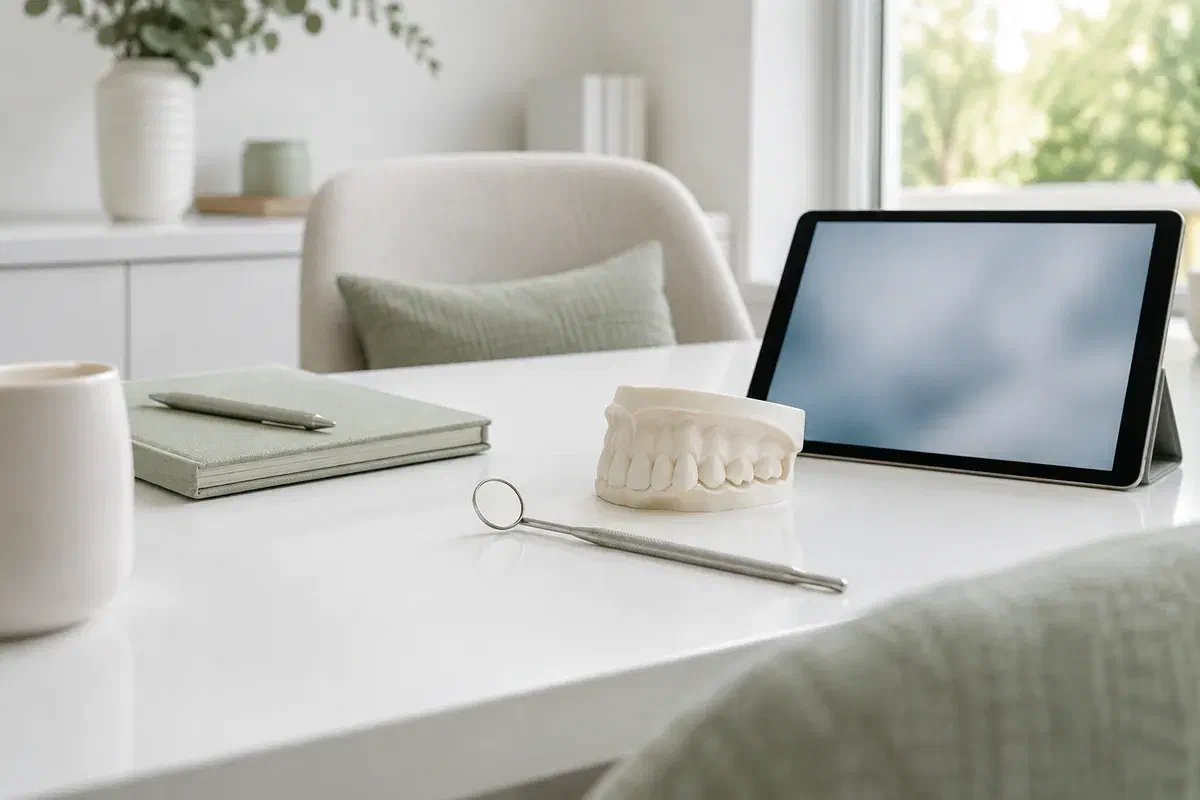
Illustrative dental planning desk with a teaching model, mirror, and tablet
Questions a proposal can sharpen

Is it the tooth, the angle, or the light?

Photos exaggerate some things and hide others. A design discussion should help you pin down a real feature, and it may confirm that something you noticed doesn't need treatment.

A tooth that seems too long or too wide

In a photo it can be hard to tell whether a tooth is truly out of proportion or just catching the camera. A side-by-side proposal can show what you are reacting to. Then ask whether a new outline would mean adding material, reshaping, or moving the tooth.

Not knowing which treatment a preview implies

Previews that look alike may depend on quite different work, from bonding to orthodontics to crowns. Ask what each would change and what it would keep. The image itself won't tell you whether you are looking at a surface treatment or months of tooth movement.

Several issues that might need an order

If colour, gum line and position are all on your mind, find out how they affect one another. One stage may need to be finished before another can be planned. A good proposal lays this out rather than letting a tidy image stand in for open decisions.

Think of a preview as an illustration, not a diagnosis or a promise. Ask what has been confirmed by the exam and what still needs to be checked.

What you gain from a visual

A clearer conversation, with less guesswork

It is easier to agree on a change when you are both looking at the same thing. Instead of hoping words like brighter or more even mean the same to the clinician, you can point to an edge or a gap and say what you prefer.

That shared view is where the benefit lies. You should be able to question it, learn what it leaves out, and compare it with other routes, including doing nothing. An appealing picture shouldn't rush a decision that hasn't been fully explained.

Patient information: Research — smile documentation and digital planning · Clinical study — digital and conventional smile design

A way to test your own reaction

Seeing a proposal often tells you more about your preferences than any description could. You might find a subtle change suits you better than a perfectly even row. That reaction is useful in planning, though it doesn't replace the clinical assessment.

Consistency if a lab or specialist is involved

When others contribute to the work, shared records help keep the goal consistent. Ask how the plan will be communicated, who is responsible for which part, and who will tell you if something changes.

The full picture of what a change asks of you

Ask what the illustrated result would need in terms of preparation, visits, fees and maintenance. Once that is clear, you may choose a lighter touch or decide to leave things as they are, and either choice is reasonable.

What the planning involves

Four stages, each with room for questions

Records and tools vary with the case. Ask which steps are recommended, the fees for each, and whether an additional assessment or a referral could be needed.

  1. Explain what you noticed

    Bring up the photo or moment that prompted the visit, along with your dental history, symptoms and any earlier cosmetic work. The clinician examines the teeth, gums and bite. Mention deadlines, such as an upcoming event, and anything you want unchanged.

  2. Gather the right records

    Clinical photographs and other suitable records may be suggested so the proposal reflects reality. Ask why each is needed. A design built from proper records is far more useful than one based on the photo that first caught your attention.

  3. Walk through the proposal

    Shapes and proportions are reviewed along with the treatment needed to produce them. Ask about alternatives and limits, and whether a physical mock-up or more assessment would help. Find out which details are still provisional.

  4. Decide at your own pace

    You may ask for changes, take time to think, or choose to proceed. Before anything else, confirm the scope, estimate and next stage. Looking at a design is not the same as signing up for every procedure in it.

After you've seen it

Sleep on it before anything permanent

Most people go home to think after a planning review. Revisit the explanation, not just the image, and ask follow-up questions before agreeing to work that can't be reversed.

Match the look to the procedures

Make a note of which teeth would be treated and how. Ask whether the same preference could be reached another way. Record anything still unanswered about preparation, referral or records so it is settled before treatment.

Know the limits of a preview

A preview can't show how a restoration will feel, or how a material will look in bright sun versus a dim room. Ask how bite and comfort will be assessed. If a trial smile is offered, ask what it can't tell you either.

Don't pause your regular care

Keep up with checkups and treatment for any active problem. Tell the team about new symptoms or work done by another provider. A proposal may need updating if your teeth or the planned sequence change.

Deciding how far to go with planning

The smallest useful step is often the right one.

Digital design is one planning method among others. Whether you need it depends on the change in question and what information a careful decision requires.

For when a visual comparison would clarify the goal

A digital design

A digital illustration can help when proportions or a broader change are being considered. Ask what records support it and what it represents. It still needs a clinical explanation of what is feasible, what preparation is involved and what upkeep follows.

For when another kind of assessment would help

A mock-up, models or more records

Some questions are better explored with study models, extra records or a temporary trial in the mouth, where suitable. Ask what each can show and what remains uncertain. No planning aid replaces the exam or confirms every detail ahead of time.

For when you are still deciding whether to change anything

A consultation only

If the concern is minor, or you aren't sure it is worth acting on, a simple assessment may be enough. You can decide later if further planning would help. Ask about scope and fees before any extra records are made.

Oakville questions about smile planning

Things people ask before they decide

These answers help separate what a proposal shows from what treatment would involve. Ask anything else at your visit.

(905) 876-4488
What if the thing I noticed in a photo turns out not to need treatment?
That is a perfectly good outcome. Cameras, lighting and angles can exaggerate small differences. If the exam finds nothing that needs care, you can leave things as they are or keep an eye on them at routine visits.
Can a design be ready before a specific event?
Mention the date when you book. Some planning can be done fairly quickly, but treatment itself may take longer, and rushing irreversible work is rarely wise. Ask what is realistic in your timeframe and what could wait until afterwards.
Is the preview a promise of how my smile will look?
No. It shows a proposal within the limits of the records and the method used. Materials, clinical conditions and how treatment proceeds all shape the actual result. Ask which parts are realistic goals and which remain provisional.
Could orthodontics give me the look in the design instead of veneers?
In some cases, moving teeth is one of the routes to a proposed shape or alignment. In others, restorative work or a combination may be suggested. Ask whether an orthodontic opinion is worth getting before any permanent change to tooth structure.
Does digital smile design look at my lips and face, or just my teeth?
Smile design generally considers how the teeth relate to the lips and face, which is part of why photographs are used. Ask how those relationships were considered in your proposal and what limits they place on the change.
How should I plan my visits from Oakville if I need more than one appointment?
Ask at booking what the first visit covers and whether records or a review might follow separately. Knowing the likely number of appointments helps you arrange time away from work or family commitments in advance.
From Oakville to a clearer plan

Find out what's realistic before deciding what you want.

Come in to our Bronte Street practice and tell us what caught your eye. Together we can look at whether a visual plan would be useful, what information it would rely on, and how it might guide your next decision.

The right planning method depends on individual needs. A digital image does not guarantee an outcome and is no substitute for clinical assessment and a full discussion of treatment.

Visit Milton Dental Clinic
Unit 1, 342 Bronte St. S, Milton, ON L9T 5B7
Get directions Clinic hours
Monday–Thursday
11am–7pm
Friday–Sunday
By appointment only

Areas we serve

  • Milton
  • Oakville
  • Mississauga
  • Georgetown
  • Halton Hills
  • Acton
  • Campbellville
  • Brampton
  • Burlington
  • Puslinch
  • Rockwood
  • Erin
  • Caledon
  • Etobicoke
  • Old Milton
  • Bronte Meadows
  • Timberlea
  • Dorset Park
  • Dempsey
  • Clarke
  • Beaty
  • Coates
  • Harrison
  • Scott
  • Willmott
  • Ford
  • Bowes
  • Cobden
  • Walker
  • Mountain View
  • Milton Heights
  • Hawthorne Village
  • Valley View
  • Fallingbrook
  • Nassagaweya
  • Trafalgar
  • Esquesing
  • Nelson
  • Brookville
  • Moffat
  • Glen Williams
  • Norval
  • Limehouse
  • Stewarttown
  • Ashgrove
  • Hornby
  • Silver Creek
  • Speyside
  • Scotch Block
  • North Oakville
  • River Oaks
  • Glen Abbey
  • West Oak Trails
  • Palermo
  • Bronte Creek
  • College Park
  • Joshua Creek
  • Uptown Core
  • Preserve
  • Iroquois Ridge
  • Lisgar
  • Meadowvale
  • Meadowvale Village
  • Churchill Meadows
  • Erin Mills
  • Central Erin Mills
  • Streetsville
  • East Credit
  • Creditview
  • Heartland
  • Sheridan
  • Mount Pleasant
  • Credit Valley
  • Huttonville
  • Churchville
  • Springbrook
  • Northwest Brampton
  • Bram West
  • Fletcher's Meadow
  • Fletcher's Creek South
  • Alton Village
  • Orchard
  • Millcroft
  • Headon Forest
  • Tansley
  • Brant Hills
  • Tyandaga
  • Kilbride
  • Lowville
  • Aberfoyle
  • Morriston
  • Arkell
  • Hillsburgh
  • Freelton
  • Carlisle
  • Waterdown
  • Flamborough
  • Mountsberg

How can we help?

Milton Dental Clinic

Have a question about your smile? Choose the option that works best for you.

For urgent dental concerns, please call.
Messages are reviewed during clinic hours.