

Illustrative patient and dental clinician comparing tooth shades during a consultation
Cosmetic Dentistry

Internal Tooth Bleaching in Puslinch

A dark tooth that also feels tender, or sits beside a puffy patch of gum, needs its health checked before anyone talks about colour. From Puslinch, book an examination that sorts out the clinical questions first and then explains whether internal bleaching could follow.

Health before shade

First, is the tooth well? Then, can it be lighter?

Darkness in a root-treated tooth is often a cosmetic concern and nothing more. Sometimes, though, it comes alongside a twinge when biting, a small bump on the gum, or a filling that has started to feel rough. Internal bleaching, a dentist-performed method of lightening the tooth from inside the crown, can only be considered once questions like these have answers. It is not a surface whitening product.

So the examination leads with health. Your dentist looks at what is causing the colour, whether the root canal treatment is still doing its job, how the gum and bone around the root appear, and how much sound tooth remains. Where something is unresolved, that care comes first, and appearance is revisited afterwards.

Travelling in from Puslinch, you will get the most from a first visit by describing everything you have noticed, not only the colour. Mention any injury, the root canal and roughly when it was done, earlier whitening, and whether the shade or comfort has changed recently. We can then explain what the tooth needs now and what might follow.

Have a dark, tender tooth checked
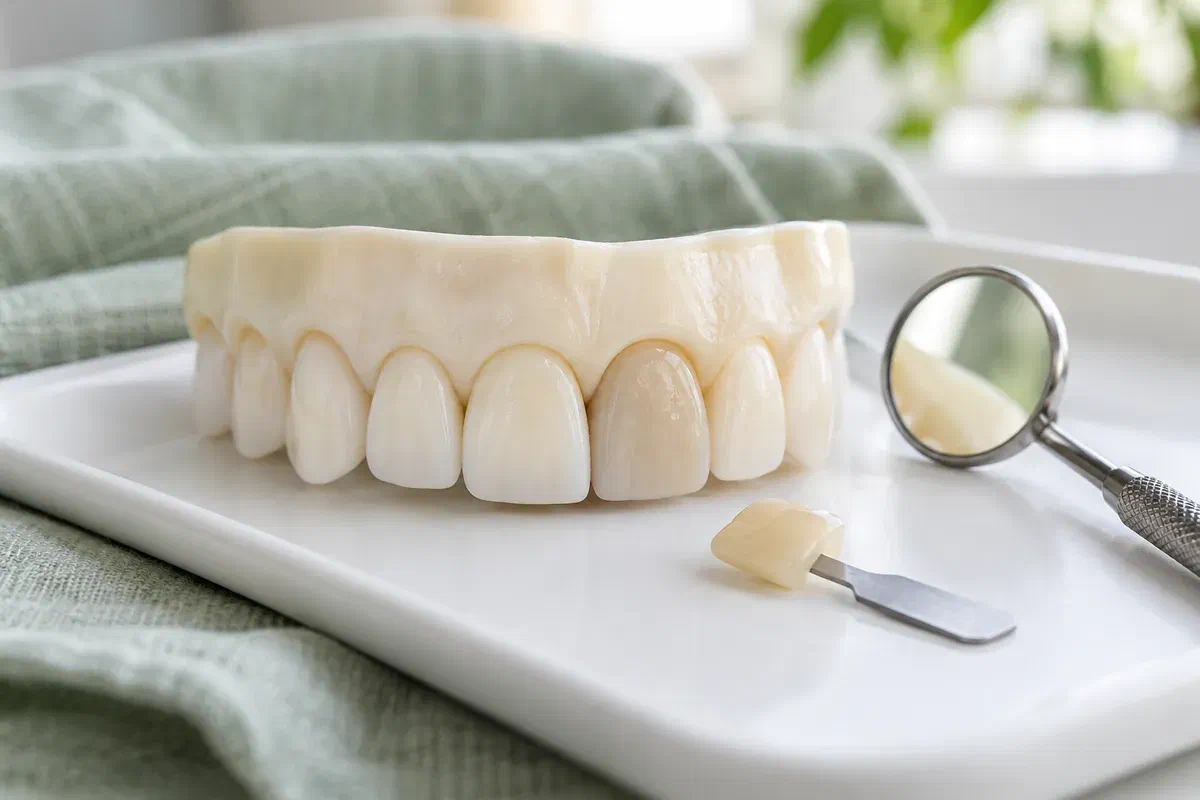
Illustrative front-teeth model with one subtly darker central tooth beside a shade sample
Signals to report

Colour is the visible part. Comfort tells the rest.

Some changes point to a health issue, others only to appearance. Describe both, so the conversation about shade begins with a clear view of how the tooth is doing.

Darkening that followed an injury

Share when the tooth was hurt and what was done, even if years have passed. Injury history informs how your dentist assesses the tooth and the risks of any treatment. The colour cannot confirm by itself what condition the tissues are in.

A root canal tooth that now looks different

Show what bothers you about the appearance and mention every filling and whitening attempt you know of. The discolouration may sit in the tooth, in a filling, or elsewhere. That affects what bleaching might change, if it is suitable at all.

Tenderness, a gum bump, or a rough filling

These deserve a clinical look before anything else. Bleaching does not treat infection, and it cannot repair a broken or leaking seal over the access. Your dentist may recommend root canal review or restorative care as the first step.

Never try to drain a gum bump, remove a filling, or put whitening material inside a tooth yourself. Internal bleaching requires a healthy starting point, a barrier over the root filling, and a dentist’s plan.

Once the tooth is healthy

Colour can be addressed without covering, in some cases.

After any health issue has been handled, a suitable tooth may be lightened from within without the preparation a veneer or crown requires. Responses vary considerably. The shade might move noticeably closer to its neighbours, or only a little, and a perfect or permanent match is never assured.

The decision should include the risks. Colour can return, nearby fillings may need replacing to match, and further care may be needed. External cervical root resorption, an uncommon but potentially serious complication, involves tooth structure being lost where the root meets the crown.

Patient information: Leeds Teaching Hospitals — whitening and non-vital bleaching · Research review — internal bleaching and external cervical resorption

Treatment that follows diagnosis

Make sure any cosmetic plan is built on a clear understanding of why the tooth is dark. Usually the goal is a tooth that blends, rather than whitening the whole smile. Ask how the target shade will be recorded.

More natural tooth left in place

Compare what bleaching and covering would each involve in terms of preparation. Either way, a suitable permanent restoration will be required. Your dentist will treat health, colour, and protection as linked decisions.

Reviews that look at health too

Ask how both colour and comfort will be checked during treatment, and when your dentist would stop. Know what happens if the response is limited. A careful plan has a clear finish and a schedule for follow-up.

Order of care

Diagnose, treat if needed, then consider bleaching.

Technique is selected only after examination and any necessary treatment. Ask about visit numbers, the temporary seal, root protection, and how the access will finally be closed.

  1. Find out what is going on

    History, symptoms, the existing filling, and the root canal are examined, usually with radiographs and shade records. Ask whether the tooth needs root canal review, repair, or further investigation before cosmetic work.

  2. Settle health questions, then discuss options

    With the tooth in suitable condition, your dentist explains the bleaching technique and what keeps the root filling and soft tissue safe. Discuss limits, complications, fees, and the option of leaving the shade. Confirm what follow-up is planned.

  3. Carry out monitored bleaching

    Access is made through the crown, a barrier is placed over the root filling, and the bleaching agent goes in according to protocol. A temporary seal may hold between visits. Follow instructions closely and report any new symptom.

  4. Restore and keep watching

    Your dentist judges the colour response and ends bleaching at the right point. A suitable permanent restoration then closes the tooth. Ask about re-matching visible fillings and the review schedule for the months and years ahead.

Staying alert during treatment

Pay attention to how the tooth feels, not only how it looks.

Instructions vary by technique and stage. Keep them in writing, and contact us if comfort changes, the gum swells, or the temporary seal fails.

Use nothing beyond what was prescribed

Do not add home whitening, extend a stage, or interfere with the temporary seal. Unsure about something? Ask first. Your dentist relies on a precise account of what has been used and how the tooth has reacted.

Report changes to the seal or comfort

Follow the eating and brushing advice for the tooth. If the temporary filling breaks or comes out, or if the tooth becomes sore, call us soon. Waiting for the next planned review is not appropriate for these changes.

Complete treatment and keep reviews

Attend the appointment for the permanent restoration even if the colour already pleases you. Continue regular dental visits and mention later changes in shade or comfort. A root-treated tooth needs ongoing monitoring.

Patient information: American Association of Endodontists — root resorption

Paths forward

When health and appearance both need answers

Each option solves a different problem. Ask which ones address health, which address colour, and which the tooth needs first. The least extensive suitable choice is individual.

Once examination supports a colour change

Internal bleaching after the tooth is cleared

A dentist may propose it for inner discolouration in a root-treated tooth judged healthy enough. Discuss the likely change, protection, and permanent restoration. It is a supervised clinical treatment, not an over-the-counter product.

Where symptoms or a failing seal are found

Root canal review or restorative care

Investigation or treatment may be needed before any cosmetic step. Ask what the concern is and how dealing with it might affect your later options. Bleaching never replaces treating an active problem.

For other causes or preferences

Covering, other whitening, or monitoring

Depending on what is behind the colour, a veneer, crown, or different approach may suit better. Compare preparation, upkeep, and matching. Deciding against treatment for a sound tooth is also perfectly reasonable.

Puslinch questions

Dark, tender, or both: what happens next?

Questions about symptoms, root canal review, and when bleaching becomes an option.

(905) 876-4488
Does a dark tooth always mean something is wrong inside?
Not always. Some root-treated teeth darken without any active problem. Others change colour alongside other issues. Your dentist will examine the tooth to tell the difference.
If my root canal needs to be redone, can bleaching happen afterwards?
Possibly. After the retreatment, and provided the tooth is in suitable condition, your dentist can reassess whether internal bleaching is appropriate. Timing depends on how the tooth responds.
Why does my root-treated tooth feel sore when I bite?
There can be several reasons, some of which need treatment. Please book an examination rather than waiting. Bleaching would not be considered until the cause is understood.
Is it safe to bleach a tooth with a small bump on the gum above it?
A gum bump near a root-treated tooth should be examined before any cosmetic treatment. It may point to a problem that needs care first. Your dentist will explain what the findings mean.
How long after treatment for a problem can bleaching be discussed?
There is no fixed waiting period. Your dentist will want the tooth to be stable and comfortable, and may review it before discussing colour. Ask what timeline applies in your case.
Can my exam and any urgent care be arranged on one trip from Puslinch?
Tell us about symptoms when you book so we can set aside enough time. Depending on the findings, some care may be possible at the first visit, with further appointments planned together.
Booking from Puslinch

Let us check the tooth’s health first.

Call our Bronte Street practice about a darker root-treated tooth, especially if it also feels tender. We will examine it, address any health concern, and explain whether internal bleaching could be the next step.

Bleaching is considered only after the tooth’s health is confirmed. Results vary, treatment is dentist-supervised, and a permanent restoration is always required.

Visit Milton Dental Clinic
Unit 1, 342 Bronte St. S, Milton, ON L9T 5B7
Get directions Clinic hours
Monday–Thursday
11am–7pm
Friday–Sunday
By appointment only

Areas we serve

  • Milton
  • Oakville
  • Mississauga
  • Georgetown
  • Halton Hills
  • Acton
  • Campbellville
  • Brampton
  • Burlington
  • Puslinch
  • Rockwood
  • Erin
  • Caledon
  • Etobicoke
  • Old Milton
  • Bronte Meadows
  • Timberlea
  • Dorset Park
  • Dempsey
  • Clarke
  • Beaty
  • Coates
  • Harrison
  • Scott
  • Willmott
  • Ford
  • Bowes
  • Cobden
  • Walker
  • Mountain View
  • Milton Heights
  • Hawthorne Village
  • Valley View
  • Fallingbrook
  • Nassagaweya
  • Trafalgar
  • Esquesing
  • Nelson
  • Brookville
  • Moffat
  • Glen Williams
  • Norval
  • Limehouse
  • Stewarttown
  • Ashgrove
  • Hornby
  • Silver Creek
  • Speyside
  • Scotch Block
  • North Oakville
  • River Oaks
  • Glen Abbey
  • West Oak Trails
  • Palermo
  • Bronte Creek
  • College Park
  • Joshua Creek
  • Uptown Core
  • Preserve
  • Iroquois Ridge
  • Lisgar
  • Meadowvale
  • Meadowvale Village
  • Churchill Meadows
  • Erin Mills
  • Central Erin Mills
  • Streetsville
  • East Credit
  • Creditview
  • Heartland
  • Sheridan
  • Mount Pleasant
  • Credit Valley
  • Huttonville
  • Churchville
  • Springbrook
  • Northwest Brampton
  • Bram West
  • Fletcher's Meadow
  • Fletcher's Creek South
  • Alton Village
  • Orchard
  • Millcroft
  • Headon Forest
  • Tansley
  • Brant Hills
  • Tyandaga
  • Kilbride
  • Lowville
  • Aberfoyle
  • Morriston
  • Arkell
  • Hillsburgh
  • Freelton
  • Carlisle
  • Waterdown
  • Flamborough
  • Mountsberg

How can we help?

Milton Dental Clinic

Have a question about your smile? Choose the option that works best for you.

For urgent dental concerns, please call.
Messages are reviewed during clinic hours.