

Illustrative patient and dental clinician reviewing an aligner beside its protective case
Cosmetic Dentistry

Invisalign Attachment Repair in Halton Hills

Two people in aligners under one roof means twice the trays to track. When an attachment goes missing in a Halton Hills household, a quick note of whose tooth, which tray, and when helps us advise on the right next step.

One house, several sets of trays

Whose attachment is it, anyway?

It happens more than you might think: a parent and a teenager both in clear aligners, cases scattered between the kitchen and the car, and nobody quite sure whose tray number is whose. Then someone mentions a bump has gone from a tooth, and the details are fuzzy.

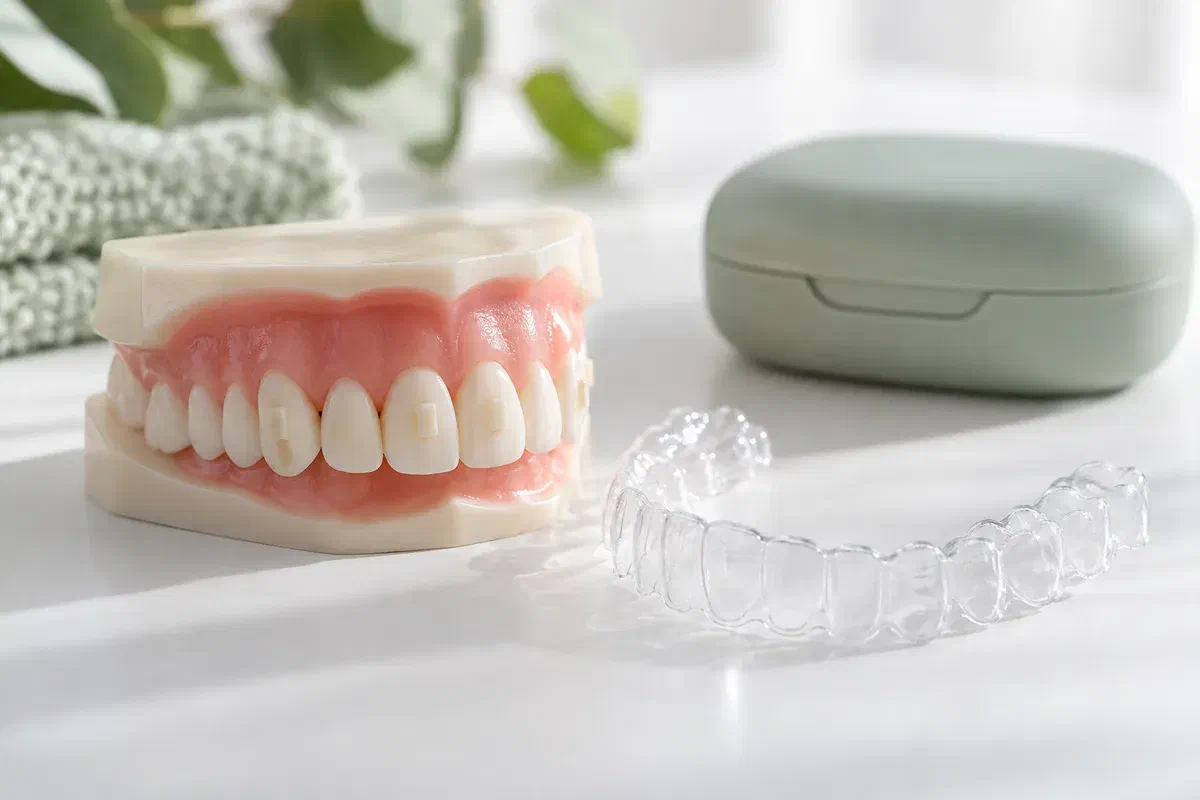
An attachment is a small, tooth-coloured composite feature bonded to a particular tooth so the aligner can hold or move it in a planned way. Because each one belongs to one person’s plan, the useful facts are personal: which tooth, how that person’s tray fits now, and what stage they have reached.

Jot those down and call the office supervising that person’s aligners. If it is us, we can advise and, if needed, book a visit. If another provider runs that treatment, start with them so any help stays coordinated. Nobody in the house should try a glue fix.

Report a missing attachment
Illustrative tooth model with small tooth-coloured attachments beside an aligner and case
Keeping track at home

Write it down while it is fresh

Nobody at home needs to work out whether it is urgent or why it happened. A short written note, kept with the aligner case, makes the call much easier.

The tooth and the moment

Record whose mouth, which side and tooth, and the day it was noticed. Add whether it went during a snack or while the tray was being taken out. If nobody is sure an attachment was there, the team can confirm from that person’s plan.

The tray and its fit

Note the number on the current tray and whether it now lifts away from a tooth, feels loose, looks bent, or is hard to press on. Avoid forcing it into place, and do not let anyone move ahead to the next tray just to see.

Comfort and past trouble

Mention a scratchy surface, a sore cheek, or an attachment that has come off before. Repeats help the clinician think about surface, fit, or removal habits. For teens, a parent adding what they have noticed can help, without any sense of blame.

Keep the person’s current aligners in their own case and bring them to the visit. Ask which tray they should be in now and whether the next change should wait.

What a focused review gives you

Fix it once, in line with that person’s plan

Attachments are a prescribed part of aligner treatment, placed for specific movements. If one needs replacing, it should match the planned shape and position. The visit also gives the clinician a chance to confirm the aligner is tracking well and to notice anything else that needs attention.

Reaching out early keeps the household from guessing about tray changes. The clinician can tell you whether to come in before the next switch and what to do until then. Lost attachments vary, so there is no one waiting period that applies to everyone.

Patient information: Invisalign — the purpose and placement of attachments

Guidance for the right person and stage

Ask whether that attachment is active right now and how its loss changes the current instructions. The answer belongs to that person’s plan. What worked for a sibling or spouse may not apply.

The aligner gets a look too

Mention cracks, rough edges, or fit changes alongside the missing bump. The clinician can tell whether the tray or the attachment is behind the problem. Handling both avoids a second visit for discomfort that was never explained.

A plan everyone at home can follow

Before leaving, confirm the current tray, next change date, and next review. If that differs from the printed schedule, ask for it again and update your note at home. Clear instructions help the whole household stay on track.

From Halton Hills to our chair

What to expect at a repair appointment

The visit depends on whether the attachment is completely gone, partly chipped, or connected to something else. Let us know about any filling, crown, or recent work on that tooth.

  1. Check the stage and the tooth

    Expect questions about the tray being worn, daily hours, the day the bump was missed, and anything that hurts. The clinician looks at the plan for that tooth. If a different office supervises, their details may be needed before going further.

  2. Look at the surface and the tray fit

    Any leftover composite is examined and the aligner is tried in if useful. Ask whether the concern goes beyond the attachment. The findings should be explained before a new one is placed.

  3. Bond a new attachment if needed

    When replacement is required, the tooth surface is readied and composite is shaped to the planned form, typically with a placement template. It is set with a curing light, and excess material is tidied away. This is always done in the clinic.

  4. Confirm fit and next steps

    The tray is tried over the new attachment and the clinician explains how to continue. If removal has been difficult, practise it before leaving. Note the stage, next change date, and contact plan for any repeat.

Back at home

Habits that help attachments stay put

Stick with the treating clinician’s wear and change instructions. A new attachment is not a reason to go back a tray, skip one, or add days unless advised.

Practise the removal method

If the tray catches on the new attachment, ask for another demonstration. Remove aligners only when needed and do not flex them to get around a bump. Report any fit problem rather than trimming the tray.

Clean every attachment, every time

Brush carefully around the composite and keep up flossing or interdental cleaning. Ask the team how to reach a tricky spot. For younger wearers, a quick parent check can help, and lingering irritation is worth mentioning.

Spot problems without fiddling

Discourage picking at attachments and chewing on hard objects. If one chips or disappears again, add it to your note and call. Repeated loss needs review, not stronger pressure on the tray or glue from a drawer.

Choosing what happens next

Replace it, check further, or watch closely

The plan, tray fit, and tooth condition shape the advice. Feel free to ask why one approach was chosen and what should be worn in the meantime.

When the feature is part of the current movement

Rebuild the attachment

The clinician replaces the attachment to its prescribed design and confirms the tray engages it. Ask whether the timing affects the next switch. It is part of the aligner sequence, not an unrelated filling.

When fit or discomfort needs clarifying

Assess the tray or tooth first

A cracked tray, a change on the tooth, or unexpected soreness may need attention as well. Describe every change, even small ones. The clinician may suggest a different step or a revised plan before continuing.

When the original plan must lead

Monitor or coordinate with the provider

There may be specific timing or review instructions. If another office supervises, coordination comes first. Without the right treatment details, no clinic can be sure of recreating the attachment correctly.

Halton Hills household questions

Practical answers for busy homes

When you call, say whose attachment it is, which tooth, the tray number, and how things feel. Those few facts let us respond properly.

(905) 876-4488
Two of us are in aligners. Can we book repairs on the same day?
Often that can be arranged if both people are treated by our team and both need to be seen. Mention it when you call. Each person’s repair still follows their own plan.
How do I help my teenager keep track of attachment problems?
Keep a simple note in the aligner case with the tray number and any issue, including the date. Encourage them to tell you as soon as something feels different. That makes it easier to call with clear details.
What if we mixed up whose aligner is whose?
Do not guess. Each tray is made for one person and one stage. Call the team, describe what happened, and bring the trays so they can be identified and checked before anyone continues.
Can a missing attachment be left until the next routine visit?
Ask the supervising clinician rather than deciding yourself. It depends on what that attachment is doing at the current stage. A quick report lets them decide whether to see the person sooner.
Is it safe to try sticking the bump back on?
No. Household glue and other adhesives are not suitable. A new attachment is bonded in the clinic using the planned shape and position.
Does a missing attachment mean the whole treatment is in trouble?
Not necessarily. It is something to report and assess. The clinician reviews fit and stage, explains any effect, and arranges a response that suits the plan.
Help for households north of Milton

Bring the note, the trays, and your questions

If a family member is in aligner treatment with us and loses or chips an attachment, call our Bronte Street practice. Tell us whose tooth, which tray they are on, and how it feels, so we can plan a visit that suits their stage.

If another clinic supervises the aligners, contact them for direction first. Urgent symptoms should be reported by phone, not through an online request.

Visit Milton Dental Clinic
Unit 1, 342 Bronte St. S, Milton, ON L9T 5B7
Get directions Clinic hours
Monday–Thursday
11am–7pm
Friday–Sunday
By appointment only

Areas we serve

  • Milton
  • Oakville
  • Mississauga
  • Georgetown
  • Halton Hills
  • Acton
  • Campbellville
  • Brampton
  • Burlington
  • Puslinch
  • Rockwood
  • Erin
  • Caledon
  • Etobicoke
  • Old Milton
  • Bronte Meadows
  • Timberlea
  • Dorset Park
  • Dempsey
  • Clarke
  • Beaty
  • Coates
  • Harrison
  • Scott
  • Willmott
  • Ford
  • Bowes
  • Cobden
  • Walker
  • Mountain View
  • Milton Heights
  • Hawthorne Village
  • Valley View
  • Fallingbrook
  • Nassagaweya
  • Trafalgar
  • Esquesing
  • Nelson
  • Brookville
  • Moffat
  • Glen Williams
  • Norval
  • Limehouse
  • Stewarttown
  • Ashgrove
  • Hornby
  • Silver Creek
  • Speyside
  • Scotch Block
  • North Oakville
  • River Oaks
  • Glen Abbey
  • West Oak Trails
  • Palermo
  • Bronte Creek
  • College Park
  • Joshua Creek
  • Uptown Core
  • Preserve
  • Iroquois Ridge
  • Lisgar
  • Meadowvale
  • Meadowvale Village
  • Churchill Meadows
  • Erin Mills
  • Central Erin Mills
  • Streetsville
  • East Credit
  • Creditview
  • Heartland
  • Sheridan
  • Mount Pleasant
  • Credit Valley
  • Huttonville
  • Churchville
  • Springbrook
  • Northwest Brampton
  • Bram West
  • Fletcher's Meadow
  • Fletcher's Creek South
  • Alton Village
  • Orchard
  • Millcroft
  • Headon Forest
  • Tansley
  • Brant Hills
  • Tyandaga
  • Kilbride
  • Lowville
  • Aberfoyle
  • Morriston
  • Arkell
  • Hillsburgh
  • Freelton
  • Carlisle
  • Waterdown
  • Flamborough
  • Mountsberg

How can we help?

Milton Dental Clinic

Have a question about your smile? Choose the option that works best for you.

For urgent dental concerns, please call.
Messages are reviewed during clinic hours.