The missing bump
Say which side and tooth and roughly when it happened. Mention if it broke during a meal out or when removing the tray. If you are not sure there was an attachment on that tooth, we can check the plan remotely.


Lost an attachment while away for work or a long weekend? Before booking with an unfamiliar office, call the team that holds your plan. From Puslinch, we can advise on timing, interim tray wear, and the repair itself.
Attachments have a knack for letting go at inconvenient times: halfway through a work trip, at a cottage, or on a weekend away with the family. Your first instinct may be to find the nearest dental office. A better first step is a phone call to the people who designed your treatment.
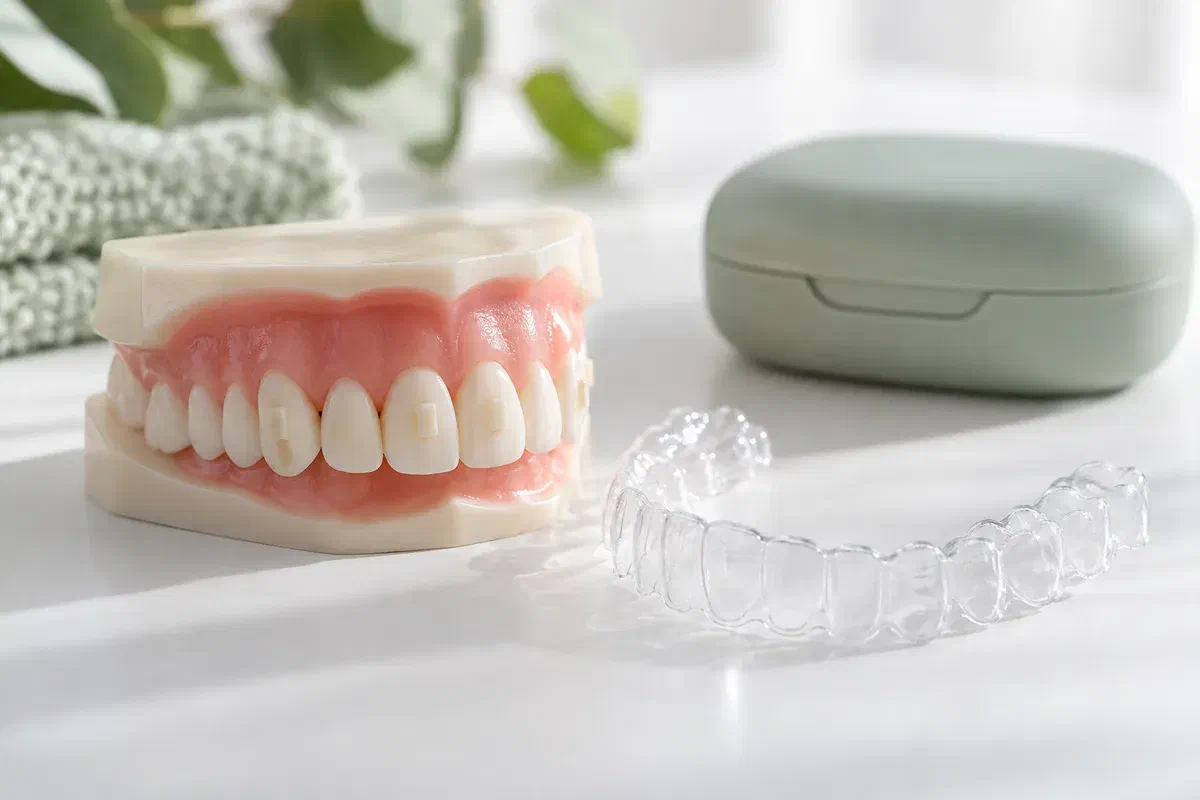
These small, tooth-coloured composite shapes are placed exactly where your aligner plan needs a grip point. Their size, angle, and position are part of the prescription. Without that information, another clinic may struggle to rebuild the attachment the way your plan intends.
If we supervise your aligners, ring us with the tooth, tray number, and how things fit; we can usually tell you whether the repair can wait until you are back. If another office leads your care, contact them instead. Either way, hold off on home remedies while you are away.
Deciding urgency is not up to you, even when you are far from home. Clear observations let us give useful advice without seeing you straight away.
Say which side and tooth and roughly when it happened. Mention if it broke during a meal out or when removing the tray. If you are not sure there was an attachment on that tooth, we can check the plan remotely.
Watch for space between tray and tooth, a looser hold, a warped edge, or resistance seating it. Read off the tray number. Avoid forcing a tray that will not settle, and do not change to the next one early because you are away.
Tell us about rough spots, soreness, or whether this attachment has come off before. Recurrence helps the clinician think about the surface, fit, or removal technique. Honest details make phone advice more reliable.
Keep your current aligners safely in their case, and pack the previous and next trays if you have them. Ask which tray to wear until you are home and whether your change date should shift.
An attachment is not a generic bump; it is designed for a particular movement. A replacement should match that design, usually with the original template. When you are back, the visit also gives the clinician a chance to check aligner fit and spot anything else that arose while you were away.
Calling promptly, even from a distance, takes the guesswork out of tray wear. You will hear whether the repair can wait until you return and what to do in the meantime. There is no standard waiting period that applies to every lost attachment.
Patient information: Invisalign — the purpose and placement of attachments
Ask whether the attachment matters for what is moving now, and how long it is reasonable to continue without it. The answer depends on your plan. Advice from someone who cannot see it is necessarily more general.
Point out any crack, sharp edge, or change in fit that happened during the trip. The clinician can distinguish a tray problem from an attachment problem and handle both in one appointment.
Before hanging up, confirm which tray to wear, whether to delay the next change, and when to come in. If the advice differs from your printed schedule, ask for it to be repeated.
The visit depends on whether the attachment is gone, chipped, or bundled with another issue that arose while travelling. Let us know about fillings, crowns, or recent work on the tooth.
We ask which tray you wore and for how long, the date the bump came off, and whether anything else changed. The plan for that tooth is checked. If another office supervises treatment, their information may be needed before we proceed.
Any leftover composite is looked at and the aligner is tried in to compare fit. Ask whether anything beyond the attachment needs attention. You will hear the findings before replacement is discussed.
If a replacement is needed, the tooth is prepared and composite is shaped using the planned design, usually through a template. The material is light-cured and the excess removed. This is a clinical task, not something to improvise elsewhere.
The tray is tried over the result and you will hear how to proceed. If removal was difficult while travelling, practise now. Confirm your stage, next change date, and what to do if it happens on another trip.
Your treating clinician’s wear and change instructions still guide everything. A new attachment is not a reason to go back a tray, skip one, or add days unless you are advised to.
Ask for a refresher if the tray catches on the attachment. Avoid unnecessary removal and do not twist the plastic to clear a bump, especially when you are rushing. Report fit problems rather than trimming.
Bring a travel toothbrush, floss or interdental brushes, and your case. Clean around each attachment before trays go back in. Ask about any hard-to-reach spot, and mention irritation that lingers.
Avoid poking at attachments or using your teeth on packaging. If one chips or disappears again, note when and call. Repeated loss needs review, not more force on the tray or a pharmacy adhesive.
Call with the tooth, the tray number, and any fit or comfort change. We can advise from a distance and plan the repair for your return.
If our practice oversees your aligners and an attachment chips or comes off while you are away, phone our Bronte Street office. Give us your tray, the tooth, and how it feels, and we will plan the repair for when you are back.
If another office supervises your aligners, call them first. For urgent symptoms, seek prompt care nearby rather than waiting for an online reply.
