

Illustrative adult patient discussing aligner treatment with a dental clinician
Cosmetic Dentistry

Invisalign Consultations in Oakville

Comparing aligner offers can feel like comparing apples and oranges. Coming from Oakville for an Invisalign consultation gives you a clinical assessment, a plain account of what any proposal includes, and room to weigh alternatives before you agree to treatment.

For Oakville adults comparing aligner plans

What, exactly, would the treatment involve?

Two aligner proposals can sound alike and still describe very different amounts of work. One may straighten a few front teeth while another addresses the bite as a whole. Before comparing numbers, it helps to know which kind of plan your own teeth actually call for.

Invisalign moves teeth with a prescribed set of removable clear trays, changed in sequence over months. A consultation considers whether that method suits the movement you want, how your upper and lower teeth fit together, and whether gums and supporting bone are healthy enough to begin.

Plenty of people arrive with an estimate from elsewhere or an online ad in mind. That is fine to bring along. Use the time to ask what records are needed, who would supervise the work and what you would be responsible for each day. Nothing obliges you to start, and a careful answer may simply be a clearer next step.

Arrange an aligner assessment
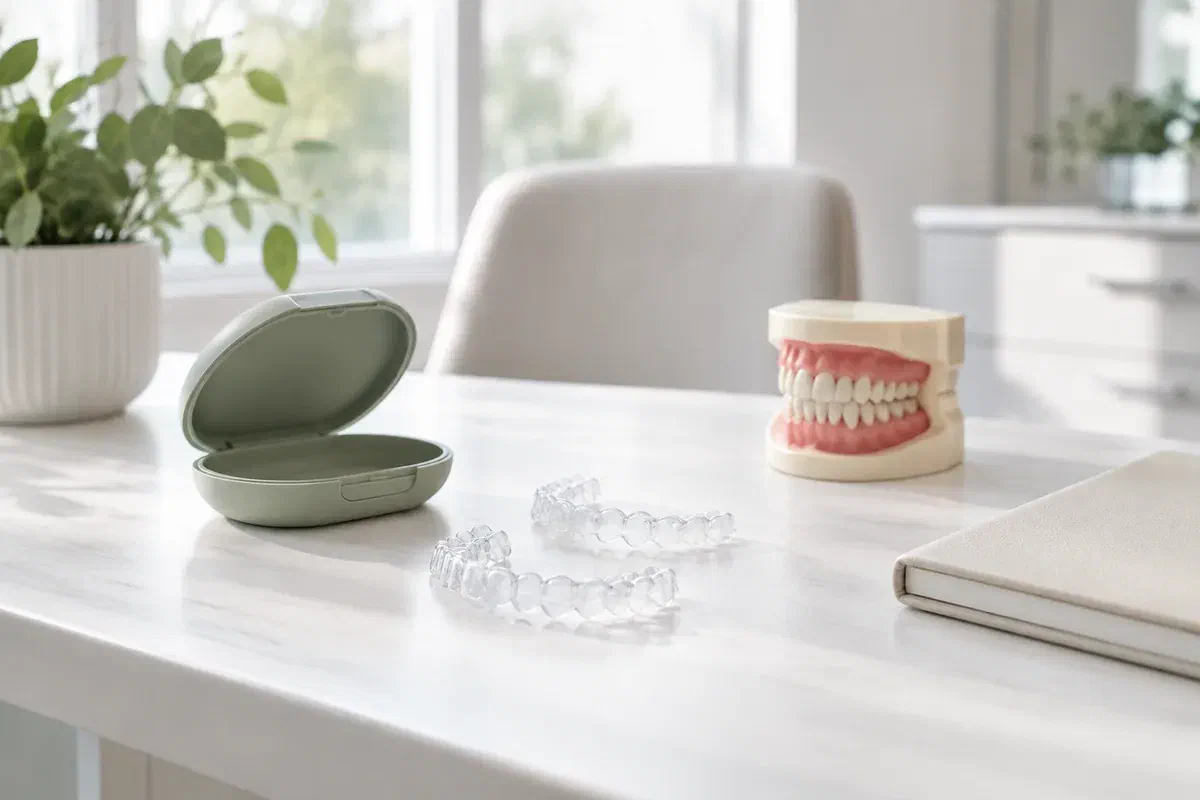
Illustrative aligners, protective case, tooth model, and notebook on a consultation desk
Information that sharpens the comparison

Goals, history and the hours trays would need

The clinician can only give a useful opinion with the full picture. Share what you want to change, what has already been done and any doubts about time, comfort or fees.

The result you are picturing

Describe the overlap, spacing or turned tooth you would like improved. Ask whether changing it affects your bite further back. A sound proposal sets out its target and its limits instead of implying every imperfection will disappear.

Earlier treatment and restorations

List any braces, retainers, crowns, bridges, implants, injuries or gum therapy you have had. Bring an appliance if asked. Existing work can change planning and the order of care, and it should be reviewed before anyone orders trays from your scans.

Daily wear in a demanding schedule

Consider business lunches, workouts, travel and whether you would remember to put trays back in. Aligners only deliver when worn consistently and cleaned well. Ask how that commitment fits your current life, not just how invisible the trays look in photos.

Sometimes a first discussion shows that a fuller exam, extra records, other treatment or a specialist referral should happen before any recommendation. Ask what this visit includes and what would be a separate appointment.

What the visit should clarify

A plan you can compare on substance

You should come away knowing why aligners do or do not suit the movements involved and which clinician would plan and supervise your care. A recognisable trademark on its own says nothing about whether the approach is right for your teeth.

Good proposals describe what happens after the final tray. Retainers and follow-up visits protect the result, so ask about their role and fees before signing. Ask too how refinement trays or a revised plan would be handled, since treatment does not always unfold exactly as first modelled.

Patient information: Invisalign Canada — treatment stages and retention · British Orthodontic Society — questions before orthodontic treatment

A stated aim and the reasoning behind it

Ask which teeth would shift, which bite relationships would change and what would stay the same. When you can put the aim in your own words, setting a short cosmetic plan beside a more complete one becomes far simpler.

A frank view of living with aligners

Ask about removing trays to eat, cleaning, safe storage and how often check-ins would be scheduled. Find out whether attachments are expected. Clear trays may still show small bumps and usually feel snug for a day or two with each change.

Fees whose limits are spelled out

Ask what the figure covers and what might be added, such as more records, lost-tray replacements, retainers or extra stages. Confirm what the estimate assumes about length of treatment. That clarity makes comparison meaningful rather than a contest of headline prices.

The consultation, step by step

Listen, examine, compare, then pause.

Scope depends on the appointment you book and any records you already hold. Ask beforehand whether the visit is an initial talk or includes the records needed for a detailed treatment proposal.

  1. Start with what you want and what came before

    Explain your goals and any earlier orthodontic care. Mention health conditions, medications, symptoms and dental work. If a relocation, new role or extended travel is ahead, say so early so continuity can be built into the plan.

  2. Look closely at teeth, gums and bite

    The clinician examines how the teeth relate and decides whether further records would support diagnosis. Photographs, X-rays or a scan may be advised for a particular reason. Ask whether any decay or gum concern should be treated beforehand.

  3. Set aligners beside the other choices

    Discuss suitability, likely stages, risks and the wear and review commitments. Ask about attachments or space creation if they come up. A digital simulation, if shown, illustrates a plan and should not be read as a guaranteed outcome.

  4. Confirm the next step before anything is ordered

    You may need more records, a specialist opinion or time with the estimate. Make sure you know what was agreed, whether the next stage has a fee and how to ask questions afterwards.

Weighing the proposal

Compare the whole course, start to retainer.

Before any treatment begins, the usual next step is clarifying the plan and arranging recommended care. Keep up your normal oral-health routine while you take time to decide.

Map the wear schedule onto a real week

Invisalign’s own guidance generally refers to 20 to 22 hours of daily wear, and your clinician gives your specific instructions. Run through meals, cleaning and travel days. Flag any likely obstacle rather than counting on partial wear to do the same work.

Pin down supervision and contact points

Ask who will check progress, how frequently, and whom to reach about a tray that fits poorly or goes missing. Find out what happens if teeth fall behind schedule. Clear lines of responsibility matter throughout care.

Coordinate any other treatment

Tell the team about fillings, crowns or procedures planned with another provider. Changing a tooth’s shape can affect scans and fit. Stick to the agreed sequence and check whether another assessment is needed before starting.

Patient information: Invisalign Canada — patient questions and wear guidance

Recommendations you might hear

Sometimes yes, sometimes something else

Ask why the suggested step suits you. Interest in Invisalign does not mean treatment has to begin, and a different approach is not a lesser one.

When assessment and routine both point that way

Go forward with Invisalign planning

If aligners fit the clinical goals, further records and a full proposal may follow. Confirm scope, limitations and responsibilities before ordering, and expect the plan to include monitoring and retention as well as active movement.

When the bite or movement needs another method

Explore a different appliance or specialist advice

Certain problems respond better to another appliance or orthodontist input. Ask why that fits and what the referral should establish. Your preference for removable trays can still be discussed next to the clinical needs.

When findings or timing favour waiting

Address other care, delay or monitor

An active dental issue or a packed season might take priority. You may also choose not to pursue an elective change at all once you know the options. Ask which findings need care and how monitoring would work.

Oakville aligner questions

Questions that make two quotes easier to compare

Ask about your own teeth, the proposed scope and the realities of treatment. Promotions cannot settle the details of an individual plan.

(905) 876-4488
Why might two aligner quotes differ so much?
They may describe different scopes, such as a limited front-tooth plan versus treatment of the bite, or include different extras. Ask each provider what is being moved, what is included and what is assumed about length.
Can I bring a treatment plan from another office to discuss?
Yes. Bring whatever written information you have. The clinician can explain how the proposal relates to their own findings, though an opinion still depends on examining your teeth rather than reading a plan alone.
Is a mail-order aligner kit the same as an in-office consultation?
Not in the same sense. An in-person assessment examines teeth, gums and bite and can identify problems to treat first. Ask how supervision and follow-up would work in any option you are considering.
What should a complete Invisalign estimate list?
Ask it to name the included stages and the exclusions, including records, reviews, refinement trays, replacements and retainers. Confirm any assumptions about duration. Comparing the full scope is more useful than comparing the first payment.
Do I need to decide on the day of the consultation?
No. The purpose is to understand findings and options. Ask which records or decisions come next and whether they carry separate fees, then take the time you need with an elective proposal.
Will I see a preview of how my teeth could look?
A digital simulation may be shown when records are taken for planning. Treat it as an illustration of the intended movement. Ask how closely results usually follow it and what could lead to changes along the way.

Patient information: Align Technology — patient instructions and treatment considerations

Invisalign advice for Oakville

Bring the quote, the questions and your calendar.

Book time at our Bronte Street practice to discuss whether Invisalign or another orthodontic approach makes sense for you. We can explain the assessment, what treatment would require and the possible next steps, so you can decide in your own time.

Suitability, scope and any referral are determined after assessment. Ask about consultation fees and included records when you book.

Visit Milton Dental Clinic
Unit 1, 342 Bronte St. S, Milton, ON L9T 5B7
Get directions Clinic hours
Monday–Thursday
11am–7pm
Friday–Sunday
By appointment only

Areas we serve

  • Milton
  • Oakville
  • Mississauga
  • Georgetown
  • Halton Hills
  • Acton
  • Campbellville
  • Brampton
  • Burlington
  • Puslinch
  • Rockwood
  • Erin
  • Caledon
  • Etobicoke
  • Old Milton
  • Bronte Meadows
  • Timberlea
  • Dorset Park
  • Dempsey
  • Clarke
  • Beaty
  • Coates
  • Harrison
  • Scott
  • Willmott
  • Ford
  • Bowes
  • Cobden
  • Walker
  • Mountain View
  • Milton Heights
  • Hawthorne Village
  • Valley View
  • Fallingbrook
  • Nassagaweya
  • Trafalgar
  • Esquesing
  • Nelson
  • Brookville
  • Moffat
  • Glen Williams
  • Norval
  • Limehouse
  • Stewarttown
  • Ashgrove
  • Hornby
  • Silver Creek
  • Speyside
  • Scotch Block
  • North Oakville
  • River Oaks
  • Glen Abbey
  • West Oak Trails
  • Palermo
  • Bronte Creek
  • College Park
  • Joshua Creek
  • Uptown Core
  • Preserve
  • Iroquois Ridge
  • Lisgar
  • Meadowvale
  • Meadowvale Village
  • Churchill Meadows
  • Erin Mills
  • Central Erin Mills
  • Streetsville
  • East Credit
  • Creditview
  • Heartland
  • Sheridan
  • Mount Pleasant
  • Credit Valley
  • Huttonville
  • Churchville
  • Springbrook
  • Northwest Brampton
  • Bram West
  • Fletcher's Meadow
  • Fletcher's Creek South
  • Alton Village
  • Orchard
  • Millcroft
  • Headon Forest
  • Tansley
  • Brant Hills
  • Tyandaga
  • Kilbride
  • Lowville
  • Aberfoyle
  • Morriston
  • Arkell
  • Hillsburgh
  • Freelton
  • Carlisle
  • Waterdown
  • Flamborough
  • Mountsberg

How can we help?

Milton Dental Clinic

Have a question about your smile? Choose the option that works best for you.

For urgent dental concerns, please call.
Messages are reviewed during clinic hours.