

Illustrative patient and clinician discussing a tooth model before restorative planning
Cosmetic Dentistry

Pre-Restorative Tooth Alignment in Brampton

Adding an orthodontic stage before a crown, bridge, implant or bonding means more time, more visits and more cost. For people weighing that commitment from Brampton, we can help you understand what moving teeth first would add, what it would demand, and how the stages could be arranged.

Counting the commitment

Worth the extra stage?

That is usually the real question once alignment is mentioned alongside restorative work. Pre-restorative tooth alignment means moving selected teeth so that a later crown, bridge, implant crown or bonding can be planned around better positions. It is part of one restorative plan, and it should be judged by what it contributes to that plan.

For many people the honest answer is that no movement is needed. A restoration can often be designed around teeth exactly where they are. When movement is proposed, ask what it would change, how long the commitment is likely to be in your case, and how the restoration would look and function if you went without it.

Households in Brampton often balance shift work, school timetables and budgets, so it helps to raise those constraints at the first visit. Bring any proposals or estimates you have. Our team can outline the assessment still needed, whether specialist input would help and how the intended restoration shapes the rest.

Talk through the commitment involved
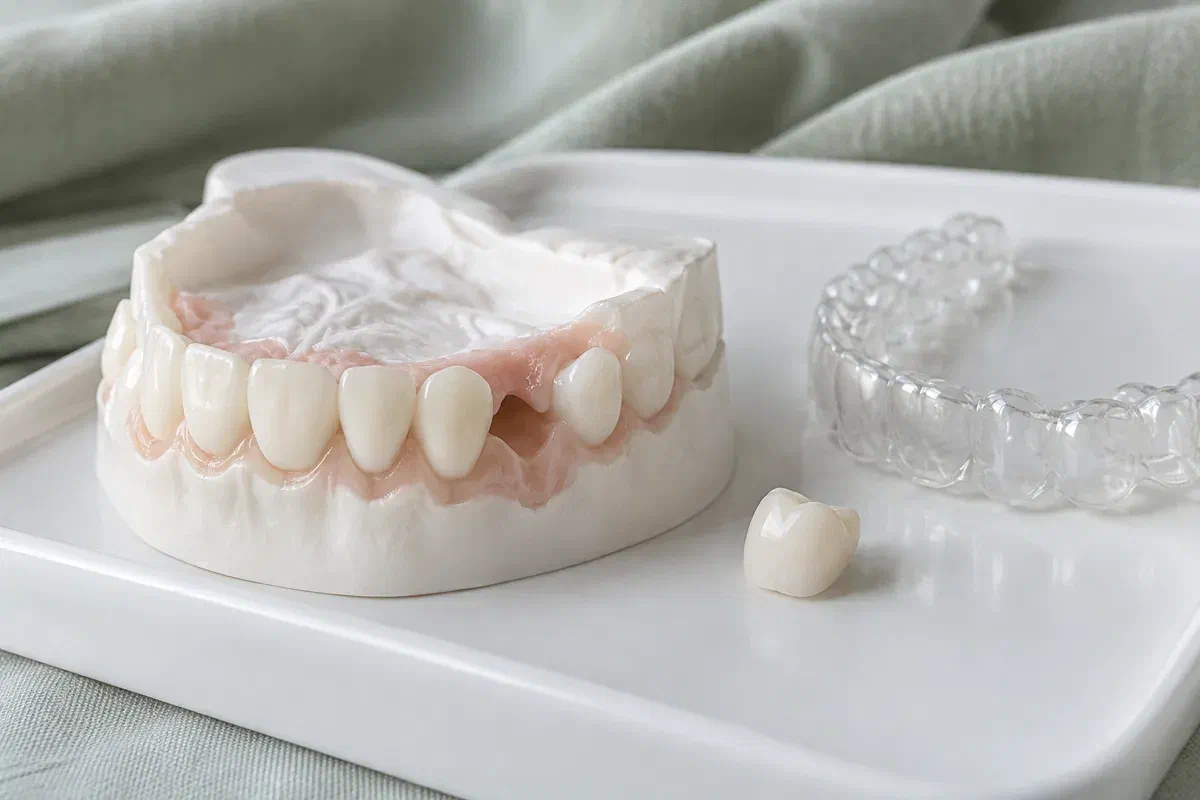
Illustrative tooth model, ceramic crown sample, and clear aligner on a consultation tray
When it may be worth considering

Three situations where position can shape the outcome

Movement is only worth the effort if a different tooth position would change your restorative care. Examination and records help clinicians make that call.

An uneven space for a replacement

A gap may have narrowed or shifted, leaving a shape that does not suit the bridge or implant being discussed. Nearby teeth and roots need assessment, since the opening you can see is only part of what determines whether a replacement will fit well.

A misaligned tooth being crowned or bonded

Tilting, turning or irregular wear may limit how a restoration can be shaped. Moving a tooth changes its position, while restorative shaping alters its form. The team should explain whether combining the two offers a real benefit in your situation.

Several treatments to schedule and pay for

Orthodontics, gum care and restorations may each come with separate appointments and estimates. Ask how they fit into one sequence and who is coordinating it. Knowing the order helps you plan time off and spending without surprises.

A placed implant stays fixed in the bone and cannot be moved orthodontically. Let the team know about all implants and planned restorations before any movement plan is prepared.

What you gain from a clear plan

You can see what each stage is for, and what it will ask of you.

Any value in alignment comes from what it does for the restoration. The explanation should be specific: whether movement would alter space, tooth relationships or the restoration’s design. That specificity is what lets you decide whether the added stage earns its cost in time and money.

The commitment deserves equal attention. Orthodontic movement brings its own visits, home responsibilities, risks, fees and a retention phase that continues after teeth have moved. Compare that with a suitable plan without movement, then decide which approach fits your priorities and your schedule.

Patient information: British Dental Journal — principles of interdisciplinary orthodontic and restorative treatment

A defined endpoint, agreed early

The clinicians should settle on the positions the restoration needs before any appliance is fitted. The aim is a workable restoration, not simply straighter teeth. Learn what must be reviewed before the restorative stage can begin.

Costs and trade-offs for each option

Find out what restoring the tooth without movement would involve, including its benefits, limitations and upkeep. Having both options described in the same detail makes it easier to judge whether a combined plan is justified.

A schedule with clear responsibilities

Know who provides each stage, who checks progress and whom to call between appointments. If care is shared between practices, ask how information will move between them so you are not left relaying messages yourself.

Step by step

A plan built from the finished restoration backwards

Staged care can involve more than one clinician and several reviews. Understand what information is needed before committing, and which decisions are still provisional.

  1. Set out the concern, the budget and the timing

    Explain the tooth or space involved, earlier advice, symptoms and what matters to you in the result. Bring estimates or records. Being open about work schedules and budget allows the whole sequence to be planned realistically from the start.

  2. Examine oral health and take records

    The clinicians assess the teeth, gums and the relationships that matter for the restoration. Additional records may help with space, roots or bite. Any decay or gum disease may need treatment before movement is considered.

  3. Agree on positions, stages and alternatives

    Discuss the movement proposed, the appliance options, alternatives, limits and risks. Understand how the restoration will fit the final arrangement. If a specialist is recommended, ask what they should answer and who will bring their advice into the plan.

  4. Confirm readiness, then restore

    The end result of movement is checked against the agreed plan. Ask how positions will be held while the restoration is made. Updated records or another planning conversation may be needed before irreversible restorative work proceeds.

Protecting your investment of time

Retention keeps the work you have already done.

The time between stages needs its own guidance. Find out what to wear, which appointments to keep and how a change of schedule will be handled.

Keep to the retainer schedule

Wear the appliance as prescribed and tell the team about damage or a change in fit. Teeth can move back if wear stops once they look right. Ask how positions will be maintained until the restoration or a review by another clinician.

Tell us about care elsewhere

A new filling, extraction or crown at another office can affect the sequence or how an appliance fits. Keep each clinician informed. If an appointment changes, check whether another stage needs to be rescheduled as well.

Know the long-term routine

Retention may need adjusting to the final restoration, so ask who will check it. Review cleaning and follow-up for both the restoration and the orthodontic result. The final visit should leave you clear on how each will be maintained.

Weighing the paths

Pick the sequence that justifies its demands.

Depending on findings, the assessment may support combined treatment, restoration alone or a further opinion. Ask what each would mean for the tooth and your wider oral health.

When position clearly matters to the result

Orthodontic stage, then restoration

A movement stage may be recommended when it offers a meaningful benefit for the restoration. Ask about the endpoint, how it will be verified and how retention will hold it. Keep the restoration as the reference point throughout.

When existing positions are workable

Restoration with teeth left in place

Restoring without moving teeth is frequently appropriate. Learn what preparation, appearance, function and maintenance would involve. Set these against the combined option rather than assuming the longer plan is automatically better.

When the findings need further review

More information before committing

Specialist advice or other treatment may be needed before the order of care is decided. Ask what is unresolved and what can safely wait. Take the time you need with an elective combined plan before agreeing to it.

Planning questions from Brampton

Time, cost and commitment, answered plainly

These answers can help you understand the demands of each stage before you decide.

(905) 876-4488
How many appointments does alignment before a restoration usually involve?
It varies with the movement needed, the appliance and how many clinicians are involved. Ask for an outline of expected visits for each stage, including records, adjustments, reviews and the restorative appointments themselves.
Can treatment stages be spread out to suit my budget?
Some flexibility may be possible, but delays between stages can affect results. Discuss your constraints openly and ask which steps can safely wait and which need to follow each other closely.
Can you help me understand what my dental insurance may cover?
Coverage depends entirely on your plan. We can provide treatment details you can submit to your insurer, and some plans offer a predetermination. Ask your provider directly about orthodontic and restorative limits before committing.
How long will I need a retainer after the teeth are moved?
Retention is often needed for a long time, and sometimes indefinitely, to keep teeth in their new positions. Ask what the plan is in your case and how retention will work around the final restoration.
Is alignment always needed before an implant restoration?
No. The space, neighbouring teeth and roots must be assessed, and many implant restorations go ahead without movement. Ask whether it would make a meaningful difference for you, and what the alternative would involve.
What if my crown is postponed once the teeth have been aligned?
Tell the clinicians and ask how positions should be held during the wait. Confirm which appliance to wear and whether a review is needed. Avoid stopping wear or switching to an old retainer without guidance.
A Brampton planning visit

Ask what the extra stage would add before you take it on.

Book a consultation at our Bronte Street practice to discuss alignment before restorative care. We can explain the assessment, the coordination involved and any specialist input that would help you reach a decision.

Whether teeth need moving, and in what order care proceeds, depends on individual assessment. No specific appliance, specialist or outcome is assumed.

Visit Milton Dental Clinic
Unit 1, 342 Bronte St. S, Milton, ON L9T 5B7
Get directions Clinic hours
Monday–Thursday
11am–7pm
Friday–Sunday
By appointment only

Areas we serve

  • Milton
  • Oakville
  • Mississauga
  • Georgetown
  • Halton Hills
  • Acton
  • Campbellville
  • Brampton
  • Burlington
  • Puslinch
  • Rockwood
  • Erin
  • Caledon
  • Etobicoke
  • Old Milton
  • Bronte Meadows
  • Timberlea
  • Dorset Park
  • Dempsey
  • Clarke
  • Beaty
  • Coates
  • Harrison
  • Scott
  • Willmott
  • Ford
  • Bowes
  • Cobden
  • Walker
  • Mountain View
  • Milton Heights
  • Hawthorne Village
  • Valley View
  • Fallingbrook
  • Nassagaweya
  • Trafalgar
  • Esquesing
  • Nelson
  • Brookville
  • Moffat
  • Glen Williams
  • Norval
  • Limehouse
  • Stewarttown
  • Ashgrove
  • Hornby
  • Silver Creek
  • Speyside
  • Scotch Block
  • North Oakville
  • River Oaks
  • Glen Abbey
  • West Oak Trails
  • Palermo
  • Bronte Creek
  • College Park
  • Joshua Creek
  • Uptown Core
  • Preserve
  • Iroquois Ridge
  • Lisgar
  • Meadowvale
  • Meadowvale Village
  • Churchill Meadows
  • Erin Mills
  • Central Erin Mills
  • Streetsville
  • East Credit
  • Creditview
  • Heartland
  • Sheridan
  • Mount Pleasant
  • Credit Valley
  • Huttonville
  • Churchville
  • Springbrook
  • Northwest Brampton
  • Bram West
  • Fletcher's Meadow
  • Fletcher's Creek South
  • Alton Village
  • Orchard
  • Millcroft
  • Headon Forest
  • Tansley
  • Brant Hills
  • Tyandaga
  • Kilbride
  • Lowville
  • Aberfoyle
  • Morriston
  • Arkell
  • Hillsburgh
  • Freelton
  • Carlisle
  • Waterdown
  • Flamborough
  • Mountsberg

How can we help?

Milton Dental Clinic

Have a question about your smile? Choose the option that works best for you.

For urgent dental concerns, please call.
Messages are reviewed during clinic hours.