

Illustrative patient and clinician discussing a tooth model before restorative planning
Cosmetic Dentistry

Pre-Restorative Tooth Alignment in Caledon

The most important checkpoint in a combined plan comes when movement ends and the restoration is about to begin. For households in Caledon, we can explain how that readiness is judged, whether alignment is needed for your crown, bridge, implant crown or bonding, and how the stages link up.

Knowing when to stop

Finished, according to whom?

Teeth that look straight in the mirror are not necessarily ready for a crown or bridge. In pre-restorative tooth alignment, movement has one job, which is to place selected teeth where the planned restoration needs them. Knowing when that job is done depends on a target agreed long before the appliance comes off.

Of course, many restorations never need that target at all. Teeth are commonly restored in the positions they already occupy. If movement is suggested, you should hear exactly what it would accomplish for the restoration, and how the tooth would otherwise be treated.

Travelling from Bolton or one of Caledon’s other villages, it helps to know the main checkpoints in advance. Bring earlier proposals and imaging to the first visit. Our team can explain the assessment needed, who would confirm each stage and whether a specialist opinion would help, keeping the final restoration as the guide.

Ask how readiness is judged
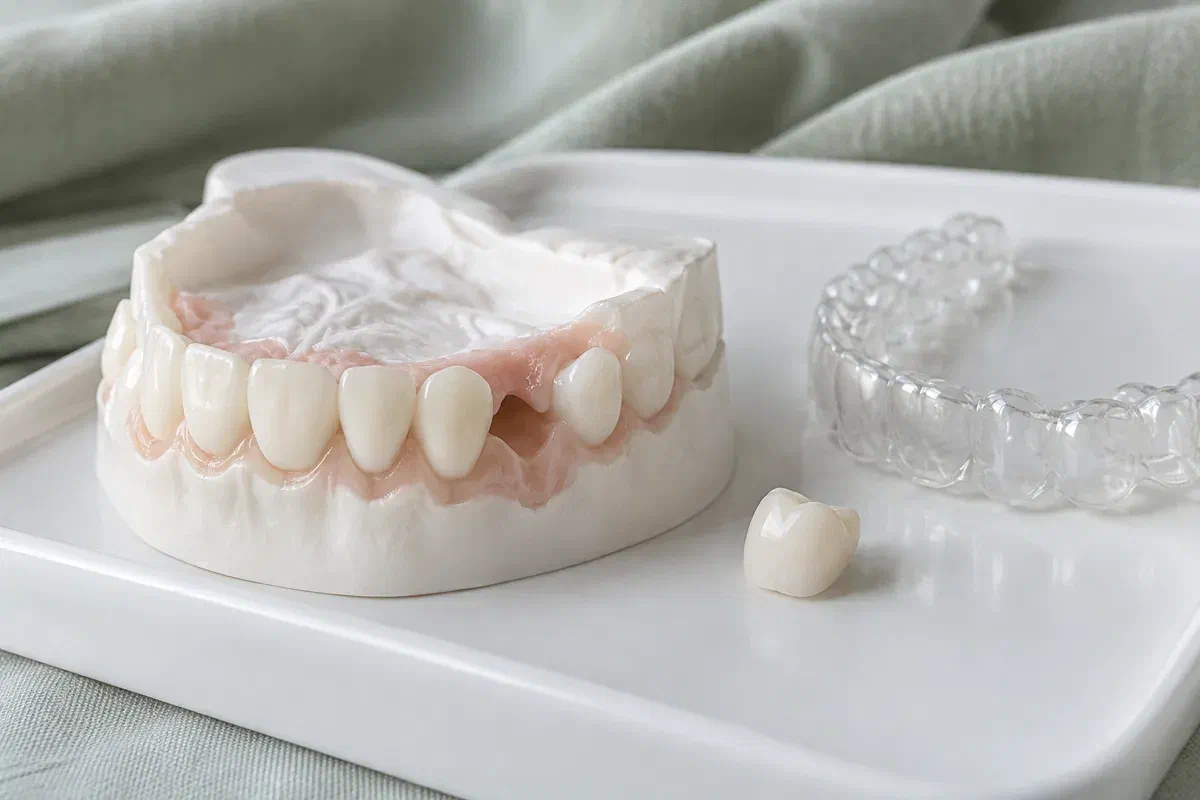
Illustrative tooth model, ceramic crown sample, and clear aligner on a consultation tray
When an endpoint may be needed

The situations that make a target worth setting

A different position is only worth pursuing if it would change your restorative care. Examination and records help clinicians decide whether to set a movement target at all.

Space for a replacement tooth

If a gap has narrowed or become uneven, an implant crown or bridge may need a particular width and shape. Roots and neighbouring teeth need assessment too, since the visible opening does not show everything the replacement depends on.

Angle or rotation affecting a crown or bonding

A tooth that leans, twists or has worn unevenly may be harder to restore well where it sits. Moving it changes position; reshaping changes form. Ask whether combining the two would offer a real benefit, and what target would show the movement had worked.

Several stages with handovers between them

When gum care, orthodontics and restorations are all planned, each handover is a checkpoint. Find out who confirms that one stage is complete before the next begins, and how that decision will be communicated.

Implants are set in bone and will not move with orthodontic treatment. Make sure the team knows about any implants and all planned restorations before a target is defined.

Why a shared endpoint matters

Agreeing on finished, before you begin

Alignment helps only if it improves the restoration, and the target is how that improvement is measured. The explanation should describe what would change, such as space for a replacement, a tooth’s angle or how the bite meets. A target you can understand is easier to trust.

Reaching that target takes commitment: appointments, appliance care, possible risks, fees and retention afterwards. Weigh those against a plan that keeps teeth where they are, and choose based on your priorities rather than a sense that more treatment must be better.

Patient information: British Dental Journal — principles of interdisciplinary orthodontic and restorative treatment

A target written into the plan

The orthodontic and restorative clinicians should define the positions needed before movement begins, so both know what finished means. The aim is a restoration that works, not simply straighter teeth. Ask how the target will be recorded.

An alternative judged on its own merits

Understand how the tooth would be restored without movement, with the benefits, limits and maintenance of that path. A combined plan should be supported by the findings, and should not be presented as the default.

A clear sign-off process

Know who carries out each stage, who confirms readiness and whom to contact between appointments. If different practices are involved, ask how the sign-off will be shared, so the restorative stage does not start before everyone agrees.

From goal to sign-off

Set the finish line first, then plan the route.

Several clinicians and checkpoints may be involved. Find out what has to be known before you commit, and which decisions might be revisited along the way.

  1. Explain the restoration you need

    Describe the tooth or gap, earlier advice, symptoms and what you want from the result. Bring records or estimates. Mention time, travel or budget limits so the sequence and its checkpoints can be planned together.

  2. Assess health and take baseline records

    The clinicians examine teeth, gums and the relationships around the planned restoration. Baseline imaging, scans or models give a reference to compare against later. Decay or gum disease usually needs attention before movement starts.

  3. Define the target and the stages

    Discuss which teeth would move, the appliance, alternatives, limitations and risks. Agree on the positions the restoration needs and how they will be measured. If a specialist is consulted, clarify their question and who will combine their advice.

  4. Sign off readiness before restoring

    When movement ends, new records are compared with the baseline and the target. Ask who confirms readiness and what will hold positions while the restoration is made. Nothing irreversible should happen until that sign-off is complete.

After sign-off

The target has been reached. Now keep it.

Once readiness is confirmed, the teeth still need holding until the restoration is fitted. Know your retainer instructions, the next review and how a schedule change will be managed.

Hold the result with your retainer

Wear it as directed and report any damage or change in fit quickly. Teeth can move away from the target if wear stops. Ask how positions will be kept while the restoration is made or another clinician reviews the result.

Keep clinicians aware of other treatment

An extraction, filling or crown elsewhere can affect the sequence or how an appliance fits. Tell everyone involved. If one appointment is rearranged, check whether that changes the timing of another stage.

Agree how both results will be looked after

Retention may need updating to fit the restoration’s final shape, so ask who will see to it. Confirm how cleaning and periodic checks will cover the restoration and the aligned teeth from then on.

Approaches compared

Set a target, restore as is, or learn more

The assessment may support combined care, a restoration alone or another opinion. Consider what each would mean for the tooth, how readiness would be judged and your long-term oral health.

When position directly affects the restoration

Move toward a target, then restore

A movement stage may be recommended where reaching specific positions offers a meaningful restorative benefit. Agree the target, who will confirm it and how retention will hold it until the restoration is in place.

When current positions are suitable

Restore with no movement stage

Restoring the tooth where it sits is often a sound choice, with no orthodontic endpoint to reach. Discuss the preparation, appearance, function and long-term care, and compare these honestly with the combined plan.

When a clear target cannot yet be set

Pause for further assessment

A specialist opinion or other oral-health treatment may be needed before a target or sequence is agreed. Ask what is unresolved and what can safely wait. Take whatever time you need before agreeing to elective combined care.

Caledon questions on readiness

How do clinicians know the teeth are ready?

These answers focus on endpoints, checkpoints and the handover to restoration.

(905) 876-4488
What records are used to check that movement is finished?
Clinicians may compare new photographs, scans, models or X-rays with those taken at the start and with the agreed target. Ask which records will be used in your case and who will review them.
Can the target change partway through movement?
Sometimes, if new findings arise or the restorative plan is revised. Any change should be discussed and agreed by the clinicians involved. Ask to be told when and why the target is being adjusted.
What happens if the teeth do not reach the planned positions?
The clinicians would review whether further movement, a modified restoration or a different approach is appropriate. Ask how this would be handled and what options would remain.
Who gives the go-ahead for my bridge once alignment is done?
Readiness should be confirmed jointly by the clinicians managing movement and restoration. Ask who has the final say and how that decision will be shared with you and with each office.
Do all implant restorations need orthodontics beforehand?
No. The space, roots and neighbouring teeth are assessed, and many implant restorations proceed without movement. Ask whether movement would make a real difference for you and what the alternative involves.
Can I review the costs of each checkpoint and stage in advance?
Yes. Ask for estimates covering each stage, provider and review, including records, orthodontic visits, the restoration and retainers. Clarify which amounts may change once later findings are known.
Planning from Caledon

Ask what finished will look like before you start.

Arrange a consultation with our team on Bronte Street about whether alignment should precede your restoration. We will explain the assessment, how readiness would be confirmed and when a specialist opinion may help.

The need for movement, and the order of treatment, depends on individual assessment. No specific appliance, specialist referral or result is assumed.

Visit Milton Dental Clinic
Unit 1, 342 Bronte St. S, Milton, ON L9T 5B7
Get directions Clinic hours
Monday–Thursday
11am–7pm
Friday–Sunday
By appointment only

Areas we serve

  • Milton
  • Oakville
  • Mississauga
  • Georgetown
  • Halton Hills
  • Acton
  • Campbellville
  • Brampton
  • Burlington
  • Puslinch
  • Rockwood
  • Erin
  • Caledon
  • Etobicoke
  • Old Milton
  • Bronte Meadows
  • Timberlea
  • Dorset Park
  • Dempsey
  • Clarke
  • Beaty
  • Coates
  • Harrison
  • Scott
  • Willmott
  • Ford
  • Bowes
  • Cobden
  • Walker
  • Mountain View
  • Milton Heights
  • Hawthorne Village
  • Valley View
  • Fallingbrook
  • Nassagaweya
  • Trafalgar
  • Esquesing
  • Nelson
  • Brookville
  • Moffat
  • Glen Williams
  • Norval
  • Limehouse
  • Stewarttown
  • Ashgrove
  • Hornby
  • Silver Creek
  • Speyside
  • Scotch Block
  • North Oakville
  • River Oaks
  • Glen Abbey
  • West Oak Trails
  • Palermo
  • Bronte Creek
  • College Park
  • Joshua Creek
  • Uptown Core
  • Preserve
  • Iroquois Ridge
  • Lisgar
  • Meadowvale
  • Meadowvale Village
  • Churchill Meadows
  • Erin Mills
  • Central Erin Mills
  • Streetsville
  • East Credit
  • Creditview
  • Heartland
  • Sheridan
  • Mount Pleasant
  • Credit Valley
  • Huttonville
  • Churchville
  • Springbrook
  • Northwest Brampton
  • Bram West
  • Fletcher's Meadow
  • Fletcher's Creek South
  • Alton Village
  • Orchard
  • Millcroft
  • Headon Forest
  • Tansley
  • Brant Hills
  • Tyandaga
  • Kilbride
  • Lowville
  • Aberfoyle
  • Morriston
  • Arkell
  • Hillsburgh
  • Freelton
  • Carlisle
  • Waterdown
  • Flamborough
  • Mountsberg

How can we help?

Milton Dental Clinic

Have a question about your smile? Choose the option that works best for you.

For urgent dental concerns, please call.
Messages are reviewed during clinic hours.