

Illustrative patient and clinician discussing a tooth model before restorative planning
Cosmetic Dentistry

Pre-Restorative Tooth Alignment in Georgetown

Worn or chipped front teeth that overlap slightly can be tricky to rebuild with bonding, veneers or crowns. From Georgetown, you can talk with us about whether a little orthodontic movement first would give those restorations a fairer starting point, or whether they can be shaped well as things are.

Front teeth, rebuilt well

Bond them now, or line them up first?

Front teeth that have chipped, worn down or overlapped over the years are a common reason to consider bonding, veneers or crowns. When one tooth sits forward of its neighbours, though, rebuilding it evenly can mean adding material in some places and removing it in others. Pre-restorative alignment looks at whether repositioning a few teeth first would make that work more balanced.

Sometimes it would, and sometimes it would add time without much gain. Many front-tooth restorations are planned successfully around existing positions. A sound recommendation explains what movement would change about the restoration, and also describes how the teeth could be restored without it.

Before your visit from Georgetown, consider photos of your smile from a few years ago, notes from previous dentists and any cosmetic proposals you have been given. Our team can review them, explain what still needs assessing and whether orthodontic or other specialist input would add anything to the final result.

Ask about aligning before bonding or crowns
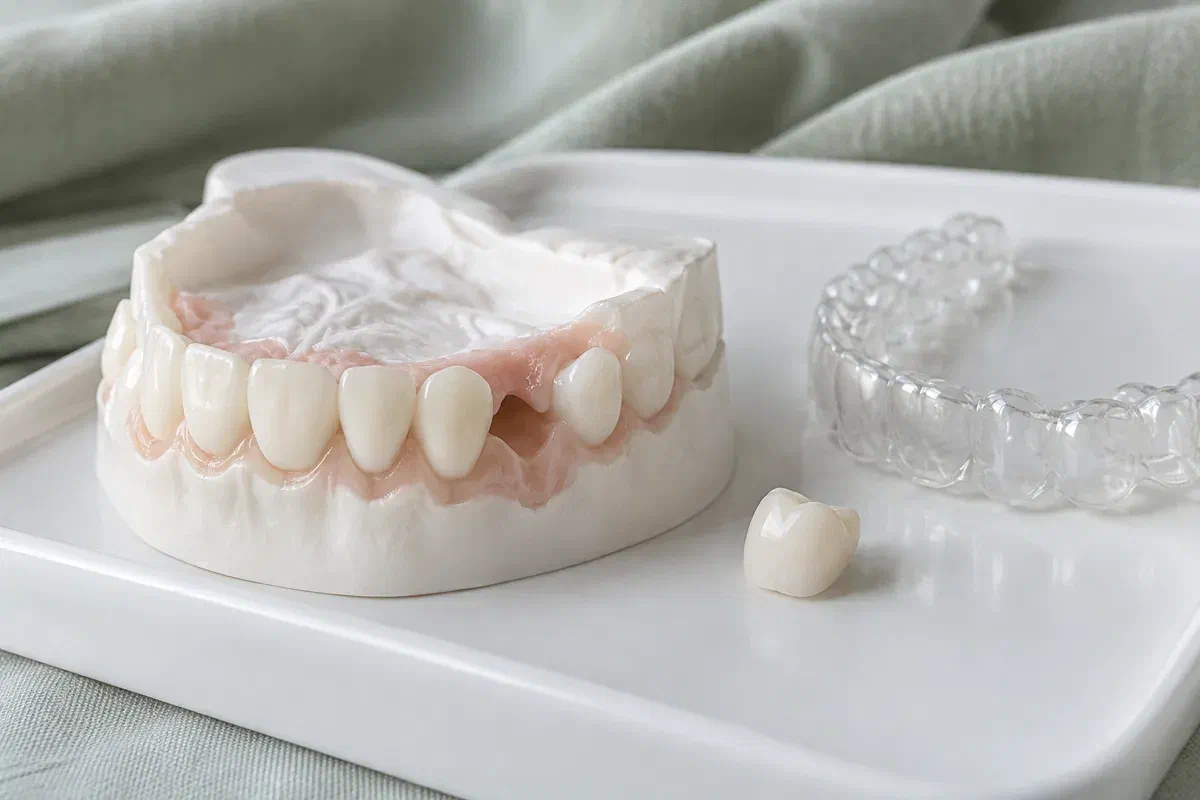
Illustrative tooth model, ceramic crown sample, and clear aligner on a consultation tray
When alignment may come into it

Crowding, overlap and wear rarely affect just one tooth.

The real question is whether a change in position would alter the restorative options. A clinical examination with photographs or scans helps clarify that.

An uneven space beside a front tooth

A small gap, or a space shared unequally between teeth, can make it hard to replace or widen a tooth naturally. Roots and adjacent teeth need assessment, because a bridge, implant crown or bonded addition depends on more than how wide the gap appears.

Overlapping teeth planned for veneers or bonding

When a tooth is rotated or pushed forward, restoring it in its current spot may require more shaping of tooth structure in some areas. Moving teeth and restoring them change different things. Ask whether combining the two offers a real advantage for your smile.

Cosmetic and restorative goals mixed together

Whitening, bonding, crowns and orthodontics may all have been mentioned at once. It helps to know which comes first and who coordinates the order. Shade matching and tooth shape, for example, depend on decisions made earlier in the plan.

A dental implant is fixed in bone and will not move with an orthodontic appliance. Tell us about any implants and all restorations you are considering before alignment is planned.

The case for planning ahead

The restoration decides the destination. Movement only helps reach it.

Aligning teeth before front restorations is worthwhile when it changes what the restorations can achieve: a more even space, a tooth at a better angle, or less need to alter tooth structure in one area. The person recommending it should be able to describe that change specifically.

Orthodontic movement brings its own appointments, home care, possible risks, fees and a retention period that continues afterwards. For front teeth, there may also be a stretch of time when the smile looks unfinished. Weigh that against a plan without movement before deciding what fits your priorities.

Patient information: British Dental Journal — principles of interdisciplinary orthodontic and restorative treatment

A smile design and tooth positions that match

Before anything moves, the clinicians should agree on where each tooth must sit for the planned bonding, veneers or crowns. The goal relates to the restorations, not simply straighter teeth. Ask what will be reviewed before restorative work begins.

An honest alternative

Understand how your front teeth would be restored in their present positions, including the benefits, limits and upkeep involved. A combined route should be supported by your findings rather than presented as the more complete option.

Clear roles throughout

Know who provides the movement, who places the restorations, who reviews progress and whom to call between visits. Where these happen at different practices, ask how photographs, scans and the design plan will be shared.

Planning the smile in stages

Design the final teeth, then plan the path to them.

A combined plan can include several clinicians and reviews. Make sure you know what is still to be decided, and which parts of the plan depend on later findings.

  1. Talk about what bothers you and why

    Point out the chips, wear or overlap you notice, earlier advice you have had and what you want your smile to look and feel like. Bring photos or estimates. Practical limits, like an upcoming event or budget, help shape a realistic order.

  2. Examine and record your smile

    The clinicians assess the health of your teeth and gums, the bite and how your front teeth relate. Photographs, scans or models may be taken to study shape and space. Any decay or gum concerns are typically dealt with before orthodontics begins.

  3. Agree on target positions and a restorative design

    Discuss which teeth would move, the appliance that might be used, alternatives and the limits and risks of each. A preview or mock-up may sometimes help show how the restorations would sit. If a specialist is involved, clarify their role and who brings the plan together.

  4. Check the result before restorations are made

    When movement ends, the new positions are compared with the agreed design. Ask how teeth will be kept in place while bonding, veneers or crowns are prepared. Updated photos or scans may be taken before any permanent shaping of tooth structure.

Holding the alignment

Retain first, restore second.

In the weeks between alignment and restoration, front teeth can still shift. Ask for written retainer instructions and the date of your next check, and how a delay would be managed.

Keep the retainer in as instructed

Wear it on the schedule you were given and report any damage or change in fit. A smile that looks straight can begin to relapse if retention stops. Ask how positions will be protected while your restorations are being planned or made.

Hold off on other cosmetic work until it is discussed

Whitening, a filling or new bonding elsewhere could affect shade matching, the sequence or an appliance’s fit. Mention any plans to every clinician involved. If an appointment changes, check whether another stage needs adjusting.

Leave with a routine for both

Your retainer may need updating after bonding, veneers or crowns alter tooth shape, so confirm who will check it. Go over how to clean and protect the new restorations as well as the aligned teeth.

Paths to a restored smile

Three sensible starting points

The assessment might support alignment before restoration, restoration alone or another opinion. For each, think about the effect on your front teeth, your timeline and your long-term oral health.

When tooth position limits the restoration

Align first, then bond, veneer or crown

This may be recommended when repositioning would let the restorations be shaped more evenly. Before agreeing, understand where the teeth need to finish, who confirms it and how retention will hold them until the restorations are placed.

When existing positions can be worked with

Restore the teeth where they sit

Front teeth can often be restored attractively without orthodontics. Discuss the preparation, appearance, function and upkeep this would involve, and compare it fairly with the combined plan instead of assuming extra steps lead to a better smile.

When the situation needs another view

Look further before choosing

A specialist opinion, gum treatment or more detailed records may be needed first. Ask what is still unknown and what can wait. Cosmetic combined plans are elective, so you can take the time you need before agreeing.

Georgetown smile questions

Front-tooth restorations and alignment: what people ask

These answers can help you understand how movement and restoration work together for front teeth.

(905) 876-4488
Can I see how my teeth might look before committing to alignment?
Digital previews or mock-ups are sometimes used to show a possible result. They are planning tools, not guarantees. Ask how closely a preview reflects what your teeth and restorations could realistically achieve.
Should whitening happen before or after teeth are aligned?
Whitening, if wanted, is usually planned before tooth-coloured restorations are matched, because restorations do not lighten. Ask how whitening, alignment and restoration should be ordered in your case.
Would aligners be visible while my front teeth are moving?
Clear aligners are designed to be discreet, though small attachments are sometimes bonded to teeth. Other appliances may be more noticeable. Ask which options suit the movement needed and what each would look like.
Does aligning crooked front teeth first always mean less shaping for veneers?
Not always. Your dentist can describe the likely preparation with and without movement, but the answer depends on tooth condition, position and the design chosen. Be wary of any guaranteed saving.
What if I want restorations soon and cannot wait for orthodontics?
Explain your timeline openly. Ask what could be achieved by restoration alone, what the trade-offs would be and whether any part of the plan could be staged differently without compromising the result.
Can I get estimates for each stage before I decide?
Yes. Ask for each stage and provider to be outlined with estimates, including records, orthodontic reviews, restorations, whitening if planned and retainers. Clarify which amounts may change after later findings.
Visiting from Georgetown

Show us your smile goals, and we will look at tooth position together.

Arrange a conversation at our Bronte Street practice about whether alignment should come before bonding, veneers or crowns. We will explain the assessment, the coordination involved and when a specialist view may help.

Whether to move teeth, and in what order, depends on an individual assessment. No particular appliance, specialist service or cosmetic outcome is promised.

Visit Milton Dental Clinic
Unit 1, 342 Bronte St. S, Milton, ON L9T 5B7
Get directions Clinic hours
Monday–Thursday
11am–7pm
Friday–Sunday
By appointment only

Areas we serve

  • Milton
  • Oakville
  • Mississauga
  • Georgetown
  • Halton Hills
  • Acton
  • Campbellville
  • Brampton
  • Burlington
  • Puslinch
  • Rockwood
  • Erin
  • Caledon
  • Etobicoke
  • Old Milton
  • Bronte Meadows
  • Timberlea
  • Dorset Park
  • Dempsey
  • Clarke
  • Beaty
  • Coates
  • Harrison
  • Scott
  • Willmott
  • Ford
  • Bowes
  • Cobden
  • Walker
  • Mountain View
  • Milton Heights
  • Hawthorne Village
  • Valley View
  • Fallingbrook
  • Nassagaweya
  • Trafalgar
  • Esquesing
  • Nelson
  • Brookville
  • Moffat
  • Glen Williams
  • Norval
  • Limehouse
  • Stewarttown
  • Ashgrove
  • Hornby
  • Silver Creek
  • Speyside
  • Scotch Block
  • North Oakville
  • River Oaks
  • Glen Abbey
  • West Oak Trails
  • Palermo
  • Bronte Creek
  • College Park
  • Joshua Creek
  • Uptown Core
  • Preserve
  • Iroquois Ridge
  • Lisgar
  • Meadowvale
  • Meadowvale Village
  • Churchill Meadows
  • Erin Mills
  • Central Erin Mills
  • Streetsville
  • East Credit
  • Creditview
  • Heartland
  • Sheridan
  • Mount Pleasant
  • Credit Valley
  • Huttonville
  • Churchville
  • Springbrook
  • Northwest Brampton
  • Bram West
  • Fletcher's Meadow
  • Fletcher's Creek South
  • Alton Village
  • Orchard
  • Millcroft
  • Headon Forest
  • Tansley
  • Brant Hills
  • Tyandaga
  • Kilbride
  • Lowville
  • Aberfoyle
  • Morriston
  • Arkell
  • Hillsburgh
  • Freelton
  • Carlisle
  • Waterdown
  • Flamborough
  • Mountsberg

How can we help?

Milton Dental Clinic

Have a question about your smile? Choose the option that works best for you.

For urgent dental concerns, please call.
Messages are reviewed during clinic hours.