

Illustrative patient and clinician discussing a tooth model before restorative planning
Cosmetic Dentistry

Pre-Restorative Tooth Alignment in Halton Hills

Gum treatment, orthodontics and a new crown or bridge can each sound sensible on their own, yet the order matters. For households across Halton Hills, we can sort out whether moving teeth belongs in your restorative plan at all, and where it would sit among the other steps.

Putting treatments in order

A calendar full of dental appointments, and no clear sequence

It often starts with a list. A course of gum treatment, a suggestion to see an orthodontist, then an estimate for a crown or bridge. Pre-restorative tooth alignment is the part of that list concerned with moving teeth so the restoration at the end has a better starting point. Understanding where it fits can make the rest of the list easier to follow.

Not every list needs that item. Teeth are commonly restored in their current positions, and plenty of plans skip orthodontics entirely. If movement is on your list, the reason should tie directly to the restoration, and you should also hear how things would proceed without it.

Coming from Georgetown, Acton, Glen Williams or one of the smaller hamlets in Halton Hills, bring every recommendation you have received, even old ones. Our team can sort what has been assessed, what still needs checking and whether a specialist opinion would help, keeping the final restoration as the reference.

Get help ordering your treatment plan
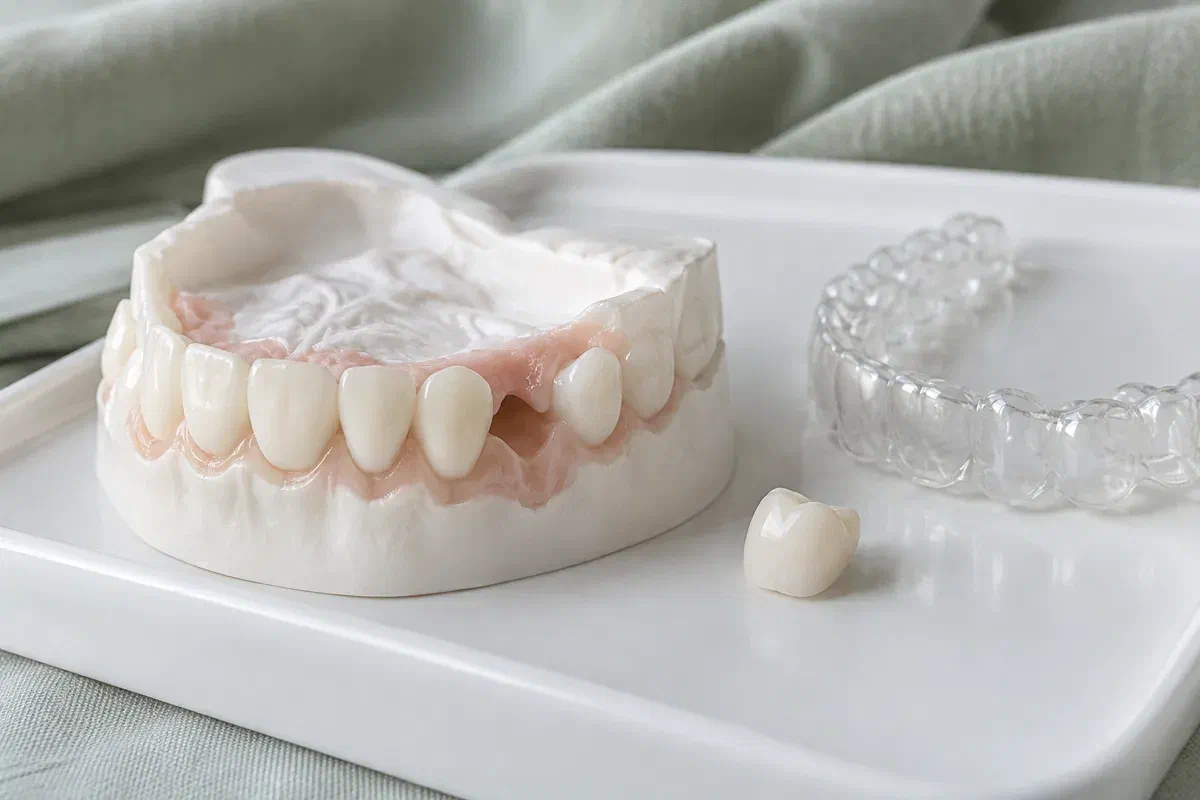
Illustrative tooth model, ceramic crown sample, and clear aligner on a consultation tray
Where position can make a difference

Spacing, angle and sequence

Changing where a tooth sits matters only if it would change the care you need. An examination, supported by records, is how that question gets answered.

Room for a missing tooth’s replacement

Over time, a gap may shrink or skew as neighbouring teeth drift. A bridge or implant crown needs a suitable space, and the roots beside it matter as much as the opening itself. Both deserve a look before anyone designs the replacement.

Teeth out of line that need restoring

Restoring a leaning, rotated or heavily worn tooth can be harder when it sits awkwardly. Moving it and reshaping it solve different problems. Expect a plain explanation of whether combining them would help, or whether one is enough on its own.

Recommendations from several sources

A hygienist, a dentist and an orthodontist may each have suggested something different. Ask how their advice joins up and who is responsible for the order. When appointments are planned as a sequence, one stage is less likely to complicate another.

Unlike natural teeth, implants are fused to the jawbone and stay where they were placed. Mention any implants, and every restoration being considered, before an orthodontic proposal is drawn up.

Why the order matters

Each stage prepares the ground for the next.

Alignment is valuable only when the restoration benefits. A worthwhile recommendation names the gain: a better-shaped space, a tooth at a more workable angle, or a bite that lets the restoration be designed more soundly. Without that link, the extra stage is hard to justify.

Movement also adds its own demands to a busy household. There are additional appointments, appliance care at home, possible risks, fees and months or longer of retention. Hold that up against a plan that leaves teeth alone, and choose the one that matches what matters to you.

Patient information: British Dental Journal — principles of interdisciplinary orthodontic and restorative treatment

A destination set before departure

The clinicians should agree on the tooth positions that suit the restoration before any appliance is fitted. Straightness for its own sake is not the target. You should also know what checks will happen before the restorative work is booked.

Room to compare without pressure

Hear how the tooth would be restored if it stayed put, and what that would mean for appearance, function and maintenance. A combined plan earns its place through your findings, never by being presented as the default.

Clear lines of responsibility

Write down who handles each stage, who reviews progress and whom to contact if there is a problem between visits. Where an orthodontist and restorative dentist practise separately, ask how they will share records and decisions.

How the sequence is worked out

Health first, then position, then restoration

Several clinicians and reviews can be involved. Before committing, understand what still needs finding out and which parts of the plan are firm.

  1. Gather the recommendations and your goals

    Bring the list, along with symptoms you have noticed and what you most want from treatment. Old estimates and imaging are useful. Let us know about work hours, children’s schedules or budget limits so the full order of care can be discussed together.

  2. Check gums, teeth and supporting bone

    Healthy foundations come before movement. The clinicians look for active decay or gum disease that should be treated first, and assess the space, roots and bite relevant to your restoration. Additional imaging or models may be requested.

  3. Choose the movement, the appliance and the alternatives

    Review exactly which teeth would move, the appliance that might be used, other options and the limits and risks attached. You should be able to picture how the restoration will sit afterwards. If a specialist joins in, agree on the question they will answer and who will coordinate.

  4. Confirm the teeth are where they need to be

    Before restorative work starts, the new positions are checked against the original target. Ask what will keep them stable while the crown or bridge is made. Sometimes fresh records or another short planning visit come first, before any irreversible step.

Holding positions in the meantime

The pause between stages has a job to do.

Once movement ends and before the restoration is fitted, specific instructions apply. Leave with a clear retainer routine, your next review date and a plan for any change in timing.

Treat the retainer as part of treatment

Wear it exactly as instructed, and report cracks, looseness or a change in fit. Leaving it out because the teeth seem done can let them drift. Ask how the result will be protected until the restoration or another clinician’s review.

Join up care across offices

An extraction, filling or crown elsewhere can change the plan or affect how an appliance fits. Make sure each clinician knows what the others are doing. When one date moves, check whether it pushes another stage back too.

Finish with one maintenance routine

After the restoration is fitted, the retainer may need adjusting to the new shape, so find out who will handle it. Review how to clean around the restoration and the aligned teeth, and when each will next be checked.

Options to weigh

Move, restore, or pause to learn more

Depending on what the assessment shows, combined care, restoration by itself or a further opinion may be sensible. Consider how each choice affects the tooth, the other treatments on your list and your overall oral health.

When position limits the restoration

Realign selected teeth, then restore

This may be suggested when repositioning clearly improves the restorative result. Before agreeing, understand the agreed finishing point, how it will be verified and how retention will carry the result through to the restoration.

When present positions are workable

Restore without an orthodontic stage

Often the tooth can be restored well as it is. Discuss what preparation, appearance, function and long-term care would be involved. Compare this fairly with the combined plan, rather than assuming more steps produce a better outcome.

When findings call for another view

Investigate further first

Specialist advice, gum treatment or more imaging may need to come before the sequence is settled. Identify the open questions and what can wait without harm. You can take time to consider an elective combined plan before saying yes.

Halton Hills questions

Untangling a multi-step dental plan

These answers can help you see how the pieces of a combined plan fit together.

(905) 876-4488
Does gum treatment need to be finished before teeth are moved?
Active gum disease is usually addressed before orthodontic movement is considered, so the supporting tissues are as healthy as possible. Ask how stability will be confirmed and how your gums will be monitored while teeth are moving.
Can two members of our household be planned at the same time?
You are welcome to ask about coordinating appointments for more than one person. Each plan is still based on its own assessment. Let us know your preferred times so visits can be arranged as conveniently as is practical.
Should a cracked or decayed tooth be repaired before alignment starts?
Often an urgent or active problem is managed first, sometimes with a temporary restoration, and the final restoration follows movement. Ask what is recommended for that particular tooth and why.
Will moving my teeth first mean less enamel is removed for a crown?
That cannot be promised. Your dentist can explain the preparation expected with and without movement, but tooth condition, position and the restorative aim all affect it. Approach any guaranteed benefit with caution.
Who keeps track of the overall plan when several dentists are involved?
Ask at the start who will coordinate the sequence and confirm when each stage is ready. Knowing who leads the plan makes it easier to ask questions and handle changes between visits.
Is the cost of each stage explained separately?
It should be. Ask for estimates for each stage and provider, including records, orthodontic reviews, restorations and retainers, and find out which amounts could change once later findings are known.
Planning from Halton Hills

Bring the whole list, and we will help you put it in order.

Visit our Bronte Street practice to discuss whether alignment belongs before your restorative treatment. We will explain what assessment is needed, how stages could be coordinated and when specialist input might help.

Tooth movement and treatment order are decided through individual assessment. No specific appliance, specialist service or result is assumed.

Visit Milton Dental Clinic
Unit 1, 342 Bronte St. S, Milton, ON L9T 5B7
Get directions Clinic hours
Monday–Thursday
11am–7pm
Friday–Sunday
By appointment only

Areas we serve

  • Milton
  • Oakville
  • Mississauga
  • Georgetown
  • Halton Hills
  • Acton
  • Campbellville
  • Brampton
  • Burlington
  • Puslinch
  • Rockwood
  • Erin
  • Caledon
  • Etobicoke
  • Old Milton
  • Bronte Meadows
  • Timberlea
  • Dorset Park
  • Dempsey
  • Clarke
  • Beaty
  • Coates
  • Harrison
  • Scott
  • Willmott
  • Ford
  • Bowes
  • Cobden
  • Walker
  • Mountain View
  • Milton Heights
  • Hawthorne Village
  • Valley View
  • Fallingbrook
  • Nassagaweya
  • Trafalgar
  • Esquesing
  • Nelson
  • Brookville
  • Moffat
  • Glen Williams
  • Norval
  • Limehouse
  • Stewarttown
  • Ashgrove
  • Hornby
  • Silver Creek
  • Speyside
  • Scotch Block
  • North Oakville
  • River Oaks
  • Glen Abbey
  • West Oak Trails
  • Palermo
  • Bronte Creek
  • College Park
  • Joshua Creek
  • Uptown Core
  • Preserve
  • Iroquois Ridge
  • Lisgar
  • Meadowvale
  • Meadowvale Village
  • Churchill Meadows
  • Erin Mills
  • Central Erin Mills
  • Streetsville
  • East Credit
  • Creditview
  • Heartland
  • Sheridan
  • Mount Pleasant
  • Credit Valley
  • Huttonville
  • Churchville
  • Springbrook
  • Northwest Brampton
  • Bram West
  • Fletcher's Meadow
  • Fletcher's Creek South
  • Alton Village
  • Orchard
  • Millcroft
  • Headon Forest
  • Tansley
  • Brant Hills
  • Tyandaga
  • Kilbride
  • Lowville
  • Aberfoyle
  • Morriston
  • Arkell
  • Hillsburgh
  • Freelton
  • Carlisle
  • Waterdown
  • Flamborough
  • Mountsberg

How can we help?

Milton Dental Clinic

Have a question about your smile? Choose the option that works best for you.

For urgent dental concerns, please call.
Messages are reviewed during clinic hours.