

Illustrative patient and clinician discussing a tooth model before restorative planning
Cosmetic Dentistry

Pre-Restorative Tooth Alignment in Oakville

An implant or bridge planned for a gap that has closed in a little raises a fair question: replace the tooth now, or reopen the space first? Coming from Oakville, you can discuss with us whether limited movement would help, and how each stage would be planned and reviewed.

Space, first

A missing tooth leaves a gap. Time can reshape it.

Picture a back tooth removed a few years ago. The neighbours lean in, the space narrows near the gumline, and now an implant crown or bridge is being discussed. Pre-restorative alignment is about deciding whether nudging those teeth back would give the replacement a better foundation, or whether the restoration can be designed around things as they stand.

Movement is one tool, not a requirement. Plenty of implant and bridge plans proceed with no orthodontic stage at all. When repositioning is raised, the explanation should connect it to a specific benefit for the replacement tooth, and should be honest about what you would gain and give up by skipping it.

Before your first visit from Oakville, gather what you already have: a surgeon’s notes, previous X-rays or a written treatment plan. We can review those, outline the assessment still needed and talk about whether an orthodontic or other specialist view would help. The final replacement guides each recommendation from the outset.

Discuss a gap before replacing a tooth
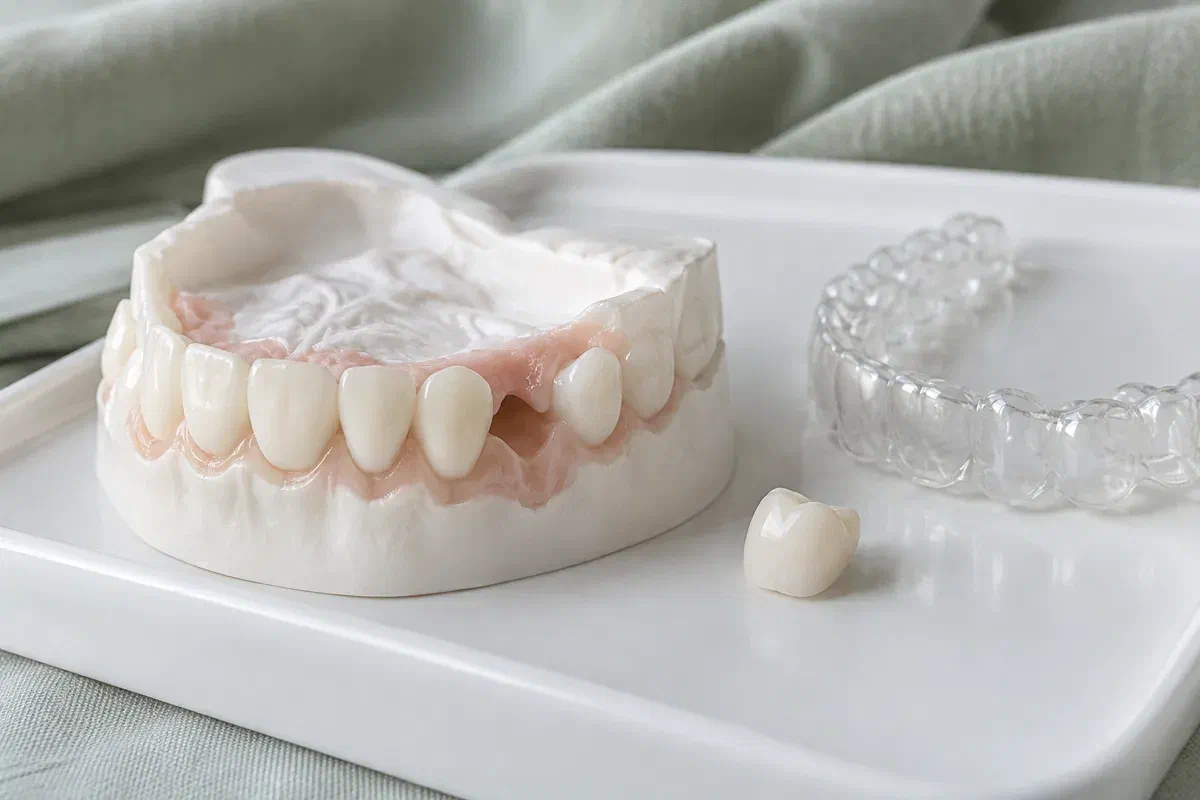
Illustrative tooth model, ceramic crown sample, and clear aligner on a consultation tray
Situations worth a second look

Is the space really the shape the replacement needs?

Tooth position matters only when changing it would alter the care you receive. Your examination and records are how clinicians judge whether that is likely.

A gap that has tipped or narrowed

Teeth on either side of a missing tooth can tilt so the opening is wider at the biting edge than at the root level. An implant or bridge depends on more than what is visible. Neighbouring roots and tooth angles need to be assessed before the replacement is designed.

A crown or bonding planned on a tooth out of line

A rotated, leaning or oddly worn tooth can restrict how a restoration is shaped. Repositioning moves the tooth; reshaping changes its outline. Ask whether using both would give a better-reasoned result for this tooth, or whether one approach is enough.

Advice from different clinicians that does not line up

Perhaps a surgeon, an orthodontist and a general dentist have each suggested something. It helps to know how those pieces connect and who is responsible for the order. Treatment flows better when each appointment respects what the other stages still require.

Existing implants are fused to bone and stay put when teeth around them are moved. Let the team know about every implant and planned restoration before any orthodontic plan is prepared.

What planning together offers

Fewer surprises when the replacement tooth is finally made

The value of moving teeth lies in what it does for the planned replacement. A useful recommendation spells out whether repositioning would improve available room, change how neighbouring teeth relate, or alter the restoration’s design. A general claim that straighter teeth are better is not enough.

Alignment also asks something of you. It brings extra visits, daily appliance care, its own risks, added cost and a retention phase afterwards. Compare that commitment with a sound plan that leaves the teeth in place, and decide which fits the outcome you care about.

Patient information: British Dental Journal — principles of interdisciplinary orthodontic and restorative treatment

One target that all clinicians share

The orthodontic finish should be defined by what the implant crown or bridge needs, agreed before movement begins. Find out what has to be confirmed, and by whom, before the restorative step is booked.

Alternatives laid out side by side

Learn how the space would be restored if no teeth moved, and what that would mean for appearance, function and upkeep. A combined plan should stand on the findings in your mouth, not on an assumption that more treatment is better treatment.

Responsibilities that are easy to follow

You should know who provides each stage, who checks progress and whom to call between appointments. This matters especially when an orthodontist, a surgeon and your restorative dentist work at different practices, so ask how records will be passed along.

Mapping the stages

Begin at the replacement tooth and plan backwards.

A combined approach may include several clinicians and more than one review. Ask what has to be known before you commit and which choices are still provisional.

  1. Explain the gap, the history and your goals

    Share when the tooth was lost, any earlier proposals, symptoms and what matters to you in the result. Bring imaging or estimates if you have them. Mention work, family or budget constraints so the full sequence can be planned rather than just the first appointment.

  2. Check health, space and roots

    The clinicians examine your teeth and gums and the relationships around the gap. Further imaging or models may be needed to understand root angles, available space and your bite. Decay or gum disease might need to be treated before movement is considered.

  3. Decide the movement and the restorative plan together

    Go through the proposed movement, appliance choices, alternatives, limitations and risks. You should see how the replacement will sit in the final arrangement. If a specialist is consulted, ask what they are being asked to answer and who will bring that advice into one plan.

  4. Confirm the space before replacement

    When movement finishes, the result is measured against what the replacement needs. Ask how positions will be maintained while the implant crown or bridge is prepared. New records or another planning discussion may be needed before irreversible work begins.

Holding the space

The room you created needs protecting until the tooth is replaced.

Between the end of movement and the replacement, the teeth need specific care. Know which appliance to wear, which visits to keep and how plan changes will be managed.

Wear the retainer exactly as advised

Follow the wear schedule and tell the team about breakage, looseness or a change in fit. A space that looks ready can begin to close again if the retainer is left out. Ask how the gap will be kept open while you wait for the replacement or another clinician’s input.

Keep every office informed

A filling, extraction or new crown done elsewhere can affect the sequence or the fit of an appliance. Make sure each clinician knows about care booked with others. When one appointment moves, check whether another stage needs to move with it.

Finish with a maintenance plan for both

Retention may need adjusting around the final restoration, so confirm who will check it. Review cleaning around the new tooth as well as the aligned teeth. The last restorative appointment should leave you clear on long-term care for each.

Possible routes

Open the space, work with it, or learn more first?

Depending on findings, the assessment may support combined care, restoration alone or a further opinion. Ask what each would mean for the gap and for the rest of your mouth.

When the gap limits the replacement

Reposition teeth, then replace the missing one

Moving neighbouring teeth may be suggested when it gives the implant crown or bridge a clearly better setting. Ask what endpoint is required, how it will be confirmed and how retention will hold it. The replacement should stay central to every discussion.

When the existing space is adequate

Replace the tooth with no prior movement

Many gaps can be restored well as they are. Learn what the preparation, look, function and maintenance would be. Compare that directly with the combined route instead of assuming that an extra orthodontic stage will always improve the outcome.

When the picture is still incomplete

Seek further assessment before deciding

A specialist opinion, gum treatment or more imaging may be needed before the sequence is chosen. Ask what remains uncertain and what can wait safely. An elective combined plan does not need to be accepted on the day it is proposed.

Oakville questions about gaps

Before you replace a tooth, ask these.

These answers help show how movement and replacement connect, before either begins.

(905) 876-4488
Could a gap be closed with orthodontics instead of being filled?
In some situations, closing a space may be an option worth discussing, while in others replacement is more suitable. It depends on the bite, the neighbouring teeth and your preferences. Ask the clinicians to compare both possibilities for your mouth.
Does the implant surgery happen before or after teeth are moved?
The order varies with the plan. Because an implant will not move once it is in place, its position usually has to fit the final arrangement of the surrounding teeth. Ask the clinicians how they intend to coordinate timing in your case.
Will reopening a space make the gum or bone ready for an implant?
Tooth movement does not by itself guarantee that the site is suitable. Bone and gum conditions still need separate assessment, and further treatment may be recommended. Ask what the implant clinician will need to see before placement can be considered.
Is orthodontic work always required before an implant crown?
No. Many implant crowns are placed without any preceding movement. The decision follows assessment of space, roots and the neighbouring teeth, so ask what your findings show and what each alternative would involve.
How do I avoid a long string of trips from Oakville during staged care?
Tell us at the start which days and times usually work for you. Where it is clinically appropriate, reviews can sometimes be grouped or planned in advance. Ask which appointments need to be in person and which questions can be handled by phone.
What should I bring to compare a combined plan with a simpler one?
Bring any written proposals, estimates and imaging from other clinicians, plus a list of your questions. Ask for each option’s stages, providers, likely fees and maintenance to be explained, including which figures may change later.
Planning a visit from Oakville

Talk through the gap before anything is booked.

Arrange a consultation at our Bronte Street practice to discuss whether moving teeth would help your implant or bridge. We can explain the assessment, the coordination involved and when a specialist opinion may be useful.

The need for movement and the order of treatment depend on individual assessment. No specific appliance, specialist service or outcome is assumed.

Visit Milton Dental Clinic
Unit 1, 342 Bronte St. S, Milton, ON L9T 5B7
Get directions Clinic hours
Monday–Thursday
11am–7pm
Friday–Sunday
By appointment only

Areas we serve

  • Milton
  • Oakville
  • Mississauga
  • Georgetown
  • Halton Hills
  • Acton
  • Campbellville
  • Brampton
  • Burlington
  • Puslinch
  • Rockwood
  • Erin
  • Caledon
  • Etobicoke
  • Old Milton
  • Bronte Meadows
  • Timberlea
  • Dorset Park
  • Dempsey
  • Clarke
  • Beaty
  • Coates
  • Harrison
  • Scott
  • Willmott
  • Ford
  • Bowes
  • Cobden
  • Walker
  • Mountain View
  • Milton Heights
  • Hawthorne Village
  • Valley View
  • Fallingbrook
  • Nassagaweya
  • Trafalgar
  • Esquesing
  • Nelson
  • Brookville
  • Moffat
  • Glen Williams
  • Norval
  • Limehouse
  • Stewarttown
  • Ashgrove
  • Hornby
  • Silver Creek
  • Speyside
  • Scotch Block
  • North Oakville
  • River Oaks
  • Glen Abbey
  • West Oak Trails
  • Palermo
  • Bronte Creek
  • College Park
  • Joshua Creek
  • Uptown Core
  • Preserve
  • Iroquois Ridge
  • Lisgar
  • Meadowvale
  • Meadowvale Village
  • Churchill Meadows
  • Erin Mills
  • Central Erin Mills
  • Streetsville
  • East Credit
  • Creditview
  • Heartland
  • Sheridan
  • Mount Pleasant
  • Credit Valley
  • Huttonville
  • Churchville
  • Springbrook
  • Northwest Brampton
  • Bram West
  • Fletcher's Meadow
  • Fletcher's Creek South
  • Alton Village
  • Orchard
  • Millcroft
  • Headon Forest
  • Tansley
  • Brant Hills
  • Tyandaga
  • Kilbride
  • Lowville
  • Aberfoyle
  • Morriston
  • Arkell
  • Hillsburgh
  • Freelton
  • Carlisle
  • Waterdown
  • Flamborough
  • Mountsberg

How can we help?

Milton Dental Clinic

Have a question about your smile? Choose the option that works best for you.

For urgent dental concerns, please call.
Messages are reviewed during clinic hours.