

Illustrative patient and clinician discussing a tooth model before restorative planning
Cosmetic Dentistry

Pre-Restorative Tooth Alignment in Old Milton

Teeth that have drifted since an old extraction, or worn edges beside an ageing bridge, can complicate the next restoration. From Old Milton, talk with us about whether repositioning a few teeth first would make sense, and how the stages could be arranged around your life.

Replacing work from years ago

Has your mouth changed since that last bridge was made?

Many people around Old Milton, the town’s historic downtown, have dental work that is decades old. Over that time, teeth beside a missing tooth may lean, an opposing tooth may drop toward the space, and the bite can settle differently. Pre-restorative alignment asks a narrow question: would moving some of those teeth help the new restoration you are planning?

Often the answer is no. A replacement crown or bridge can usually be designed around the teeth as they are today. Sometimes, though, a tipped tooth or uneven space limits what can be done well. Your dentist should explain the specific difference movement would make, and the trade-offs of leaving things alone.

Bring along anything you have from earlier treatment, including old estimates, X-rays or a specialist’s letter. Our team at Bronte Street can review what is already known, what still needs assessing, and whether an orthodontic opinion would add anything. The restoration you want at the end shapes every part of that conversation.

Talk about drifted teeth and new restorations
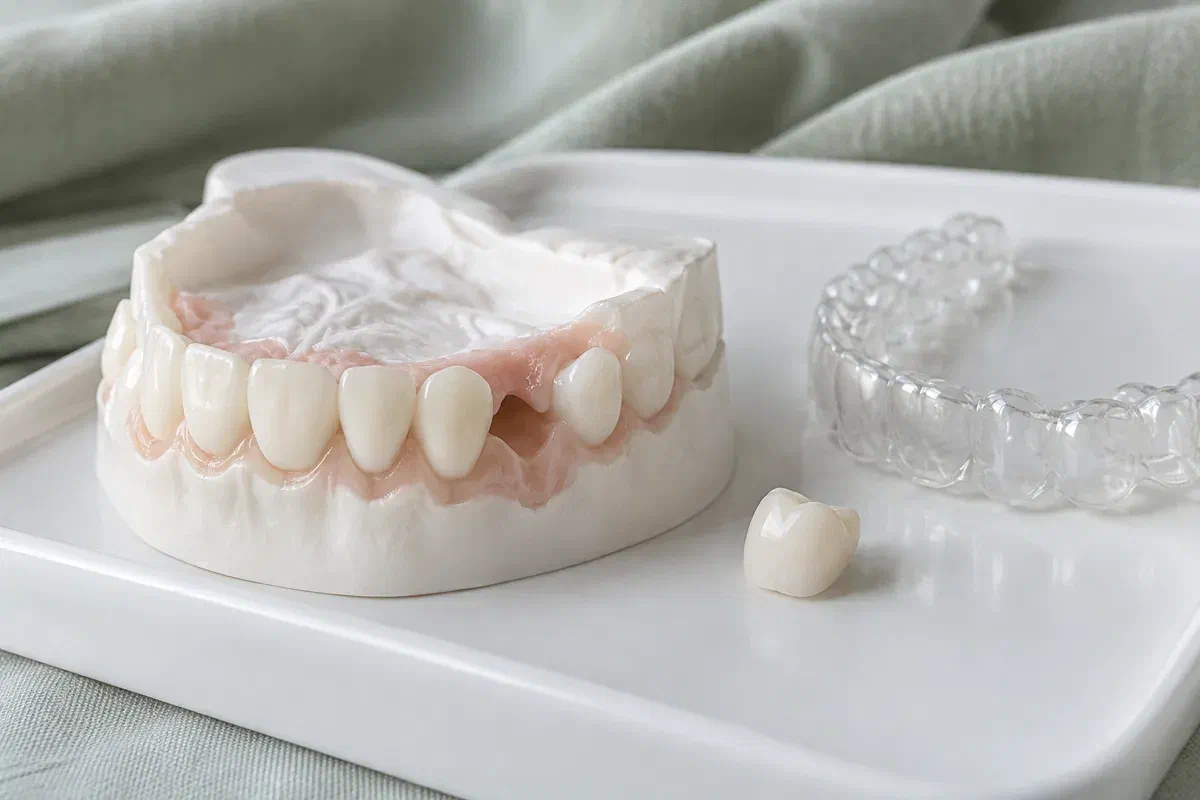
Illustrative tooth model, ceramic crown sample, and clear aligner on a consultation tray
What time can do to spacing

Old gaps rarely stay the shape they were.

Movement is only worth discussing if a different tooth position would change your restorative options. An examination and records help show whether that is true in your case.

A long-standing space beside a missing tooth

Neighbouring teeth can tilt into a gap left years ago, leaving room that is narrow at one level and wide at another. Before a bridge or implant crown is planned, roots and adjacent teeth need checking. What looks like enough space from the front may not be.

A tilted or worn tooth needing a new crown

Wear, rotation or a lean can affect how a new crown or bonded surface is shaped. Moving a tooth changes where it sits, while reshaping changes its form, and the two are not interchangeable. Your clinician should say plainly whether combining them would help this tooth.

Treatment suggestions collected over many years

You may have heard about gum care at one visit, a crown at another and braces once in passing. It is reasonable to ask how these fit together now and who is overseeing the order. Each step tends to go better when the others are taken into account.

Implants already in your mouth are anchored in bone and will not shift with orthodontic forces. Tell us about any implants and planned restorations before an alignment proposal is drafted.

The point of planning together

Movement should serve the restoration, not the other way round.

The case for alignment rests on what it does for the final crown, bridge or implant. A clear recommendation should say whether moving teeth would improve available space, the relationship between neighbouring teeth, or the design itself. If you cannot see the connection, keep asking until you can.

An orthodontic stage brings commitments of its own. You would have extra appointments, appliance care at home, some risks, added expense and a retention period afterwards. Set those against a reasonable plan that skips movement, and choose what suits your priorities and circumstances.

Patient information: British Dental Journal — principles of interdisciplinary orthodontic and restorative treatment

Positions and design agreed in advance

Everyone involved should share one picture of where the teeth need to finish. That target comes from the restoration’s needs rather than from making teeth look straighter. Find out what has to be confirmed before restorative work is scheduled.

A fair look at the alternatives

Request an explanation of how the tooth would be restored if nothing moved. Each approach has strengths, drawbacks and maintenance needs. Combined treatment should be recommended because of your findings, never because it sounds more thorough.

Someone clearly in charge of each step

Know which clinician provides each stage, who reviews progress and whom you contact with a problem. If orthodontic and restorative care are delivered at different practices, ask how notes and images will be shared between them.

Four stages of planning

From the restoration you need back to the first assessment

Staged care can involve several clinicians and reviews. Before committing, learn what information is still required and which decisions remain open to change.

  1. Describe the old work and your goals

    Tell us which tooth or gap you want treated, what was recommended before, any symptoms and what you care about most in the outcome. Older records and estimates are helpful. Practical limits on time or budget are worth mentioning so the whole plan can be discussed.

  2. Examine current health and take records

    Clinicians check the condition of teeth and gums and the relationships that matter for the proposed restoration. Images or models may be needed to understand space, root angles or the bite. Decay or gum problems might need treatment before any movement starts.

  3. Agree where teeth should end up

    Discuss the movement being proposed, possible appliances, alternatives, limitations and risks. You should see how the planned restoration fits the finished positions. When a specialist is involved, ask what they are being asked to assess and who will combine their advice with the rest of the plan.

  4. Confirm the teeth are ready

    Once movement is complete, results are measured against the agreed target. Find out how positions will be held while the restoration is made and placed. Fresh records or another planning conversation may come first, before any tooth is irreversibly prepared.

While the restoration is prepared

Protect the new positions during the handover.

The period between alignment and restoration needs its own clear instructions. Find out what to wear, which visits matter and how changes to the plan will be handled.

Stay with the retainer routine

Wear the appliance as instructed and let us know if it cracks, loosens or feels different. Stopping because the teeth look right can allow them to move back. Ask how the result will be held while you wait for the next stage or another clinician’s review.

Mention any other planned treatment

An extraction, filling or new crown elsewhere may affect timing or how an appliance fits. Keep every clinician aware of work booked at other offices. If you move an appointment, check whether it changes the timing of another stage.

Leave with a plan for both results

Retention may need updating once the final tooth shape is in place, so learn who will review it. Go over cleaning and check-ups for the new restoration and the aligned teeth together. You should finish knowing how each will be looked after.

Deciding on a sequence

Each approach has a reason, and each has limits.

Your assessment may favour combined treatment, a restoration on its own, or further investigation. Find out what each path would mean for the tooth and for your oral health overall.

When position changes the restorative result

Realigning first, restoring second

Movement before restoration may be suggested where repositioning offers a meaningful gain. Learn what endpoint is needed, how it will be measured and how retention links the stages. The restoration should remain the focus throughout.

When existing positions are workable

Restoring the teeth in their current places

Restoring a tooth without orthodontic treatment can be entirely appropriate. Discuss the preparation, look, function and upkeep involved. Compare these openly with the combined option, without assuming an added stage is always the better choice.

When the findings raise further questions

Gathering more information first

A specialist view or other dental treatment may be needed before the order of care is fixed. Identify the open questions and what can safely wait. You are free to take time over an elective combined plan before agreeing to it.

Questions from Old Milton

Answers for teeth that have shifted over the years

These questions can help connect each stage of treatment before any work begins.

(905) 876-4488
Can teeth that drifted many years ago still be moved?
Often they can, but suitability depends on the health of the teeth, roots and gums. Long-standing changes are assessed in the same way as recent ones. Ask what the examination shows and whether movement would genuinely help the planned restoration.
Is there an age limit for orthodontic movement before restorative care?
Adults of many ages have teeth moved when it suits their plan. Gum health, bone support and general health matter more than the number of years. Discuss your history openly so the clinicians can judge what is reasonable.
Should my old bridge be removed before teeth are aligned?
That depends on the bridge, the teeth supporting it and the movement planned. Teeth joined by a bridge cannot move independently. Ask how the existing work would be handled and what temporary arrangement might be needed in the meantime.
Will moving a tooth before its new crown always preserve more tooth structure?
No guarantee can be given. Your dentist should describe the preparation expected with and without movement for your particular tooth. Condition, position and the restorative aim all influence the answer, so be cautious of any promise that sounds certain.
What if the new crown or bridge has to wait after my teeth are aligned?
Let the clinicians know and ask how the positions will be held during the delay. Confirm which appliance to wear, how often, and whether a review is needed. Do not substitute an old retainer or stop wearing the current one without advice.
Can I see a breakdown of costs for every stage before agreeing?
Yes. Request an outline of each stage, who provides it and the estimated fees, including records, orthodontic reviews, restorations and retainers. Ask which figures are firm and which may change once later findings are known.
Plan care from Old Milton

Bring your history, and let’s talk about the next restoration.

Book time at our Bronte Street practice to discuss whether alignment should come before your crown, bridge or implant. We will explain the assessment, coordination and any specialist input that could help you decide.

Any need for tooth movement, and the order of treatment, depends on individual assessment. No particular appliance, specialist service or result is promised.

Visit Milton Dental Clinic
Unit 1, 342 Bronte St. S, Milton, ON L9T 5B7
Get directions Clinic hours
Monday–Thursday
11am–7pm
Friday–Sunday
By appointment only

Areas we serve

  • Milton
  • Oakville
  • Mississauga
  • Georgetown
  • Halton Hills
  • Acton
  • Campbellville
  • Brampton
  • Burlington
  • Puslinch
  • Rockwood
  • Erin
  • Caledon
  • Etobicoke
  • Old Milton
  • Bronte Meadows
  • Timberlea
  • Dorset Park
  • Dempsey
  • Clarke
  • Beaty
  • Coates
  • Harrison
  • Scott
  • Willmott
  • Ford
  • Bowes
  • Cobden
  • Walker
  • Mountain View
  • Milton Heights
  • Hawthorne Village
  • Valley View
  • Fallingbrook
  • Nassagaweya
  • Trafalgar
  • Esquesing
  • Nelson
  • Brookville
  • Moffat
  • Glen Williams
  • Norval
  • Limehouse
  • Stewarttown
  • Ashgrove
  • Hornby
  • Silver Creek
  • Speyside
  • Scotch Block
  • North Oakville
  • River Oaks
  • Glen Abbey
  • West Oak Trails
  • Palermo
  • Bronte Creek
  • College Park
  • Joshua Creek
  • Uptown Core
  • Preserve
  • Iroquois Ridge
  • Lisgar
  • Meadowvale
  • Meadowvale Village
  • Churchill Meadows
  • Erin Mills
  • Central Erin Mills
  • Streetsville
  • East Credit
  • Creditview
  • Heartland
  • Sheridan
  • Mount Pleasant
  • Credit Valley
  • Huttonville
  • Churchville
  • Springbrook
  • Northwest Brampton
  • Bram West
  • Fletcher's Meadow
  • Fletcher's Creek South
  • Alton Village
  • Orchard
  • Millcroft
  • Headon Forest
  • Tansley
  • Brant Hills
  • Tyandaga
  • Kilbride
  • Lowville
  • Aberfoyle
  • Morriston
  • Arkell
  • Hillsburgh
  • Freelton
  • Carlisle
  • Waterdown
  • Flamborough
  • Mountsberg

How can we help?

Milton Dental Clinic

Have a question about your smile? Choose the option that works best for you.

For urgent dental concerns, please call.
Messages are reviewed during clinic hours.