

Illustrative patient and clinician discussing a tooth model before restorative planning
Cosmetic Dentistry

Pre-Restorative Tooth Alignment in Puslinch

Orthodontic movement before a crown, bridge, implant crown or bonding is targeted work, aimed at the restoration rather than a whole new smile. For households in Puslinch, we can explain what that narrower goal means, when it is worth it and how the stages would be organized.

A targeted kind of orthodontics

Not a makeover. A better footing for one restoration.

People sometimes hear “orthodontics before your crown” and picture a full set of braces and a transformed smile. Pre-restorative tooth alignment is usually more focused than that. The idea is to move particular teeth, or redistribute a space, so the restoration planned afterwards has the room and angles it needs.

Because the goal is so specific, the answer is often that no movement is required. Crowns, bridges and implant crowns are routinely made around teeth in their current positions. When movement is advised, the reason should point to the restoration itself, and you should also be shown the plan that does not involve it.

Coming from Puslinch, it may help to raise travel and scheduling at the first visit, along with any earlier proposals or X-rays. Our team can talk through what has been assessed, what is still needed and whether specialist input would add clarity, always with the finished restoration in mind.

Learn what targeted alignment involves
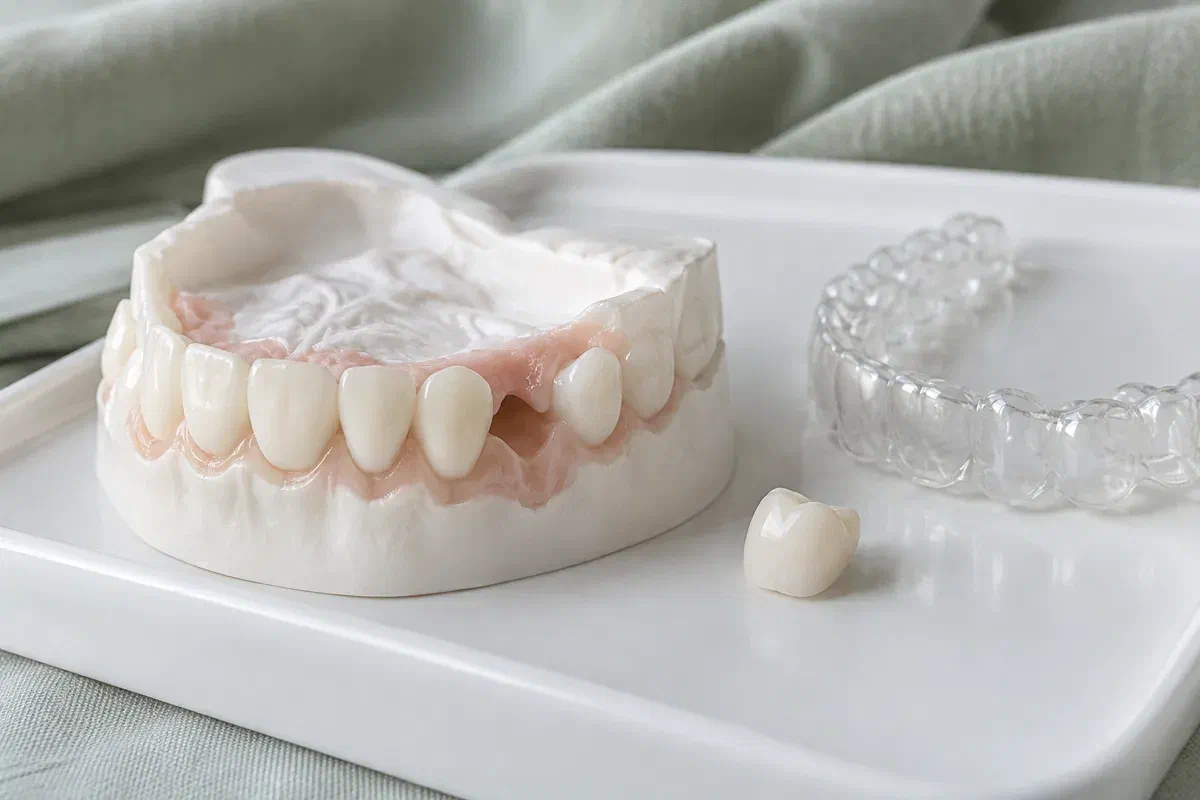
Illustrative tooth model, ceramic crown sample, and clear aligner on a consultation tray
Where a focused change may help

Three common reasons a small movement is considered

Movement is relevant only when a different position would change your restorative care. Examination and records help clinicians decide whether that applies.

A space shared unevenly

After tooth loss, the remaining space can end up too narrow, or split between two smaller gaps. That shape may not suit a bridge or implant crown. The roots and teeth on either side need assessing alongside the visible opening.

One tooth out of step with its neighbours

A tooth that is tipped, turned or sitting forward can be awkward to crown or bond evenly. Moving it and reshaping it are distinct options. Your clinician should explain whether combining them would offer a reasoned benefit for that tooth.

Treatment ideas that need lining up

Several recommendations, such as gum care, orthodontics and restorations, may have arrived without a clear order. Ask how they relate and who will coordinate the sequence, so one step does not get in the way of another.

Implants are anchored in bone and do not respond to orthodontic appliances. Share details of any implants and planned restorations before movement is discussed.

Why focus pays off

A narrow aim keeps the plan honest.

Targeted alignment is useful only when it improves the restoration. Look for a specific explanation of what would change, whether that is space for a replacement, a tooth’s angle or how the bite meets the new crown. General talk of a nicer smile is not the same thing.

Even limited movement asks something of you: appointments, appliance care at home, some risk, extra cost and a period of retention afterwards. Compare that with a reasonable plan that leaves teeth as they are, and decide which fits your priorities.

Patient information: British Dental Journal — principles of interdisciplinary orthodontic and restorative treatment

A defined finish line for movement

The clinicians should agree on the positions the restoration needs before anything moves. That keeps orthodontic work focused on the restorative goal rather than drifting toward general straightening. Find out what will be confirmed before restoration begins.

Honest comparison with doing less

Hear how the tooth would be restored if it stayed put, with the benefits, limits and maintenance that route carries. A combined plan should rest on your findings, not on the assumption that more treatment is better.

Roles you can keep track of

Know who provides each part of treatment, who checks progress and whom to contact if something comes up between visits. If care involves different practices, ask how records and decisions will be passed along.

Getting to a plan

Define the restoration, then decide how little movement it needs.

A combined approach can involve several clinicians and checkpoints. Ask what information is required before committing, and which decisions could be revisited.

  1. Start with the restoration in question

    Explain which tooth or gap needs attention, what has been suggested before, any symptoms and what matters most to you. Bring records or estimates if available. Mention scheduling limits so the sequence can be planned as a whole.

  2. Assess oral health and the area involved

    The clinicians examine teeth and gums and the relationships that matter for the restoration. Imaging, scans or models may help clarify roots, space and bite. Any decay or gum disease generally needs treatment before movement is considered.

  3. Agree the minimum movement and the stages

    Review which teeth would move, the appliance proposed, alternatives, limitations and risks. You should be able to see how the restoration fits the end positions. If a specialist is involved, find out what question they are answering and who brings the advice together.

  4. Confirm the area is ready to restore

    Once movement ends, the result is checked against the agreed target. Ask what will keep the teeth stable during restorative work. Fresh records or another short planning conversation may be needed before any permanent preparation.

Before the restoration arrives

Small movements can undo themselves without retention.

Between the two stages, specific instructions apply. Be clear on your retainer routine, the next review and the plan if restorative dates need to change.

Keep the retainer routine going

Wear it as directed and report damage or a different fit promptly. Even small movements can relapse if retention stops. Ask how the result will be held until your restoration is fitted or another clinician has reviewed it.

Let every clinician know what is planned

Work elsewhere, like an extraction, filling or crown, can change the sequence or affect an appliance. Keep each office informed. If you rearrange one visit, check whether it changes the timing of another stage.

Leave with one care routine

A new crown or bonded surface can alter a tooth’s outline enough to affect how a retainer sits, so find out who looks at the fit afterwards. Ask for one set of cleaning instructions and one check-up schedule that covers both the restoration and the teeth that were moved.

Options in focus

How much movement, if any?

The assessment may support a focused movement stage, a restoration alone or a further opinion. Think about the effect on the tooth, the time involved and your overall oral health.

When one area’s position limits the result

Focused movement before the restoration

Limited movement may be suggested where it offers a clear restorative benefit for one part of the mouth. Before saying yes, know the exact positions being aimed for, who measures them at the end, and what keeps the teeth there until the crown or bridge is fitted.

When the current arrangement is workable

Restoration without movement

Restoring the tooth where it is can be a sound choice. Learn what preparation, appearance, function and upkeep it would involve. Compare it with the combined plan directly, rather than assuming an extra stage must improve things.

When the findings need another opinion

Further assessment first

A specialist view or other oral-health treatment may be needed before a sequence is agreed. Identify what is still uncertain and what can safely wait. You can take time with an elective combined plan before deciding.

Puslinch questions

Targeted alignment, explained

These answers can help clarify how focused movement connects to the restoration that follows.

(905) 876-4488
Will only the teeth near my restoration be moved?
Sometimes, but not always. Depending on the bite and movement needed, more teeth may need to be included for stability or control. Ask which teeth would be involved and why.
Can targeted alignment also improve the look of my other teeth?
It may have some effect, but the priority is the restoration. If you want broader cosmetic changes, say so, and ask how that would alter the plan, its length and its commitments.
Is limited movement less of a commitment than full orthodontic treatment?
It can involve fewer teeth or a shorter course, but it still needs appointments, appliance care and retention. Ask what your specific plan would require from start to finish.
Does an implant crown always need neighbouring teeth moved first?
No. Many implant crowns are placed without any preceding movement. Assessment of the space, roots and neighbouring teeth determines whether it would help, so ask what your findings show.
Can I ask for the cost of each stage before agreeing?
Yes. Request estimates for each stage and provider, including records, orthodontic reviews, the restoration and retainers. Ask which figures are confirmed and which may change with later findings.
What should I do if the restoration must be postponed after movement?
Let the clinicians know and ask how positions should be held in the meantime. Confirm which appliance to wear and whether a review is needed, and avoid stopping wear without advice.
From Puslinch to Bronte Street

Ask how much movement your restoration really needs.

Plan a conversation with our team about whether targeted alignment should come before your crown, bridge or implant crown. We can explain what the assessment involves, how the stages would connect and when a specialist opinion may help.

Any movement, and the order of care, is decided only after an individual assessment. No appliance, specialist referral or result is assumed in advance.

Visit Milton Dental Clinic
Unit 1, 342 Bronte St. S, Milton, ON L9T 5B7
Get directions Clinic hours
Monday–Thursday
11am–7pm
Friday–Sunday
By appointment only

Areas we serve

  • Milton
  • Oakville
  • Mississauga
  • Georgetown
  • Halton Hills
  • Acton
  • Campbellville
  • Brampton
  • Burlington
  • Puslinch
  • Rockwood
  • Erin
  • Caledon
  • Etobicoke
  • Old Milton
  • Bronte Meadows
  • Timberlea
  • Dorset Park
  • Dempsey
  • Clarke
  • Beaty
  • Coates
  • Harrison
  • Scott
  • Willmott
  • Ford
  • Bowes
  • Cobden
  • Walker
  • Mountain View
  • Milton Heights
  • Hawthorne Village
  • Valley View
  • Fallingbrook
  • Nassagaweya
  • Trafalgar
  • Esquesing
  • Nelson
  • Brookville
  • Moffat
  • Glen Williams
  • Norval
  • Limehouse
  • Stewarttown
  • Ashgrove
  • Hornby
  • Silver Creek
  • Speyside
  • Scotch Block
  • North Oakville
  • River Oaks
  • Glen Abbey
  • West Oak Trails
  • Palermo
  • Bronte Creek
  • College Park
  • Joshua Creek
  • Uptown Core
  • Preserve
  • Iroquois Ridge
  • Lisgar
  • Meadowvale
  • Meadowvale Village
  • Churchill Meadows
  • Erin Mills
  • Central Erin Mills
  • Streetsville
  • East Credit
  • Creditview
  • Heartland
  • Sheridan
  • Mount Pleasant
  • Credit Valley
  • Huttonville
  • Churchville
  • Springbrook
  • Northwest Brampton
  • Bram West
  • Fletcher's Meadow
  • Fletcher's Creek South
  • Alton Village
  • Orchard
  • Millcroft
  • Headon Forest
  • Tansley
  • Brant Hills
  • Tyandaga
  • Kilbride
  • Lowville
  • Aberfoyle
  • Morriston
  • Arkell
  • Hillsburgh
  • Freelton
  • Carlisle
  • Waterdown
  • Flamborough
  • Mountsberg

How can we help?

Milton Dental Clinic

Have a question about your smile? Choose the option that works best for you.

For urgent dental concerns, please call.
Messages are reviewed during clinic hours.