

Illustrative patient and clinician discussing a tooth shade guide
Cosmetic Dentistry

Professional Teeth Whitening in Acton

Is it your whole smile that looks dull, or one or two teeth that catch your eye? From Acton, a whitening assessment sorts out which it is, because a general bleaching course and an uneven or single dark tooth can call for different answers.

Whole smile or one tooth?

Look closely at where the colour difference actually sits.

Stand in good daylight and the pattern often becomes clearer. Maybe every tooth looks a little yellow, or maybe one stands apart. Professional whitening is meant for the first situation: a dentist-supervised bleaching approach that lightens natural teeth across the smile. It works differently from polishing, which only takes away surface stain.

Even across a whole smile, teeth vary. Some are naturally a touch darker than their neighbours, and not all of them respond to bleaching in equal measure. Crowns, veneers and fillings do not lighten, and sensitivity has to be weighed before beginning.

If you are booking from Acton, describe which teeth bother you and whether the difference has changed recently. We can talk through the assessment, the approaches we offer and what they cannot fix, so you know the instructions and possible side effects first.

Have your tooth colour assessed
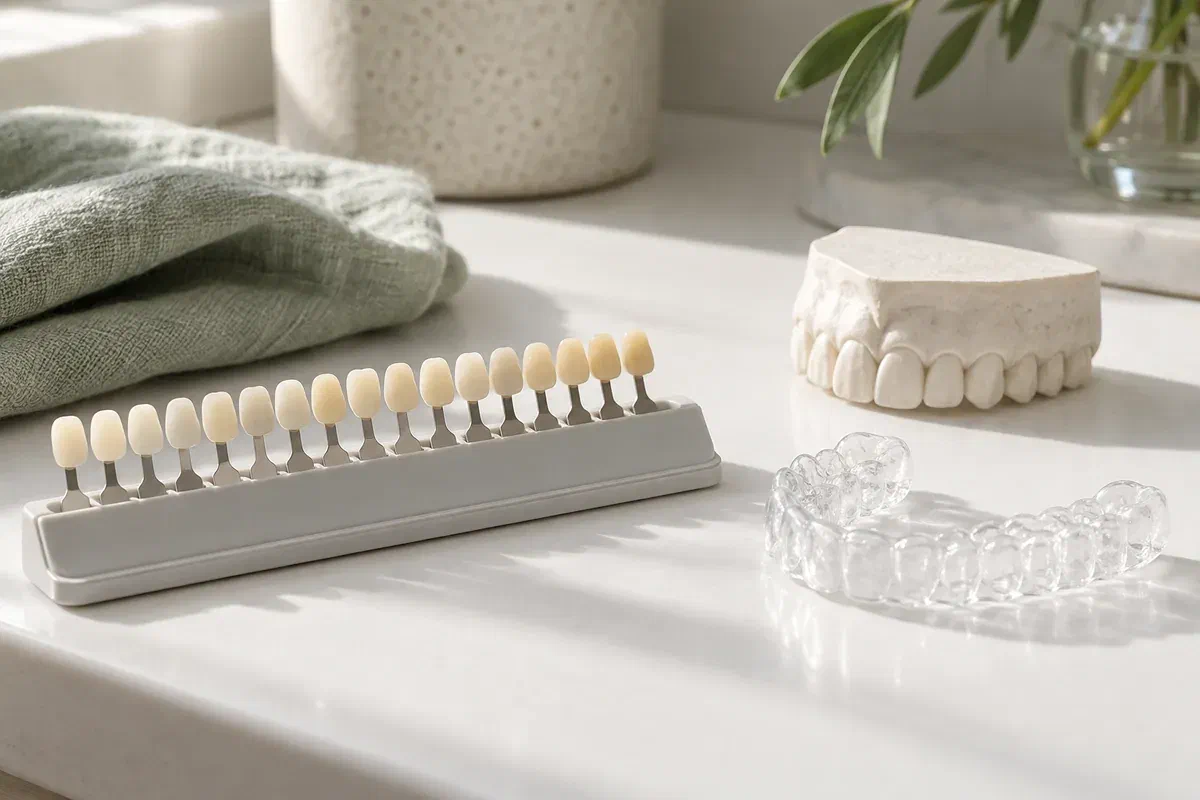
Illustrative natural tooth shade samples, a clear dental tray, and tooth model
Patterns worth pointing out

Where you see the difference changes the plan.

Show the clinician which teeth concern you and mention any discomfort, dental work or previous whitening. Those observations help decide whether whole-smile bleaching makes sense.

A tooth that aches or feels sensitive

Pain, cold sensitivity, exposed roots or one tooth that feels different from the others may point to something needing care. Ask whether that should be treated before whitening and how the plan would deal with sensitivity.

Restorations that stand apart

A filling or crown can look like a stained tooth from a distance. Point out any dental work in your smile and ask how it compares with your natural teeth now. Bleaching may make a difference more visible, and changing the restoration is its own question.

Hoping everything will match

Many people want every tooth to end up the same colour. Explain what you are hoping for and ask what is realistic for your starting shades. An even result across every tooth, or a guaranteed number of shades, should not be promised.

A single front tooth that has turned grey or dark, especially after a knock or root canal treatment, usually needs its own assessment. A whole-smile product may not change it and could widen the contrast.

What an assessment sorts out

Clarity about which problem you are solving

Professional input is most useful in telling different colour concerns apart. A clinician can identify what is behind your discolouration, confirm whether your teeth and gums are healthy enough for bleaching, and explain what a whole-smile method can and cannot do for an uneven pattern.

Once a course starts, you have someone to ask. Sensitivity, gum irritation or a patchy look can be reported. The response should be guided by your product and your findings, not by trying to lighten one tooth with extra gel.

A tooth-by-tooth starting point

Note the current shade, including any teeth that already look different. Agree on what improvement would satisfy you and when it should be judged. Some variation between teeth commonly remains even when the overall smile looks brighter.

Directions for the whole-smile method

Ask which approach is recommended, why it suits you and what appointments are involved. Make sure you understand how to apply it, for how long, and how to store it. Never adapt instructions to target a single tooth yourself.

A plan that includes the odd one out

If a single tooth or a restoration may need separate treatment, decide the order before starting anything. Ask when shade matching should happen and how whitening might affect it. Considering both together avoids chasing a moving target.

From observation to decision

Map the colour, find the cause, choose the response.

The steps depend on what we offer and what your exam reveals. Before treatment is arranged, ask what each visit includes and what it will cost.

  1. Point out what you see

    Show us which teeth concern you, what you have tried and any reactions. We review health details, medicines and dental history. Pregnancy or breastfeeding should be mentioned, since it may be sensible to delay elective whitening.

  2. Examine each area of concern

    Teeth, gums and restorations are checked to understand why colour differs and whether care is needed first. Sensitivity is discussed. Sometimes a cleaning evens things out, and sometimes one tooth needs its own investigation.

  3. Agree on a whole-smile approach, if suitable

    The clinician explains the proposed method, the expected range of change, side effects and alternatives. Take-home trays should be fitted and their use shown. For treatment in the chair, confirm what it includes; a laser is not assumed.

  4. Recheck the pattern afterwards

    Raise concerns during the course and keep your review. Compare the result tooth by tooth before adding anything. If a filling or crown now stands out, its condition and options are assessed rather than replacement being automatic.

Through the course, back in Acton

Don’t try to even things out on your own.

Extra applications, longer wear or concentrating gel on one tooth will not produce a better result. Keep your directions and our contact details nearby.

Use the product exactly as shown

Stay with the amount, schedule and handling you were given. Don’t combine systems or keep going to make one tooth match. If trays are damaged or a step is unclear, call the team before carrying on.

Tell us if teeth or gums hurt

Short-term sensitivity or gum irritation can occur. Ask what suits your product and symptoms, including whether to pause and come in. Persistent or strong pain needs review and should not be ignored.

Colour won’t stay put forever

Teeth can slowly darken again after whitening. Keep up routine dental care and ask what may influence their look. A future course should follow your findings at that time rather than repeat the first plan.

Patient information: American Dental Association — whitening effects and adverse reactions

Matching the answer to the pattern

Even colour may need more than one tool.

What fits depends on why the colour varies and on your oral health. Ask why a recommendation suits your findings and what alternatives would involve.

When natural teeth across the smile can be lightened

Whole-smile supervised whitening

Depending on suitability and availability, a dentist-supervised method used at home or in the chair may be discussed. Review its directions, limits and side effects. It should be chosen for your pattern of colour, not a promise of uniform brightness.

When surface stain makes some teeth look darker

Cleaning to separate stain from shade

Professional cleaning may clear suitable surface marks while the natural shade stays the same, which can reveal the true pattern. Ask whether to reassess afterwards before deciding on bleaching. The two treatments have different aims.

When the concern is a single tooth or restoration

Separate care for one tooth, or no change

A dark tooth, a visible restoration or a developmental colour difference may need its own discussion. Ask what an alternative involves and how it is maintained. Deciding that your healthy natural variation is fine is also reasonable.

Uneven colour questions

When some teeth look different from the rest

These answers are general. A consultation looks at the pattern in your smile, your findings and what a whitening course can realistically change.

(905) 876-4488
One of my front teeth looks darker than the others. Will whitening fix it?
Not necessarily. A single dark tooth can have a different cause from general discolouration, especially after an injury or root canal. It should be assessed before any whole-smile product is used.
Why do my eye teeth look more yellow than my front teeth?
Canines are often naturally a little darker than the teeth beside them. Whitening may lighten them, but some difference can remain. Ask what change is realistic for your teeth.
Can white spots on my teeth be whitened away?
White spots have various causes, and bleaching may not blend them in. Point them out at your consultation so the clinician can explain how whitening might affect their appearance and what other options exist.
Will whitening make the old filling on my front tooth stand out?
It might. Fillings do not lighten, so the natural tooth around one may become lighter than the filling. Ask how noticeable that could be and whether to discuss the filling separately.
Could a tooth that has turned dark be a sign of a problem?
It can be, particularly after an injury. That is why a darkened tooth deserves an assessment rather than more whitening. Call promptly if it is painful or the area is swollen.
Should I finish whitening before a single tooth is treated?
Talk about the order with the clinician. The answer depends on what the single tooth needs and on whether its shade will be matched to the rest of your smile afterwards.
Tooth colour assessments for Acton

Find out what is really behind the difference.

Visit our Bronte Street practice for a whitening consultation. We will look at the pattern of colour in your smile, check suitability, dental work and sensitivity, and explain what needs attention before you begin.

No whitening result is identical or permanent. Suitability, method, fees and any reason to wait come from an individual assessment.

Visit Milton Dental Clinic
Unit 1, 342 Bronte St. S, Milton, ON L9T 5B7
Get directions Clinic hours
Monday–Thursday
11am–7pm
Friday–Sunday
By appointment only

Areas we serve

  • Milton
  • Oakville
  • Mississauga
  • Georgetown
  • Halton Hills
  • Acton
  • Campbellville
  • Brampton
  • Burlington
  • Puslinch
  • Rockwood
  • Erin
  • Caledon
  • Etobicoke
  • Old Milton
  • Bronte Meadows
  • Timberlea
  • Dorset Park
  • Dempsey
  • Clarke
  • Beaty
  • Coates
  • Harrison
  • Scott
  • Willmott
  • Ford
  • Bowes
  • Cobden
  • Walker
  • Mountain View
  • Milton Heights
  • Hawthorne Village
  • Valley View
  • Fallingbrook
  • Nassagaweya
  • Trafalgar
  • Esquesing
  • Nelson
  • Brookville
  • Moffat
  • Glen Williams
  • Norval
  • Limehouse
  • Stewarttown
  • Ashgrove
  • Hornby
  • Silver Creek
  • Speyside
  • Scotch Block
  • North Oakville
  • River Oaks
  • Glen Abbey
  • West Oak Trails
  • Palermo
  • Bronte Creek
  • College Park
  • Joshua Creek
  • Uptown Core
  • Preserve
  • Iroquois Ridge
  • Lisgar
  • Meadowvale
  • Meadowvale Village
  • Churchill Meadows
  • Erin Mills
  • Central Erin Mills
  • Streetsville
  • East Credit
  • Creditview
  • Heartland
  • Sheridan
  • Mount Pleasant
  • Credit Valley
  • Huttonville
  • Churchville
  • Springbrook
  • Northwest Brampton
  • Bram West
  • Fletcher's Meadow
  • Fletcher's Creek South
  • Alton Village
  • Orchard
  • Millcroft
  • Headon Forest
  • Tansley
  • Brant Hills
  • Tyandaga
  • Kilbride
  • Lowville
  • Aberfoyle
  • Morriston
  • Arkell
  • Hillsburgh
  • Freelton
  • Carlisle
  • Waterdown
  • Flamborough
  • Mountsberg

How can we help?

Milton Dental Clinic

Have a question about your smile? Choose the option that works best for you.

For urgent dental concerns, please call.
Messages are reviewed during clinic hours.