

Illustrative patient discussing an enamel colour concern with a dental clinician
Cosmetic Dentistry

Resin Infiltration for White Spots in Rockwood

No braces, no obvious reason, yet there are pale flecks or cloudy patches on your front teeth. Those marks still have a cause, and identifying it is the first step in deciding whether resin infiltration is worth considering.

No braces, still spots

Where did these white marks come from?

Braces get most of the attention when white spots come up, but plenty of people with marks never wore them. Enamel can form unevenly while teeth develop, for reasons that include illness, injury to a baby tooth or extra fluoride in early childhood. Early mineral loss from plaque can also show up as chalky patches, with or without orthodontic treatment.

That variety matters, because resin infiltration suits some of these marks better than others. In the procedure, a suitable lesion with an intact surface is prepared and a low-viscosity resin is drawn into its pores, then cured with light. Once filled, the porous enamel can transmit light more like healthy enamel, so the patch may become less noticeable, though the degree of change differs between lesions.

When you book from Rockwood, we begin by trying to work out which kind of mark you have. The exam and your history guide whether infiltration, preventive care, another approach or simply monitoring the teeth is sensible. You will also get a candid view of how much of the marking might stay visible.

Find out what is behind your white marks
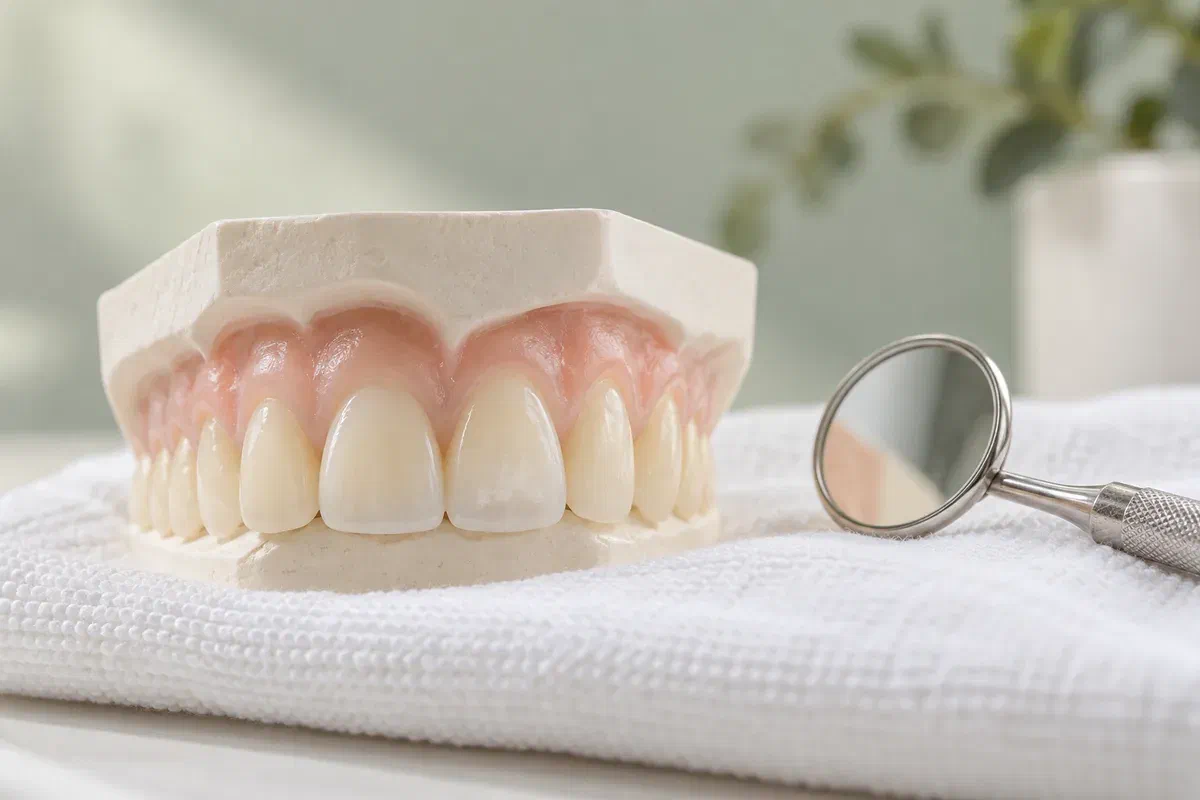
Illustrative dental teaching model with a subtle white enamel patch beside a dental mirror
Possible origins

Three kinds of mark, each with its own outlook

Mention when you noticed the marks, whether they have changed, and anything relevant such as childhood illness, an injury, braces, sensitivity or whitening. Photos help show your concern, but the cause needs an exam.

Chalky areas where plaque collects

Even without braces, the area near the gums can lose mineral if plaque sits there. The clinician will check whether the lesion is active and how to prevent progress. A cosmetic plan should not leave doubt about the surface’s health.

Flecks, clouds or bands from development

Marks that came in with the teeth, especially if they appear on several teeth in a pattern, often have a developmental cause. Origin shapes the options. These lesions can respond to infiltration differently from those caused by plaque.

A patch with roughness, pitting or a twinge

If you can feel a change, see a defect or notice sensitivity, the concern goes beyond colour. More examination may be needed, and repair may come before appearance. Infiltration is not designed to rebuild lost enamel.

Suitability is judged lesion by lesion. Infiltration is meant for selected marks where the enamel surface remains intact; a broken surface leads to a separate restorative discussion.

When infiltration makes sense

A modest step for the right lesion

If your mark proves suitable, infiltration offers a way to address appearance from within the enamel, often discussed before any restoration that covers the tooth. Ask how the surface will be prepared, what it offers over leaving the tooth untouched and what it cannot change.

Results vary across studies, including complete masking for some lesions, partial improvement for others and little difference for some, with developmental marks especially unpredictable. Agree what change you would welcome, how it will be compared later and what comes next if the patch is still visible.

Patient information: Clinical study — variable masking of developmental and post-orthodontic lesions

Matched to each mark’s cause

If you have several marks, they may not share one cause. Some could suit infiltration and others might not. That explains why a plan may include certain teeth and leave others for observation.

Grounded expectations

Tell the clinician what would make a difference to you: a fainter outline, a more even smile in pictures, or simply knowing the cause. Then find out how close each lesion is likely to get to that goal. Treat other people’s results as illustration only, since their marks may have had a different cause.

Other routes worth knowing

Microabrasion, bonding, whitening and remineralization are all worth setting beside infiltration for your situation. Consider preparation, likely benefit, maintenance and fees. Choosing not to proceed does not tie you to a larger cosmetic plan.

How it is planned

History first, then treatment if suitable

The steps depend on what the exam shows and the system used. Ask what each appointment covers, how your gums and lips are protected, and when the change should be assessed.

  1. Piece together the history

    Share what you know about your early dental and medical history, how long the marks have been there and what you have tried. The clinician examines each lesion. Prevention or more investigation may be advised before an elective procedure.

  2. Agree on the teeth and the outlook

    Decide which surfaces are included. Discuss the expected change, the chance that a mark only partly fades, alternatives, fees and consent. If a dental material has ever caused you a reaction, say so now.

  3. Treat the suitable lesions

    Where appropriate, the area is isolated and the lesion surface conditioned, then the resin is applied, given time to penetrate and set with a curing light. Ask about each step and the comfort measures. It is a professional procedure and not a home treatment.

  4. Review together

    Before you leave, you look at the tooth together and pick a date to see it again, once any short-term dryness has settled. Photographs taken at the start make the comparison fairer. Where a mark is still visible, the next step is a conversation, not an assumption that more preparation or a new procedure must follow.

Afterward

Steady habits around a changed tooth

Use the instructions given for the treatment you had. A better appearance does not replace checkups or the preventive routine recommended for you.

Confirm the near-term guidance

Before heading home, check whether eating, drinking, brushing or any product use should change for a little while. Note it down if that helps. Strict routines you may see online for whitening or bonding may not apply.

Keep up good prevention

Brushing near the gums, cleaning between teeth and any fluoride advice suited to you protect the enamel. Ask whether your fluoride use is right for your situation. Prevention helps keep new chalky areas from forming.

Report anything that concerns you

If the treated surface becomes rough, uncomfortable or changes colour in a worrying way, let us know. The clinician can tell you how long to wait before judging the look again. Avoid abrasive home remedies or attempts to scrub away a remaining mark.

Patient information: Clinical follow-up — reviewing colour after white-spot infiltration

Rockwood options

Different causes, different answers

A visible mark does not always need treatment. Whichever route is suggested, it is fair to ask what it is meant to achieve, how it alters the tooth and what watching it instead would involve.

When enamel health is the priority

Protect the enamel and wait

Preventive care and review may come first or be enough on their own. Ask what the clinician will look for and when the question will be revisited. A healthy surface and an invisible mark are separate goals.

When the lesion type supports it

Infiltration or another light surface treatment

Once the exam is done, the clinician can say which marks look like candidates for infiltration and which might respond better to another surface approach. Discuss preparation and the chance of leftover contrast. If methods are combined, their purpose and sequence should be clear before anything irreversible.

When the problem goes past suitable porous enamel

Restoring a tooth with a different defect

Pitted, damaged or misshapen enamel may be better served by bonding or a different restoration, if that suits your goals. Weigh the preparation and future upkeep against the benefit. A mark that is just visible should not lead automatically to a larger restoration.

Rockwood questions

White marks without a braces history

Each lesion’s cause, surface and depth shape the discussion. An exam is needed before a personal plan or likely result can be suggested.

(905) 876-4488
Why do I have white spots if I never had braces?
White marks have many possible causes, including uneven enamel development, early mineral loss from plaque, and childhood factors such as illness or injury to a baby tooth. The exam helps narrow down which applies to you.
Can fluoride cause white flecks on teeth?
Extra fluoride while teeth are forming in early childhood is one recognized cause of faint white flecking. It is only one possibility. Ask the clinician what they see, and keep following the fluoride advice given for your current needs.
Are developmental marks harder to treat with infiltration?
They can respond less predictably than marks from plaque, partly because their structure varies. Ask what the clinician thinks caused yours and what range of change is realistic.
Do white marks on several teeth need treating all at once?
Not necessarily. Some may suit infiltration, others may need nothing more than monitoring. Ask which teeth are included and why, and whether treatment could be staged.
Will infiltration make my whole smile lighter?
No. The resin is aimed at suitable porous lesions, not the overall shade of your teeth. If general colour bothers you as well, tell the clinician, since whitening and infiltration may need to be planned in a particular order.
What if a mark has a small hole in it?
Then the priority shifts to the defect itself, which the clinician will assess and treat appropriately. Infiltration is meant for intact lesions and should not replace a needed repair. Mention roughness, food catching or sensitivity.
From Rockwood

Find the cause, then choose

Book a visit with us on Bronte Street to have your white marks examined and their probable cause explained. We will go over the options that suit your teeth, what prevention involves and how much change each mark could realistically show.

Suitability and availability are confirmed after examination. Infiltration may not fully mask a mark, and other care may be recommended.

Visit Milton Dental Clinic
Unit 1, 342 Bronte St. S, Milton, ON L9T 5B7
Get directions Clinic hours
Monday–Thursday
11am–7pm
Friday–Sunday
By appointment only

Areas we serve

  • Milton
  • Oakville
  • Mississauga
  • Georgetown
  • Halton Hills
  • Acton
  • Campbellville
  • Brampton
  • Burlington
  • Puslinch
  • Rockwood
  • Erin
  • Caledon
  • Etobicoke
  • Old Milton
  • Bronte Meadows
  • Timberlea
  • Dorset Park
  • Dempsey
  • Clarke
  • Beaty
  • Coates
  • Harrison
  • Scott
  • Willmott
  • Ford
  • Bowes
  • Cobden
  • Walker
  • Mountain View
  • Milton Heights
  • Hawthorne Village
  • Valley View
  • Fallingbrook
  • Nassagaweya
  • Trafalgar
  • Esquesing
  • Nelson
  • Brookville
  • Moffat
  • Glen Williams
  • Norval
  • Limehouse
  • Stewarttown
  • Ashgrove
  • Hornby
  • Silver Creek
  • Speyside
  • Scotch Block
  • North Oakville
  • River Oaks
  • Glen Abbey
  • West Oak Trails
  • Palermo
  • Bronte Creek
  • College Park
  • Joshua Creek
  • Uptown Core
  • Preserve
  • Iroquois Ridge
  • Lisgar
  • Meadowvale
  • Meadowvale Village
  • Churchill Meadows
  • Erin Mills
  • Central Erin Mills
  • Streetsville
  • East Credit
  • Creditview
  • Heartland
  • Sheridan
  • Mount Pleasant
  • Credit Valley
  • Huttonville
  • Churchville
  • Springbrook
  • Northwest Brampton
  • Bram West
  • Fletcher's Meadow
  • Fletcher's Creek South
  • Alton Village
  • Orchard
  • Millcroft
  • Headon Forest
  • Tansley
  • Brant Hills
  • Tyandaga
  • Kilbride
  • Lowville
  • Aberfoyle
  • Morriston
  • Arkell
  • Hillsburgh
  • Freelton
  • Carlisle
  • Waterdown
  • Flamborough
  • Mountsberg

How can we help?

Milton Dental Clinic

Have a question about your smile? Choose the option that works best for you.

For urgent dental concerns, please call.
Messages are reviewed during clinic hours.