

Illustrative patient discussing tooth crowding with a clinician and dental study model
Cosmetic Dentistry

Treatment for Crowded Teeth in Mississauga

Your hygienist keeps finding tartar in the same overlapped corner. For people coming from Mississauga, our crowding assessment looks at why those spots are hard to clean, how much space the arch lacks and whether moving teeth is worth it for you.

Crowding and cleaning, for Mississauga

Hard-to-clean corners are a good place to start.

Overlapping teeth create little ledges and tight angles where plaque settles and a brush skids past. That is often what brings crowding up at a cleaning appointment, long before anyone talks about appearance. Underneath, the issue is space: the arch is too small for the teeth to stand side by side, so some turn, tip or step out of line.

There are two separate questions here. First, how can you keep those areas healthy right now? Second, would moving teeth be worthwhile, and if so, how would the room be found? Answering the second means looking at both arches, the bite, the gums and the bone. Jumping straight to a brand of aligner skips that groundwork.

Let us know your priority, whether it is easier cleaning, a better-looking smile, a bite that has started to change, or overlap that came back after orthodontics. We can explain the assessment, say whether a specialist should be consulted, and make the scope clear before you decide on anything active.

Ask about crowding and cleaning
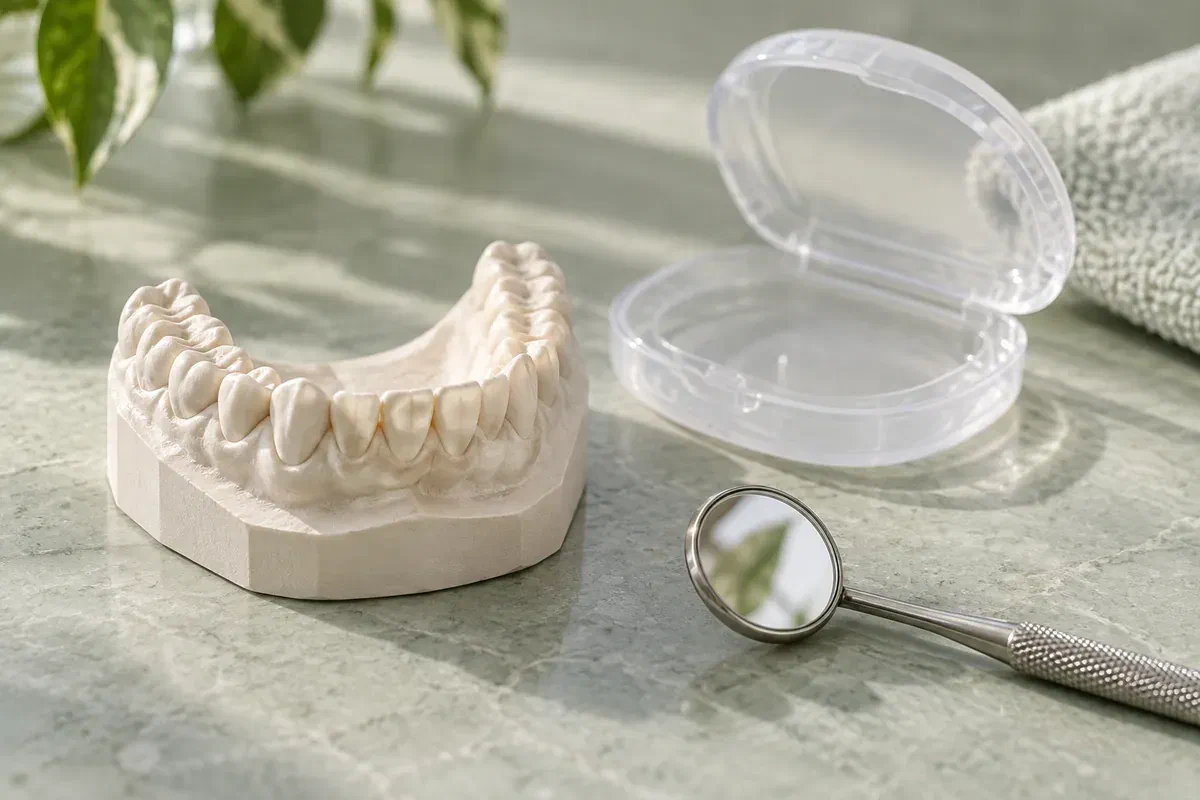
Illustrative lower dental study cast with mild front-tooth overlap beside a case and mirror
What you might be dealing with

Plaque traps, a misplaced tooth, a change after braces.

Tell us what you have noticed and what you would like to improve. Similar overlap can come from different space and bite arrangements, so details help.

Build-up in the same tight spots

Point out where floss tears or brushing never feels complete. We can suggest interdental brushes, angles or other aids that may help immediately. If the gums there are inflamed, that needs settling before any appliance is considered.

A tooth pushed out of the row

Tell us whether it has always sat outside the line or has drifted recently. We look at its neighbours and how it meets the opposite teeth. Getting it into line means planning for the room it needs, not simply improving how it looks.

Overlap returning after orthodontics

Describe your earlier treatment and how long retainers were worn, and bring any you still have. We can talk about what has moved and whether to hold things steady or correct them. A fresh retainer and new movement are different jobs.

Bleeding that does not settle, a tooth that feels mobile, pain, a gap appearing somewhere new, or overlap that seems to be worsening fast should all be mentioned when you book. They may not be ordinary crowding.

Why it is worth looking closely

Understanding space helps you decide whether movement is worth it.

An assessment should give you a plain explanation of how much room is missing, which teeth would need to move and what moving them would actually improve. That applies to cleaning as much as to appearance. Any recommended method should be linked to your examination, not offered as one answer for every crowded mouth.

It also helps you judge the effort involved. Treatment adds cleaning around appliances, regular reviews and years of retainer wear. For some, better daily cleaning is enough; for others, alignment makes sense. A good plan says clearly what it can change and what will still need care afterwards.

A plain account of the space plan

Ask how room would be created or used, and why that suits your teeth and bite. If reducing enamel, removing a tooth, widening the arch or another step is suggested, ask what it is for and what else could be done. Each deserves its own discussion.

Goals that include gum health

Talk about how the planned positions would change contacts, cleaning and the rest of the arch. Ask whether the proposal is limited or comprehensive. Understanding what stays the same tells you whether the outcome addresses the problem that brought you in.

A long-term view of retention

Ask about retainers up front, covering wear, cleaning, check-ups and replacement. They keep the result in place and are part of treatment itself. Build that commitment into your comparison of the available approaches.

The planning path

Healthy gums, measured space, then a choice of appliance.

Which records, how many appointments and which options apply depend on how much crowding there is and what we find. Ask who plans, provides and monitors each stage.

  1. Start with the changes you have seen

    Describe the overlap, how it has changed and what you hope for, including any cleaning concerns your hygienist has raised. Mention past orthodontics, missing teeth, fillings, crowns and planned dental work. Bring retainers or records if asked.

  2. Check the gums, bite and both arches

    We examine the upper and lower teeth along with the gums and bone. Records may be suggested to map space and positions. Ask why each is needed, and whether gum care or other dental treatment should come first.

  3. Compare approaches openly

    Go through the suggested appliance, the way space would be handled, risks, alternatives and what you would need to do. Ask how the plan changes if you skip one step. If specialist input is advised, confirm who refers and who coordinates related care.

  4. Monitor, then move to retention

    Keep scheduled reviews during treatment and report appliance or cleaning trouble. Ask how progress is measured and what might lengthen the timeline. Before finishing, settle the retainer plan and what to do if one is lost or no longer fits.

Cleaning with an appliance

Attachments and aligners add new places to clean.

Follow the instructions given for your appliance and plan. Copying a friend’s wear schedule, or using an older appliance to catch up on missed days, can cause problems.

Learn a routine for crowded areas

Ask us to demonstrate cleaning between overlapping teeth and around brackets or attachments. Keep routine dental and hygiene visits going alongside orthodontic reviews. If bleeding or soreness makes it hard, tell us so the advice can change.

Report appliance problems quickly

Let the treating clinician know about a loose attachment, an aligner that does not fit snugly or a schedule you are struggling to keep. Ask what to do instead of moving ahead or back on your own. Clear updates make each review more accurate.

Care for retainers like teeth

When active treatment ends, clean and wear retainers as directed and attend recommended reviews. Contact the responsible provider if one is lost, cracked or uncomfortable. Overlap returning is a reason to get advice, not to force an old appliance on.

Patient information: British Orthodontic Society — retainers and maintaining tooth positions

Options to discuss

Different amounts of crowding call for different plans.

Ask why an option suits your crowding and what compromises it involves. Look at the whole plan, not only how visible the appliance would be.

When moving teeth is the right step

Aligners or fixed braces where appropriate

The appliances considered depend on the movements needed and clinical suitability. Ask about daily care, monitoring and realistic limits. Preferring removable or discreet treatment is worth saying, but it does not decide what is suitable.

When alignment also needs room to be made

A planned step to create space

Some plans use a carefully chosen measure to gain space. Ask what is involved, whether it is permanent and how the alternative compares. Reducing enamel or removing a tooth belongs within an agreed, complete plan, never as a separate quick fix.

When timing, complexity or preference points elsewhere

Better cleaning and monitoring, or referral

You might focus on cleaning and keep the current arrangement, or want more information before deciding. For children, growth and erupting teeth affect timing. Ask what to monitor and when to come back if you choose to wait.

Patient information: British Orthodontic Society — planned interproximal reduction

Questions about overlap and hygiene

Clear answers on crowding, cleaning and care.

Every answer depends on your examination, space, bite and oral health. Visible overlap by itself cannot show what treatment you need.

(905) 876-4488
Do crowded teeth make gum problems more likely?
Overlapping areas can be harder to clean, which may make plaque control more difficult. Gum health depends on many factors, so ask what the examination shows in your case and how to clean those areas well.
Which cleaning tools help with overlapping teeth?
Floss, interdental brushes or other aids may suit different spaces. Ask for a demonstration in your own mouth, since the best tool depends on how tight the contacts are and where the overlap sits.
Will straightening make my teeth easier to clean?
It may improve access in some areas, but that depends on the movement planned and how well cleaning is kept up during treatment. Ask how the intended positions would change the areas you find difficult.
Are clear aligners right for every amount of crowding?
Not automatically. The clinician needs to assess the movements and space strategy. Ask whether aligners, fixed appliances or specialist care fits your findings and what other steps might be involved.
Should gum treatment happen before teeth are moved?
Active gum or dental problems usually need attention before an appliance is fitted. Ask what the examination found and whether any treatment should be completed first, and how gum health will be checked during alignment.
How can I fit appointments in from Mississauga?
Ask for an outline of the expected visits at the start, and whether records and discussions can be grouped. Knowing the review schedule ahead of time makes it easier to plan around work and family commitments.
Mississauga crowding visits

Bring the spot your hygienist keeps mentioning.

Book an assessment at our Bronte Street practice to look at crowding, cleaning trouble and the changes you have in mind. We will explain what is needed to weigh up suitable options and whether referral to an orthodontist would help.

Whether an appliance is suitable, how space is managed and the scope, timing and fees of treatment depend on individual assessment. A particular system or extraction-free result cannot be guaranteed.

Visit Milton Dental Clinic
Unit 1, 342 Bronte St. S, Milton, ON L9T 5B7
Get directions Clinic hours
Monday–Thursday
11am–7pm
Friday–Sunday
By appointment only

Areas we serve

  • Milton
  • Oakville
  • Mississauga
  • Georgetown
  • Halton Hills
  • Acton
  • Campbellville
  • Brampton
  • Burlington
  • Puslinch
  • Rockwood
  • Erin
  • Caledon
  • Etobicoke
  • Old Milton
  • Bronte Meadows
  • Timberlea
  • Dorset Park
  • Dempsey
  • Clarke
  • Beaty
  • Coates
  • Harrison
  • Scott
  • Willmott
  • Ford
  • Bowes
  • Cobden
  • Walker
  • Mountain View
  • Milton Heights
  • Hawthorne Village
  • Valley View
  • Fallingbrook
  • Nassagaweya
  • Trafalgar
  • Esquesing
  • Nelson
  • Brookville
  • Moffat
  • Glen Williams
  • Norval
  • Limehouse
  • Stewarttown
  • Ashgrove
  • Hornby
  • Silver Creek
  • Speyside
  • Scotch Block
  • North Oakville
  • River Oaks
  • Glen Abbey
  • West Oak Trails
  • Palermo
  • Bronte Creek
  • College Park
  • Joshua Creek
  • Uptown Core
  • Preserve
  • Iroquois Ridge
  • Lisgar
  • Meadowvale
  • Meadowvale Village
  • Churchill Meadows
  • Erin Mills
  • Central Erin Mills
  • Streetsville
  • East Credit
  • Creditview
  • Heartland
  • Sheridan
  • Mount Pleasant
  • Credit Valley
  • Huttonville
  • Churchville
  • Springbrook
  • Northwest Brampton
  • Bram West
  • Fletcher's Meadow
  • Fletcher's Creek South
  • Alton Village
  • Orchard
  • Millcroft
  • Headon Forest
  • Tansley
  • Brant Hills
  • Tyandaga
  • Kilbride
  • Lowville
  • Aberfoyle
  • Morriston
  • Arkell
  • Hillsburgh
  • Freelton
  • Carlisle
  • Waterdown
  • Flamborough
  • Mountsberg

How can we help?

Milton Dental Clinic

Have a question about your smile? Choose the option that works best for you.

For urgent dental concerns, please call.
Messages are reviewed during clinic hours.