

Illustrative patient describing a previous sensitivity experience during a dental consultation
Cosmetic Dentistry

Whitening for Sensitive Teeth in Brampton

Your sister used the same whitening kit and felt nothing, while your teeth ached for days. Teeth differ, and so do the reasons they react. Travelling from Brampton, you can have that reaction reviewed, your teeth examined, and your own options explained.

Same product, different teeth

Why did it bother you and nobody else at home?

Kits get passed around households. A spouse, a cousin or a teenager might use one with no trouble, while you spend the week wincing at every cold drink. That contrast can feel confusing, but it is common. Each person’s teeth, gums, fillings and existing sensitivity are different, and those differences can matter far more than the product.

A visit about whitening for sensitive teeth looks at your mouth specifically. It does not come with a promise that the next try will be comfortable. Instead, the dentist considers why you reacted, checks for any separate dental cause, and helps you think through whether bleaching is a good idea for you right now, later or not at all.

Coming in from Brampton, bring the shared kit or its name and tell us how you used it, when you noticed the ache and how long it hung on. You will not be asked to repeat it. After the exam, the dentist will lay out the options plainly, and keeping your natural shade is one of them.

Ask why whitening affected you differently
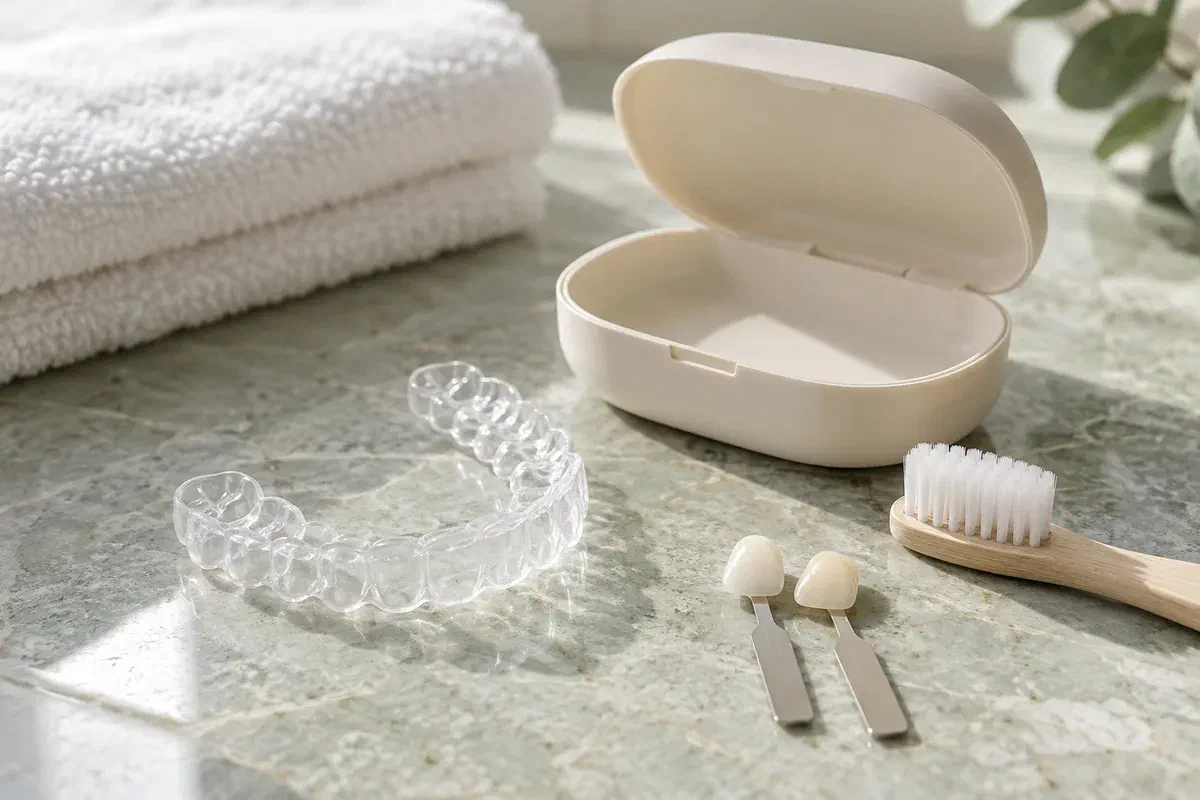
Illustrative empty whitening tray, open case, soft toothbrush, and natural shade samples
Pinpointing your reaction

The product, your teeth, or your gums?

What felt like the same problem may have had different causes. Your account steers what the dentist examines before anyone discusses lightening again.

Trouble that started with the kit

Name the product, how often you applied it and for how long. If others in the house used it differently, that is worth knowing too. Do not worry about the exact concentration, and there is no need to try it again before you come in.

A tooth that was touchy already

Think back: did sweets, cold drinks, brushing or biting already bother you before you whitened? A cavity, wear, a crack, an older filling or a receded gum can each make a tooth sensitive. A product built for sensitive teeth cannot find or fix that cause.

Sore gums, or one tooth that stays painful

Notice whether the discomfort was on the gum surface or felt deeper. Mention anything that lasted after you stopped, recurred without whitening or kept returning to one tooth. That kind of pattern can move a dental problem to the top of the list.

Stop using a product that triggers a reaction and seek guidance from a dental professional. Finishing the kit or chasing a shade by using more is not recommended.

What you take away

Advice for your teeth, not the family average

Hearing that a product worked for someone else tells you little about your own mouth. The exam replaces that comparison with facts about your teeth: what needs care, what affects whitening and why. Plenty of people decide to postpone or keep their colour once they have this information, and that is a good use of a visit.

Where another try is reasonable, you start with a clear playbook. It covers whom to call, which symptoms to describe and when your next review falls. Even so, risk does not vanish. The point is that you will not be borrowing someone else’s routine or improvising when a tooth reacts.

Guidance rooted in your experience

Explain what made the last attempt unpleasant and what would help you consider something else. Expect the dentist to link any proposal to your own history rather than to how a relative fared. A different label alone does not justify a second attempt.

An honest picture of uncertainty

Ask what can be fine-tuned with professional guidance and what remains unknown. No method is certain to prevent sensitivity. You can choose to leave whitening alone if the possible gain does not seem worth it, even when it is clinically reasonable.

Thought given to the rest of your smile

Restorations such as fillings, crowns and veneers do not lighten the way enamel does. Before picking a shade, ask how the match might change and whether any replacement would be purely optional. A cosmetic decision should not drift into a bigger restorative plan.

How a visit unfolds

Hear the story, check the mouth, choose together.

The number of steps depends on your symptoms and the findings. Until you get advice, leave the household kit alone, especially if it caused you trouble.

  1. Outline what you did and felt

    Describe the kit, how you applied it, when the ache started and how it changed after you stopped. Mention anything else you used and whether a clinician looked at it at the time. Uncertain details can be recorded as uncertain.

  2. Examine your teeth and gums

    The dentist checks the areas involved and may suggest further tests. Ask whether there is something to treat before any cosmetic step. Your earlier reaction does not rule out a separate dental issue in the present.

  3. Choose your direction

    Discuss possible benefits, limitations, fees and alternatives. If whitening is suitable, the dentist selects a product and gives you instructions for your teeth, not someone else’s. Confirm your review date and how to respond to sensitivity or sore gums.

  4. Check progress before continuing

    Attend follow-up and share how it really went, including any use outside the plan. Ask whether you have reached a sensible stopping point. Further sessions or top-ups should be discussed on their own rather than taken for granted.

If you go ahead

Your comfort tells us how the plan is going.

Stick to the advice given for your teeth and your approach. What worked for a family member, an online schedule or an old leaflet may not fit.

Keep your own product and notes

Use your own supplies rather than sharing, keep the instructions and write down any reaction with the date and area. Bring that information to your review. Do not combine products, add extra applications or dilute anything.

Ring us before you resume

If you stopped because something hurt, ask before the next application. Tell us whether symptoms have cleared or are still present. Adjusting trays, shortening sessions or adding a desensitizing paste by yourself may not deal with the cause.

Protect your regular routine

Ask which toothpaste and brushing approach suit you, and mention any area that hurts to clean. Whitening does not replace checkups or cleanings, and a lighter shade should never come at the cost of caring for your teeth and gums.

What could come next

Several routes, and whitening is just one.

Compare the cause of your discomfort with the change you want. Ask which option fits and what it can realistically do, without adding treatment you do not need.

When comfort or tooth health is the priority

Treat the cause and wait on whitening

The exam might reveal a separate issue or something to monitor. That care is worth discussing in its own right before thinking about appearance. Holding off on elective bleaching lets you revisit it later with a clearer picture.

When part of the concern is external

Cleaning for stain on the surface

Ask whether surface stain plays a role in the colour you notice and whether cleaning is appropriate. The two treatments aim at different things, so a cleaner look is not a guaranteed shift in the tooth’s own colour.

When the dentist supports another try

A personal whitening plan

Go over the method, instructions, likely reactions and follow-up. Ask what makes the plan suitable for you specifically and how to raise any concern quickly. The choice remains elective and informed, with no shade or comfort guaranteed.

Patient information: American Dental Association — whitening methods, natural teeth, and possible sensitivity

Questions about reacting differently

What people want to know

Bring your kit details and any concerns about trying again. The dentist will explain the exam findings and whether more cosmetic treatment is reasonable for you.

(905) 876-4488
Why would one person react to a whitening kit when another does not?
Teeth and gums vary, and so do things like existing sensitivity, worn areas, exposed roots and fillings. How a product is used can differ too. An exam helps the dentist understand what may have contributed in your case.
Is it safe to share whitening trays or kits within a family?
It is best not to share trays or products. Custom trays are made for one mouth, and a product that suits one person may not suit another. Ask the dentist about an approach that fits your own teeth.
Can teenagers in the house use the same whitening products as adults?
Ask a dentist before a young person starts any whitening. Suitability depends on the individual, and the dentist can explain what is appropriate. Do not assume that a product an adult tolerated is right for someone younger.
If my sensitivity faded, can I go back to the shared kit?
Check with a dentist first. Symptoms settling does not show that repeating the same routine is wise. The advice depends on the product, how you reacted and what the exam shows today, including other possible causes.
Does a single painful tooth mean I should stop whitening entirely?
Stop and get it checked. A tooth that hurts on its own or keeps hurting may have a separate cause, such as decay or a crack. Describe whether it aches with biting, temperature or without any trigger.
Am I expected to whiten if I come in for the consultation?
Not at all. Whitening is elective, and keeping your natural shade is a perfectly good choice. Any health findings can be handled separately, and a visit for advice does not commit you to anything.
Brampton visitors welcome

Get advice for your teeth specifically.

Book with our Bronte Street practice to talk over a whitening reaction or sensitivity that has not gone away. The dentist will examine your teeth, explain what may be behind it and help you decide whether a careful plan or no whitening suits you.

Suitability, product, instructions, fees and colour change all depend on assessment. Sensitivity may still happen, and no particular shade or pain-free result is promised.

Visit Milton Dental Clinic
Unit 1, 342 Bronte St. S, Milton, ON L9T 5B7
Get directions Clinic hours
Monday–Thursday
11am–7pm
Friday–Sunday
By appointment only

Areas we serve

  • Milton
  • Oakville
  • Mississauga
  • Georgetown
  • Halton Hills
  • Acton
  • Campbellville
  • Brampton
  • Burlington
  • Puslinch
  • Rockwood
  • Erin
  • Caledon
  • Etobicoke
  • Old Milton
  • Bronte Meadows
  • Timberlea
  • Dorset Park
  • Dempsey
  • Clarke
  • Beaty
  • Coates
  • Harrison
  • Scott
  • Willmott
  • Ford
  • Bowes
  • Cobden
  • Walker
  • Mountain View
  • Milton Heights
  • Hawthorne Village
  • Valley View
  • Fallingbrook
  • Nassagaweya
  • Trafalgar
  • Esquesing
  • Nelson
  • Brookville
  • Moffat
  • Glen Williams
  • Norval
  • Limehouse
  • Stewarttown
  • Ashgrove
  • Hornby
  • Silver Creek
  • Speyside
  • Scotch Block
  • North Oakville
  • River Oaks
  • Glen Abbey
  • West Oak Trails
  • Palermo
  • Bronte Creek
  • College Park
  • Joshua Creek
  • Uptown Core
  • Preserve
  • Iroquois Ridge
  • Lisgar
  • Meadowvale
  • Meadowvale Village
  • Churchill Meadows
  • Erin Mills
  • Central Erin Mills
  • Streetsville
  • East Credit
  • Creditview
  • Heartland
  • Sheridan
  • Mount Pleasant
  • Credit Valley
  • Huttonville
  • Churchville
  • Springbrook
  • Northwest Brampton
  • Bram West
  • Fletcher's Meadow
  • Fletcher's Creek South
  • Alton Village
  • Orchard
  • Millcroft
  • Headon Forest
  • Tansley
  • Brant Hills
  • Tyandaga
  • Kilbride
  • Lowville
  • Aberfoyle
  • Morriston
  • Arkell
  • Hillsburgh
  • Freelton
  • Carlisle
  • Waterdown
  • Flamborough
  • Mountsberg

How can we help?

Milton Dental Clinic

Have a question about your smile? Choose the option that works best for you.

For urgent dental concerns, please call.
Messages are reviewed during clinic hours.