

Illustrative patient describing a previous sensitivity experience during a dental consultation
Cosmetic Dentistry

Whitening for Sensitive Teeth in Puslinch

Months have passed since whitening made your teeth sore, the memory has faded a little, and the idea of trying again is creeping back. Before you do, people from Puslinch can review that old reaction with our dentist and have their teeth checked as they are today.

Coming back to the idea

Time has passed. The question of why it hurt has not.

It is common to set whitening aside after a sore week, then find yourself thinking about it again the next spring. By then the details are fuzzy. Was it the cold sensitivity, the sore gums, or one tooth in particular? And your teeth may have changed since: a new filling, a chip, a bit more recession. All of that matters.

A sensitive-teeth whitening consultation picks up where you left off. It is not a method that promises no discomfort. The dentist helps you reconstruct the earlier reaction, examines your teeth and gums as they stand now, and gives you a clear opinion on whether another attempt is reasonable, or whether something else should come first.

Rural households in Puslinch often plan trips around several errands, so feel free to ask about pairing this visit with a regular checkup. Bring whatever you still have from the old kit, even just a photo, and share what you remember. You do not need to try it again. We will explain each option, and leaving your shade unchanged is one.

Revisit an old whitening reaction
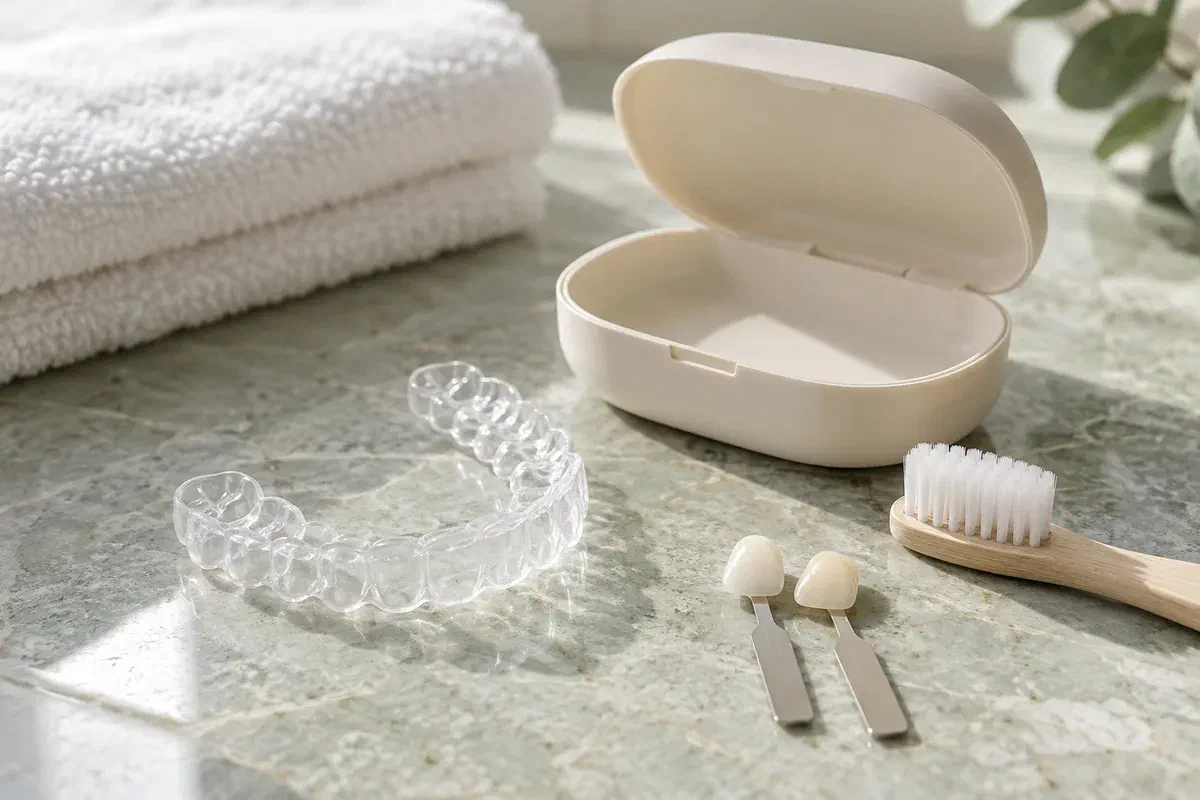
Illustrative empty whitening tray, open case, soft toothbrush, and natural shade samples
Jogging your memory

Even rough recollections help.

If the details have blurred, that is fine. A few clues about what you felt let the dentist decide what to examine before any new plan.

The product you think was responsible

Name it if you can, or describe the type, such as strips, trays or a brush-on gel. Mention anything else you used that season, like whitening toothpaste. An old box or receipt helps, but guesses are welcome. Nobody expects you to know its strength.

Sensitivity that has been around for a while

Has a tooth reacted to cold, sweets, brushing or chewing, before or since? Decay, cracks, wear, ageing fillings and exposed roots are possible causes. A product labelled for sensitive teeth cannot tell you which one you are dealing with.

Gum soreness, or a tooth that still bothers you

Try to remember whether the trouble was on the gums or inside a tooth. Mention anything that continued long after you stopped or has come back since. A lingering, localized symptom may need checking before any talk of appearance.

If a whitening product causes a reaction, stop and get advice from a dental professional. Reaching for the old kit to finish it is not recommended.

Why a fresh assessment helps

Today’s teeth, not last year’s guess

Your mouth may look different now than it did during that first attempt, so an up-to-date exam is the right starting point. The dentist can explain what needs attention, what affects the whitening question and why. Some people decide to wait longer or stay with their colour, and that is a sound result.

If another round is reasonable, you will begin with the support already arranged. That means knowing whom to call, what to describe and when you will be reviewed. It cannot make sensitivity impossible. It does keep you from relying on a half-remembered routine or improvising when a tooth reacts.

A recommendation that reflects both then and now

Tell the dentist what you recall about the earlier attempt and what would help you feel ready to try something different. Ask how any suggestion links to that history and to what the exam shows today. A new brand is not reason enough.

Realistic expectations

Ask what can be adjusted under guidance and what remains uncertain. Any whitening method can bring on sensitivity. You can decide the potential improvement is not worth it, even if whitening is clinically acceptable.

Accounting for dental work done since

If you have had a filling, crown or veneer placed since your last attempt, mention it. Restorations keep their colour while natural teeth lighten. Ask how a change might affect the match; replacing anything would be up to you.

Picking up the thread

Remember, re-examine, decide, follow up.

The steps depend on how your teeth feel now and what the exam shows. Please do not reopen the old kit while you wait for advice.

  1. Rebuild the earlier picture

    Share what you remember about the product, how you used it, when discomfort began and how long it lasted. Mention other products and any dental visits since, including treatment elsewhere. Vague answers are fine and can be noted as approximate. What matters is giving the dentist a sense of the pattern.

  2. Examine your teeth as they are now

    The dentist checks your teeth and gums, paying attention to areas that reacted before, and may suggest further tests. Ask whether anything should be treated first. An old reaction does not rule out a newer problem.

  3. Decide on a direction

    Discuss the potential benefit, limits, fees and other choices. If whitening is suitable, the dentist chooses the product and gives you instructions for your teeth. Confirm when you will be reviewed and what to do if sensitivity returns.

  4. Follow up before going further

    Keep your follow-up, and describe how it went, including anything that differed from the plan. Ask whether you have reached a good stopping point. Further sessions or future top-ups are a separate decision.

This time around

Keep notes so the details do not fade again.

Follow the guidance for your plan and your teeth. A friend’s routine, an online timetable or the leaflet from the old kit may not apply now.

Record what you use and how you feel

Keep the instructions, and write down any reaction with the date and the area. This time the details will be easy to share at review. Avoid combining products, adding sessions or diluting the gel.

Stop and ask before resuming

If something hurts and you stop, get advice before the next application. Tell us whether it has settled or is lingering. Shortening sessions, swapping trays or adding a desensitizing paste on your own may not address the cause.

Keep up regular care

Ask which toothpaste and brushing technique suit your sensitivity, and mention any area that hurts to clean. Whitening is not a replacement for checkups, and a lighter smile should not take priority over healthy teeth and gums. If you live farther out, keeping regular visits on the calendar helps catch small problems early.

Choosing again

Another try, a different step, or no whitening

Consider what caused the earlier discomfort and the change you want now. Ask which option fits and what it can realistically achieve, without unnecessary treatment.

When tooth health or comfort needs attention

Address sensitivity before whitening

The exam may reveal something to treat or monitor. That care can be discussed for its own sake first. Putting whitening on hold again is fine; it lets you decide later with better information. There is no deadline on an elective treatment, and a second pause is not a failure.

When part of the colour is external

Professional cleaning for surface stain

Ask whether surface stain is part of the concern and whether a cleaning would help, perhaps at the same visit as a checkup. Cleaning removes deposits rather than bleaching, so it does not change the tooth’s natural shade.

When assessment supports another attempt

A fresh whitening plan

Talk through the approach, the instructions, how reactions would be handled and the follow-up schedule. Ask why it suits your history. It remains an elective, informed choice, with no promised shade or comfort.

Patient information: American Dental Association — whitening methods, natural teeth, and possible sensitivity

Questions about returning to whitening

Starting over after a long pause

Bring whatever you remember about the earlier product and your worries about trying again. The dentist can explain what they find and whether cosmetic treatment is sensible.

(905) 876-4488
I do not remember the name of the product. Is the consultation still useful?
Yes. Describe the type of product, how you used it and what you felt. The exam of your teeth today matters most. The dentist can work with approximate information, and a description such as “thin strips I wore for half an hour” is often enough to start a useful conversation.
Can an old, opened whitening kit still be used?
Please ask before using any old product, especially one that caused a reaction. Check the packaging for dates, but more importantly find out whether whitening suits your teeth now. If bleaching is recommended, the dentist can advise on a suitable product rather than leaving you to rely on something that has sat in a cupboard.
Have my teeth changed enough since then to affect the advice?
They may have. New fillings, chips, wear or gum changes can all matter. That is why the dentist examines your teeth as they are today rather than relying only on your earlier experience.
Can I book this alongside a regular checkup to save a trip?
Ask when booking. Depending on scheduling and what is needed, it may be possible to combine visits. If the exam shows something that needs separate attention, the team will explain the next steps.
Does waiting a long time mean I will react less next time?
Not necessarily. Time alone does not change why you reacted. The dentist can assess the possible causes and explain whether another attempt is reasonable. No approach can guarantee you will avoid sensitivity.
Can I just ask questions without planning to whiten?
Of course. Whitening is elective, and you are welcome to come in for advice only. Keeping your natural shade is a valid outcome, and any health findings can be dealt with separately.
Puslinch whitening consultations

Ready to reconsider? Start with a fresh look.

Contact our Bronte Street practice to talk about an earlier whitening reaction before trying again. We will examine your teeth as they are now, explain the options and support you whether you go ahead carefully or decide against it.

Our advice on suitability, products, instructions and fees, and any colour change, follows an assessment. Sensitivity can still happen, and we cannot promise a shade or comfort.

Visit Milton Dental Clinic
Unit 1, 342 Bronte St. S, Milton, ON L9T 5B7
Get directions Clinic hours
Monday–Thursday
11am–7pm
Friday–Sunday
By appointment only

Areas we serve

  • Milton
  • Oakville
  • Mississauga
  • Georgetown
  • Halton Hills
  • Acton
  • Campbellville
  • Brampton
  • Burlington
  • Puslinch
  • Rockwood
  • Erin
  • Caledon
  • Etobicoke
  • Old Milton
  • Bronte Meadows
  • Timberlea
  • Dorset Park
  • Dempsey
  • Clarke
  • Beaty
  • Coates
  • Harrison
  • Scott
  • Willmott
  • Ford
  • Bowes
  • Cobden
  • Walker
  • Mountain View
  • Milton Heights
  • Hawthorne Village
  • Valley View
  • Fallingbrook
  • Nassagaweya
  • Trafalgar
  • Esquesing
  • Nelson
  • Brookville
  • Moffat
  • Glen Williams
  • Norval
  • Limehouse
  • Stewarttown
  • Ashgrove
  • Hornby
  • Silver Creek
  • Speyside
  • Scotch Block
  • North Oakville
  • River Oaks
  • Glen Abbey
  • West Oak Trails
  • Palermo
  • Bronte Creek
  • College Park
  • Joshua Creek
  • Uptown Core
  • Preserve
  • Iroquois Ridge
  • Lisgar
  • Meadowvale
  • Meadowvale Village
  • Churchill Meadows
  • Erin Mills
  • Central Erin Mills
  • Streetsville
  • East Credit
  • Creditview
  • Heartland
  • Sheridan
  • Mount Pleasant
  • Credit Valley
  • Huttonville
  • Churchville
  • Springbrook
  • Northwest Brampton
  • Bram West
  • Fletcher's Meadow
  • Fletcher's Creek South
  • Alton Village
  • Orchard
  • Millcroft
  • Headon Forest
  • Tansley
  • Brant Hills
  • Tyandaga
  • Kilbride
  • Lowville
  • Aberfoyle
  • Morriston
  • Arkell
  • Hillsburgh
  • Freelton
  • Carlisle
  • Waterdown
  • Flamborough
  • Mountsberg

How can we help?

Milton Dental Clinic

Have a question about your smile? Choose the option that works best for you.

For urgent dental concerns, please call.
Messages are reviewed during clinic hours.