

Illustrative private dental conversation about an oral health concern
General & Family Dentistry

Bad Breath Assessment and Treatment in Puslinch

Many people assume persistent bad breath comes from the stomach. Often the mouth is worth checking first. From Puslinch, book an oral assessment that rules dental causes in or out and helps you decide whether a doctor’s visit should come next.

Breath assessments for Puslinch

Stomach, sinuses, or something in the mouth?

Ask around and you will hear plenty of theories about bad breath: indigestion, an empty stomach, sinus trouble. Some of those can play a role, yet the mouth itself is a common source and is easy to examine. That makes a dental assessment a reasonable first stop, even if nothing hurts and even if you suspect the cause lies elsewhere.

Within the mouth, possible contributors include plaque and gum inflammation, a coating on the tongue, reduced saliva, food that collects near restorations and appliances that need better cleaning. Several can be present together. A strong meal explains one evening. A smell that persists despite good brushing is worth looking into before deciding it must come from the digestive system.

The visit begins with a private conversation about what has been noticed, how long it has gone on, any health symptoms and what you have tried. We examine the mouth and explain the findings. If there is no clear oral explanation, or your history points elsewhere, we will help you decide whether to speak with your family doctor.

Start with an oral assessment
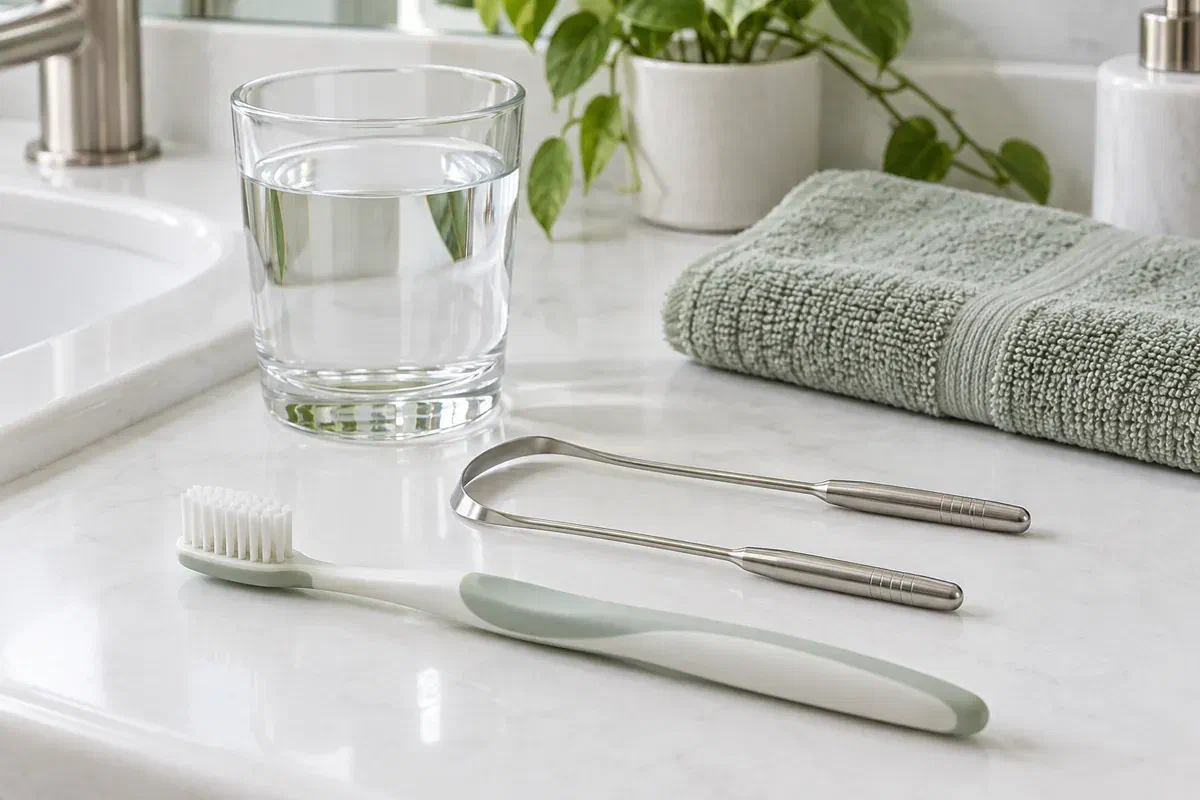
Toothbrush, tongue cleaner, and glass of water illustrating everyday oral care
Mouth-based clues

Signs that point to an oral source

Let us know if the odour is strongest on waking, after eating, or evenly through the day. Changes in the mouth can suggest where to look, but none of them confirms the cause on its own.

Bleeding gums or trapped food

Inflamed gums, plaque and spots where food wedges are among the oral contributors worth ruling in or out. Tell us which areas are difficult to clean. We examine gums, teeth and existing dental work rather than recommending a stronger paste.

Ongoing dryness

A dry mouth can affect breath. Mention thirst, a sticky feeling, mouth breathing and new medicines. Dryness can have medical as well as oral explanations, so we consider your history before suggesting any product.

A removable appliance

Dentures and other appliances need their own routine, and one that collects debris or fits poorly deserves a check. Bring it along and describe how you clean it. We look at the tissues beneath it as well.

When a foul taste arrives alongside a swollen gum, an aching tooth or pus, an infection may be brewing. Ring us rather than masking it until an ordinary appointment comes round.

Why check the mouth first

Rule things in, or rule them out

Without an examination, it is hard to know whether advice is aimed at the right problem. An assessment links recommendations to findings such as a cleaning blind spot, inflamed gums, an appliance issue or dryness. If those are present, you have a clear reason to act. If they are not, you have useful information to take to your doctor.

You can also share how the concern affects your daily life. Breath worry can make social situations harder or lead to frequent checking. Tell us. We will respond respectfully, including when the mouth looks healthy and a medical assessment seems the better next step.

A clear oral picture

We check teeth, gums and soft tissues and explain what we find. That is helpful whether or not a dental cause turns up, and a breath concern will not be treated as a reason for extensive dental work.

Practical cleaning guidance

If technique needs adjusting, ask us to demonstrate with tools you can use comfortably. Being able to clean a tricky area properly is more useful than an armful of new products.

Knowing when to involve a doctor

We agree when to review and what would make a medical assessment sensible. That keeps a persistent concern moving toward an answer instead of stalling between guesses.

What the assessment involves

History, examination, explanation, review

Bring the names of your medicines and any health conditions, plus the oral care products you use. If you have noticed a pattern, such as heartburn or a blocked nose alongside the odour, mention it.

  1. Talking about health and timing

    Which came first, the odour or other symptoms such as heartburn, a sour taste or a stuffy nose? We want to know how long it has been going on, whether it ever clears and what seems to change it. Smoking, dryness and appliances may be discussed too. Tell us what you have tried and whether anything caused irritation.

  2. A careful oral examination

    We assess the teeth, gums, tongue and mouth lining for plaque, gum swelling, cavities, food traps and appliance problems. Extra tests are recommended only when they would help answer a specific question.

  3. Explaining the findings

    We tell you what we found and whether gum care, repair of a tooth or another treatment is advisable. Home care and dryness advice are tailored. Ask about fees, and whether each recommendation is aimed at the breath concern or a different issue.

  4. Reviewing and referring if needed

    At review we see what has changed. If oral care does not account for the concern, or your symptoms suggest a medical cause, we can write down what was examined and found so you have something concrete to share with your family doctor. We will be open about uncertainty rather than promising a result.

While you see how things go

Do the oral part well

Follow the routine we agree on. If a product stings, makes the mouth feel drier or is awkward to use, tell us so we can recommend something different.

Daily cleaning done gently

Brush with fluoride toothpaste twice daily and clean between teeth once a day. We may suggest light tongue cleaning. More force is not better; brushing or scraping until tissues bleed only irritates them.

Appliance care

Clean dentures or appliances using the method advised for their material and wear them as directed. Ask about storage and soaking products. Do not use household cleaners in an attempt to remove odour.

Dryness and medical follow-up

Tell us if dryness continues. Discuss medicine concerns with the prescriber, and keep any appointments your doctor arranges. Do not stop a medicine yourself. Long-lasting dryness should be investigated because it can also affect the teeth.

Patient information: NHS — caring for the mouth when breath is a concern · NIDCR — dry mouth

Possible outcomes

Dental care, support, or a referral

If we can identify an oral contributor, treatment aims at it. Ask how each recommendation relates to the findings and what we will suggest if the odour continues.

If plaque or gum disease is found

Gum and cleaning care

A tailored routine and appropriate professional gum treatment may be recommended. The amount depends on your gums. Treatment for established periodontal disease can involve more than a standard cleaning.

If a tooth or appliance needs care

Treatment of a specific problem

Decay, a restoration that traps food or an appliance concern may need targeted treatment. Discuss the diagnosis, alternatives and likely benefit. Dealing with one finding does not guarantee every source of odour is resolved.

If the cause seems to lie elsewhere

Medical assessment or symptom support

A visit to your physician, dry-mouth care or a product used for a specific purpose may be appropriate. A cosmetic rinse can briefly mask breath without treating disease. Ask what any product is designed to do.

Patient information: American Dental Association — mouthrinse and its limitations

Puslinch questions

Mouth or medical? Common questions

Explain the concern however you like. Even if you suspect a non-dental cause, the history and oral examination give useful information to start from.

(905) 876-4488
Can acid reflux cause bad breath?
Reflux can affect breath for some people, and it is worth mentioning heartburn or a sour taste. Because oral causes are common, examining the mouth is still useful. If reflux seems likely, your physician is the right person to assess it.
Could sinus or throat problems be involved?
They can contribute in some cases, for example with postnasal drip or ongoing throat symptoms. Mention them during your visit. If the mouth does not explain the odour, a physician can assess nose and throat causes.
Should I see my doctor or my dentist first?
For many people, a dental assessment is a sensible starting point because oral sources are common and can be checked directly. If you have other symptoms, such as weight loss or difficulty swallowing, speak with your doctor promptly as well.
Does fasting or skipping meals affect breath?
It can. Going a long time without eating or drinking may leave the mouth drier and change breath for a while. This tends to improve once you eat and drink. Persistent odour despite regular meals is worth assessing.
Will a mouthwash tell me whether the cause is oral?
Not reliably. A rinse may mask odour briefly whatever its source. An examination is a better way to identify oral contributors. Ask whether any rinse is appropriate for your findings.
Can I book from Puslinch at a time that suits farm or shift work?
Weekday appointments run Monday to Thursday, 11am to 7pm, and Friday to Sunday visits are by appointment. Ask when booking for a time that works around your schedule, and mention if you would like any follow-up planned at the same time so you can arrange work around it.
Breath care for Puslinch

Check the mouth, then decide

Book an appointment at our Bronte Street practice for a private conversation and an oral examination. Bring your questions and the names of your medicines and products. We will explain what we find and help you decide whether a medical opinion should be next.

Toothache, a puffy cheek or gum, or a change that alarms you is a reason to ring us directly. Use the online request for ordinary bookings.

Visit Milton Dental Clinic
Unit 1, 342 Bronte St. S, Milton, ON L9T 5B7
Get directions Clinic hours
Monday–Thursday
11am–7pm
Friday–Sunday
By appointment only

Areas we serve

  • Milton
  • Oakville
  • Mississauga
  • Georgetown
  • Halton Hills
  • Acton
  • Campbellville
  • Brampton
  • Burlington
  • Puslinch
  • Rockwood
  • Erin
  • Caledon
  • Etobicoke
  • Old Milton
  • Bronte Meadows
  • Timberlea
  • Dorset Park
  • Dempsey
  • Clarke
  • Beaty
  • Coates
  • Harrison
  • Scott
  • Willmott
  • Ford
  • Bowes
  • Cobden
  • Walker
  • Mountain View
  • Milton Heights
  • Hawthorne Village
  • Valley View
  • Fallingbrook
  • Nassagaweya
  • Trafalgar
  • Esquesing
  • Nelson
  • Brookville
  • Moffat
  • Glen Williams
  • Norval
  • Limehouse
  • Stewarttown
  • Ashgrove
  • Hornby
  • Silver Creek
  • Speyside
  • Scotch Block
  • North Oakville
  • River Oaks
  • Glen Abbey
  • West Oak Trails
  • Palermo
  • Bronte Creek
  • College Park
  • Joshua Creek
  • Uptown Core
  • Preserve
  • Iroquois Ridge
  • Lisgar
  • Meadowvale
  • Meadowvale Village
  • Churchill Meadows
  • Erin Mills
  • Central Erin Mills
  • Streetsville
  • East Credit
  • Creditview
  • Heartland
  • Sheridan
  • Mount Pleasant
  • Credit Valley
  • Huttonville
  • Churchville
  • Springbrook
  • Northwest Brampton
  • Bram West
  • Fletcher's Meadow
  • Fletcher's Creek South
  • Alton Village
  • Orchard
  • Millcroft
  • Headon Forest
  • Tansley
  • Brant Hills
  • Tyandaga
  • Kilbride
  • Lowville
  • Aberfoyle
  • Morriston
  • Arkell
  • Hillsburgh
  • Freelton
  • Carlisle
  • Waterdown
  • Flamborough
  • Mountsberg

How can we help?

Milton Dental Clinic

Have a question about your smile? Choose the option that works best for you.

For urgent dental concerns, please call.
Messages are reviewed during clinic hours.