

Illustrative dental consultation with an older patient and her chosen support person
General & Family Dentistry

Caregiver-Assisted Dental Visits in Burlington

For wheelchair users and anyone who needs help moving, the details matter before the trip from Burlington. Confirm access, transfers and the role of your support person with us first.

Mobility first

Check the access. Then book the chair.

For someone who uses a wheelchair, a scooter or a walker, the dental appointment often hinges on a few practical questions: can they stay seated, will a transfer be needed, and who will help with it? Asking those questions before setting out from Burlington saves a frustrating afternoon and gives us time to think about what is realistic.

A caregiver-assisted visit lets that kind of help be planned alongside the dental care. The companion may be a partner, an adult child, a friend or a personal support worker. They might assist with movement, communication, remembering advice or daily brushing. Each person’s mix is different, and needing a hand with one thing says nothing about their ability to manage the rest.

Our aim is to keep the patient at the centre. Their priorities, comfort and questions shape the visit. The companion’s knowledge adds detail, particularly about routines at home, but the plan is built around the individual rather than a label attached to their mobility or health.

Ask about access for a supported visit
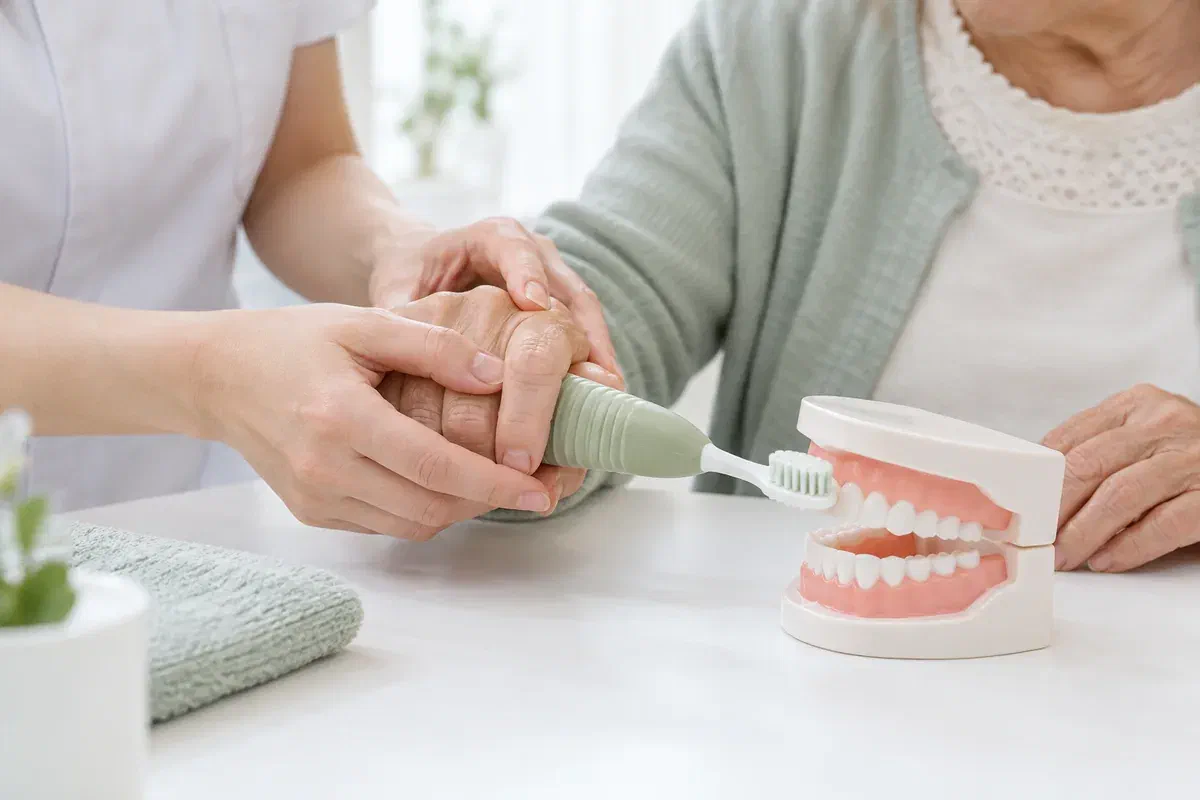
Illustrative practice with a larger toothbrush handle and a dental model
Things to tell us early

Equipment, energy and everything in between

Two wheelchair users can need very different things from a dental appointment. Tell us what worked at past visits elsewhere, and what turned out to be a problem.

Talking and understanding

Let the team know about hearing loss, low vision, speech differences or a preferred language. Some patients need longer to answer or want instructions one at a time. Explain how your companion usually helps, so space remains for your own replies.

Seating, transfers and endurance

Describe the chair or mobility aid, whether you transfer independently or with help, how far you can recline, and how long sitting stays comfortable. Ask us to confirm arrangements; lifting assistance and specialised equipment should not be assumed. Answers may affect appointment length or point toward another setting.

What your companion has spotted

A helper may notice bleeding gums, a denture rubbing, food being avoided or brushing becoming harder to tolerate. Note the specifics and when they started. These changes need a proper look rather than being written off as part of a known condition.

Severe pain, swelling, difficulty eating or drinking, or a sudden worrying change should prompt a phone call, not a wait. Planning an introductory visit is no reason to delay urgent care.

Where a companion makes a difference

From the dental chair back to your own bathroom

Reaching the back teeth from a wheelchair, or brushing with limited shoulder movement, is a different task from the one most leaflets describe. A companion who helps at home can explain what the routine really looks like, which lets the dental team suggest changes that fit the bathroom, the sink height and the hands doing the work.

Decide early how present you want that person to be. Some patients like their companion right beside them; others want help only with the transfer and the instructions at the end. Say so when you book. The arrangement is not fixed and can be adjusted as needs change.

Patient information: NIDCR — oral health support and individualized care

Clearer medical context

An accurate medication list, any instructions relevant to dental treatment and specific observations help the team understand the whole picture. Point out details that should be confirmed with your physician or another clinician.

Brushing methods that suit your reach

Ask how brushing and cleaning between teeth could be adapted for limited reach, grip or shoulder movement. An adapted handle may keep you independent; in other cases a helper needs to do the brushing. Advice should fit the actual task.

Follow-up everyone understands

With your permission, agree who receives instructions and how they are passed on. Before leaving, confirm the next visit, signs to watch for and the daily routine, so nobody is left reconstructing the plan from memory.

Arranging the visit

Settle the practical questions on the phone, not in the doorway.

Please contact us before booking if your visit depends on mobility or other support. We can talk through why you need to be seen, what to bring and which needs require extra planning.

  1. Tell us about the patient and the help

    Describe the dental issue, how you prefer to communicate and what support you expect. Name who will attend and their role. Share mobility and medical details so the appointment setting can be reviewed in advance.

  2. Confirm consent and roles

    The dentist discusses proposed care with the patient and uses the appropriate consent process. A companion helping with a transfer or with conversation does not thereby gain authority over treatment. Where a substitute decision-maker is needed, that person and relevant papers must be established.

  3. Take breaks as needed

    Each part of the examination is explained clearly. Agree on a signal to stop, talk about positioning and pressure points, and tell us how you are feeling as the visit goes on. Some appointments focus on assessment, with treatment planned for another time.

  4. Finish with a joint plan

    We review what we found, the options, costs and follow-up with you and an authorized companion where that fits. Ask about the home routine until it is clear. Agree who will book next and how new symptoms or brushing difficulties should be reported.

Everyday care

A routine built around your reach and comfort

Help could be a reminder, a steadying hand or full brushing by someone else. Ask for advice that reflects your abilities and any limits on swallowing or positioning rather than a technique made for another person.

Stay part of the routine

Helpers should explain what they are about to do and leave room for you to do what you can. You might brush the front while a companion reaches the molars. If care becomes painful or upsetting, pause and ask us what could be causing trouble.

Try adapted tools

Ask whether a longer or thicker handle, an electric brush or another cleaning aid would help. The choice should account for grip, coordination and safe use. A helper’s fingers belong outside the bite, and the mouth should never be forced.

Track what changes

Keep note of bleeding, swelling, foods you avoid, denture problems or care that feels less comfortable. Write down when it began and what was seen. Details like these help far more than a vague sense that things are getting harder.

Choosing a format

Three ways a supported visit can work

The route forward depends on the dental problem and the help required. Ask what our office can offer safely and comfortably, and when another provider would be better placed.

Communication and practical help

An appointment with your companion

Your companion can add history or keep track of advice while you remain part of every decision. Agree when they should contribute, and say if you would like any of the conversation held without them.

When pacing helps

A shorter first visit or staged care

Where clinically appropriate, an introductory visit or treatment split into stages may be offered. Its purpose and limits should be clear. Urgent problems still need prompt assessment, even if routine care is usually paced slowly.

When more resources are needed

A setting with other facilities

Certain mobility, medical or treatment needs are better met by a provider with different equipment, such as specialised lifting or hospital resources. We can discuss referral and continuity. A helper’s presence cannot widen what a particular office is set up to provide.

Mobility and support questions

Before you load the chair into the car

Patients, partners and personal support workers all ask how to prepare. However the day is organised, your own wishes and the reason for the visit set the direction.

(905) 876-4488
Can I stay in my own wheelchair for a dental check-up?
Ask the team before booking. Whether an examination can be done from your own chair depends on what is needed and how you can be positioned safely. We would rather confirm the options with you in advance than leave it to the day of the appointment.
What details about my mobility aid are helpful to share?
Mention the type of chair or aid, whether it tilts or reclines, whether you transfer on your own or with help, and how long you can sit comfortably. Also share any pain, pressure or breathing concerns that change when you lean back.
Is my personal support worker allowed to help me transfer?
Talk to us about the transfer you normally use and who usually assists. Do not assume staff-assisted lifting or particular equipment will be available. Confirming the details ahead helps decide whether this office is the right place for the visit.
My partner comes with me. Does that mean they can agree to treatment for me?
No. Attending with you does not give a partner the authority to make your dental decisions. Consent is sought from you, and a substitute decision-maker is brought in only where the law requires one. Let us know about any arrangements in place.
Can we take breaks if sitting gets uncomfortable?
Yes, raise it when you book and again at the start of the visit. Agree on a signal that means pause. If you cannot continue, we can talk about a shorter assessment, another appointment or a referral, while making sure urgent concerns still have a plan.
Is there anything to plan before making the trip from Burlington?
Confirm access and support arrangements by phone first, so the journey is not wasted. Bring your medication list and any relevant care notes. If transport needs to be booked, allow some flexibility in case the visit runs a little longer than expected.
Planning from Burlington

Call first, and we will work out the access together.

Phone our Bronte Street practice to describe your dental concern and the support you will need, from transfers to communication. The earlier we hear about access requirements, the sooner we can say what is possible and what to bring.

Please talk to us directly about equipment or transfer needs. Sending a request through the website does not confirm access arrangements or a booking time.

Visit Milton Dental Clinic
Unit 1, 342 Bronte St. S, Milton, ON L9T 5B7
Get directions Clinic hours
Monday–Thursday
11am–7pm
Friday–Sunday
By appointment only

Areas we serve

  • Milton
  • Oakville
  • Mississauga
  • Georgetown
  • Halton Hills
  • Acton
  • Campbellville
  • Brampton
  • Burlington
  • Puslinch
  • Rockwood
  • Erin
  • Caledon
  • Etobicoke
  • Old Milton
  • Bronte Meadows
  • Timberlea
  • Dorset Park
  • Dempsey
  • Clarke
  • Beaty
  • Coates
  • Harrison
  • Scott
  • Willmott
  • Ford
  • Bowes
  • Cobden
  • Walker
  • Mountain View
  • Milton Heights
  • Hawthorne Village
  • Valley View
  • Fallingbrook
  • Nassagaweya
  • Trafalgar
  • Esquesing
  • Nelson
  • Brookville
  • Moffat
  • Glen Williams
  • Norval
  • Limehouse
  • Stewarttown
  • Ashgrove
  • Hornby
  • Silver Creek
  • Speyside
  • Scotch Block
  • North Oakville
  • River Oaks
  • Glen Abbey
  • West Oak Trails
  • Palermo
  • Bronte Creek
  • College Park
  • Joshua Creek
  • Uptown Core
  • Preserve
  • Iroquois Ridge
  • Lisgar
  • Meadowvale
  • Meadowvale Village
  • Churchill Meadows
  • Erin Mills
  • Central Erin Mills
  • Streetsville
  • East Credit
  • Creditview
  • Heartland
  • Sheridan
  • Mount Pleasant
  • Credit Valley
  • Huttonville
  • Churchville
  • Springbrook
  • Northwest Brampton
  • Bram West
  • Fletcher's Meadow
  • Fletcher's Creek South
  • Alton Village
  • Orchard
  • Millcroft
  • Headon Forest
  • Tansley
  • Brant Hills
  • Tyandaga
  • Kilbride
  • Lowville
  • Aberfoyle
  • Morriston
  • Arkell
  • Hillsburgh
  • Freelton
  • Carlisle
  • Waterdown
  • Flamborough
  • Mountsberg

How can we help?

Milton Dental Clinic

Have a question about your smile? Choose the option that works best for you.

For urgent dental concerns, please call.
Messages are reviewed during clinic hours.