

Illustrative dental consultation with an older patient and her chosen support person
General & Family Dentistry

Caregiver-Assisted Dental Visits in Campbellville

Maybe you only need a lift and a second pair of ears, not someone speaking for you. From Campbellville, plan exactly how much help you want at your dental visit, and keep the rest private.

Help on your terms

A ride, a reminder, and your privacy intact

Out in the countryside around Campbellville, it is common for a neighbour, friend or adult child to drive someone to appointments. That does not mean the passenger wants help with everything. You might want company in the waiting room and nothing more, or someone to listen to the instructions at the end so you are not relying on memory alone.

A caregiver-assisted visit lets you define that help clearly. Tell us what you would like your companion to do, and what you would rather handle yourself. Share anything that affects care, such as hearing, mobility, swallowing, positioning or medical conditions. Our team can then explain what we can arrange and, if needed, whether another setting would suit particular needs.

You remain the decision-maker throughout. Your companion’s observations can be helpful, especially about changes you have not noticed, but you decide how much of the conversation they hear. Support should be shaped around your preferences rather than assumptions based on age, health or a diagnosis.

Choose the support you want
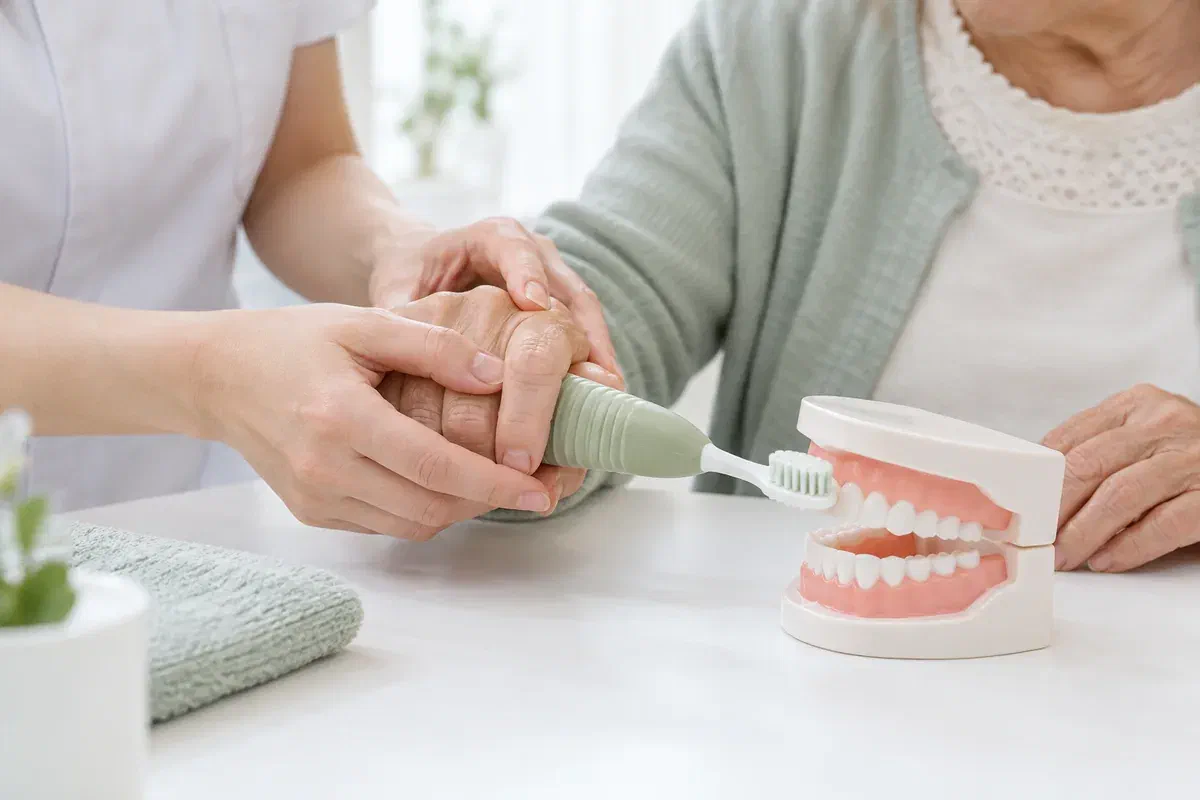
Illustrative practice with a larger toothbrush handle and a dental model
What to tell us

Name the help you want, and the help you don’t.

Needing a hand with one thing says nothing about the rest. Tell us what has made past appointments easier, and where too much help felt unwelcome.

Hearing, eyesight and pace

Mention hearing aids, low vision, a preferred language or a need for slower conversation. You may like information in writing or one step at a time. Let us know whether your companion should help with this, or whether you would rather they stayed out of it.

Getting settled in the chair

Describe a cane, walker or wheelchair, sore joints, trouble reclining, or how long sitting stays comfortable. Check with us before relying on transfer help or particular equipment being there. These details may shape the length of the visit or the best setting.

Changes you or a companion have noticed

You might have started avoiding certain foods, seen bleeding when brushing, or found a denture loosening. A companion may notice things too. Note what happened and when. Changes like these need assessment rather than being blamed on age or an existing condition.

Phone us promptly about significant pain, swelling, problems eating or drinking, or a sudden change you are worried about. Preferring a gradual approach should never mean waiting on something urgent.

Light support, real benefits

A second listener can make advice stick.

Even a confident patient can leave an appointment unsure of the details: how often to rinse, when to come back, which side to brush more gently. A companion who hears the summary can help you recall it later. If they also help at home, they can tell the team what the real routine looks like, which keeps recommendations practical.

You decide where your companion sits during the visit. They can be beside you the whole time, wait outside until the end, or step out for any part you would like to keep private. Mention your preference when booking. It can change from visit to visit.

Patient information: NIDCR — oral health support and individualized care

Accurate background

Bring your current medication list and any instructions from other health professionals that affect dental care. Keep the information accurate, and flag anything that should be confirmed with your doctor or pharmacist.

Tips that suit your hands

If brushing or flossing has become harder, ask how your technique or tools could be adapted. A thicker handle or floss holder may keep you independent. If a companion helps you at home, they can watch a demonstration too.

Instructions shared only as you wish

Decide who should receive information and how, with your consent. Confirm the next appointment, warning signs and home care before leaving, so you are not left piecing the plan together later.

Setting it up

Your preferences go on the booking.

Get in touch before scheduling if your visit needs particular support. We can discuss the reason for the appointment, what to bring and whether any needs require extra planning.

  1. Explain what you want

    Share the dental concern, how you prefer to communicate and the specific help your companion will offer. Tell us who is coming and their role. Mention mobility or medical needs so the setting can be considered ahead of time.

  2. Keep consent with you

    Proposed care is explained to you, and the dentist follows the appropriate consent process. A friend or relative who drives you does not gain any authority over your treatment by doing so. Only where a substitute decision-maker is required would that person and their documents be identified.

  3. Go at a comfortable pace

    Each step is described as it comes. Agree on a signal to pause, mention positioning or joint pain, and tell us how you are feeling. Some appointments focus on assessment and planning, with treatment booked for another time.

  4. Decide who hears the summary

    The dentist goes over what was found, your choices, the costs and what happens next with you, and with your companion only if you wish. Ask about home care until it is clear. Agree who will book the next visit and how to contact us about new symptoms.

Your daily routine

Keep doing as much as you can yourself.

Support might be as small as a reminder or as hands-on as help with brushing. Ask for advice that fits your abilities and any limits on swallowing or positioning, rather than a technique meant for someone else.

Ask for only the help you need

If someone helps you, they should explain what they plan to do and leave the rest to you. You may manage most of your mouth and need help with one area. If brushing becomes painful, stop and ask us what may be causing it.

Adjust tools before giving up

A wider handle, powered brush, floss pick or other aid can make a real difference when grip or reach changes. Choose with safety and coordination in mind. A helper should never place fingers between your teeth or force your mouth open.

Notice and note

Keep a record of bleeding, swelling, foods you avoid, denture discomfort or brushing that feels harder, with dates. Specific notes help the team far more than a general sense that something feels off.

How much support

From a little help to a lot

The right next step depends on the dental concern and the support you would like. Ask what can be done safely and comfortably here, and when a referral would make more sense.

Recall and reassurance

Companion for part of the visit

Your companion can join for the history or the summary while you handle the rest. Agree when they should contribute, and keep any part of the conversation private if you prefer.

When easing in helps

A gentle, staged start

Where clinically appropriate, a shorter first visit or care split into stages may be discussed. The purpose and limits should be clear. Urgent issues still need prompt assessment, whatever pace you prefer for routine care.

When needs go further

Care in another setting

Some health, mobility or treatment needs are best met by a provider with different facilities. We can discuss referral and continuity. Bringing a companion does not extend what a general office is able to offer.

Questions about light support

Help that stays in the background

Patients, relatives and friends around Campbellville often ask how this works when only a little help is needed. The arrangement should follow your wishes and the clinical reason for the visit.

(905) 876-4488
My neighbour drives me. Can she wait outside and just hear the instructions at the end?
Yes. Tell us when booking, and remind the team on arrival. You can see the dentist on your own and invite her in when the summary is given. Only the information you agree to share will be discussed with her.
Can I ask for part of my appointment to be private?
Yes. You can ask your companion to step out for any part of the discussion. Mention it on the day or when booking. Some topics, such as health history or treatment choices, are ones many people prefer to talk through alone.
Is a friend treated differently from a family member?
Not in terms of authority. Neither a friend nor a relative automatically gains the right to make decisions about your treatment simply by attending. You decide what information they receive. Let us know if there is a formal arrangement in place.
I live on a rural property and come in rarely. Can I group my questions into one visit?
Mention everything when booking so the team can plan the time. Whether several concerns can be dealt with together depends on your comfort and what is clinically appropriate. Assessment sometimes comes first, with treatment scheduled for a later visit.
Can my companion write down the home-care advice for me?
With your agreement, yes. We can also go over the key points at the end. Ask questions until you are both clear on what to do, what to watch for, and when to call.
What should I do if a problem starts between visits?
Call the team and describe what you notice. Significant pain, swelling, or difficulty eating or drinking should be reported promptly. Swelling that affects breathing or swallowing needs emergency medical care straight away.
Supported visits for Campbellville

Keep the help you want, and nothing more.

Call our Bronte Street practice to tell us about the dental concern and how you would like your companion to be involved. Mentioning communication or access needs early helps us prepare and tell you what to bring.

Please phone about access or support arrangements. A request submitted online does not confirm equipment, transfer help or an appointment time.

Visit Milton Dental Clinic
Unit 1, 342 Bronte St. S, Milton, ON L9T 5B7
Get directions Clinic hours
Monday–Thursday
11am–7pm
Friday–Sunday
By appointment only

Areas we serve

  • Milton
  • Oakville
  • Mississauga
  • Georgetown
  • Halton Hills
  • Acton
  • Campbellville
  • Brampton
  • Burlington
  • Puslinch
  • Rockwood
  • Erin
  • Caledon
  • Etobicoke
  • Old Milton
  • Bronte Meadows
  • Timberlea
  • Dorset Park
  • Dempsey
  • Clarke
  • Beaty
  • Coates
  • Harrison
  • Scott
  • Willmott
  • Ford
  • Bowes
  • Cobden
  • Walker
  • Mountain View
  • Milton Heights
  • Hawthorne Village
  • Valley View
  • Fallingbrook
  • Nassagaweya
  • Trafalgar
  • Esquesing
  • Nelson
  • Brookville
  • Moffat
  • Glen Williams
  • Norval
  • Limehouse
  • Stewarttown
  • Ashgrove
  • Hornby
  • Silver Creek
  • Speyside
  • Scotch Block
  • North Oakville
  • River Oaks
  • Glen Abbey
  • West Oak Trails
  • Palermo
  • Bronte Creek
  • College Park
  • Joshua Creek
  • Uptown Core
  • Preserve
  • Iroquois Ridge
  • Lisgar
  • Meadowvale
  • Meadowvale Village
  • Churchill Meadows
  • Erin Mills
  • Central Erin Mills
  • Streetsville
  • East Credit
  • Creditview
  • Heartland
  • Sheridan
  • Mount Pleasant
  • Credit Valley
  • Huttonville
  • Churchville
  • Springbrook
  • Northwest Brampton
  • Bram West
  • Fletcher's Meadow
  • Fletcher's Creek South
  • Alton Village
  • Orchard
  • Millcroft
  • Headon Forest
  • Tansley
  • Brant Hills
  • Tyandaga
  • Kilbride
  • Lowville
  • Aberfoyle
  • Morriston
  • Arkell
  • Hillsburgh
  • Freelton
  • Carlisle
  • Waterdown
  • Flamborough
  • Mountsberg

How can we help?

Milton Dental Clinic

Have a question about your smile? Choose the option that works best for you.

For urgent dental concerns, please call.
Messages are reviewed during clinic hours.