

Illustrative dental consultation with an older patient and her chosen support person
General & Family Dentistry

Caregiver-Assisted Dental Visits in Erin

Brushing someone else’s teeth gets complicated when swallowing is a worry. From Erin or Hillsburgh, plan a dental visit where the caregiver learns a home routine that respects those limits.

Home routines with care

The evening routine, done safely

It is nine o’clock, the house is quiet, and you are standing beside a parent who coughs whenever water reaches the back of the mouth. Questions pile up: how much toothpaste, how to rinse, whether the denture should stay out. For households in Erin and the nearby villages, a caregiver-assisted visit is a chance to bring those evening questions to the dental team.

Daily brushing is only one part of what a companion may do. They might also handle the drive, the medication list, the walker or the reminders. Share the whole picture, including how the patient communicates and any positioning, swallowing or health concerns. Our team can then talk through what we are able to arrange, and whether a different provider or setting would serve the patient better.

Through every stage, the person receiving care keeps their say. A caregiver often notices what the patient cannot easily describe, and that view is useful. Even so, the routine has to fit the individual and what they want, rather than a blanket rule based on their age or a medical label.

Plan a visit about home mouth care
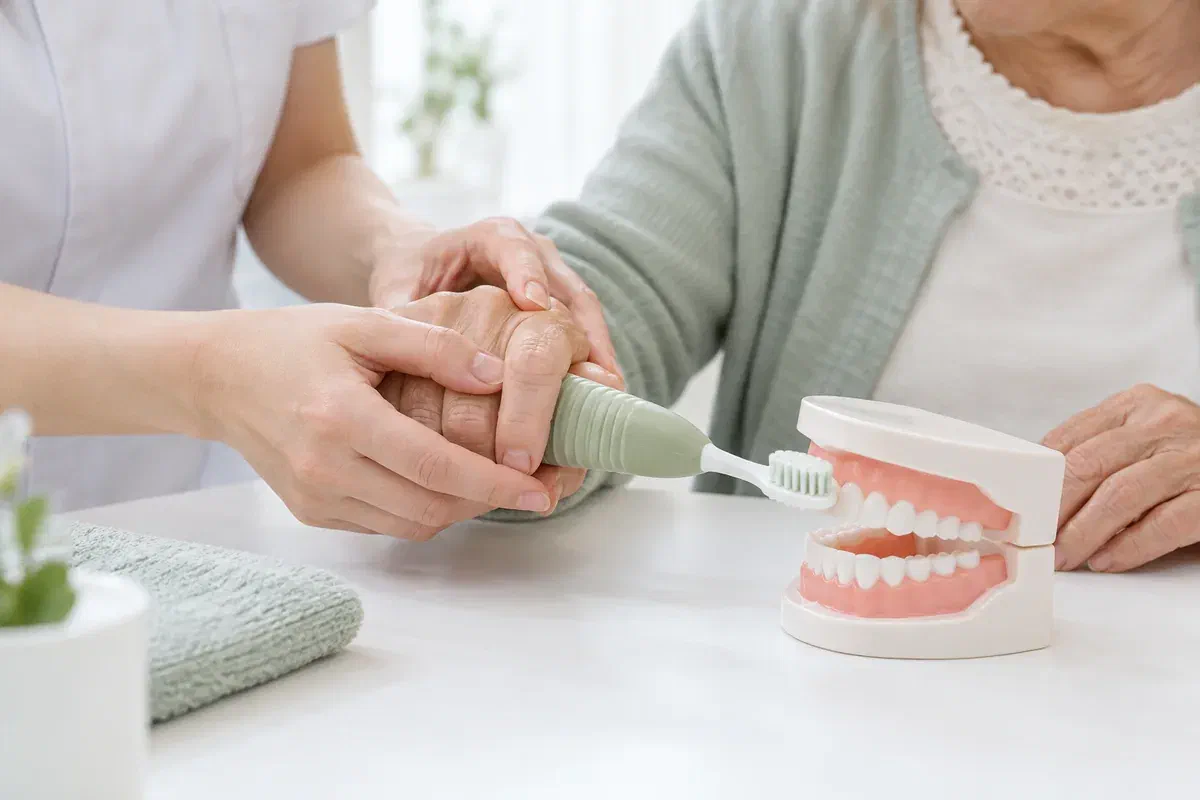
Illustrative practice with a larger toothbrush handle and a dental model
Useful to hear before booking

Describe a typical brushing session.

The same diagnosis can play out very differently at the sink. Tell us what went well at earlier appointments, and what tends to make care at home difficult.

Understanding and responding

Explain whether the patient uses hearing aids or glasses, prefers a certain language, or needs a pause before replying. Single, short instructions may suit some. Describe your usual role, so the conversation still makes room for their own answers.

Sitting upright and staying comfortable

Let us know about wheelchairs, walkers, any advice to stay upright, difficulty reclining and how quickly the patient tires. Check with us about transfer help or equipment rather than assuming it. Positioning matters for safety and may affect visit length or the setting.

Signs during meals and brushing

Coughing at the sink, food held in the cheek, gums that bleed, or a denture left out more often are all worth noting. Write down what happened and roughly when. These signs need professional attention rather than being put down to mood or the existing condition.

Call promptly for intense pain, swelling, being unable to eat or drink, or anything that has changed suddenly and worries you. A slow, introductory plan is never a reason to delay urgent care.

Bringing the home routine into the room

Advice that works at your own sink

When the person who brushes every night describes the routine in detail, the dental team can see where it might be adjusted. Is the patient seated or standing? Do they spit, or is rinsing difficult? Which teeth are hardest to reach? Practical answers lead to advice that fits a real bathroom rather than an ideal one.

It is also worth agreeing how the caregiver will take part. Some patients like their helper beside the chair for everything; others prefer a private conversation first and the helper invited in for the hands-on part. Note the choice when booking. It can be revisited at any visit.

Patient information: NIDCR — oral health support and individualized care

Swallowing and medical guidance in one place

Bring the medication list and any written swallowing or diet guidance from a speech-language pathologist or physician. Keep it current, and mention anything you would like the dentist to confirm with them.

Hands-on technique coaching

Ask to see brushing and between-teeth cleaning adapted for the patient’s grip, posture and swallowing. An adapted handle may help one person manage alone; another needs the caregiver to do it. A short demonstration builds confidence.

A plan the household can repeat

Decide, with the patient’s agreement, who should receive instructions and how they are shared among helpers. Before leaving, check the follow-up date, the symptoms that need a call, and the daily steps.

How a supported visit runs

From the first call to a routine you can trust

Reach out before booking when the visit depends on particular help. We can talk about what the patient needs to be seen for, what to bring along, and any needs that call for further planning.

  1. Start with the patient’s needs

    Tell us the dental concern, the communication approach that works and the support you provide. Mention who is coming and why. Share swallowing, mobility or medical details so the appointment can be planned around them.

  2. Clarify consent

    Proposed care is discussed with the patient, and the dentist uses the appropriate consent process. Doing the daily brushing does not give a caregiver authority over treatment decisions. If a substitute decision-maker is needed, that person and their paperwork must be identified.

  3. Keep the patient upright and informed

    Each step is explained first. Agree a signal to pause, discuss how far the chair can safely recline, and watch for coughing or tiredness. An early visit may be mostly assessment and home-care teaching, with treatment arranged later.

  4. Leave with clear next steps

    The dentist reviews what was found, possible treatments, costs and follow-up with the patient and any authorized helper. Ask until the home routine is clear. Agree who books next time and how to reach us about new problems.

The nightly routine

Small, careful steps at the sink

Some patients need a reminder; others need every tooth brushed for them. Request advice that fits their abilities and the swallowing guidance they already have, rather than a routine designed for someone else.

Go at their pace

Talk them through each move before you make it, and let them take on whatever part they can. They may brush the front teeth while you finish further back. If care hurts or distresses them, put the brush down and call us to work out why.

Pick tools with swallowing in mind

Ask whether a small-headed brush, a modified handle or another aid would suit. Choices should reflect grip, coordination and safe use. Never place fingers between the teeth or prise the jaw open.

Note anything new

Write down bleeding, swelling, refused foods, denture trouble, coughing during care or other changes, with the date. Clear notes help us much more than a general sense that brushing has become a struggle.

Options to talk over

Not one size of supported visit

The way forward depends on what is happening in the mouth and how much assistance is needed. Ask what our office can do safely and comfortably, and when referral would be more appropriate.

Practical help and recall

A visit with the caregiver alongside

The caregiver can provide history and note instructions while the patient joins in decisions. Agree when the caregiver should speak, and whether any part of the conversation should be private.

When familiarity helps

A gradual or staged approach

Where clinically suitable, a short introductory visit or care in stages may be considered. Its purpose and limits should be understood. An urgent problem still needs prompt assessment, whatever the usual pace.

When more resources are needed

Referral to a different setting

Some swallowing, medical or mobility needs are better managed where other facilities are available. We can discuss referral and coordinated care. A caregiver’s help, however skilled, does not extend what each office can do.

Home-care questions

What caregivers ask about brushing safely

Patients, family caregivers and support workers often raise these. Every answer depends on the patient’s wishes and their own clinical situation.

(905) 876-4488
How do I brush someone’s teeth if they have trouble spitting?
Ask the dental team for a method suited to the patient, and share any swallowing guidance from their other clinicians. Positioning, the amount of toothpaste and how the mouth is cleared all matter. A demonstration during the visit can help.
Should the patient sit up during brushing at home?
Follow any positioning advice from their medical team, and ask us how it applies to mouth care. Many people find an upright, supported position more comfortable, but the right approach depends on the individual.
Can I learn to clean a denture for someone with swallowing difficulties?
Yes. Ask for a demonstration of removing, cleaning and storing the denture, adapted to the patient’s comfort. Mention any instructions about wearing it during meals or overnight from their other clinicians.
Does helping with daily care mean I can approve dental treatment?
No. Daily caregiving does not by itself give authority to consent. The dentist follows the appropriate process, involving a substitute decision-maker only where required. Let us know about any arrangements and bring relevant documents.
What if coughing makes it hard to continue the examination?
Tell the team straight away. We can stop, sit the patient up and discuss the safest next step, which could be a shorter assessment, another visit or a referral. Urgent symptoms still need timely attention.
Living in rural Erin, how can we limit the number of trips?
Call ahead so support, access and swallowing information is shared before the day. Bring the medication list and any clinician letters. Where appropriate, assessment and home-care teaching may be combined in a single visit.
Coming from Erin

Bring the bedtime questions with you.

Phone our Bronte Street practice to describe the dental concern, the help the patient receives at home and any swallowing guidance in place. Sharing access needs early lets us prepare and tell you what to bring.

Please call about specific access or support needs. Requests sent online do not on their own confirm equipment, transfer help or an appointment.

Visit Milton Dental Clinic
Unit 1, 342 Bronte St. S, Milton, ON L9T 5B7
Get directions Clinic hours
Monday–Thursday
11am–7pm
Friday–Sunday
By appointment only

Areas we serve

  • Milton
  • Oakville
  • Mississauga
  • Georgetown
  • Halton Hills
  • Acton
  • Campbellville
  • Brampton
  • Burlington
  • Puslinch
  • Rockwood
  • Erin
  • Caledon
  • Etobicoke
  • Old Milton
  • Bronte Meadows
  • Timberlea
  • Dorset Park
  • Dempsey
  • Clarke
  • Beaty
  • Coates
  • Harrison
  • Scott
  • Willmott
  • Ford
  • Bowes
  • Cobden
  • Walker
  • Mountain View
  • Milton Heights
  • Hawthorne Village
  • Valley View
  • Fallingbrook
  • Nassagaweya
  • Trafalgar
  • Esquesing
  • Nelson
  • Brookville
  • Moffat
  • Glen Williams
  • Norval
  • Limehouse
  • Stewarttown
  • Ashgrove
  • Hornby
  • Silver Creek
  • Speyside
  • Scotch Block
  • North Oakville
  • River Oaks
  • Glen Abbey
  • West Oak Trails
  • Palermo
  • Bronte Creek
  • College Park
  • Joshua Creek
  • Uptown Core
  • Preserve
  • Iroquois Ridge
  • Lisgar
  • Meadowvale
  • Meadowvale Village
  • Churchill Meadows
  • Erin Mills
  • Central Erin Mills
  • Streetsville
  • East Credit
  • Creditview
  • Heartland
  • Sheridan
  • Mount Pleasant
  • Credit Valley
  • Huttonville
  • Churchville
  • Springbrook
  • Northwest Brampton
  • Bram West
  • Fletcher's Meadow
  • Fletcher's Creek South
  • Alton Village
  • Orchard
  • Millcroft
  • Headon Forest
  • Tansley
  • Brant Hills
  • Tyandaga
  • Kilbride
  • Lowville
  • Aberfoyle
  • Morriston
  • Arkell
  • Hillsburgh
  • Freelton
  • Carlisle
  • Waterdown
  • Flamborough
  • Mountsberg

How can we help?

Milton Dental Clinic

Have a question about your smile? Choose the option that works best for you.

For urgent dental concerns, please call.
Messages are reviewed during clinic hours.