

Illustrative dental consultation with an older patient and her chosen support person
General & Family Dentistry

Caregiver-Assisted Dental Visits in Puslinch

Supporting someone at the dentist is not the same as deciding for them. Before travelling from Puslinch, sort out roles, consent and paperwork so the visit can focus on care.

Support versus authority

Who signs, and who simply stands beside them?

Families often assume that whoever brings a relative to the dentist can approve the treatment. In reality, being a caregiver and being a decision-maker are separate roles. For a household in Puslinch planning a visit for an ageing parent or an adult with a disability, clearing up that difference beforehand avoids an awkward pause at the chair and a wasted journey.

Support can still cover a lot. A companion may help with communication, transport, medication history, mobility or brushing at home. Describe which of these apply, along with any swallowing, positioning or medical concerns. Our team can explain what we can arrange, and whether a different setting or provider might better suit the person’s needs.

Whenever the patient is able to understand and decide, the choice is theirs, even if they need help to get there. A companion’s insight can be extremely useful, especially for describing changes the patient finds hard to explain, but help should be tailored to the individual rather than assumed from their age or diagnosis.

Talk to us about roles and consent
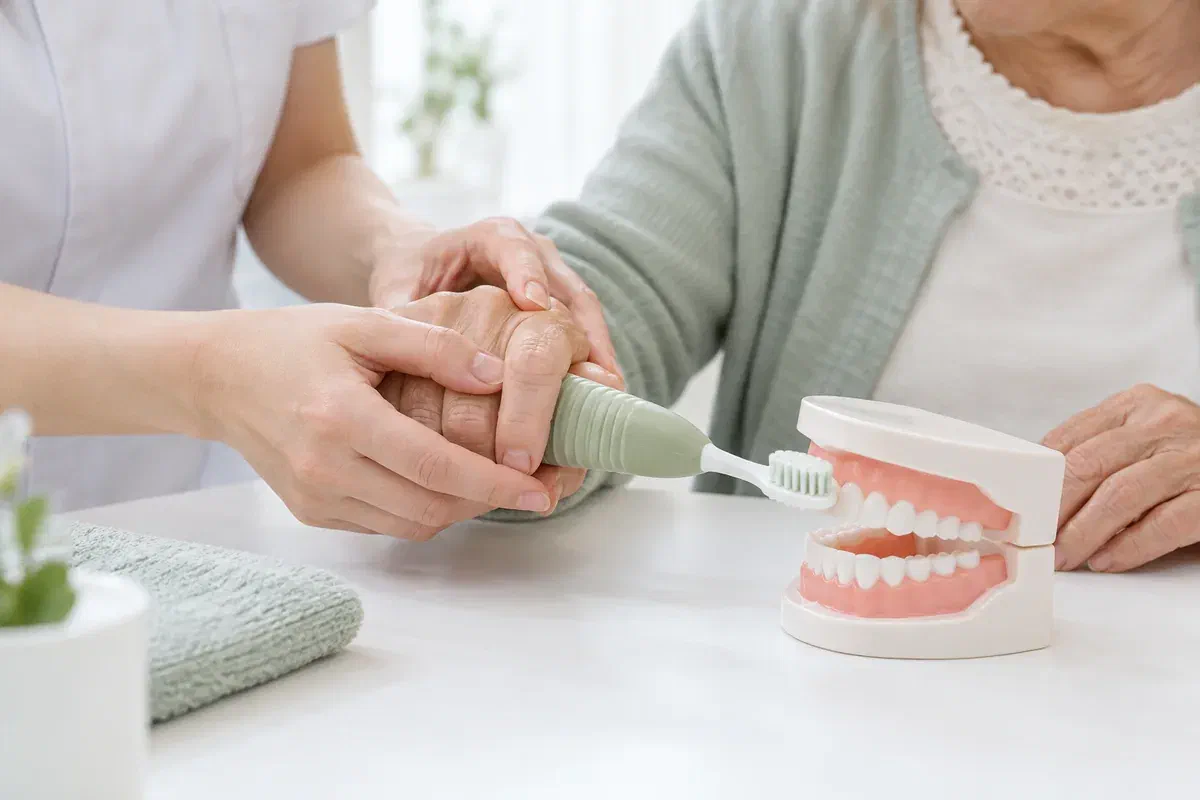
Illustrative practice with a larger toothbrush handle and a dental model
Helpful before the first call

Practical needs first, then the paperwork.

Diagnoses describe conditions, not people. Tell us what made earlier appointments go smoothly, what got in the way, and whether anyone holds formal authority for health decisions.

Communication and understanding

Mention hearing, vision, language or memory needs, and whether the patient prefers short explanations or extra time. Describe how the companion usually helps. We will direct questions to the patient first, so they can take part as fully as possible.

Mobility and seated comfort

Explain walkers, wheelchairs, transfers, difficulty reclining and how long sitting is comfortable. Rather than assuming equipment or lifting help is on hand, ask us to confirm arrangements. These details may affect how long the visit runs or where care is best given.

Changes seen during daily care

A caregiver may notice soft-food preferences, bleeding gums, a denture that rubs, or resistance to brushing. Write down what you saw and when it began. These changes need assessment, not an assumption that they are part of a known condition.

Serious pain, swelling, being unable to manage food or drink, or an alarming sudden change all warrant a call straight away. Sorting out paperwork or familiarization should never delay urgent assessment.

When roles are clear

Less confusion, more useful care

Once everyone knows who supports and who decides, the companion can concentrate on what they do best: describing the real routine at home. Which hand movements are hard, whether the denture is worn overnight, when discomfort shows up. That makes the dental team’s advice more practical, and more likely to be followed after the visit.

It also helps to agree how involved the companion will be in the room. Some patients want them present for everything; others want them only for the instructions. Mention it when booking. Preferences and capacity can both change over time, so the arrangement can be reviewed.

Patient information: NIDCR — oral health support and individualized care

The right documents, if any

If someone holds formal authority for health decisions, bring a copy of the relevant documentation. Also bring an accurate medication list and care notes, and flag anything to confirm with a physician or another clinician.

Home-care guidance for the actual task

Ask how brushing and flossing could be adapted to the patient’s reach and dexterity. One person stays independent with an adapted handle; another needs direct help. A demonstration lets the companion practise with guidance.

A handover with permission

Agree, with the patient’s consent where they can give it, who receives instructions and how. Before leaving, be sure everyone knows the follow-up date, what symptoms to watch and the home routine, so nobody has to reconstruct the plan afterward.

Planning the appointment

Roles settled, then care begins.

Contact us before booking if the visit depends on particular support or a substitute decision-maker. Together we can go over why the patient is coming in, which documents matter and any extra planning required.

  1. Share needs and roles

    Describe the dental concern, communication preferences and the support involved. Tell us who will attend, how they help, and whether anyone else holds decision-making authority. Flag access or health issues as well, so we can judge in advance whether our setting suits.

  2. Confirm the consent pathway

    The dentist explains proposed care to the patient and assesses which consent process applies. Ontario sets out who may act as a substitute decision-maker; a caregiver’s presence alone does not qualify them. If one is needed, the team must identify that person and any supporting documents.

  3. Examine at a manageable pace

    Each step is explained in a way suited to the patient. Agree on a pause signal, raise positioning concerns, and keep us informed about how they are coping. A first visit may be mostly about understanding the problem, leaving treatment for a later date.

  4. Confirm the plan with the right people

    Results, treatment choices, costs and next steps are shared with the patient and, where appropriate, the authorized decision-maker. Ask for clarification on home care. Decide who will book next and how new symptoms or routine difficulties will be reported.

After the appointment

Respectful help with daily mouth care

Day-to-day help might be a reminder on the fridge or brushing done entirely by you. Whatever the level, the advice you get should fit this patient’s abilities, posture and swallowing, not someone else’s routine.

Ask before you help

Say what you are going to do and invite the patient to do whatever part they can. Someone may brush most teeth and need help with one awkward corner. If the routine starts to hurt or upset them, stop and phone us for advice.

Choose suitable aids

A chunkier grip, an electric brush or a floss holder can sometimes make the difference. Pick with hand strength, coordination and safety in mind. Keep fingers out from between the teeth, and never force the mouth open to complete care.

Record and report

Note bleeding, swelling, refused foods, denture issues or brushing that is becoming harder to tolerate, with dates and specifics. Clear observations help the team assess the concern rather than relying on vague descriptions.

Possible paths

Different needs, different visits

The format that suits depends on what is wrong and how much help the patient needs. Ask which of these our office can manage well, and when another provider would be the better call.

Communication and recall

An assessment with a companion

A companion can fill in the medical background or jot down advice, while choices stay with the patient wherever possible. Settle beforehand when the companion speaks, and whether some topics should be discussed privately.

When building familiarity helps

A staged or introductory plan

If it is clinically sensible, a short first meeting or treatment spread over several visits may be offered. Everyone should know what each step can and cannot achieve. An urgent problem still has to be seen quickly.

When more resources are needed

Referral to another setting

Some medical, mobility or treatment needs are better met elsewhere, with different facilities. We can discuss referral and how care stays coordinated. Neither a caregiver nor a decision-maker can make every procedure suitable for every office.

Consent and support questions

Untangling who decides

Patients, relatives and support workers all ask about roles. The answers below are general; the dentist will confirm what applies to each patient and visit.

(905) 876-4488
What is a substitute decision-maker in dental care?
It is a person who makes treatment decisions on behalf of someone who is not capable of making a particular decision themselves. Ontario law sets out who can fill that role. The dentist determines whether one is needed for the proposed care.
Can a patient be capable of some dental decisions but not others?
Capacity can depend on the specific decision and the time it is made. The dentist assesses this as part of the consent process. Families should share relevant information, but they should not assume the answer in advance.
Which documents should we bring if someone holds a power of attorney for personal care?
Bring a copy of the document and any related information. Tell us about it when booking so the team can review what applies. Note that a power of attorney for property alone does not cover health decisions.
Can I support my mother at the appointment even if I am not her decision-maker?
Yes. You can help with communication, history and home care with her agreement. Decisions stay with her if she is capable, or with the appropriate substitute decision-maker if she is not. Let us know your role when booking.
What if the patient becomes too uncomfortable to finish the assessment?
Speak up and we will stop. The options then include a brief partial look, rebooking, different preparation next time, or referral elsewhere. Nobody should be pushed through an exam, though worrying symptoms will still need a plan soon.
How can we avoid a wasted trip from Puslinch over paperwork?
Call ahead to explain the situation and ask which documents are needed. Bring the medication list and any decision-making paperwork. Confirming these details beforehand lets the visit focus on the patient rather than on administration.
Planning from Puslinch

Clear roles make for a calmer appointment.

A call to our Bronte Street practice lets you lay out the dental problem, who is coming and whether anyone holds decision-making authority. Raise communication or access needs at the same time, and we will tell you what to bring.

Access, support and consent questions are best handled by phone. Sending a web request does not reserve equipment, transfer assistance or a time.

Visit Milton Dental Clinic
Unit 1, 342 Bronte St. S, Milton, ON L9T 5B7
Get directions Clinic hours
Monday–Thursday
11am–7pm
Friday–Sunday
By appointment only

Areas we serve

  • Milton
  • Oakville
  • Mississauga
  • Georgetown
  • Halton Hills
  • Acton
  • Campbellville
  • Brampton
  • Burlington
  • Puslinch
  • Rockwood
  • Erin
  • Caledon
  • Etobicoke
  • Old Milton
  • Bronte Meadows
  • Timberlea
  • Dorset Park
  • Dempsey
  • Clarke
  • Beaty
  • Coates
  • Harrison
  • Scott
  • Willmott
  • Ford
  • Bowes
  • Cobden
  • Walker
  • Mountain View
  • Milton Heights
  • Hawthorne Village
  • Valley View
  • Fallingbrook
  • Nassagaweya
  • Trafalgar
  • Esquesing
  • Nelson
  • Brookville
  • Moffat
  • Glen Williams
  • Norval
  • Limehouse
  • Stewarttown
  • Ashgrove
  • Hornby
  • Silver Creek
  • Speyside
  • Scotch Block
  • North Oakville
  • River Oaks
  • Glen Abbey
  • West Oak Trails
  • Palermo
  • Bronte Creek
  • College Park
  • Joshua Creek
  • Uptown Core
  • Preserve
  • Iroquois Ridge
  • Lisgar
  • Meadowvale
  • Meadowvale Village
  • Churchill Meadows
  • Erin Mills
  • Central Erin Mills
  • Streetsville
  • East Credit
  • Creditview
  • Heartland
  • Sheridan
  • Mount Pleasant
  • Credit Valley
  • Huttonville
  • Churchville
  • Springbrook
  • Northwest Brampton
  • Bram West
  • Fletcher's Meadow
  • Fletcher's Creek South
  • Alton Village
  • Orchard
  • Millcroft
  • Headon Forest
  • Tansley
  • Brant Hills
  • Tyandaga
  • Kilbride
  • Lowville
  • Aberfoyle
  • Morriston
  • Arkell
  • Hillsburgh
  • Freelton
  • Carlisle
  • Waterdown
  • Flamborough
  • Mountsberg

How can we help?

Milton Dental Clinic

Have a question about your smile? Choose the option that works best for you.

For urgent dental concerns, please call.
Messages are reviewed during clinic hours.