

Illustrative consultation about three-dimensional dental imaging
General & Family Dentistry

CBCT 3D Dental Scans in Brampton

Worried about radiation from a 3D dental scan? That is a sensible question to raise. From Brampton, learn how CBCT exposure is weighed against the reason for the scan, what alternatives exist, and how the images inform your care.

Brampton questions about dose

Worth the exposure?

It is reasonable to hesitate when a dentist suggests a 3D scan. Cone-beam computed tomography (CBCT) is an X-ray exam, and it usually involves more radiation than the small images taken at check-ups. That does not make it wrong to have one. It means the scan should be answering a question that matters enough to justify the dose.

CBCT produces three-dimensional information about teeth, jawbone and the structures around them. It can help with selected questions, such as the anatomy around a planned implant or a problem that an exam and flat X-rays have not resolved. It is unrelated to the light-based scanner used for digital impressions, which involves no X-rays. Your clinician should explain the reason, the alternatives, the limits of what a scan can show and the expected exposure.

Get in touch with Milton Dental Clinic to talk through a scan recommendation and your concerns about it. Bring any referral and information about earlier X-rays. Ask where the scan would be taken, who will read it and how results reach your treating dentist. An online enquiry does not confirm imaging, on-site scanning or suitability.

Talk through radiation concerns
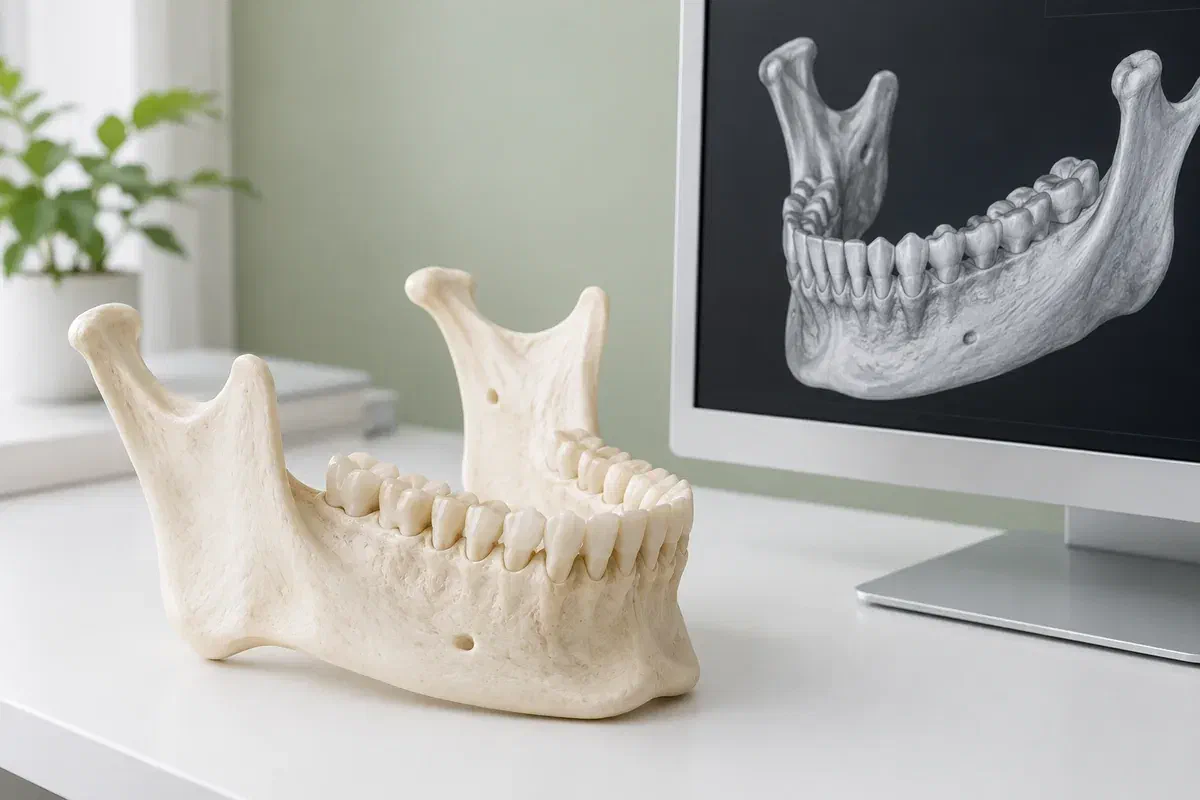
Illustrative jaw teaching model beside a generic three-dimensional dental rendering
When the benefit may justify a scan

A reason strong enough to weigh

The examples below are the kind of question that can make the exposure worthwhile. They are prompts for discussion, not guarantees that a scan is needed.

Avoiding surprises during a procedure

For an implant or certain surgery, knowing where nerves and sinuses lie relative to the bone can matter. Ask what is unknown, how the answer would change the plan and whether another treatment path exists if you decide against the scan.

Investigating a stubborn tooth problem

When a root canal concern or other dental issue is not explained by existing findings, 3D imaging may add useful detail. It supplements the exam and your symptoms rather than replacing them, and some scans leave the question open.

Pinpointing an unexpected finding

If an unerupted tooth or an unusual area was spotted on another image, its exact position may need checking. Ask why the proposed field of view is suitable, since covering more area adds exposure without necessarily adding useful information.

If exposure is your main worry, ask directly whether the X-rays already taken, or a lower-dose image, could answer the question instead.

Balancing the two sides

What you may gain, and what it costs in dose

On the benefit side, a clinician can study a CBCT in thin slices and from several directions, which may help with diagnosis, treatment planning or evaluating an area later. Those gains depend on the scan being chosen for a specific reason.

On the other side is radiation. CBCT uses ionizing radiation and typically delivers more than conventional dental X-rays. The actual dose depends on the unit, its settings and how large a region is captured, so it is not the same for everyone. Careful practice keeps the exam as limited as the question allows while still producing adequate images. No responsible clinician will call it risk-free.

Patient information: FDA — dental cone-beam computed tomography

A question that justifies it

Ask what will be done differently because of the result. If the answer links the scan to a real decision, such as how to approach a procedure safely, the benefit is easier to weigh against the dose.

A reading that considers all of you

The images are reviewed with your health history, the exam and earlier records. Ask who will interpret them and how anything incidental will be reported back to you.

No need to repeat it elsewhere

Sharing a completed scan, with your authorization, can help another clinician avoid ordering a duplicate. When more than one office is involved, check how the files will travel between them.

How it is arranged

Keep the exam as small as the question.

The scan may be booked separately from your treatment discussion, possibly with an outside provider. Confirm who is doing it, where, at what fee and how results will be reported before you head out from Brampton.

  1. Justify it first

    The responsible clinician considers why a scan is proposed and whether existing images already answer the question. Mention any previous scans and where they were done. Ask what the new images should reveal and how that could change the plan.

  2. Share anything that affects safety

    Follow the instructions given. Tell the team if you are or might be pregnant, cannot easily keep still, or need help getting positioned. Remove metal near the head, such as jewellery, as directed.

  3. Capture only what was ordered

    You will be positioned and asked to stay still while the machine rotates around your head. The procedure varies with the equipment and area. Raise any discomfort before the scan so the team can consider adjustments.

  4. Get a proper explanation

    Images must be interpreted by someone qualified. Ask when the report will be available and who will discuss it. Further tests or a revised plan may follow, depending on the findings.

After your scan

Get full value from the dose you received

Once the exposure has happened, the priority is making sure the information is read and used. That takes some coordination when the scan was performed outside the office managing your treatment.

Confirm the results route

Ask whether to book a follow-up or wait for the referring clinician to call. If a procedure depends on the report, check that it has arrived before assuming you can proceed.

Record it for next time

Write down the date, provider and area scanned. Mention it if another clinician proposes imaging in future. It may not cover a new question, but checking it first can spare you an unnecessary repeat exposure.

Act on new symptoms anyway

Do not let a pending result delay care for pain that is getting worse, swelling or another new problem. Tell the treating team about changes so they can decide whether to see you sooner.

Lower-dose alternatives first

Least imaging, enough information

The clinical question should set the imaging choice. Ask whether the benefit outweighs the exposure, and whether a lower-dose approach could give the same answer.

When nothing new is needed

Exam and existing records

Your history, a careful exam and recent images may be enough to make a decision. Talking about treatment does not automatically mean more imaging. Your dentist should explain any remaining uncertainty.

When a flat view answers it

Conventional X-rays

Intraoral or panoramic images, which generally involve less exposure than CBCT, may supply what is required. Ask why a particular view is recommended and whether it gives enough detail.

When depth is truly needed

A justified CBCT

A qualified provider picks an appropriate exam and reporting arrangement. Field size and settings should fit the diagnostic need and your own factors. A scan should never be ordered just because more detail is technically possible.

Dose and safety questions

Asking about radiation is part of good care

Bring the referral or recommendation with you. Talking it over can clarify what is proposed and whether your dentist or the imaging provider is best placed to answer practical questions about exposure.

(905) 876-4488
Can I say no to a CBCT scan?
Yes. You can decline or ask for more time to decide. It helps to understand how that choice might affect diagnosis or treatment planning, and whether another form of imaging could provide some of the information.
How often is it reasonable to have a dental CBCT?
There is no routine schedule. Each scan should be justified by a current clinical question. If you have had one recently, let your dentist know so they can consider whether it already answers what they need.
What does field of view mean on a CBCT referral?
It describes how much of the head and jaws the scan captures. A smaller field can be suitable for a focused question, while a larger one covers more anatomy. The appropriate size depends on what needs to be seen.
Are children scanned the same way as adults?
Children are generally considered more sensitive to radiation, so the need for imaging and the scan settings deserve particular care. Ask the clinician why a scan is suggested for your child and whether other imaging could answer the question.
If I might be pregnant, should I still go to my imaging appointment?
Contact the referring clinician and the imaging team before the appointment. They can review the clinical need, timing and appropriate precautions. Do not simply cancel a needed assessment without talking about why the imaging was requested.
Can my existing X-rays be used to reduce how much imaging I need?
Possibly. Your dentist can review what you already have and decide whether it answers the question. Share where and when earlier images were taken so they can be requested if helpful.

Patient information: RCDSO — dental CT scanner requirements

3D imaging and Brampton households

Raise the dose question with us.

Write or call our Bronte Street practice with your concerns and any referral details. We can explain how a scan would fit into your dental assessment, what the alternatives are, and what comes next. If a scan goes ahead, confirm the provider and appointment first.

Online requests are enquiries only and do not book a scan. If pain or swelling needs prompt attention, call us directly.

Visit Milton Dental Clinic
Unit 1, 342 Bronte St. S, Milton, ON L9T 5B7
Get directions Clinic hours
Monday–Thursday
11am–7pm
Friday–Sunday
By appointment only

Areas we serve

  • Milton
  • Oakville
  • Mississauga
  • Georgetown
  • Halton Hills
  • Acton
  • Campbellville
  • Brampton
  • Burlington
  • Puslinch
  • Rockwood
  • Erin
  • Caledon
  • Etobicoke
  • Old Milton
  • Bronte Meadows
  • Timberlea
  • Dorset Park
  • Dempsey
  • Clarke
  • Beaty
  • Coates
  • Harrison
  • Scott
  • Willmott
  • Ford
  • Bowes
  • Cobden
  • Walker
  • Mountain View
  • Milton Heights
  • Hawthorne Village
  • Valley View
  • Fallingbrook
  • Nassagaweya
  • Trafalgar
  • Esquesing
  • Nelson
  • Brookville
  • Moffat
  • Glen Williams
  • Norval
  • Limehouse
  • Stewarttown
  • Ashgrove
  • Hornby
  • Silver Creek
  • Speyside
  • Scotch Block
  • North Oakville
  • River Oaks
  • Glen Abbey
  • West Oak Trails
  • Palermo
  • Bronte Creek
  • College Park
  • Joshua Creek
  • Uptown Core
  • Preserve
  • Iroquois Ridge
  • Lisgar
  • Meadowvale
  • Meadowvale Village
  • Churchill Meadows
  • Erin Mills
  • Central Erin Mills
  • Streetsville
  • East Credit
  • Creditview
  • Heartland
  • Sheridan
  • Mount Pleasant
  • Credit Valley
  • Huttonville
  • Churchville
  • Springbrook
  • Northwest Brampton
  • Bram West
  • Fletcher's Meadow
  • Fletcher's Creek South
  • Alton Village
  • Orchard
  • Millcroft
  • Headon Forest
  • Tansley
  • Brant Hills
  • Tyandaga
  • Kilbride
  • Lowville
  • Aberfoyle
  • Morriston
  • Arkell
  • Hillsburgh
  • Freelton
  • Carlisle
  • Waterdown
  • Flamborough
  • Mountsberg

How can we help?

Milton Dental Clinic

Have a question about your smile? Choose the option that works best for you.

For urgent dental concerns, please call.
Messages are reviewed during clinic hours.