

Illustrative consultation about three-dimensional dental imaging
General & Family Dentistry

CBCT 3D Dental Scans in Halton Hills

A child’s adult tooth that has not shown up yet can lead to talk of a 3D scan. For Halton Hills families, here is how CBCT 3D dental scans fit that kind of question, what parents can ask first, and how results shape the next step.

For parents across Halton Hills

The tooth that is late to arrive

Sometimes a baby tooth hangs on long past its time, or a gap stays empty, and a regular X-ray shows an adult tooth sitting somewhere unexpected. Knowing exactly where it is, and how it relates to neighbouring roots, may matter for planning. That is one situation where a clinician might bring up cone-beam computed tomography, or CBCT.

CBCT uses X-rays to collect three-dimensional information about teeth, bone and nearby structures. It is a separate tool from the light-based scanner used to take digital impressions for braces or aligners. Because young people are generally considered more sensitive to radiation, the case for scanning a child should be especially clear: what will be learned, what else could answer it, what the images might miss and what exposure is involved. The same reasoning applies to adults with implant or root canal questions.

Reach out to Milton Dental Clinic to talk through a scan suggestion for yourself or your child. Bring any referral and the dates of previous X-rays. Ask where imaging would happen, who reads it and how results reach the treating dentist or orthodontist. An online enquiry is not confirmation of a scan or of its suitability.

Ask about imaging for your child
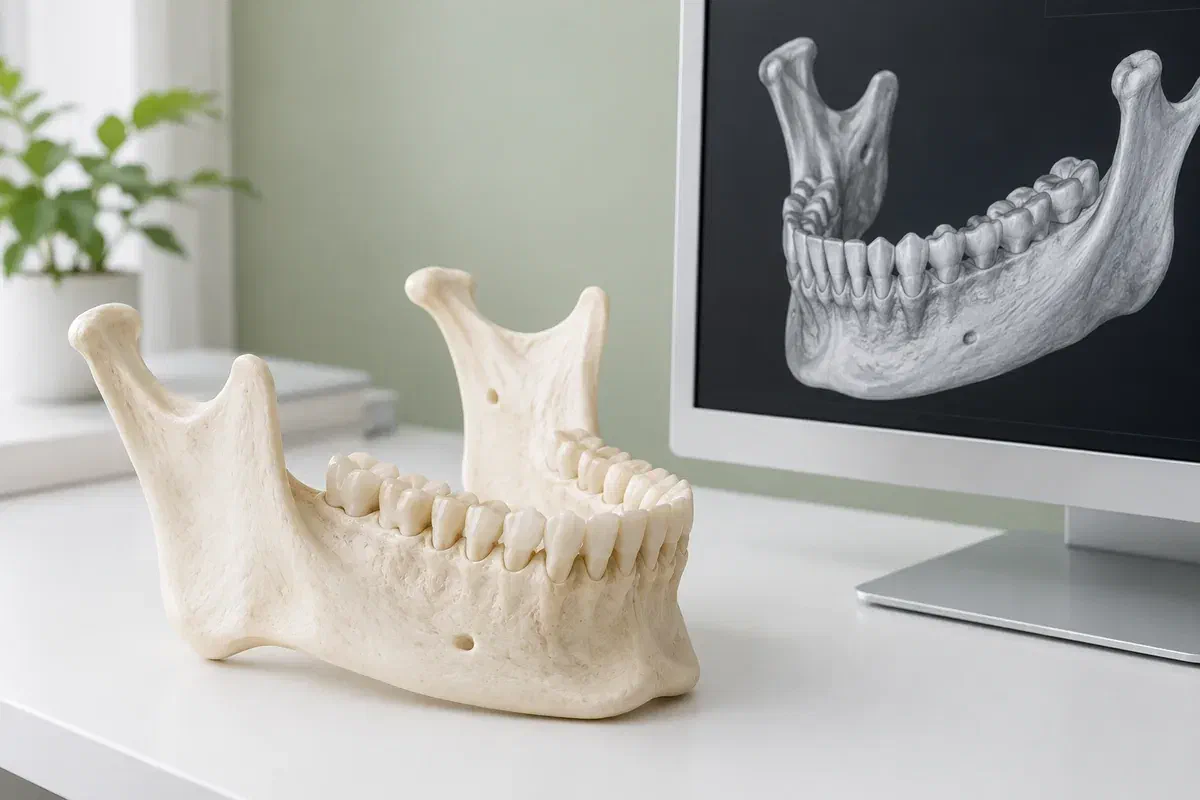
Illustrative jaw teaching model beside a generic three-dimensional dental rendering
When depth may be discussed

Position, proximity and puzzles

Three kinds of question tend to lead to CBCT conversations, at any age. Each is a reason to talk it over, not proof that a scan is required.

Space around nerves and sinuses

For adults planning an implant or surgery, the amount of bone and the location of key structures can shape the approach. Ask what is uncertain, how the answer changes the plan and what options would remain if a scan is not done.

Tooth trouble with no clear source

Certain root canal or dental problems stay unexplained after an exam and standard images. A scan may contribute, but symptoms and clinical findings still guide diagnosis, and the result is not always conclusive.

A tooth that has not come through

An unerupted or impacted tooth may need its position and its relationship to neighbouring roots understood before treatment. Ask why the proposed scan area suits the question. For a child, a smaller, focused field may be all that is needed.

For children especially, ask whether existing X-rays, or a simpler lower-dose image, could answer the question before CBCT is arranged.

What three dimensions can show

Seeing where a tooth sits, not just that it is there

A flat X-ray can confirm that a tooth exists but may leave its exact depth or angle unclear. With CBCT, a qualified clinician can view the area in slices and from several sides, which may help with diagnosis, treatment planning and follow-up. The value is real only when it serves a specific question.

Ionizing radiation is involved, and a CBCT generally delivers more than routine dental X-rays. The dose varies with the unit, its settings and the region captured. For any patient, and particularly for children, the goal is a scan limited to what is needed that still provides adequate detail. Promising zero risk, or one dose for all, would not be accurate.

Patient information: FDA — dental cone-beam computed tomography

A plan that waits on the answer

Ask what will be decided once the scan is read, for example how a tooth might be guided into place or whether surgery is worth considering. The image should connect to a choice, not just to impressive technology.

Read with the whole history

The scan is interpreted together with medical and dental history, the exam and earlier records. Find out who is responsible for reading it and how other findings will be shared with you.

Shared between the people involved

Children’s care may involve a family dentist and an orthodontist or surgeon. Ask how the images and findings will be sent, with your consent, so everyone works from the same completed exam.

How it usually goes

What will my child actually do?

The scan and the planning conversation may be separate visits. Confirm the provider, location, fee and reporting arrangements before leaving Halton Hills, particularly if the referral came from another office.

  1. Confirm why, and check old images

    The responsible clinician reviews the reason for a scan and whether earlier X-rays already answer it. Let them know when and where previous images were taken. Ask what new information is expected and how it could affect the plan.

  2. Prepare your child, and yourself

    Follow the provider’s instructions. Explain to your child that they will need to keep very still for a short time. Tell the team about anxiety, difficulty staying still or a possible pregnancy if the patient is an adult. Remove earrings or other metal near the head.

  3. The scan

    Your child sits or stands in the unit, often with a chin rest, and keeps as steady as a statue while the arm travels round. Details vary with the device. Raise concerns before the scan begins so the team can consider adjustments.

  4. Go over the findings

    Proper interpretation is essential. Ask when the report will be ready and who will explain it to you. The findings may lead to more assessment or a different plan.

After the appointment

Follow the report, not just the appointment.

The scan gathers information; the benefit comes from reading it well and acting on it. That is worth checking when more than one office is involved in your family’s care.

Ask who will be in touch

Find out whether to book a results visit or wait for the referring dentist or orthodontist to contact you. If treatment is planned around the report, confirm it has arrived before assuming the next step is ready.

Keep a family imaging note

Write down the date, the provider and the area scanned for each family member. Mention it if a new scan is suggested later. It may not answer a different question, but a review can help avoid unneeded repeats.

Watch for changes meanwhile

Waiting for a scan or report is no reason to put off care for worsening pain, swelling or a new problem. Tell the treating team about changes so they can decide whether the patient should be seen sooner.

Choosing the right level of imaging

Start small, step up only if needed.

The question should determine the imaging. Ask whether the benefit justifies a CBCT and whether another approach could provide the same answer with less exposure.

When the answer is already available

Exam and existing images

History, an exam and recent X-rays may be enough to decide. A treatment discussion does not automatically require a new scan. The clinician should explain any uncertainty that remains.

When a flat view gives enough

A panoramic or intraoral X-ray

Conventional images often help locate developing teeth and may supply what is needed. They do a different job from CBCT. Find out what the proposed view is meant to show and whether its detail will be adequate.

When depth matters for the plan

A focused CBCT

A qualified provider chooses the exam and how it will be reported. The area covered and settings should reflect the diagnostic question and the patient’s age and needs. A scan should not be ordered simply because more detail is possible.

Questions from parents

Before a young person has a 3D scan

Bring the referral or orthodontic note you received. Going through it together helps clarify what is being requested and who can best answer practical questions about the scan.

(905) 876-4488
Why would an orthodontist want a 3D scan of my child’s teeth?
In selected cases, such as an impacted tooth, three-dimensional information can help clarify its position and relationship to nearby roots. Ask what decision depends on the scan and whether conventional X-rays could provide enough information.
Can I stay with my child during the scan?
Policies vary by imaging provider, and radiation safety rules may limit who can stay in the room. Ask in advance so you can prepare your child, and let staff know if your child is nervous.
Is a CBCT scan uncomfortable for children?
The scan does not involve needles, but your child will need to keep still in position for a short time, which some find difficult. Tell the team ahead of time if your child is anxious or has trouble staying still.
Will my child need more scans as treatment goes on?
Not automatically. Any further imaging should be justified by a new clinical question. Keep a note of scans already taken and mention them whenever additional imaging is suggested.
Is the 3D scan the same as the impression scan for aligners?
No. Aligner impressions usually use a light-based scanner that records tooth surfaces. CBCT uses X-rays to examine internal structures. Ask which one has been recommended and why.
Can we arrange appointments for two children on the same trip?
Often families try to group visits. Mention this when you contact us. Scheduling depends on availability and on whether each child actually needs imaging, which should be decided individually.

Patient information: RCDSO — dental CT scanner requirements

Halton Hills family imaging questions

Talk it through before anyone is scanned.

Contact our Bronte Street practice with your questions and any referral or orthodontic notes. We can explain how a scan might fit into the dental assessment and help clarify the next step. Confirm the imaging provider and appointment details before attending.

Online requests are enquiries, not confirmed imaging bookings. If a child has facial swelling or worsening pain, please call.

Visit Milton Dental Clinic
Unit 1, 342 Bronte St. S, Milton, ON L9T 5B7
Get directions Clinic hours
Monday–Thursday
11am–7pm
Friday–Sunday
By appointment only

Areas we serve

  • Milton
  • Oakville
  • Mississauga
  • Georgetown
  • Halton Hills
  • Acton
  • Campbellville
  • Brampton
  • Burlington
  • Puslinch
  • Rockwood
  • Erin
  • Caledon
  • Etobicoke
  • Old Milton
  • Bronte Meadows
  • Timberlea
  • Dorset Park
  • Dempsey
  • Clarke
  • Beaty
  • Coates
  • Harrison
  • Scott
  • Willmott
  • Ford
  • Bowes
  • Cobden
  • Walker
  • Mountain View
  • Milton Heights
  • Hawthorne Village
  • Valley View
  • Fallingbrook
  • Nassagaweya
  • Trafalgar
  • Esquesing
  • Nelson
  • Brookville
  • Moffat
  • Glen Williams
  • Norval
  • Limehouse
  • Stewarttown
  • Ashgrove
  • Hornby
  • Silver Creek
  • Speyside
  • Scotch Block
  • North Oakville
  • River Oaks
  • Glen Abbey
  • West Oak Trails
  • Palermo
  • Bronte Creek
  • College Park
  • Joshua Creek
  • Uptown Core
  • Preserve
  • Iroquois Ridge
  • Lisgar
  • Meadowvale
  • Meadowvale Village
  • Churchill Meadows
  • Erin Mills
  • Central Erin Mills
  • Streetsville
  • East Credit
  • Creditview
  • Heartland
  • Sheridan
  • Mount Pleasant
  • Credit Valley
  • Huttonville
  • Churchville
  • Springbrook
  • Northwest Brampton
  • Bram West
  • Fletcher's Meadow
  • Fletcher's Creek South
  • Alton Village
  • Orchard
  • Millcroft
  • Headon Forest
  • Tansley
  • Brant Hills
  • Tyandaga
  • Kilbride
  • Lowville
  • Aberfoyle
  • Morriston
  • Arkell
  • Hillsburgh
  • Freelton
  • Carlisle
  • Waterdown
  • Flamborough
  • Mountsberg

How can we help?

Milton Dental Clinic

Have a question about your smile? Choose the option that works best for you.

For urgent dental concerns, please call.
Messages are reviewed during clinic hours.