

Illustrative conversation between an older adult and a dental clinician
General & Family Dentistry

Dental Care for Older Adults in Milton

The crowns, bridges and dentures you have relied on for years still deserve attention. In Milton, our team helps older adults keep what works, look into what has changed, and plan care around daily life.

Milton · dental work with a long history

Your mouth has a story. We start by listening to it.

Many people in later life carry decades of dentistry: a filling from the 1980s, a bridge placed after a sports injury, a partial denture added more recently. Each piece has its own history. Your birthday does not decide what comes next. The condition of your teeth, gums and appliances, your general health and your own wishes do.

Some visits begin with a clear problem, such as a crown that suddenly feels high or a denture that clicks while you talk. Others begin with nothing more than a wish to keep things as they are. Both are good reasons to come in. We look at what you have, explain what we find in plain terms, and set out the choices that exist.

Plenty of long-time Milton households now include adult children who help with errands, and you are welcome to bring someone along. Decide beforehand how much you want them involved; questions will still come to you. If you need extra time, a particular chair position or help with hearing, tell us when you book so it can be arranged.

Talk with us about your dental work
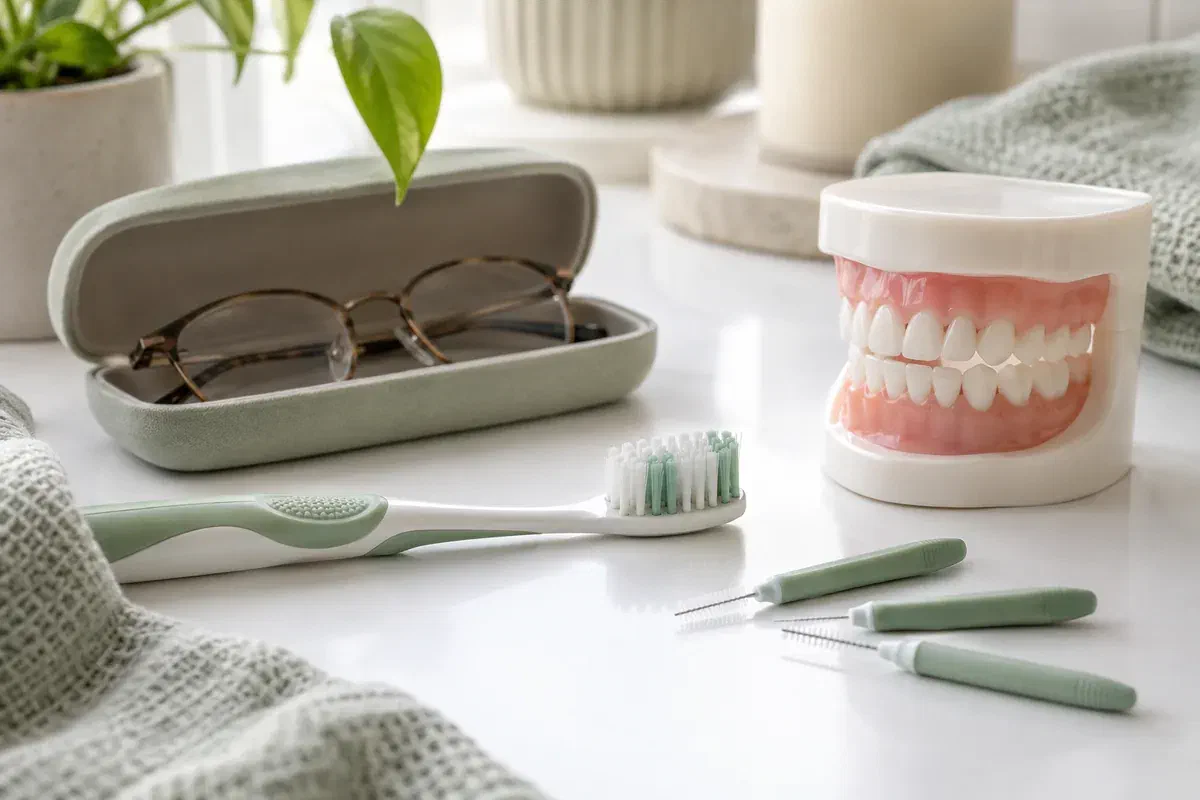
Easy-grip toothbrush, interdental brushes, dental model, and reading glasses
Signs worth mentioning

What used to be easy now takes a little more effort

A change does not have to hurt before it is worth raising. Let us know when chewing, cleaning or wearing an appliance has become harder, even if the difference seems minor to you.

Old restorations that feel different

Long-serving fillings and crowns can still develop trouble around their edges. Notice whether floss catches, food packs into one spot, or your teeth meet differently when you close. The dentist checks the tooth beneath and nearby before suggesting whether to watch, repair or replace it.

A dry mouth or tender tissue

A mouth that stays dry is not simply something to put up with as the years pass. Medications and medical conditions often play a part. Burning, a sore spot or tissue that looks different should be examined rather than treated again and again with whatever is in the cupboard.

Brushing or denture care slipping

Stiff fingers, weaker eyesight or a change in who helps at home can turn a simple routine into a chore. Tell us which part has become awkward. When a denture rubs or shifts, note when it happens so both the appliance and the gums under it can be examined.

Getting older does not explain every change in the mouth. Please mention a sore that lingers, a new lump, bleeding you cannot account for, or any new difficulty chewing or swallowing, so the right assessment can follow.

What a good plan does

Built around your goals, not a birth year

Planning begins with two things: what you want from your mouth and what the examination actually shows. For one person the goal is keeping a favourite tooth comfortable. For another it is a denture that stays put, or a cleaning routine with fewer steps. You can ask how each suggestion serves that goal and what upkeep it brings.

Logistics count too. Talk through how many appointments are involved, what recovery might feel like, the costs, and any help you would need at home afterward. Sometimes work can be spread over time. A sound recommendation leaves room for comparison and does not assume two people of similar age want identical results.

An honest account of your existing work

You can ask which crowns, bridges and fillings are doing their job and which need watching. Knowing the difference helps separate pressing problems from changes that can wait for review. A restoration being old is not, on its own, enough reason to remove it.

Cleaning methods that suit your hands

The team can show you handle shapes, interdental aids and angles for reaching difficult areas. When a spouse or carer helps, a short demonstration lets them assist in the way you prefer. Advice should fit what you can comfortably manage day to day.

Plans that can change with you

Health, energy and support at home rarely stay fixed. When an earlier plan stops feeling workable, say so. Revisiting choices is a normal part of ongoing care, and you can always ask for the reasoning to be explained again before agreeing to the next step.

Inside the appointment

First your story, then a careful examination

Please bring an up-to-date list of medicines, any recent health news, and the dentures or appliances you would like checked. Jotting down your top concerns beforehand keeps the visit centred on them.

  1. Talk through health and daily habits

    We ask why you came in, review your medical history and medicines, and learn how you eat and keep your mouth clean. Recent changes matter even when they seem unrelated. Let us know whether hearing, eyesight, seating or communication support would help.

  2. Examine teeth, gums and appliances

    The dentist looks at what is relevant to you: gums, natural teeth, existing work and the tissues that support a denture. X-rays or other imaging may be suggested when they would answer a specific question. Describe symptoms that come and go, since they may not appear during the visit.

  3. Weigh the options side by side

    For each reasonable choice, you can ask what it involves now and what it will need later, along with benefits, limits, costs and visit numbers. If your physician or a specialist should be consulted, you should understand why and what happens next.

  4. Settle on a plan you can keep

    Before you leave, confirm the treatment or monitoring plan, home-care steps and when to return. Written notes are available if they help. A support person can join practical arrangements with your consent, while decisions continue to involve you.

Daily care in Milton homes

Keep the routine simple and the goal clear

Home care should match your natural teeth, your dental work and any appliance you wear. A hands-on demonstration of the steps that matter most is usually more useful than piecing together advice from product labels.

Adjust the tools to fit your grip

Brush natural teeth with fluoride toothpaste and clean between them in a way that works for you. A thicker handle or a different interdental aid can help when holding things is hard. Showing us how you use them lets the advice target the real problem.

Treat the denture as its own task

Clean your appliance according to its material and design, and clean your gums and tongue as well. Ask how long to wear it and when to leave it out. If it rubs or feels loose, report it rather than adding more adhesive to mask the issue.

Track dryness alongside medicines

Note when dryness started and whether it followed a new prescription or a change in health. Relief measures and extra protection for teeth can then be discussed. Never stop a prescribed medicine on your own, and mention any fluid limits your doctor has set.

Patient information: NIDCR — understanding persistent dry mouth · NIDCR — oral health resources for older adults

Choosing a direction

Three broad paths, matched to what matters to you

Care may aim to protect what is working, fix one specific problem, or improve how an appliance performs. You can ask how the expected gain stacks up against the effort of treatment and its upkeep.

When things feel comfortable now

Protect and maintain

Here the focus is keeping natural teeth and current dental work healthy through good cleaning, preventive measures and regular reviews. Any area under watch comes with a clear explanation of what would lead to treatment. Feeling fine is not a substitute for an examination.

When one problem stands out

Fix the specific problem

A cracked tooth, a gum issue or a crown that bothers you may need specific attention. Ask about conservative approaches, how long a repair might last, and what follow-up involves. Recommendations should rest on findings and health, not on assumptions about age.

When gaps get in the way

Plan around missing teeth

Options may range from adjusting a current denture to exploring other ways of replacing teeth. Suitability depends on your mouth, health, preferences and upkeep. Tell us what you hope to eat or say more easily so comparisons stay grounded in daily life.

Common questions

Ask anything. Your say counts at every step.

Questions about alternatives, scheduling, support or the reasons behind a suggestion are all welcome. Writing them down or bringing a companion can make the conversation easier.

(905) 876-4488
My crown is over twenty years old and feels fine. Should it be replaced?
Not just because of its age. The dentist looks at how it fits, the tooth around it and any signs of decay or gum trouble. Many long-standing crowns keep working well. If something needs attention, you should hear what was found and whether repair or monitoring is reasonable.
What should I bring to my first appointment?
A current list of medicines, including supplements and over-the-counter products, is especially helpful. Bring any dentures or appliances, your glasses or hearing aids if you use them, and a few notes about what has been bothering you. Recent health updates are useful too.
How often should an older adult see the dentist?
There is no single interval that suits everyone. The timing of reviews depends on your teeth, gums, dental work, appliances and health. The dentist will suggest a schedule based on your findings and explain the reasoning, and it can change if your needs do.
Does dry mouth mean my teeth are more at risk?
Saliva helps protect teeth, so persistent dryness can raise the chance of decay and make dentures less comfortable. Tell us when it began and what medicines you take. Preventive steps and symptom relief can be discussed, and your physician may need to be involved.
Can a denture that clicks or moves be improved?
Often it can be assessed and sometimes adjusted, but the cause matters. Changes in the gums and bone beneath, wear, or damage can all affect fit. Bring the denture in and describe when it moves so the appliance and tissues can be reviewed together.
I have lived in Milton for decades but have not had a dentist in years. Where do I start?
Start with a single examination appointment and tell us how long it has been. There is no judgement about the gap. We will look at the current situation, explain priorities, and help you decide what to tackle first at a pace that suits you.
Older adult dental care in Milton

Comfortable eating, talking and smiling, one step at a time

Reach our Bronte Street practice to describe your concerns and any appointment needs. You might want to protect natural teeth, have a denture reviewed or understand a new symptom. Either way, we begin with an examination and an honest conversation about choices that suit you.

Let us know about mobility, hearing, vision or seating needs when you call, so we can have arrangements ready before you arrive.

Visit Milton Dental Clinic
Unit 1, 342 Bronte St. S, Milton, ON L9T 5B7
Get directions Clinic hours
Monday–Thursday
11am–7pm
Friday–Sunday
By appointment only

Areas we serve

  • Milton
  • Oakville
  • Mississauga
  • Georgetown
  • Halton Hills
  • Acton
  • Campbellville
  • Brampton
  • Burlington
  • Puslinch
  • Rockwood
  • Erin
  • Caledon
  • Etobicoke
  • Old Milton
  • Bronte Meadows
  • Timberlea
  • Dorset Park
  • Dempsey
  • Clarke
  • Beaty
  • Coates
  • Harrison
  • Scott
  • Willmott
  • Ford
  • Bowes
  • Cobden
  • Walker
  • Mountain View
  • Milton Heights
  • Hawthorne Village
  • Valley View
  • Fallingbrook
  • Nassagaweya
  • Trafalgar
  • Esquesing
  • Nelson
  • Brookville
  • Moffat
  • Glen Williams
  • Norval
  • Limehouse
  • Stewarttown
  • Ashgrove
  • Hornby
  • Silver Creek
  • Speyside
  • Scotch Block
  • North Oakville
  • River Oaks
  • Glen Abbey
  • West Oak Trails
  • Palermo
  • Bronte Creek
  • College Park
  • Joshua Creek
  • Uptown Core
  • Preserve
  • Iroquois Ridge
  • Lisgar
  • Meadowvale
  • Meadowvale Village
  • Churchill Meadows
  • Erin Mills
  • Central Erin Mills
  • Streetsville
  • East Credit
  • Creditview
  • Heartland
  • Sheridan
  • Mount Pleasant
  • Credit Valley
  • Huttonville
  • Churchville
  • Springbrook
  • Northwest Brampton
  • Bram West
  • Fletcher's Meadow
  • Fletcher's Creek South
  • Alton Village
  • Orchard
  • Millcroft
  • Headon Forest
  • Tansley
  • Brant Hills
  • Tyandaga
  • Kilbride
  • Lowville
  • Aberfoyle
  • Morriston
  • Arkell
  • Hillsburgh
  • Freelton
  • Carlisle
  • Waterdown
  • Flamborough
  • Mountsberg

How can we help?

Milton Dental Clinic

Have a question about your smile? Choose the option that works best for you.

For urgent dental concerns, please call.
Messages are reviewed during clinic hours.